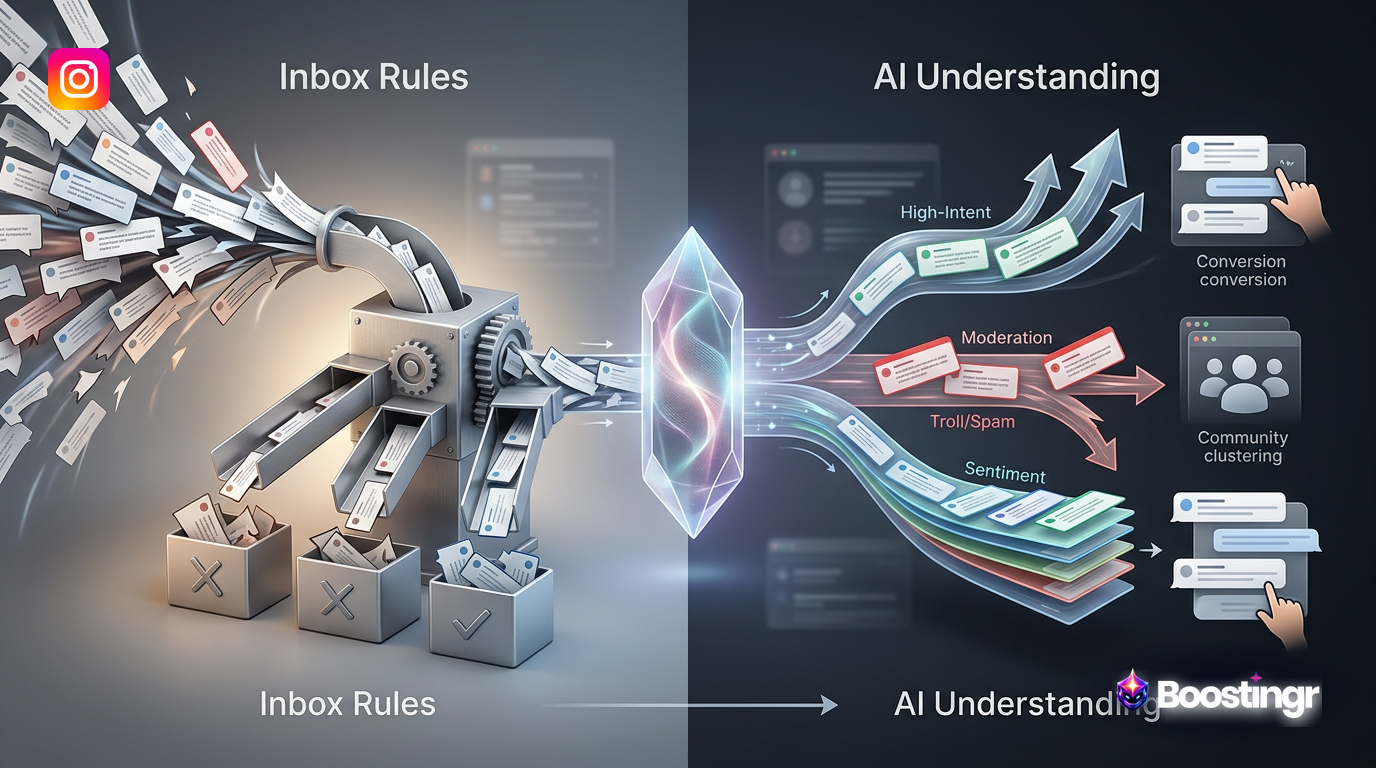
The Evolution of Social Media Comment Automation: Beyond Inbox Rules to AI Understanding
In the bustling digital town square of social media, comments are the lifeblood of engagement. They represent direct, unfiltered lines of communication with your audience, holding invaluable questions, critical feedback, heartfelt praise, and lucrative sales opportunities. According to a 2023 report by Sprout Social, 57% of consumers will follow a brand on social media to learn about new products or services, and their comments are the first signal of that interest. But as your brand's voice gets louder, the volume of these interactions grows exponentially. What starts as a manageable stream of conversations quickly becomes a roaring flood, threatening to overwhelm even the most dedicated community managers and social media teams.
Enter **social media comment automation**. The promise is alluring: reclaim thousands of hours, maintain a pristine and brand-safe comment section, and never miss an important interaction again. However, a critical distinction has emerged in the market—a chasm as wide as the one between a rotary phone and a smartphone. On one side, you have basic, rule-based inbox automation. On the other, you have intelligent, AI-powered comment management that doesn't just *react* to keywords but truly *understands* the intent, sentiment, and nuance of the people behind them.
Many brands believe they have effective automation, but what they really possess is a complex, brittle web of keyword triggers and rigid if-then rules siloed to each social platform. This approach is a band-aid, not a cure. It filters some of the noise but misses the symphony of human conversation, often leading to robotic responses, frustrated customers, and countless missed opportunities hiding in plain sight.
True social media comment automation is an evolution. It’s about deploying a centralized AI that learns your brand inside and out, understands the complexities of human language, and engages consistently and authentically across all your social channels. It’s about transforming your comment sections from a high-risk moderation liability into a strategic asset for customer acquisition, retention, and business intelligence. This definitive guide will illuminate the profound differences between these two approaches and provide a blueprint for leveraging intelligent automation to build a stronger, more engaged, and more profitable community.
The Crippling Limits of Basic Inbox Automation
Basic automation, often found in simple chatbot builders or as a bundled feature in all-in-one social media schedulers, operates on a simple, outdated principle: keyword matching. If a comment contains the word "price," trigger a pre-written response. If it contains a word from a blocklist, hide it. While this was a marginal improvement over purely manual moderation a decade ago, its limitations become painfully clear as a brand scales in the modern social landscape.
**1. Crippling Lack of Context** Basic systems are dangerously literal. They cannot grasp sarcasm, idioms, slang, or complex nuance. A comment like, "Wow, your shipping speed is *unbelievable*," could be misinterpreted as positive if the system only sees the word "unbelievable" in a positive context, leading to an inappropriate congratulatory reply. A genuine question phrased without a specific keyword, like "Will this fit a 2023 model?" goes completely ignored by a system looking for "buy" or "price." This profound lack of contextual understanding leads to tone-deaf replies, unresolved support issues, and a brand voice that feels disconnected and robotic.
**2. The Platform Silo Problem** A rule you painstakingly create for your Instagram comments doesn't automatically work on your Facebook page or YouTube channel. With basic automation, you are forced to rebuild, re-test, and re-manage your automation workflows for every single social profile. This creates a fragmented, disjointed system where brand consistency is nearly impossible to maintain. The workload doesn't truly decrease; it just shifts from manual replying to the tedious, error-prone task of manual rule-building across a dozen different dashboards. It's a recipe for inefficiency and inconsistent customer experiences.
**3. Unmanageable Scalability** What starts as a few simple rules—"if 'price', then reply X"—quickly spirals into a tangled, unmanageable mess. To account for the infinite variations in human language, you have to create dozens of rules for a single intent. To catch purchase questions, you might need rules for "price," "how much," "cost," "$$$," "what's the damage," "is it expensive," and so on. This web of rules becomes fragile, prone to breaking with the slightest change, and impossible for new team members to understand, audit, or update. It's a house of cards that inevitably collapses under its own weight.
**4. Robotic Responses and Damaged Engagement** Because basic automation relies on a finite, static library of canned responses, interactions feel sterile and impersonal. Audiences are savvy; they can spot a generic, keyword-triggered reply from a mile away. This erodes trust and can actively harm engagement. Instead of feeling heard and valued, users feel like they're shouting into a void, which discourages them from commenting in the future and can damage the brand's reputation for customer care.
**5. A Black Hole for Opportunities** Perhaps the biggest limitation is what basic automation *misses*. It's not designed to identify subtle buying signals, like a user asking, "My friend loves hers, does this work with my other gear?" It can't spot a high-value piece of user-generated content or recognize a nuanced product suggestion that could be worth millions. It fails to detect the early, subtle whispers of a PR crisis brewing in the comments. These missed opportunities represent lost revenue, lost market insights, and lost chances to build the deep brand loyalty that creates lifelong customers.
The Leap to Intelligent Social Media Comment Automation
Intelligent social media comment automation, the kind pioneered by platforms like Boostingr, represents a fundamental paradigm shift. It moves beyond primitive keyword matching to genuine AI-powered understanding. This approach is built on a sophisticated engine that leverages Natural Language Processing (NLP) and Natural Language Understanding (NLU) to analyze comments for deeper meaning, enabling a level of moderation and engagement that was previously impossible at scale.
This is where the concept of an **AI that understands people** comes to life. It’s not just reading text; it’s interpreting the underlying intent, emotion, and context to determine the *why* behind the *what*.
Key pillars of this intelligent approach include:
* **AI-Powered Understanding:** At its core, the system uses advanced NLP to perform real-time **sentiment analysis** (is the comment positive, negative, neutral, or mixed?) and **intent detection** (is the user asking for support, trying to make a purchase, leaving feedback, or just spamming?). This allows the system to know *why* someone is commenting, enabling a tailored, appropriate response. You can learn more in our guide to intent detection for comments.
* **Centralized Brand Memory:** This is the AI's single source of truth. You teach it your brand's voice, tone, product details, FAQs, support boundaries, and moderation policies. The AI internalizes this information to generate replies that are not only accurate but also perfectly on-brand. This is the key to delivering humanized, brand-safe AI replies. We provide a complete guide on how to build your AI Brand Memory for maximum effectiveness.
* **Teach Once, Engage Everywhere:** This is the powerful antidote to platform silos. With an intelligent system like Boostingr, you train your central Brand Memory *once*. That unified intelligence is then deployed instantly across all your connected social accounts—Instagram, Facebook, YouTube, TikTok, and more. A new product launch? Add the info to your Brand Memory, and the AI is immediately ready to answer questions about it on every platform. This creates unparalleled consistency and operational efficiency.
* **AI Community Intelligence:** Intelligent automation transforms your chaotic comment section into a structured, queryable database of insights. By classifying every single comment by intent and sentiment, you can instantly visualize trends, track customer satisfaction over time, and gather product feedback at scale. This turns comments into a powerful source of AI community intelligence that informs marketing, product, and business strategy.
Comparison Table
To make the distinction crystal clear, let's compare the two approaches side-by-side.
| Feature | Basic Inbox Automation (e.g., Simple Chatbots, Native Filters) | Intelligent Comment Automation (e.g., Boostingr) |
|---|---|---|
| **Core Logic** | Keyword Triggers & If/Then Rules | AI-Powered Intent & Sentiment Analysis (NLU) |
| **Context Awareness** | None. Cannot understand sarcasm, nuance, or complex questions. | High. Understands context, emotion, and underlying user intent. |
| **Multi-Platform Mgmt** | Siloed. Rules must be built and managed separately for each platform. | Unified. "Teach Once, Engage Everywhere" model applies one brain to all channels. |
| **Scalability** | Poor. Rules become a tangled, unmanageable mess as complexity grows. | Excellent. AI models scale effortlessly with comment volume and complexity. |
| **Response Quality** | Robotic & Generic. Relies on a small set of pre-written canned responses. | Humanized & Dynamic. Generates unique, on-brand replies using Brand Memory. |
| **Lead Identification** | Ineffective. Only catches explicit keywords like "buy" or "price." | Highly Effective. Identifies nuanced purchase intent and sales questions. |
| **Spam & Troll Detection** | Basic. Relies on simple keyword blocklists, easily bypassed by motivated actors. | Advanced. Uses AI to detect sophisticated spam, hate speech, and trolls. |
| **Human Oversight** | Limited. Often all-or-nothing automation with no review queue. | Granular. Full human-in-the-loop controls for reviewing, editing, and approving AI actions. |
| **Analytics & Insights** | Minimal. Basic counts of hidden or replied-to comments. | Deep. Provides Community Intelligence on sentiment, intent trends, and topics. |
The Core Components of an Advanced Automation Engine
An intelligent **social media comment automation** platform is more than just a reply bot. It's a comprehensive operating system for your entire community engagement strategy. Let's break down the key components that make this possible.
**1. AI Comment Moderation That Actually Works** Forget simple blocklists that are outdated the moment you create them. Modern AI comment moderation acts as a vigilant, 24/7 guardian for your community's health and your brand's reputation. It uses sophisticated models trained on millions of examples to: * **Detect Nuanced Spam:** Catches sophisticated spam that uses special characters (sp@m), emojis (💰💰💰), or clever phrasing ("check the link in my bio") to bypass basic filters. * **Identify Trolls and Hate Speech:** Understands the context of harmful language, harassment, dog-whistling, and trolling, hiding it before it can poison your community's atmosphere. This is critical for creating a safe, inclusive space. * **Filter Out Irrelevant Self-Promotion:** Automatically removes comments like "Check out my profile!" or "DM me for collabs" that clutter the conversation and detract from genuine engagement.
This level of moderation is crucial for maintaining a brand-safe environment and is something basic keyword filters simply cannot achieve. At Boostingr, we've observed that **implementing intelligent troll and spam detection reduces the manual moderation workload for community managers by an average of 85% within the first 30 days**. This frees them from reactive deleting to focus on proactive community building and strategic initiatives. A robust moderation strategy is the foundation of any guide on social media brand safety.
**2. Sentiment and Intent Analysis: The Power of Why** This is the engine of understanding. When a comment comes in, the AI doesn't just see a string of text. It asks critical questions to decode the human meaning behind the words: * **What is the sentiment?** Is the user happy, angry, frustrated, confused, or neutral? Advanced systems can even detect mixed sentiment, like in the comment, "I love the design, but the battery life is terrible." This allows you to prioritize negative comments for immediate human attention while celebrating positive ones. * **What is the intent?** Why did they write this? The system can classify intent into dozens of granular categories, such as: * `Purchase Intent`: "How much is this?" "Is it available in Canada?" "I need this!" * `Support Question`: "My order hasn't arrived." "How do I reset my password?" * `Positive Feedback`: "I love this new feature! Best purchase ever." * `Negative Feedback`: "The latest update is buggy and crashes constantly." * `Brand Mention`: "This reminds me of [competitor brand], but better." * `Collaboration Inquiry`: "We'd love to sponsor a video, who can I talk to?"
Understanding intent is the key to unlocking relevant, helpful automation and is a cornerstone of effective social media analytics and insights.
**3. Humanized AI Replies with Brand Memory** Once the AI understands a comment's intent, it can generate a reply. This is where Brand Memory is a game-changer. Instead of pulling from a static list of five canned responses, the AI uses its learned knowledge of your brand to craft a fresh, contextual, and helpful reply in your specific voice. It can pull product specs, reference return policies, use approved marketing language, and adopt the exact tone—be it witty, formal, or empathetic—that you've defined. This ensures that your AI Instagram reply bot or AI YouTube comment moderation tool sounds less like a bot and more like your best-trained community manager.
**4. Intelligent Lead Capture and Workflow Routing** Your comment section is a goldmine of potential customers. An intelligent automation system is your virtual prospector, working 24/7. By accurately identifying `Purchase Intent`, the system can trigger powerful, revenue-generating workflows: * **Auto-Reply with a Link:** Instantly respond to "Where can I buy this?" with a friendly reply and a direct link to the product page. * **DM for Conversion:** Automatically send a direct message to the user with a special discount code to continue the sales conversation privately and incentivize purchase. * **Escalate to Sales:** Tag the comment and notify a human sales representative via Slack or email to jump into the conversation and close a high-value deal.
This proactive approach to Instagram lead capture can have a direct and measurable impact on your revenue, turning your engagement efforts into a powerful sales channel and dramatically improving your social media ROI.
Practical Examples and Use Cases
Let's see how intelligent **social media comment automation** works in the real world for different types of organizations.
**Use Case 1: The Global E-commerce Brand** * **Challenge:** A fashion brand with millions of followers across Instagram and Facebook is inundated with thousands of comments daily in multiple languages. Questions about price, shipping, and availability are constant, alongside spam and support issues. * **Basic Solution:** They use keyword rules to hide comments with profanity and auto-reply "Check our website for pricing!" to any comment with the word "price." This feels impersonal, misses questions like "Do you ship to Australia?", and alienates potential customers. * **Intelligent Solution with Boostingr:**
- The AI analyzes all incoming comments for intent, sentiment, and language.
- `Spam` and `Hate Speech` are automatically hidden 24/7, maintaining a clean, positive environment.
- Comments with `Purchase Intent` (e.g., "love this dress, how much?") receive an instant, friendly reply in the brand's voice with a direct link to that specific dress on their website. If the comment is in Spanish, the reply is in Spanish.
- Comments with `Support Intent` (e.g., "my package is late") are automatically tagged, and a reply is generated asking the user to DM their order number, simultaneously notifying the customer support team in their helpdesk software.
- All this data is fed into a Community Intelligence dashboard, revealing that "shipping to Australia" is the top unanswered question, prompting the marketing team to create a dedicated post about international shipping, preemptively solving a major customer friction point.
**Use Case 2: The B2B SaaS Company** * **Challenge:** A SaaS company uses LinkedIn and YouTube to post educational content. Comments are often highly technical questions, partnership inquiries, or feedback from existing power users. The sales and product teams are missing valuable signals. * **Basic Solution:** No automation is used, as basic tools can't handle the technical nuance. A product marketing manager spends 10+ hours a week manually answering or routing questions to the right internal teams. * **Intelligent Solution with Boostingr:**
- The AI's Brand Memory is trained on the company's technical documentation, API guides, and knowledge base.
- It can now auto-reply to Level 1 technical questions ("Does your API support webhooks?") with accurate answers, freeing up the product team.
- It identifies comments with `Partnership Intent` ("We'd love to integrate with you") and automatically routes them to the business development team's lead queue in Salesforce.
- It spots `Feature Request` intent from power users ("You should add a CSV export here") and tags it for the product team's backlog in Jira, turning comments into a structured feedback channel.
**Use Case 3: The Professional Creator** * **Challenge:** A popular tech YouTuber wants to foster a positive community but is overwhelmed by repetitive questions ("what camera do you use?") and toxic comments from trolls on their videos. * **Basic Solution:** They spend hours manually deleting hateful comments and have a pinned comment with their gear list, which many people still miss, leading to endless repetition. * **Intelligent Solution with Boostingr:**
- The AI is trained on the creator's gear list and common FAQs via Brand Memory.
- The `Troll Detection` and `Hate Speech` filters are set to high, automatically cleaning the comment section and preserving a positive environment for their true fans.
- When a user asks, "What lens is that?", the AI generates a helpful, personalized reply: "Great question! For this shot, I was using the Sigma 18-35mm. It's a fantastic lens for low light! You can find a link in the description." This answer is pulled directly from the Brand Memory.
- The system also identifies comments with `Collaboration Intent` (e.g., "we'd love to sponsor a video") and flags them for the creator's manager, ensuring no business opportunities are missed.
From our own platform data at Boostingr, we've observed that **brands using basic keyword automation often miss over 60% of nuanced purchase intent comments**. Questions like "Does this come in blue?" or "Is it compatible with the previous model?" are frequently ignored by systems looking only for keywords like "price" or "buy," representing a significant and entirely preventable loss of potential revenue.
The "Teach Once, Engage Everywhere" Workflow in Action
The true power of an intelligent system is its profound efficiency. The "Teach Once, Engage Everywhere" model is the ultimate expression of this, allowing you to manage your entire social media comment ecosystem from a single point of control. Here’s how it works with a platform like Boostingr.
* **Step 1: Connect Your Universe.** You start by securely connecting your social accounts—Instagram Business/Creator profiles, Facebook Pages, YouTube Channels, TikTok accounts, etc.—to the central platform. This is done via official, secure APIs like the Instagram Graph API.
* **Step 2: Build Your Brand Brain.** This is the most critical step. You populate the Brand Memory with your unique knowledge. This is a simple but powerful process that can include uploading documents (brand voice guidelines, product catalogs), providing links for the AI to crawl (website FAQ pages, knowledge bases), or connecting to existing systems (like Zendesk or a product database). The AI synthesizes all this data into a comprehensive "brand brain."
* **Step 3: Define Intelligent Workflows.** Instead of keyword rules, you build powerful, context-aware workflows based on the AI's understanding. These are far more robust: * **Example Rule 1 (Support):** IF `Platform` is `Instagram` AND `Intent` is `Negative Feedback` AND `Sentiment` is `Angry`, THEN `Action` is `Hide Comment` and `Action` is `Notify Human Manager via Slack`. * **Example Rule 2 (Sales):** IF `Intent` is `Purchase Question`, THEN `Action` is `Generate AI Reply` using product info from Brand Memory AND `Action` is `Send Follow-up DM` with a 10% discount code.
* **Step 4: Deploy Universally.** Once defined, these intelligent rules and the Brand Memory are active across *all* connected platforms. The AI understands that a purchase question on YouTube is functionally the same as one on Facebook and responds with the same brand intelligence, perfectly adapted for the specific platform's format and character limits.
* **Step 5: Review, Refine, and Reinforce.** No AI is perfect on day one. A crucial part of the workflow is the human-in-the-loop review process. In a unified dashboard, you can see the AI's decisions—the comments it hid, the replies it generated. You can approve, edit, or reject its actions with a single click. This feedback is used to continuously train and refine the AI, making it smarter and more accurate over time. This creates a powerful partnership, as detailed in our guide to human-in-the-loop AI workflows.
Original Diagrams
These original visuals explain the workflow in a faster, more defensible format than plain text alone and give the article first-party assets that are easier to understand and harder to copy.
Comment Processing Workflow
This workflow illustrates how an intelligent automation system ingests comments from various social platforms, analyzes them for intent and sentiment, and then routes them to the appropriate action. It moves beyond simple keyword filters to a multi-stage process of understanding and response.
AI Decision Tree
Unlike a simple keyword filter, an AI uses a complex decision tree to analyze a comment's sentiment, intent, and context. This allows for nuanced responses that go beyond basic 'if/then' rules.
Moderation Pipeline
This pipeline shows how AI-powered moderation automatically identifies and handles spam, hate speech, and inappropriate comments in real-time. This ensures a safe community environment without constant manual oversight.
Intent Classification Flow
True automation excels at understanding *why* someone is commenting. This diagram shows how the AI classifies each comment's intent, separating sales leads from support questions and positive feedback for tailored responses.
Brand Memory Diagram
This illustrates the 'Teach Once, Engage Everywhere' concept, where the AI builds a 'brand memory.' It learns from your guidelines and past interactions to continuously refine its understanding and improve the accuracy of its automated engagements.
Checklist: Are You Ready for Intelligent Social Media Comment Automation?
If you're wondering whether it's time to move beyond basic tools and unlock the true potential of your social media engagement, ask yourself these questions:
- [ ] Do you manage official brand accounts on two or more social media platforms (e.g., Instagram, Facebook, YouTube, TikTok)?
- [ ] Does your team spend more than 5 hours per week manually deleting spam, hiding toxic comments, or answering the same questions over and over?
- [ ] Are you concerned that you're missing sales opportunities or important customer feedback buried in your comment notifications?
- [ ] Do your current automation tools (if any) feel robotic, make contextual mistakes, or fail to understand user comments?
- [ ] Do you struggle to get a clear, unified picture of community sentiment and trending topics across all your social channels?
- [ ] Is brand consistency in your customer communications a top priority that is difficult to maintain manually?
- [ ] Do you need to provide support or engage with a global audience in multiple languages?
- [ ] Do you want to free up your social media team to focus on creative, high-impact community-building activities instead of repetitive moderation?
- [ ] Are you looking for a way to prove the ROI of your community engagement efforts with hard data?
If you answered "yes" to three or more of these questions, your brand is ready to graduate from basic inbox rules to an intelligent **social media comment automation** platform. You can see how other brands have succeeded by reading our ecommerce case studies, explore our pricing plans, or sign up for a trial to see the difference firsthand.
Key Takeaways
* **There are two distinct types of automation:** Basic, rule-based automation is limited, brittle, and platform-siloed. Intelligent automation uses AI to understand context, intent, and sentiment for truly effective, scalable management. * **Understanding is the key differentiator:** Advanced platforms don't just match keywords; they understand *why* a user is commenting, allowing for far more relevant, helpful, and human-like interactions. * **The "Teach Once, Engage Everywhere" model is a force multiplier:** By using a centralized Brand Memory, you ensure brand consistency, save countless hours of redundant work, and can deploy new campaigns or product knowledge across all social platforms instantly. * **Intelligent automation is a strategic asset, not just a moderation tool:** It goes beyond cleaning up comments to provide valuable community intelligence, capture high-intent leads that drive revenue, and protect your brand's reputation 24/7. * **The goal is human augmentation, not replacement:** The best systems handle the noise, scale, and repetition, which frees up your human experts to focus on the high-value conversations, strategic planning, and creative work that build lasting brand loyalty.
As Google's own SEO Starter Guide notes, fostering a thriving community and interacting with users can be highly beneficial for visibility and brand authority. Intelligent automation is the key to making that possible at scale, ensuring your comment sections are a well-managed asset, not a chaotic liability.
FAQs
**1. Is social media comment automation safe for my brand's reputation?**
It depends entirely on the type of automation. Basic, keyword-based automation can be risky as it often misunderstands context and gives robotic replies that damage brand perception. However, intelligent automation platforms like Boostingr are designed for brand safety. They use a 'Brand Memory' to learn your specific voice and policies, and include granular human-in-the-loop workflows that allow you to review and approve AI actions, ensuring all engagement is perfectly on-brand and safe.
**2. How is intelligent comment automation different from a standard chatbot?**
Standard chatbots are typically designed for 1-on-1 conversations in a controlled environment like a website widget or DMs. Intelligent comment automation is specifically built to manage the chaotic, public, many-to-many environment of social media comment sections. It focuses on moderation (spam, trolls), public-facing classification (intent, sentiment), and engagement across multiple platforms from a single, unified 'brain', which is a much broader and more complex task. We break down the differences further in our chatbot vs. comment automation guide.
**3. Will my audience know I'm using an AI to reply to comments?**
With basic automation, yes, the replies are often generic and easily identifiable as robotic. The goal of an advanced system like Boostingr is to create 'humanized' AI replies. By using your Brand Memory, which contains your unique tone of voice, product information, and brand personality, the AI generates dynamic, contextual responses that sound authentic and natural. This makes them virtually indistinguishable from a well-trained human team member.
**4. What social media platforms does this type of automation support?**
Intelligent comment automation platforms typically integrate with the official APIs of major social networks to ensure stability and security. Boostingr, for example, supports Instagram (including Posts, Reels, and Ads), Facebook (Posts and Ads), YouTube, and TikTok. The 'Teach Once, Engage Everywhere' model means the core intelligence can be applied across any and all connected platforms, creating a unified management experience.
**5. How does the AI learn my brand's specific voice and product information?**
This is done through a feature called 'Brand Memory.' You 'teach' the AI by providing it with key information. This can include uploading documents like brand style guides, website copy, and product descriptions, or by providing links to your FAQ and knowledge base pages for the AI to crawl and learn from. The AI processes this information to build a comprehensive understanding of your brand, which it then uses to inform all its actions and replies.
**6. Can I approve AI-generated replies before they are posted?**
Absolutely. Robust intelligent automation systems are built with human oversight in mind. They offer flexible workflows where you can choose to let the AI reply instantly for certain low-risk intents (e.g., simple FAQs) while holding other replies (e.g., sensitive customer complaints or sales inquiries) in a queue for a human team member to review, edit, and approve before they go live. This gives you the perfect balance of efficiency and control.
**7. How does this automation handle comments in different languages?**
Advanced AI models are inherently multilingual. They can automatically detect the language of an incoming comment, analyze its sentiment and intent accurately within that language, and even generate a reply in that same language, provided your Brand Memory contains the relevant information (e.g., a Spanish version of your FAQ). This is a massive advantage for global brands managing international social media pages, a task that is nearly impossible with basic keyword tools.