Quick Answer
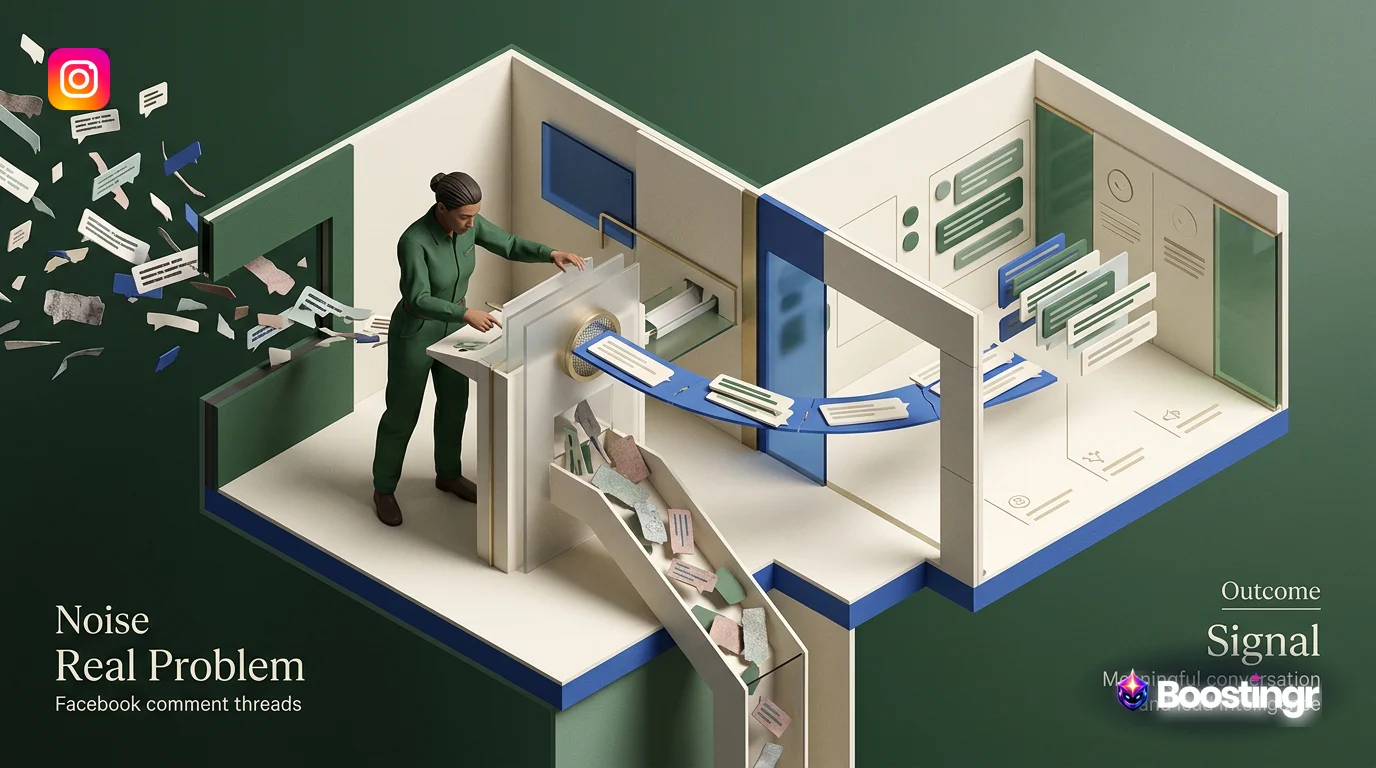
Facebook automation uses software to manage and scale marketing tasks on the platform, saving time and improving efficiency. While traditionally focused on scheduling posts or managing ads, modern automation now leverages AI to intelligently moderate comments, analyze user intent, provide brand-safe replies, and identify sales leads directly from your organic posts and ad campaigns, transforming engagement into a measurable growth engine.
The Evolution of Facebook Automation: From Simple Scheduling to AI Intelligence
The term **Facebook automation** often conjures images of two distinct activities: scheduling posts for the week or setting up complex, rule-based systems for ad campaigns. For years, the market has been dominated by tools that excel at one or the other. On one side, you have reliable workhorses like Buffer and Hootsuite, perfect for automating content publishing. On the other, you have sophisticated platforms like Ryze AI that focus on optimizing ad spend.
But this binary view leaves a massive, chaotic, and incredibly valuable gap: the comments section. This is where conversations happen, where brand perception is forged in real-time, and where high-intent customers ask buying questions. Leaving this space unmanaged or relying on simplistic, keyword-based tools is like building a beautiful storefront but leaving the front door unguarded and unanswered.
True **Facebook automation** in 2024 and beyond is not just about robotic efficiency. It's about applying intelligence to your engagement. It's about understanding the *why* behind every comment, protecting your community from harm, and systematically turning public conversations into revenue. This is the new frontier, moving beyond basic triggers to AI-powered comment intelligence. Platforms like Boostingr are built to be the operating system for this new era, focusing on the most critical part of your social presence: the community itself.
The Three Tiers of Facebook Automation: Where Do You Fit?
Understanding the landscape of automation tools is the first step to choosing the right strategy. Most tools fall into one of three categories, each serving a different primary purpose.
Tier 1: Publishing Automation (The Basics)
This is the most common and well-understood form of **Facebook automation**. These tools are essentially advanced content calendars.
* **Primary Function:** Scheduling and publishing posts across multiple pages or profiles. This includes tools that `automate facebook posts` based on a pre-set schedule. * **Example Tools:** Meta Business Suite, Buffer, Sprout Social, Hootsuite. * **Who It's For:** Marketers, social media managers, and agencies who need to maintain a consistent posting cadence without being logged in 24/7. * **The Limitation:** These tools are built for outbound communication. Their job ends the moment a post goes live. They offer little to no capability for managing the inbound flood of comments, questions, and spam that a successful post generates.
Tier 2: Ad Campaign Automation (The High-Spend)
At the other end of the spectrum are tools designed to manage the complexities of paid advertising on Facebook.
* **Primary Function:** Automating the optimization of Facebook Ad campaigns. This includes budget allocation, A/B testing, audience targeting, and rule-based actions (e.g., pausing a low-performing ad). This is the core of `facebook ads automation` and `AI for facebook ads`. * **Example Tools:** Ryze AI, AdStellar, Revealbot. * **Who It's For:** Performance marketers, media buyers, and ecommerce brands with significant ad budgets who need to maximize ROI. * **The Limitation:** While powerful for campaign metrics, these tools are largely blind to the conversations happening *on the ads themselves*. They might optimize for clicks, but they won't hide a spam comment defacing your top-performing ad or answer a buying question that could convert a user.
Tier 3: Engagement Intelligence Automation (The Missing Link)
This is the underserved middle ground and the most significant opportunity for brands. This tier focuses on automating the management of the conversations that Tiers 1 and 2 generate.
* **Primary Function:** Using AI to analyze, moderate, and respond to comments at scale. This goes far beyond a simple `facebook comment auto reply` to encompass a full `facebook workflow automation` for your community. * **Example Tools:** Boostingr. * **Who It's For:** Brands of all sizes that understand community engagement is directly tied to brand health and revenue. This includes ecommerce stores, B2B companies, creators, and agencies. * **The Power:** This is the only tier that addresses brand safety, lead generation from comments, and customer support triage in one unified system. It bridges the gap between publishing content and reaping its rewards.
Beyond "Auto-Reply": The Shift to AI Comment Intelligence
The biggest mistake brands make with engagement automation is thinking in terms of basic "auto-reply." Old-school tools that rely on simple keyword triggers (e.g., IF comment contains "price," THEN reply "We'll DM you!") are outdated and dangerous. They are rigid, lack context, and often make your brand look robotic or foolish. A user asking "What's the price of ignoring your customers?" might get the same automated DM as a genuine lead.
AI Comment Intelligence is the solution. It's a paradigm shift from *reacting to keywords* to *understanding people*. Here’s what that means in practice:
* **Intent Detection:** The AI goes beyond positive/negative sentiment to classify the *purpose* of a comment. Is it a **Purchase Intent** question ("Do you have this in blue?"), a **Support Issue** ("My order hasn't arrived"), **Spam** ("Click my profile!"), or a **PR Risk** (a hateful or defamatory remark)? * **Nuanced Sentiment Analysis:** Understanding the difference between sarcasm, genuine frustration, and delight. This allows for more appropriate and humanized responses. * **Public Lead Qualification:** The AI is trained to identify high-intent buying signals directly in public comments. Instead of just pushing everyone to DMs, it can flag a comment as a hot lead for your sales team to see, complete with context. Learn more about this in our guide to intelligent Instagram lead capture. * **Proactive Brand Safety:** The most crucial element. An intelligent system doesn't wait for a human to find a toxic comment. It identifies and hides spam, hate speech, and trolling comments in real-time, 24/7, protecting your brand reputation and the integrity of your ad spend. This is a core component of our AI comment moderation workflow.
Comparison Table: Facebook Automation Tools by Function
To visualize the landscape, here’s how different categories of **Facebook automation** tools stack up:
| Tool Category | Primary Function | Example Tools | Best For | Key Limitations |
|---|---|---|---|---|
| **Post Schedulers** | Content publishing & scheduling | Meta Business Suite, Buffer, Publer | Maintaining a consistent posting schedule | No inbound comment management; job ends at publishing. |
| **All-in-One Suites** | Publishing, basic analytics, inbox management | Sprout Social, Hootsuite | Agencies needing a single dashboard for multiple clients | Comment moderation is often manual or uses simplistic keyword rules; lacks deep AI intent analysis. |
| **Ad Optimizers** | Budget & performance automation for paid ads | Ryze AI, AdStellar | Performance marketers maximizing ad ROI | Blind to comment quality on ads; can't protect ad spend from spam or capture leads from comments. |
| **Chatbot/DM Funnels** | Rule-based comment-to-DM sequences | ManyChat, Chatfuel | Driving conversations to a private channel for sales/support | Public comment section is just a trigger; lacks public brand safety, moderation, and public lead intelligence. |
| **AI Comment Intelligence** | AI-powered moderation, intent analysis, replies & lead capture | **Boostingr** | Brands focused on safety, lead gen, and scalable community management | Focused specifically on the high-value channel of comments, not post scheduling. |
Building Your Facebook Workflow Automation Engine with AI
Implementing intelligent **Facebook automation** isn't about flipping a switch. It's about building a strategic workflow that protects your brand and drives growth. With a platform like Boostingr, you can create a powerful, automated engine for your community.
Step 1: The Foundation - Automated Brand Safety
Before you can think about engagement or leads, you must secure your space. Harmful comments on your posts and ads erode trust, create negative social proof, and can get your ad account flagged. This should always be your first priority.
**The Workflow:**
- **Connect Your Account:** Link your Facebook Page(s) to Boostingr.
- **Activate AI Moderation:** Enable the AI models for detecting spam, hate speech, trolling, and other brand-specific risks.
- **Set the Action:** Configure the system to automatically **hide** any comment that violates your policies. Hiding is superior to deleting as it makes the comment invisible to the public but keeps it visible to the original commenter and page admins, preventing further escalation.
- **Review & Refine:** The AI routes all hidden comments to a moderation queue for optional human review, helping the system learn and improve.
This single workflow runs 24/7, acting as a tireless guardian for your brand reputation on every single post and ad.
Step 2: Triage & Routing - Intelligent Classification
Once the noise is filtered out, you can focus on the signal. The next step is to have the AI automatically sort the remaining comments based on their intent, ensuring the right message gets to the right person or system instantly.
**The Workflow:**
* **Purchase Intent** (`"How much?"`, `"Where can I buy?"`): The comment is tagged as a `Lead` and can be sent to a dedicated sales queue or even pushed to a CRM. * **Support Issue** (`"It broke,"`, `"Can't log in"`): The comment is tagged as `Support` and can automatically create a ticket in Zendesk, Gorgias, or your helpdesk of choice. * **Positive Feedback** (`"I love this product!"`): The comment is tagged as `Positive UGC` and routed to a community manager to request usage rights or simply to thank the user. * **Negative Feedback** (`"I'm so disappointed"`): The comment is tagged as `Escalation` and an immediate notification is sent to your PR or senior support team.
- **AI Intent Analysis:** As each clean comment comes in, Boostingr's AI analyzes its content and context.
- **Automated Routing:** Based on the detected intent, the system triggers a specific action:
This automated triage ensures rapid response times and prevents valuable opportunities or critical issues from getting lost in the noise.
Step 3: Engagement & Lead Capture - Humanized AI Replies
With safety and routing handled, you can now automate engagement. Using Boostingr's **Brand Memory**, the AI learns your specific tone of voice, product details, and common answers from your past replies, style guides, and even your website content. This allows it to generate replies that are not just accurate but sound authentically human.
**First-Party Observation:** We've observed that brands moving from keyword-based auto-replies to Boostingr's intent-based AI see a dramatic drop in negative reactions to automated responses. When the AI can understand a user's frustration and reply with empathy, or detect a sales question and provide a precise product detail, users feel heard, not handled.
**The Lead Capture Workflow:**
- **AI Detects Buying Signal:** A user comments on your ad, `"Does this ship to Australia?"`
- **AI Crafts a Reply:** Using Brand Memory, the AI generates a public reply: `"We certainly do! Shipping to Australia typically takes 5-7 business days. You can check out all the details on our shipping page. Let us know if you have any other questions!"`
- **Simultaneous Internal Action:** At the same time, the system tags the user as a `Hot Lead` in the Boostingr dashboard and notifies the social sales team.
This workflow accomplishes three things at once: it answers the user's question publicly (helping others with the same question), it maintains a helpful and human brand voice, and it captures the lead in a structured way without relying on a clunky DM funnel.
Practical Examples and Use Cases
* **Ecommerce Brand:** An apparel brand runs Facebook ads showcasing a new jacket. Their ads get flooded with a mix of spam, questions about sizing, and positive reactions. By implementing Boostingr, they automatically hide 98% of the spam. The AI-powered `facebook comment auto reply` answers common questions like "Is this waterproof?" with pre-approved, on-brand information. Most importantly, it identifies comments like "I need this for a trip next week!" as urgent purchase intent, flagging them for immediate follow-up, directly boosting ad-driven sales.
* **B2B SaaS Company:** A project management software company shares a blog post on Facebook about team productivity. A user comments, "This is great, but does your tool integrate with Slack?" Instead of this valuable lead getting buried, Boostingr's AI identifies the intent, tags it as a `Sales Inquiry`, and alerts the B2B sales team with a direct link to the comment and user profile.
* **Mini Case Study:** A leading consumer electronics brand using Boostingr for their **Facebook automation** saw a 92% reduction in visible spam and troll comments on their high-spend ad campaigns within 48 hours. Their AI workflow automatically hid thousands of harmful comments that were creating negative social proof. In the same period, the system identified over 450 qualified sales leads from comments asking about product specifications and availability, which their overwhelmed social media team had previously been missing. This protected their ad spend and simultaneously opened a new, highly efficient channel for lead generation.
Original Diagrams
These original visuals explain the workflow in a faster, more defensible format than plain text alone and give the article first-party assets that are easier to understand and harder to copy.
Comment Processing Workflow
This workflow shows the journey of a single Facebook comment as it enters the automation system. The AI analyzes the comment and routes it down a specific path for an automated reply, moderation action, or escalation to a human agent.
AI Decision Tree
This diagram visualizes the logical steps an AI takes when evaluating a comment. It shows how the system makes sequential decisions based on sentiment, keywords, and user history to arrive at the most appropriate action.
Moderation Pipeline
This visual represents the multi-stage process for ensuring brand safety through comment moderation. Each comment passes through sequential filters for spam, hate speech, and policy violations before it is either hidden or approved.
Intent Classification Flow
This flow demonstrates how AI analyzes a comment's language to determine the user's underlying intent, such as a purchase inquiry or a support request. This classification is crucial for routing engagement to the correct automated workflow or internal team.
Brand Memory Diagram
This diagram conceptualizes how an AI develops a 'brand memory' by learning from your company's knowledge base, past interactions, and brand guidelines. The AI then uses this memory to craft replies that are contextually aware and consistent with your brand voice.
Checklist: Implementing Intelligent Facebook Automation
[ ] **Audit Your Current Process:** Identify the most time-consuming manual tasks related to your Facebook comments. Is it deleting spam, answering repetitive questions, or finding sales leads?
[ ] **Define Your Primary Goal:** Are you prioritizing brand safety, lead generation, or customer support efficiency? Your goal will define your workflow.
[ ] **Evaluate Your Tech Stack:** Does your current `facebook post scheduler` or CRM have any real comment management capabilities? Identify the gaps.
[ ] **Map Your Ideal Comment Workflows:** On a whiteboard, draw what should happen when a spam comment appears versus a sales lead. Be specific.
[ ] **Choose an Intent-First Platform:** Select a tool like Boostingr that is built on AI intent detection, not just simple keyword matching.
[ ] **Deploy Brand Safety First:** Before anything else, configure the AI to automatically find and hide spam, hate speech, and other toxic content.
[ ] **Train the AI on Your Brand Voice:** Upload your style guide, link your website, and let the AI learn how you speak. Check out our guide on creating an AI Instagram reply bot that sounds human.
[ ] **Integrate with Your Core Systems:** Connect your automation platform to your helpdesk (Zendesk, Gorgias) or CRM (Salesforce, HubSpot) for seamless routing.
[ ] **Monitor, Learn, and Refine:** Use the analytics dashboard to see how the AI is performing. Refine your rules and workflows based on real-world results to continuously improve efficiency and ROI.
Key Takeaways
* Modern **Facebook automation** has evolved far beyond post scheduling. The biggest opportunity for growth and brand protection lies in intelligently automating your comment section. * Relying on basic, keyword-based auto-replies is a risky strategy that can damage brand perception. The future is AI that understands user intent and context. * The critical first step in any comment automation strategy is deploying AI-powered moderation to protect your brand and ad spend from spam, trolls, and hate speech. * You can turn your public comments section into a powerful, high-signal lead generation channel by using AI to identify buying questions and route them to your sales team. * The most effective approach is to use a dedicated AI Comment Intelligence platform like Boostingr, which acts as the central operating system for your community engagement, connecting safety, support, and sales in one automated workflow.
Evidence, Experience, and References
This article is based on Boostingr's direct experience in developing AI-powered comment management solutions for brands worldwide. Our insights are supplemented by competitor analysis and public documentation from leading social media platforms and tool providers. All strategies discussed are compliant with Meta's official API guidelines.
* Meta Graph API Documentation: https://developers.facebook.com/docs/graph-api * Google SEO Starter Guide: https://developers.google.com/search/docs/fundamentals/seo-starter-guide * FS Poster, "Best Facebook Automation Software for 2026": https://fsposter.com/blog/best-facebook-automation-software/ * Ryze AI, "Facebook Automation Software: 15 Best Tools for 2026": https://ryze.ai/blog/facebook-automation-software * SleekFlow, "The 7 best Facebook auto reply tools in 2026": https://sleekflow.io/blog/facebook-auto-reply-tools/
About the Author
The Boostingr content team is composed of experts in AI, machine learning, and social media community management. We have years of experience building and implementing intelligent automation solutions that help brands protect their reputation, engage their audience, and drive measurable growth from their social conversations.
Last Updated
June 10, 2024
FAQs
Search Intent and Topic Map
This guide targets readers researching facebook automation and maps the topic to practical evaluation and implementation decisions. Supporting concepts include best facebook automation tools, facebook ads automation, facebook post scheduler, facebook comment auto reply, facebook messenger automation, automate facebook posts, free facebook automation tools, facebook group automation, AI for facebook ads, facebook autoresponder, facebook workflow automation, meta business suite automation, ai comment management, brand safe ai replies, comment moderation automation. These terms are used only where they clarify the reader's question, not as repeated ranking phrases.