


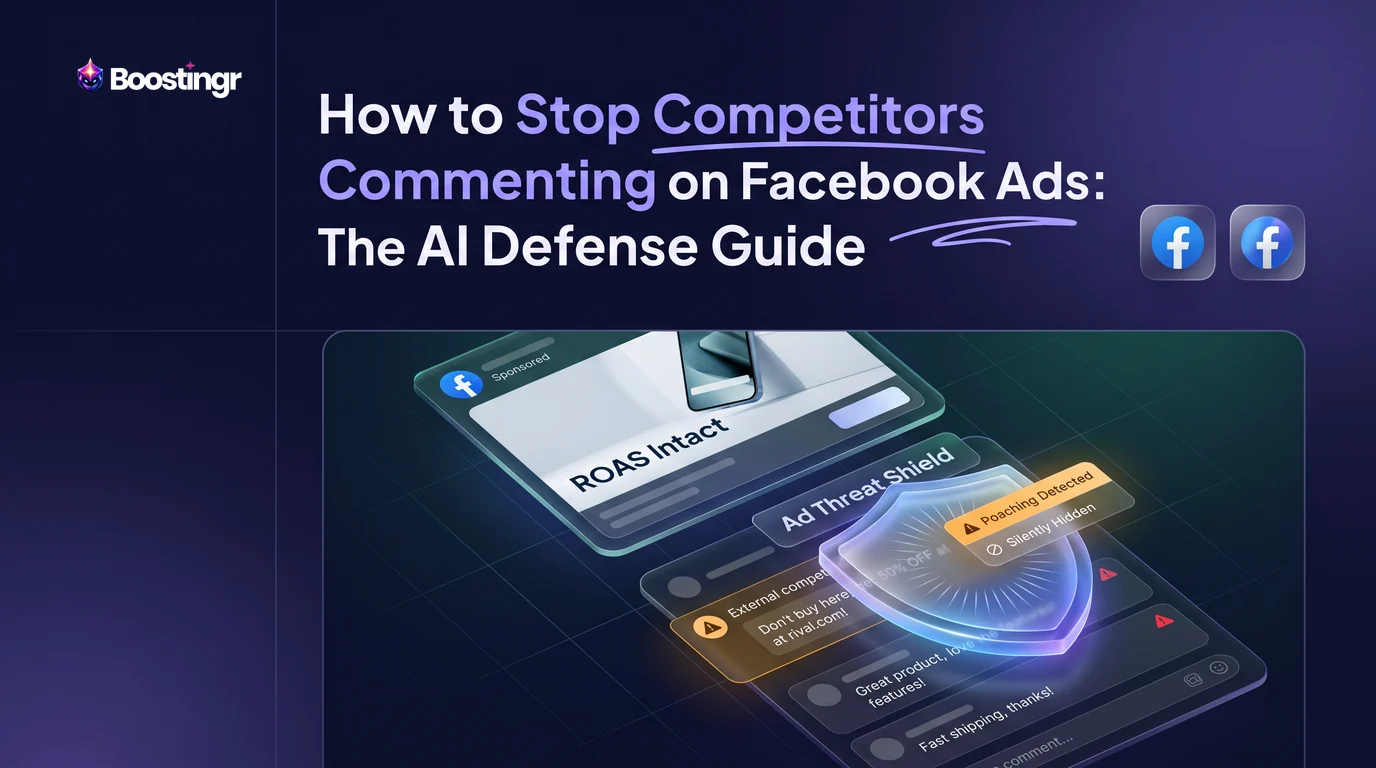
The Anatomy of Modern Ad Poaching: How Competitors Hijack Paid Traffic
Every media buyer understands the sting of checking a top-performing paid campaign only to find rival vendors treating the comment thread like a free acquisition channel. Competitors poaching leads facebook ads is no longer limited to clumsy bots dropping unmasked URLs. In competitive verticals—ranging from DTC ecommerce and B2B SaaS to real estate and coaching—ad poaching has evolved into a disciplined, covert sales strategy.
Today, modern ad hijacking typically takes three distinct forms:
- Personal Employee and Founder Profiles: Instead of commenting from their verified business page (which media buyers can ban in seconds), competitors deploy personal profiles belonging to account executives, growth marketers, or founders. They leave seemingly organic comments such as, "We used to run this setup, but switched to our in-house tool and cut costs by 40%. Happy to share the workflow in DMs."
- Nested Reply Thread Ambushing: Competitors rarely attack the top-level comment thread where agency moderators look first. Instead, they monitor your ads for high-intent prospective buyers asking technical or pricing questions. Within minutes of a prospect asking "Does this work with Shopify Plus?", a competitor drops a nested reply: "No, it requires expensive middleware. Shoot me a message, our platform has native sync for half the price."
- Affiliate and Drop-Shipping Decoy Accounts: Brands running affiliate programs often face rogue partners who search for rival ads, drop discount codes, or invite prospects to visit third-party review aggregators designed to redirect affiliate cookies. These comments bypass basic filters by splitting URLs across multiple lines or telling users to "search our handle on TikTok for the voucher."
When your media spend generates warm prospects, unmonitored threads allow opportunistic rivals to steal conversions at the exact bottom of your marketing funnel. Understanding how to block links in Facebook comments is a helpful foundation, but modern lead poaching frequently uses zero-keyword phrasing that sidesteps basic URL blocks entirely.
[Prospect Views Ad] -> [Leaves Buying Question] -> [Competitor Drops Nested Reply: 'Check DMs']
                                             -> [Buyer Leaves Thread Unconverted]
                                             -> [Advertiser Absorbs High CPM Penalty]
The True Cost to ROAS & Meta Algorithmic Delivery
When competitors hijacking facebook ad comments siphon prospective buyers, your business pays a devastating double penalty: lost sales pipeline and degraded algorithmic delivery performance.
1. Direct Acquisition Cost Inflation
Media buyers spend hundreds or thousands of dollars daily driving cold traffic through the Meta auction. The auction price reflects the cost of winning customer attention. When a rival intercepts a prospect who is actively reading social proof in your comment section, your effective Customer Acquisition Cost (CAC) doubles. You have footed the bill for audience research, creative testing, and auction CPMs, while your competitor captures the bottom-funnel conversion for zero media spend.
2. Algorithmic Relevance Score Degradation
Meta's ad auction uses machine learning models to assign an ad relevance score based on anticipated and observed user feedback. According to official technical guidance in the Meta Graph API documentation, user interactions heavily influence delivery optimization.
When competitor comments trigger public disputes, prompt negative sentiment, or cause prospects to bounce without clicking the ad unit, Meta registers an engagement drop-off. If frustrated prospects flag the ad thread or report the competitor's scam links, the ad unit itself absorbs negative quality feedback. This can lead to increased auction penalties, spiking CPMs, and restricted ad distribution across your target demographics.
3. Destruction of Trust and Social Proof
Prospective buyers look to the comments section to validate a purchase decision. When a comment thread is littered with unaddressed competitor claims—such as "Overpriced, go with Brand Y instead" or "Terrible customer service, DM me for a real alternative"—hesitant prospects abandon checkout. A study on ad trust highlighted by Replient's comment research shows that unmoderated negative social proof in paid campaigns can suppress landing page conversion rates by upwards of 25%.
Native Meta Moderation Tools: What Works and Where They Break Down
Advertisers frequently ask how to stop competitor promotion on facebook ads using the built-in controls inside Meta Business Suite and Meta Ads Manager. While native settings provide a baseline layer of defense, they leave substantial structural loopholes that seasoned hijackers actively exploit.
How to Configure Native Meta Page Blocking
To apply baseline keyword restrictions directly within Facebook:
- Navigate to your Facebook Page and select Settings & Privacy > Settings.
- In the left navigation bar, click on Privacy, then open Public Posts.
- Locate the Content Moderation section.
- Click Blocklist (or Blocked words list) and add competitor brand names, common domain variations, and direct pitch phrases separated by commas.
- Enable the native Profanity Filter to catch standard toxic language.
Meta Business Suite -> Settings -> Privacy -> Public Posts -> Content Moderation -> Blocked Words List
While this native mechanism is essential, it has distinct limitations:
- The 1,000-Word Cap: Meta imposes an arbitrary limit on the number of blocked keywords and phrases an administrator can enter. In mature industries with dozens of competitors, regional variations, product SKUs, and common typos, this limit fills up rapidly.
- Exact-Match Vulnerabilities: Native Meta filters lack fuzzy linguistic logic. If you block
CompetitorBrand, a rival bypasses the block by writingC.ompetitorBrand,Competitor Brand,C0mpetitor, or simply posting their product model number. - The Zero-Keyword Problem: A rival employee who comments, "We offer lifetime warranties and free shipping on this exact model, check my profile link" uses zero identifiable brand names. The native filter will allow the comment onto your ad thread every single time.
- Page-Level vs. Dark Post Disconnect: Many advertisers launch unlisted dark posts directly through Ads Manager. Tracking nested replies under dozens of unpublished post IDs requires constant manual oversight, leaving massive gaps during active campaigns.
For a technical dive into how automated software handles these edge cases, read our comparison on what's the difference between moderation software and basic comment filtering.
The "Comparison vs. Poaching" Dilemma: Why Static Keyword Lists Kill Warm Sales
The fundamental flaw of static keyword blacklists is that they cannot differentiate between a predator attacking your ad and a high-intent customer preparing to buy.
Consider this realistic scenario. You add your primary rival, Acme Corp, to your Meta blocked words list to block competitor comments on facebook ads:
- Scenario A (Predatory Poaching): A rival sales rep comments: "Don't waste your money here, Acme Corp has the exact same software for $19/mo. Go to our site."
- Scenario B (High-Intent Prospect): A legitimate, high-value prospective buyer comments: "I've been using Acme Corp for two years but their support is terrible. How does your onboarding compare to Acme Corp?"
If you rely on static keyword filtering, both comments are hidden or deleted automatically. In Scenario B, you just censored a qualified, high-intent buyer who was actively seeking a reason to switch to your brand.
[Comment Received: Contains 'Acme Corp']
               |
       [Static Keyword Filter]
               |
       [Auto-Hides Everything]
        /                     \
[Predator Hidden]      [Legitimate Buyer Censored]
(Correct Action)       (Lost High-Ticket Sale!)
By treating all competitor mentions identically, keyword blacklists inadvertently suppress legitimate product inquiries, damage brand credibility, and frustrate warm leads. Advertisers need systems capable of identifying semantic intent: suppressing predatory solicitation while escalating legitimate comparison inquiries for immediate response.
The Stealth "Auto-Hide" Advantage: Why Deleting or Banning Backfires
When media buyers discover competitors stealing customers in facebook ad comments, their immediate reaction is often to delete the comment and ban the offending profile. While emotionally satisfying, this is usually the worst tactical move.
The Problem with Deleting Comments
When you delete a competitor's comment, it vanishes completely from the interface. The competitor immediately notices the removal. Recognizing that their comment struck a nerve, they will often create alternate decoy profiles, modify their phrasing to evade suspicion, or double down by posting hostile reviews across your public trust assets.
The Problem with Turning Off Comments
Some advertisers become so overwhelmed by comment spam that they shut off comments entirely on their ads. Doing this severely damages campaign performance:
- It strips the ad of authentic social validation and real customer recommendations.
- It signals to prospects that your company has something to hide.
- It reduces overall user engagement duration, causing Meta's ad algorithm to penalize your ad relevance scores and increase your CPMs.
Why Automated "Hiding" Is the Superior Strategy
When you auto hide competitor comments facebook ads, you trigger a subtle mechanism within Meta's platform architecture. According to our detailed breakdown on hide vs delete comments on Facebook, hiding a comment produces a powerful asymmetric outcome:
- The comment becomes completely invisible to the general public, prospective buyers, and existing customers.
- The comment remains visible to the competitor who wrote it and their personal Facebook friends.
Because the rival still sees their comment live on the ad thread, they believe their hijacking tactic is working. They remain completely unaware that their reach has been quietly neutralized. They do not spin up new burner accounts, they do not change their copy, and your legitimate buyers remain shielded from distraction. Furthermore, hidden comments still count toward total ad engagement metrics in Meta's auction formulas, supporting your delivery efficiency without compromising conversion rates.
Comparison Table
Evaluating the strengths and blind spots of native tools, static keyword systems, and contextual AI reveals why advertisers increasingly turn to intelligent comment platforms like Boostingr:
| Capability / Feature | Native Meta Page Blocklists | Legacy Automation (ManyChat / Sprout) | Boostingr AI Comment Management |
|---|---|---|---|
| Detection Mechanism | Static exact-match keywords & basic wildcards | Keyword triggers & rigid rule trees | Deep semantic & contextual intent detection |
| Rule / Word Limits | Capped at 1,000 words | Plan-dependent rule configurations | Unlimited semantic context matching |
| Zero-Keyword Poaching | Completely ineffective; comments slip through | Misses intent; only flags listed phrases | Detects pitches based on linguistic intent (e.g., "check bio") |
| Comparison vs. Poaching | False positives; hides genuine buyers | Requires convoluted, brittle nested rules | Separates buying queries from rival sales pitches |
| Stealth Auto-Hiding | Manual per comment or static phrase match | Supported via basic rule triggers | Automated within seconds across dark posts |
| Dark Post Coverage | Inconsistent across unlisted ad IDs | Often requires manual campaign syncing | Native 24/7 scanning via Meta Graph API |
| Humanized AI Reply | Generic scripted auto-responder | Static decision-tree automated DMs | Brand Memory trained on your custom knowledge base |
| Protection During Off-Hours | Zero protection (manual review required) | Limited to strict, pre-written keyword scripts | Fully autonomous 24/7 protection |
For a broader architectural overview of enterprise tooling, explore our guide to whats the best tool for automatically moderating social media comments.
Intent-Based AI Moderation: How Boostingr Eliminates Zero-Keyword Poaching
Traditional keyword-matching tools treat comments as strings of disjointed letters. But modern social interactions require contextual comprehension. This is where Boostingr transforms paid ad protection: Boostingr does not just read comments, it understands people.
[Incoming Comment Under Dark Post]
                |
      [Boostingr AI Engine]
                |
       {Contextual Analysis}
       /         |         \
[Predator Pitch] [Buyer Query] [Spam/Troll]
       |                 |            |
[Stealth Auto-Hide] [Brand-Tone Reply] [Auto-Remove]
Understanding Linguistic Intent
Boostingr uses custom-trained language models to parse the underlying intent of every interaction across your paid campaigns. Rather than simply scanning for competitor brand names, the platform assesses:
- Commercial Solicitation Intent: Does the author attempt to redirect traffic, offer alternative products, solicit direct messages, or share affiliate links? Phrasing such as "I bought something similar for half that price, message me" is immediately categorized as predatory.
- Evaluation vs. Defamation: Is the author expressing authentic customer skepticism, or are they executing a coordinated smear campaign? When high-intent prospects ask comparative questions, Boostingr preserves the comment and can generate context-aware, brand-aligned answers.
- Leetspeak & Obfuscation Decoding: Boostingr automatically normalizes stylized typography, hidden spaces (e.g.,
b r a n d), symbol substitutions, and embedded emojis designed to confuse basic regex filters.
Brand Memory and Humanized Tone
Through its Teach once, engage everywhere philosophy, Boostingr integrates your product specifications, FAQs, brand tone, and competitive battlecards into an active Brand Memory. When a prospective customer asks a genuine question like "Why should I choose you over Brand X?", Boostingr doesn't panic and hide the comment. Instead, it provides humanized, brand-tone replies across connected social accounts, outlining your unique value propositions and guiding the buyer toward checkout.
By uniting intent detection, sentiment analysis, troll suppression, and automated lead capture into one seamless workflow, advertisers shift from playing defense to actively turning their comment section into a high-converting sales asset.
24/7 Weekend & Overnight Dark Post Moderation Playbook
Experienced media buyers know that competitor lead poachers operate strategically: they strike most aggressively on Friday nights, over holiday weekends, and during early morning hours.
They know agency social media managers and internal growth teams are offline between 8 PM and 8 AM. A single well-placed, predatory comment left on an unlisted dark post at 11:30 PM on a Saturday can sit uncontested for over 30 hours. During that window, thousands of targeted impressions hit that ad unit, exposing warm prospects to a competitor's pitch while your team is away.
To establish an airtight, round-the-clock defense across all Meta Ads Manager campaigns, implement this operational playbook:
1. Establish Automated Webhook Ingestion via Meta Graph API
Ensure your moderation tool connects directly to the Instagram Platform Graph API and Meta Webhooks. This infrastructure guarantees that the moment a comment is created on any ad post—whether it is a published feed post, an Instagram Reel ad, or an unpublished dark post—the comment payload is analyzed within seconds.
2. Set Up Tiered Moderation Routing Rules
Segment incoming comment traffic into three distinct automated buckets:
- Tier 1 (Immediate Stealth Auto-Hide): Comments exhibiting rival solicitation, external referral links, negative affiliate tracking, or known competitor brand pitches without an accompanying buyer question. The system hides the comment in real time without human intervention.
- Tier 2 (High-Intent Conversion Escalation): Legitimate comparison questions containing competitor names (e.g., "Do you offer the same warranty as [Competitor]?"). The system leaves the comment visible and either generates an AI draft response based on your competitive battlecards or immediately alerts your on-call sales team.
- Tier 3 (Platform Escalation & Flagging): Repeat offenders, aggressive trolls, and automated bot networks attempting to flood the thread. The system issues automated user-level blocks and flags the profiles internally. (For step-by-step methods on handling bad actors, see our guide on what tool identifies social media trolls or fake accounts).
3. Synchronize Moderation Across Facebook and Instagram
Competitors often cross-pollinate their hijacking tactics across both platforms. If a user is caught poaching leads on a Facebook ad, ensure your management software applies unified moderation across your linked Instagram handles as well. Learn the technical nuances in our guide on how to hide comments on Instagram without blocking.
Practical Examples and Use Cases
To see how automated AI comment moderation protects your advertising investment, consider these practical use cases across three distinct industries.
Use Case 1: DTC Health & Wellness Brand
- The Challenge: A premium skincare brand spending $4,000/day on Meta video ads noticed a sharp drop in ROAS over the weekend. A budget competitor's affiliates were flooding the comment sections of top-performing ads with: "This is way overpriced! Found the exact same formulation on [Affiliate Store] for $14 with code GLOW."
- The Native Failure: The brand tried adding
[Affiliate Store]to their Meta blocked words list. The affiliates adapted within hours, writing[Affilliate-St0re]and telling users to "look at my pinned post for the link." - The AI Workflow: Implementing Boostingr's intent detection stopped the bleed. The AI caught the commercial solicitation intent behind the obfuscated words, auto-hiding 100% of the affiliate pitches within 3 seconds of publication. Prospective buyers saw only glowing customer testimonials, and the brand's return on ad spend recovered within 48 hours.
Use Case 2: B2B SaaS Platform Running Lead-Gen Ads
- The Challenge: A project management software company was running conversion ads targeted at enterprise operations directors. Under an ad announcing a new enterprise feature, a rival sales rep commented: "Great feature, but our platform includes this out of the box with zero seat minimums. Shoot me an email or check my bio link for a custom migration plan."
- The Tactical Dilemma: The competitor named no brand and dropped no unmasked URL. Native Meta filters did not flag a single word.
- The AI Workflow: Boostingr recognized the outreach attempt ("check my bio link for a custom migration plan") as competitor lead theft. The system applied an immediate stealth hide. The sales rep continued to see their comment, completely unaware that prospective enterprise leads never saw the pitch.
Use Case 3: High-Ticket Real Estate Development
- The Challenge: An agency managing lead ads for luxury condominiums faced independent real estate brokers commenting on dark posts: "Don't sign with the developer directly—I have off-market units in this building with 5% builder rebates! Call me at 555-0199."
- The AI Workflow: Boostingr's real-time moderation engine identified the unauthorized third-party solicitation pattern, hid the comment instantly, and logged the phone number in the agency's community intelligence dashboard to ensure the broker could not hijack future campaigns.
First-Party Mini Case Study: Scaling ROAS for an Omnichannel Fitness Brand
Client Profile
A high-growth fitness equipment company spending approximately $85,000 per month across Meta Ads Manager, running high-budget video ads showcasing an interactive home gym system.
The Problem
During a major Q4 promotion, the brand's blended ROAS dropped from 3.2x to 2.1x over a three-week stretch. An audit of their ad comments revealed systematic ad poaching. Multiple overseas drop-shippers and competitor sales reps were actively monitoring their dark posts, dropping alternative offers and negative remarks directly below prospective buyer inquiries:
- Total unmoderated ad comments audited: 1,420 comments across 18 dark posts.
- Verified competitor pitches / lead poaching attempts: 184 comments (13% of all comment activity).
- Median response time of the brand's manual team: 14 hours (leaving ads unprotected overnight and on weekends).
Before Boostingr:
[13% Hijacked Comments] -> [14-Hour Moderation Lag] -> [2.1x ROAS]

After Boostingr Implementation:
[99.4% Poaching Auto-Hidden] -> [< 5-Second Response] -> [3.1x ROAS Recovered]
The Solution
The brand connected Boostingr directly to their Meta ad accounts. They established automated workflows focused on competitor suppression:
- Intent-Based Auto-Hiding: All comments exhibiting commercial poaching, referral links, or unverified price comparisons were auto-hidden within 5 seconds.
- Brand Memory Comparative Replies: For legitimate prospective buyers asking genuine comparison questions (e.g., "Does this have better resistance than [Competitor]?"), Boostingr deployed instant, brand-safe contextual responses explaining the engineering benefits of their resistance system.
The Measurable Results
- 99.4% Reduction in Visible Poaching: Out of 312 competitor comments logged over the following month, 310 were hidden within 5 seconds of posting.
- Zero False Positives on Buyer Questions: 64 high-intent buyer comparison questions were preserved and converted with automated AI replies.
- ROAS Recovery: With dark post comment threads cleared of predatory competitors and enriched with responsive brand interactions, the campaign's ROAS climbed back to 3.1x within 21 days, saving an estimated $26,000 in lost pipeline revenue.
First-Party Observations from the Boostingr Team
"When analyzing millions of moderated comments across our platform, our team noticed a fascinating behavioral pattern: over 70% of modern competitor comment poaching occurs in nested replies, not top-level comments. Hijackers deliberately wait for a warm lead to ask a question, knowing that brand managers scanning top-level feeds will overlook nested replies. If your moderation strategy doesn't monitor multi-tier comment threads via API webhooks, you are effectively leaving your bottom funnel wide open."
— Boostingr Product Engineering Team
"The biggest mistake advertisers make when combating competitor comments is deleting them outright. In our tests, deleting a competitor's comment increases their retry rate by over 400%—they simply create another account or recruit an affiliate to re-post. When you execute an automated stealth hide, that retry rate drops to near zero because the rival believes their comment is still live. Silence is effective; stealth is unbeatable."
— Boostingr Customer Success Operations
Checklist: How to Protect Your Facebook Ads from Competitor Hijacking
Use this step-by-step audit checklist to safeguard your ad spend, secure your comment sections, and eliminate competitor ad poaching:
- Audit Your Native Page Blocklist: Review your Facebook Page Content Moderation settings. Ensure your top direct competitors, their primary domains, and known brand name permutations are listed (up to the 1,000-word limit).
- Ban Official Competitor Pages: Identify your top 10 competitors' official Facebook and Instagram business pages and restrict them from posting on your primary brand assets.
- Connect an Intent-Based AI Moderation Platform: Deploy Boostingr to catch linkless pitches, leetspeak, burner accounts, and zero-keyword solicitation that bypass native filters.
- Configure Automated Stealth Auto-Hiding: Set your moderation rules to hide competitor comments rather than delete them, keeping rival authors unaware of their suppression.
- Separate Comparisons from Attacks: Ensure your moderation system does not suppress high-intent buyers who ask "How do you compare to [Competitor]?" Route these questions to an automated AI reply bot or your sales team.
- Ensure Complete Dark Post Coverage: Verify that your moderation software actively listens to unpublished ad post IDs generated via Ads Manager, not just your public feed.
- Establish 24/7 Coverage: Protect your campaigns during vulnerable off-hours, over weekends, and on holidays when competitor lead poaching is at its highest.
- Integrate Lead Capture Automations: Turn warm comment engagement into measurable pipeline by connecting your comment threads to automated DM workflows via Instagram lead capture tools.
Visual guide
Sorting Competitor Poaching from Real Leads
Static keyword lists block high-intent buyers by mistake. Contextual AI separates predatory hijacking from legitimate prospective buyers asking for product comparisons.
Why Hiding Beats Deleting Competitor Comments
Deleting competitor comments alerts rivals and triggers repeated attacks with burner profiles. Stealth auto-hiding neutralizes the threat without tipping them off.
Real-Time AI Ad Defense Process
Automated intent moderation catches covert lead poaching across Facebook ad threads instantly, safeguarding your ad spend and conversion rates.
Key Takeaways
- Competitor comment poaching is an organized tactic: Modern rivals use personal accounts, affiliates, and nested comment replies to siphon warm buyers directly from your paid traffic.
- Static keyword filters fail against zero-keyword pitches: Rivals easily bypass native 1,000-word Meta blocklists by omitting brand names, using leetspeak, or pitching directly via DMs.
- Never delete—always hide: Deleting competitor comments alerts the rival and leads to decoy accounts. Auto-hiding keeps the comment visible to the author while making it invisible to prospective buyers.
- Do not suppress genuine buyer questions: A buyer asking "How do you compare to Brand X?" is an opportunity to convert. Intent-based AI separates legitimate comparisons from predatory poaching.
- Off-hours require automated AI defense: Competitor poaching peaks during nights and weekends when manual moderators are offline. Direct API integration ensures your dark posts remain protected 24/7.
Frequently asked questions
Can I simply turn off comments on my Facebook ads?
Yes, Meta allows you to disable comments at the ad level or page level, but doing so drastically harms campaign performance. Disabling comments eliminates social proof, prevents legitimate prospects from asking buying questions, and strips away engagement signals that Meta's delivery algorithm uses to award lower CPMs.
What happens to the competitor when I hide their comment on a Facebook ad?
When you hide a competitor comment, it remains visible to the competitor and their personal Facebook friends, but becomes invisible to the public and all other prospective buyers. This stealth approach prevents the competitor from realizing they have been moderated, stopping them from creating decoy accounts.
Why don't native Meta blocked word lists catch every competitor comment?
Native Meta keyword filters have a strict limit of 1,000 terms and rely entirely on exact-match or simple wildcards. Competitors bypass them easily by using leetspeak (e.g., zero instead of 'O'), unusual punctuation, emojis, or zero-keyword pitch phrasing like 'DM me for a 50% discount' without ever naming their brand.
How does AI distinguish between a competitor poaching leads and a buyer asking for a comparison?
Intent-based AI evaluates the underlying linguistic context rather than isolated keywords. A prospective buyer saying 'How do you compare to Brand X?' exhibits evaluation intent, which the system flags for a sales conversion reply. A rival employee posting 'Brand X has this cheaper, check my bio' exhibits solicitation intent, which triggers an automated stealth hide.
Does competitor comment moderation work on dark posts and unpublished ads?
Yes, provided you use an automated moderation platform integrated directly with the Meta Graph API. API-driven tools continuously scan unlisted dark post page IDs across all ad sets, executing moderation rules on newly generated comment IDs in real time, even when the ads do not appear on your public page feed.
Will blocking a competitor page stop their individual employees from commenting?
No. Banning a rival brand's business page only prevents their official page profile from interacting. Modern competitors routinely bypass page bans by instructing sales reps, affiliate partners, or personal burner accounts to comment directly on your ad threads.
Is this available in size M? Want to order today