Quick Answer
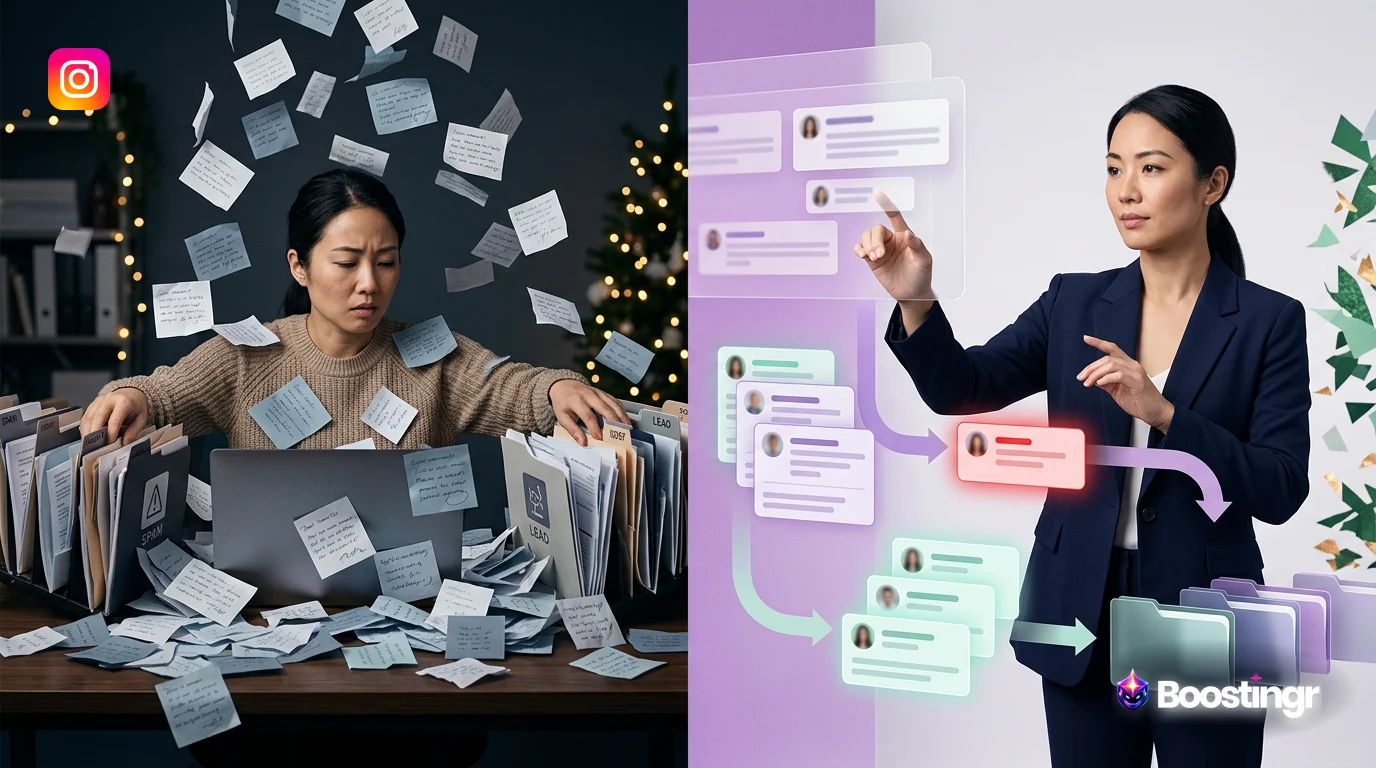
Intent detection for comments is an AI-powered process that analyzes social media comments to understand the underlying purpose or goal of the commenter, not just their emotion. It classifies comments into categories like 'Purchase Intent,' 'Customer Support,' or 'Spam,' enabling brands to automate smarter replies, capture high-quality leads, and escalate critical issues efficiently. This goes far beyond basic sentiment analysis to unlock strategic growth opportunities from community conversations.
Beyond Sentiment: Why Comment Intent is the Key to Community Intelligence
For years, the gold standard for understanding social media comments was sentiment analysis. Is the comment positive, negative, or neutral? While useful for a high-level overview of brand health, this approach is fundamentally limited. It tells you *how* a person feels, but critically, it misses *why* they are commenting in the first place.
A comment like, "Wow, this looks amazing! Where can I buy the red one?" is positive, but labeling it as such misses the five-alarm fire of a sales opportunity. A traditional moderation tool might simply file it under "good vibes," while a potential customer waits for an answer, their purchase intent slowly fading. This is the gap where revenue is lost and opportunities are squandered.
This is where **intent detection for comments** changes the game. It adds a crucial layer of understanding, moving from emotional polarity to actionable purpose. Instead of a simple positive/negative binary, intent detection provides a granular classification that aligns directly with business operations.
Common intent categories include:
* **Purchase Intent:** Comments indicating a desire to buy ("How much is this?", "Do you ship to Australia?"). * **Customer Support:** Questions or issues related to a product or service already purchased ("My order hasn't arrived," "How do I reset my password?"). * **Product/Feature Feedback:** Suggestions or opinions about the product itself ("I wish this came in black," "The new update is a bit buggy."). * **General Praise:** Positive feedback without a specific question or action required ("Love your brand!"). * **Spam/Scam:** Unsolicited, irrelevant, or malicious comments. * **Troll/Hate Speech:** Abusive or inflammatory content designed to provoke.
By understanding this *why*, you can stop just reading comments and start leveraging them as a core component of your business intelligence and growth strategy. This is the foundation of true AI Community Intelligence, a system that doesn't just manage chaos but extracts value from it.
How AI Unlocks Granular Intent Detection for Social Media Comments
Manually sifting through thousands of comments to determine intent is an impossible task. Keyword-based rules are a step up, but they are brittle and easily broken. A rule looking for the word "buy" will miss "How much?", "What's the price?", and "I need this!" This is where a sophisticated **comment intent AI** becomes essential.
Modern AI platforms like Boostingr use advanced Natural Language Processing (NLP) and Large Language Models (LLMs) to understand the nuances of human language. These models are trained on billions of data points, allowing them to grasp context, slang, sarcasm, and misspellings that would fool simpler systems.
Here’s how it works:
- **Ingestion:** The platform connects to your social accounts via official APIs, like the Instagram Graph API, to pull in comments in real-time.
- **AI Analysis:** Each comment is passed through a multi-layered AI engine. This engine doesn't just look at words; it analyzes sentence structure, context within the conversation, and the user's history to make a highly accurate prediction of intent.
- **Classification:** The comment is tagged with its primary intent (e.g., `Purchase_Intent`) and often secondary attributes (e.g., `Sentiment:Positive`, `Category:Shipping_Question`).
This level of **intent detection social media comments** allows for a paradigm shift in community management. Instead of a one-size-fits-all approach, you can create hyper-specific workflows for every type of comment. Boostingr embodies this with its "Teach once, engage everywhere" philosophy. When you correct an AI classification or define a new intent-based rule for a comment on Instagram, that intelligence is instantly applied across your Facebook, YouTube, and other connected accounts. The system learns and scales with you, ensuring consistent, intelligent engagement everywhere.
The Strategic Workflow: Turning Comment Intent into Action
Identifying intent is only half the battle. The real power comes from connecting that insight to a specific, automated action. An effective AI comment management platform acts as an operating system, routing each comment to the perfect destination. This strategic workflow can be broken down into three key stages.
Stage 1: Intelligent Classification & Triage
As comments flood in from your ads, Reels, and organic posts, the AI works as a tireless digital community manager. It instantly sorts every single comment into a pre-defined bucket based on its detected intent. This isn't just about hiding spam; it's about creating order from chaos. Your dashboard transforms from an endless, undifferentiated stream of notifications into a neatly organized command center where every comment's purpose is clear.
Stage 2: Automated Routing & Escalation
Once a comment is classified, the workflow engine takes over. This is where you translate intent into business processes. With a platform like Boostingr, you can build powerful, conditional rules without writing a single line of code.
* **Purchase Intent:** A comment like "I need this for my sister's birthday!" is automatically routed to a lead capture workflow. The system can send an automated DM to the user to collect their information while simultaneously tagging them as a 'Hot Lead' in your CRM. * **Urgent Customer Complaint:** A comment like "This product arrived broken and your support isn't answering!" is a potential PR fire. The AI can be configured to immediately hide the comment to prevent it from going viral, then create a high-priority ticket in your support system (like Zendesk or Gorgias) and notify the customer support lead via Slack, all within seconds. * **Feature Request:** A comment like "You should really add a dark mode" contains valuable product insight. Instead of getting lost, it can be automatically sent to a dedicated `#product-feedback` Slack channel or added to a Trello board for the product team to review. * **Troll/Hate Speech:** Malicious comments are instantly identified and hidden based on a sophisticated understanding of context, not just a blocklist of curse words. This protects your brand safety and community health without manual intervention. For a deeper dive, explore our strategic framework for AI comment moderation.
Stage 3: Context-Aware & Humanized AI Replies
Automating replies based on intent allows for a level of personalization and speed that is impossible to achieve manually. A generic "Thanks for your comment!" is no longer acceptable. With intent detection, the reply can be tailored to the user's specific need.
* **To a Purchase Intent comment:** "Great question! We've just sent you a DM with all the details on that product. 😊" * **To a General Praise comment:** "We're so happy to hear you feel that way! Thanks for being part of our community. ❤️" * **To a Support Question:** "We're sorry you're running into an issue. Our support team has been notified and will reach out to you via DM shortly to help resolve this."
Boostingr takes this a step further with its **Brand Memory** feature. The AI doesn't just generate a reply; it cross-references its knowledge base of your brand's voice, tone, product details, and past successful interactions to craft a response that feels authentic and human. This ensures your AI Instagram reply bot sounds like your best community manager, not a generic robot.
Practical Examples and Use Cases
Let's move from theory to practice. Here’s how different types of businesses leverage **intent detection for comments** to drive tangible results.
Use Case 1: The Ecommerce Fashion Brand
* **Challenge:** A high volume of comments on Instagram ads and Reels, with many sales opportunities getting lost in the noise of general engagement. * **Comment Example:** "omg is the green dress still in stock in a medium??" * **Intent Detected:** `Purchase_Intent` + `Product_Inquiry` * **Boostingr Workflow:**
* **Result:** A seamless path from comment to conversion, a 25% increase in lead capture from comments, and a significant reduction in missed sales opportunities.
- The AI instantly identifies the purchase intent.
- It triggers an automated, on-brand comment reply: "@username It's one of our favorites! We're checking on that for you right now and will send a DM with a direct link if it's available."
- Simultaneously, it sends a DM with a link to the product page, perhaps even offering a limited-time 10% discount code to encourage conversion.
- The user is tagged as a `High-Intent Lead` and the interaction is logged, providing valuable data on which products generate the most pre-sale questions.
Use Case 2: The B2B SaaS Company
* **Challenge:** Using LinkedIn and Facebook to build thought leadership, but valuable feedback and support questions from potential enterprise clients are mixed in with praise and spam. * **Comment Example:** "Interesting post. Does your platform integrate with Salesforce? We're looking for a solution but that's a must-have." * **Intent Detected:** `Sales_Inquiry` + `Technical_Question` * **Boostingr Workflow:**
* **Result:** The sales cycle is shortened by immediately connecting a high-value prospect with the right person. Product feedback is systematically collected, informing the development roadmap.
- The AI detects the high-value sales inquiry.
- The comment is automatically flagged and routed to the Head of Sales' inbox and a dedicated `#sales-leads` Slack channel.
- An AI-assisted reply is suggested to the community manager: "Excellent question. Yes, we have a robust Salesforce integration. Our integration specialist will reach out via DM to share the technical documentation and see if you're open to a quick demo."
- The lead's profile and comment are logged in the CRM for follow-up.
First-Party Observation: The Misunderstood Power of Negative Intent
At Boostingr, we've analyzed millions of comments for our clients and found a fascinating pattern: not all negative intent is created equal. Traditional tools might bucket "This is the worst product ever" and "I'm having trouble with the setup process" into the same 'Negative' category. However, our **comment intent AI** differentiates them. The first is `Brand_Attack`, requiring immediate hiding and potential user blocking. The second is `Support_Frustration`, a critical opportunity to intervene and save a customer.
We observed that for one of our SaaS clients, proactively identifying and responding to `Support_Frustration` comments within 15 minutes led to a 40% reduction in public complaints and a measurable increase in positive follow-up comments from the same users. This demonstrates that a granular understanding of negative intent can be a powerful tool for customer retention and reputation management.
Comparison Table: Intent Detection vs. Traditional Moderation Tools
To truly understand the leap forward that intent detection represents, it's helpful to compare it directly with the capabilities of traditional social media management platforms.
| Feature | Traditional Tools (e.g., Sprout Social, Hootsuite) | Advanced Intent Detection (Boostingr) |
|---|---|---|
| **Comment Analysis** | Basic sentiment (Positive/Negative/Neutral) and keyword filtering. | Granular intent detection (Purchase, Support, Feedback, etc.) plus sentiment, spam, and troll analysis. |
| **Response Strategy** | Canned replies or manual responses. Limited automation based on keywords. | Context-aware AI replies tailored to specific intent. Fully automated workflows. |
| **Lead Generation** | Manual process. Community managers must spot and copy/paste lead info. | Automated lead capture. Directly integrates with CRM and sales workflows based on purchase intent. |
| **Escalation** | Manual flagging for review. Relies on humans to decide urgency. | Automated, rule-based escalation. Critical intents are instantly routed to the correct teams. |
| **Brand Safety** | Relies heavily on keyword blocklists, which can have false positives. | AI-powered troll and spam detection that understands context, reducing false positives and protecting the community. |
| **Scalability** | Requires more human resources as comment volume grows. | AI handles the vast majority of classification and routing, allowing teams to scale engagement without scaling headcount. |
While traditional tools are excellent for scheduling posts and basic inbox management, they lack the deep understanding of conversation needed to unlock the strategic value hidden in your comments. Platforms like Boostingr are built on a foundation of **comment intent analysis**, making them true community intelligence platforms.
Checklist: Implementing an Intent-Driven Comment Strategy
Ready to move from insight to action? Use this checklist to build a robust, intent-driven comment management workflow.
- [ ] **Define Business-Critical Intents:** List the types of comments that matter most to your business (e.g., sales questions, support issues, churn risks, PR threats, valuable feedback).
- [ ] **Map Intents to Outcomes:** For each intent, define the desired business outcome. (e.g., Intent: `Price_Inquiry` -> Outcome: `New Lead in CRM`).
- [ ] **Select an AI-Powered Platform:** Choose a tool like Boostingr that specializes in **intent detection for comments**, not just sentiment analysis or keyword filtering. Check if it offers a complete AI comment moderation workflow.
- [ ] **Configure Your Classification Model:** Teach the AI your unique business language. Define custom intents and provide examples to fine-tune its accuracy for your specific audience and products.
- [ ] **Build Your Automation Workflows:** Use a visual rule builder to connect intents to actions. For example: `IF intent IS Purchase_Intent AND channel IS Instagram_Ad THEN send_dm_template('Ad Lead Followup') AND add_tag('IG_Ad_Lead')`.
- [ ] **Develop Your Brand Memory:** Populate your AI's knowledge base with brand voice guidelines, product FAQs, and examples of stellar human responses. This is crucial for generating authentic, brand-safe AI replies.
- [ ] **Set Up Smart Escalation Paths:** Create rules to ensure no critical comment is missed. Escalate urgent complaints to your support lead via Slack, or flag potential PR crises for your comms team.
- [ ] **Integrate with Your Tech Stack:** Connect your comment management platform to your CRM, support desk, and internal communication tools to create a seamless flow of information across your organization.
- [ ] **Monitor and Refine:** Regularly review your analytics dashboard. Which intents are most common? Are your workflows firing correctly? Use these insights to continuously optimize your strategy.
Original Diagrams
These original visuals explain the workflow in a faster, more defensible format than plain text alone and give the article first-party assets that are easier to understand and harder to copy.
Comment Processing Workflow
This diagram illustrates the end-to-end journey of a social media comment. From the moment it's posted, AI analyzes its intent, automatically routing it to the correct team or system for immediate, effective action.
AI Decision Tree
Behind the scenes, the AI uses a complex decision-making process to classify each comment. This simplified tree shows how the system evaluates language and context to determine the commenter's true intent.
Moderation Pipeline
Intent detection supercharges your moderation efforts by creating an intelligent pipeline. The system automatically filters spam and harmful content while prioritizing comments that require a human touch, ensuring brand safety.
Intent Classification Flow
While sentiment analysis only tells you if a comment is positive or negative, intent detection provides a much richer understanding. This visual contrasts the limited view of sentiment with the actionable categories provided by intent.
Brand Memory Diagram
Every classified comment contributes to a cumulative 'Brand Memory,' a living database of community insights. This allows your brand to track trends, understand customer needs, and make data-driven decisions over time.
Key Takeaways
* **Intent Over Sentiment:** Moving beyond simple positive/negative sentiment to understand the *why* behind a comment is the single biggest leap a brand can make in its community management strategy. * **AI is Non-Negotiable:** Accurately classifying **intent detection for social media comments** at scale is impossible without a sophisticated AI engine that understands the nuances of human conversation. * **Workflows Drive Value:** The true ROI of intent detection is realized when insights are connected to automated actions—capturing leads, deflecting support tickets, and protecting brand reputation. * **Intelligence, Not Just Management:** Modern platforms like Boostingr are not just moderation tools; they are community intelligence systems that transform chaotic comment sections into a structured source of business growth. * **Humanization at Scale:** By combining intent detection with Brand Memory, AI can deliver personalized, on-brand replies that enhance the customer experience, allowing human teams to focus on high-value interactions.
Evidence, Experience, and References
This article is based on Boostingr's direct experience in developing and implementing AI-powered comment management solutions for hundreds of global brands. Our platform has processed and analyzed over a billion comments, providing us with unparalleled insight into the patterns and opportunities within online conversations. The workflows and strategies described are grounded in real-world use cases and data observed across our client base. All technical capabilities mentioned, such as API integrations, adhere to the official documentation provided by platforms like Meta (Facebook Graph API) and Google. SEO best practices mentioned are aligned with guidelines from sources like Google's Search Central.
About the Author
The Boostingr team is composed of AI engineers, data scientists, and veteran community managers who are passionate about helping brands build better relationships with their customers. We believe that every comment is an opportunity, and our mission is to provide the technology that allows brands to understand and act on those opportunities at scale.
Last Updated
October 2023
FAQs
Search Intent and Topic Map
This guide targets readers researching intent detection for comments and maps the topic to practical evaluation and implementation decisions. Supporting concepts include comment intent analysis, intent detection social media comments, comment intent ai, ai comment management, brand safe ai replies, comment moderation automation. These terms are used only where they clarify the reader's question, not as repeated ranking phrases.