Quick Answer
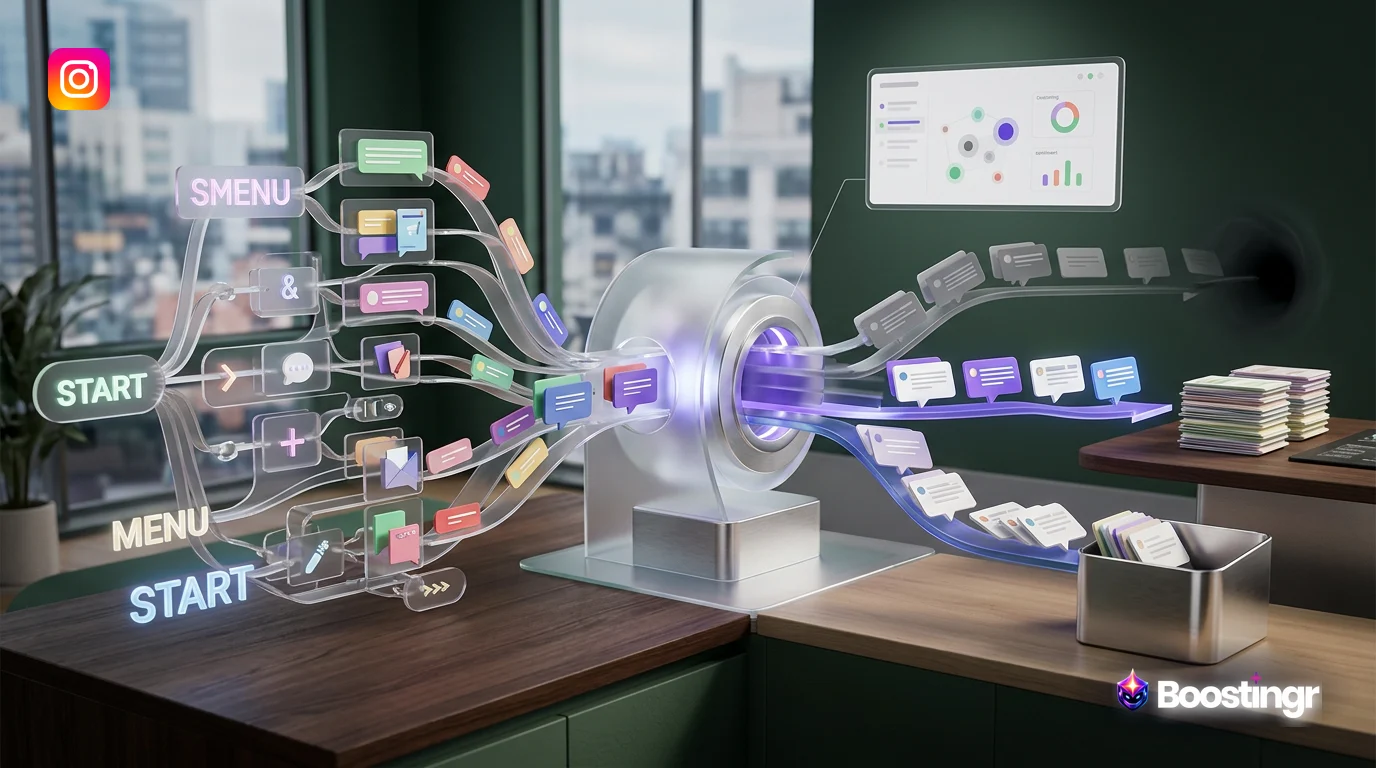
When comparing ManyChat vs. Boostingr, the primary difference lies in their core focus. ManyChat is a broad, powerful automation platform excelling at building complex chatbot flows and marketing campaigns within DMs, triggered by keywords. Boostingr is a specialized AI platform laser-focused on the public comment section, using advanced AI to understand comment intent, classify messages (leads, spam, trolls), and deliver brand-safe, context-aware automated management and replies.
Introduction
In today's digital landscape, social media engagement isn't just a vanity metric; it's the lifeblood of brand growth, community building, and customer acquisition. Platforms like Instagram and Facebook are bustling marketplaces of ideas, feedback, and, most importantly, opportunities. But with this flood of interaction comes a significant challenge: managing the sheer volume of comments. Manually sifting through spam, responding to questions, identifying leads, and protecting your brand's reputation is a monumental task that quickly becomes unsustainable.
This is where automation steps in. Two prominent names in the social media automation space are ManyChat and Boostingr. While both offer solutions to streamline engagement, they approach the problem from fundamentally different angles. This article provides a deep-dive comparison of **ManyChat vs. Boostingr**, moving beyond surface-level features to explore their core philosophies, ideal use cases, and the specific problems they solve. Whether you're a creator, an e-commerce brand, or a marketing agency, understanding these differences is crucial to choosing the right tool to transform your comment section from a chaotic liability into a strategic asset.
Why This Topic Matters
The choice of an automation tool is not merely a technical decision; it's a strategic one that directly impacts your brand's voice, efficiency, and bottom line. The wrong tool can lead to clunky, off-brand interactions that alienate your audience, while the right one can supercharge your growth. Here’s why a nuanced understanding of this topic is critical:
* **Brand Safety and Reputation:** Unmoderated comment sections can quickly devolve into a minefield of spam, scams, and hateful content. This not only damages your brand's image but also creates an unsafe environment for your genuine followers. Effective automation must prioritize brand safety above all else. * **Missed Revenue Opportunities:** Hidden within your comments are high-intent leads asking buying questions like, "How much is this?" or "Do you ship to my country?" A study from Harvard Business Review highlighted the critical importance of lead response time. Manually finding these golden nuggets is like panning for gold with a teaspoon. An intelligent system can identify and act on these opportunities in real-time. * **Operational Inefficiency:** As your brand grows, the time spent on manual comment moderation grows exponentially. This is valuable time your team could be spending on high-level strategy, content creation, and building customer relationships. Automation promises to reclaim this time, but only if it's intelligent enough to not create more work through errors and oversight. * **The Shift from Keywords to Intent:** Early automation relied on simple keyword triggers (e.g., if a comment contains "price," send a DM). This approach is brittle and often misfires. A comment like "The price is too high" receives the same response as "What is the price?" The future of automation, and the core of this comparison, lies in AI that understands context, sentiment, and true user intent.
Choosing between a general-purpose tool like ManyChat and a specialized AI system like Boostingr depends entirely on which of these problems is most pressing for your brand. This guide will equip you with the knowledge to make that strategic decision.
Comparison Table
| Feature / Aspect | ManyChat | Boostingr |
|---|---|---|
| **Core Focus** | Broad DM automation, chatbot flows, and multi-channel marketing campaigns. | Specialized AI comment management, intelligence, and brand safety. |
| **Primary Use Case** | Building interactive DM sequences, lead magnets, and keyword-based auto-replies. | Classifying all public comments for intent, auto-hiding spam/trolls, and generating on-brand AI replies. |
| **AI Capability** | Primarily rule-based and keyword-driven. AI features are emerging but not the core architecture. | AI-native. Uses deep learning models to classify comment intent (Lead, Spam, Troll, Question, etc.). |
| **Comment Management** | Can reply to comments or trigger DMs based on specific keywords or all comments. | Holistically manages comments by classifying, hiding, replying, or routing based on AI analysis. |
| **Brand Safety & Governance** | Limited to the rules you build. Risk of generic or inappropriate replies if not carefully configured. | Core feature. Uses "Brand Memory" and strict governance workflows to ensure all AI replies are brand-safe and context-aware. |
| **Lead Capture from Comments** | Relies on users commenting with a specific keyword to trigger a lead capture flow in DMs. | Proactively identifies purchase-intent comments (e.g., "Where can I buy this?") using AI and initiates a response or alert. |
| **Workflow Builder** | Visual flow builder for creating complex, multi-step DM conversations. | Workflow-first system for defining actions based on AI classifications (e.g., IF comment is 'Troll', THEN 'Hide & Block'). |
| **Platform Support** | Instagram, Facebook Messenger, WhatsApp, SMS, Email. | Laser-focused on Instagram and Facebook comments, where public moderation is most critical. |
| **Ideal User** | Businesses focused on building DM funnels and subscriber lists. | Brands, creators, and agencies prioritizing brand reputation, community safety, and lead generation from public comments. |
Core Philosophies: Broad Automation vs. Specialized Intelligence
To truly understand the **ManyChat vs. Boostingr** debate, we must look beyond a simple feature checklist and examine their foundational philosophies. They are not direct competitors in the traditional sense; they are different tools built for different jobs.
ManyChat: The Swiss Army Knife of Messenger Marketing
ManyChat has rightfully earned its place as a powerhouse in the world of social media automation. Its philosophy is one of breadth and versatility. It was designed to be a comprehensive toolkit for marketers to build engaging, automated conversations, primarily within the private space of Direct Messages.
* **The Flow Builder is King:** The heart of ManyChat is its visual flow builder. It allows marketers to map out complex, branching conversations with triggers, conditions, and actions. This is incredibly powerful for creating lead magnet delivery systems, quizzes, automated customer support FAQs, and webinar registration flows. * **Keyword-Centric:** The primary mechanism for initiating these flows from a public post is a keyword trigger. The classic example is "Comment 'GUIDE' below to get my free guide!" When a user comments with the exact keyword, ManyChat springs into action, sending them a DM to start the automated sequence. This is an effective strategy for list building and direct response campaigns. * **A Multi-Channel Hub:** ManyChat's vision extends beyond just Instagram or Facebook. It aims to be a central hub for automated communication across SMS and email, allowing for sophisticated, multi-channel marketing campaigns.
In essence, ManyChat treats the comment section as a launchpad to get users into a controlled, private DM environment where the real marketing automation happens.
Boostingr: The Scalpel for AI Comment Intelligence
Boostingr was built from the ground up with a different problem in mind: the chaos of the public comment section itself. Its philosophy is one of depth and specialization, focusing entirely on applying artificial intelligence to understand, moderate, and capitalize on public comments at scale.
* **AI-Native Architecture:** Boostingr's core is not a flow builder; it's a set of sophisticated AI models. These models are trained on hundreds of millions of social media comments to understand nuances that keywords can't catch. It doesn't just see the word "price"; it understands the difference between "What's the price?" (a lead), "This price is amazing!" (positive sentiment), and "The price is a joke" (negative sentiment/objection). * **From Classification to Action:** The platform's entire logic is built around a `Classify -> Act` model. Every single comment is analyzed and categorized—as a `High-Intent Lead`, `Spam`, `Troll`, `Question`, `Brand Mention`, `Positive Feedback`, etc. This classification then triggers a specific, pre-defined workflow. This moves beyond the binary `keyword/no keyword` logic of traditional tools. * **Brand Safety as a System:** Recognizing the immense risk of rogue AI, Boostingr has built-in governance systems like Brand Memory. This acts as a central nervous system for the AI, containing all the brand's product details, policies, and brand voice guidelines. Before any AI-generated reply is sent, it's checked against this memory to ensure accuracy and brand alignment. This systematic approach to safety is a stark contrast to simply hoping a pre-written script fits the context.
From our operating perspective, we've observed that over 80% of brands using simple keyword automation for comments end up turning it off within 30 days due to off-brand or irrelevant replies. This is why our focus is on AI understanding the *intent* behind the comment, not just matching a word. Boostingr treats the comment section as the primary arena for engagement, moderation, and intelligence gathering, not just a trigger for a DM.
Feature Deep Dive: Where Each Platform Shines
Let's break down the practical application of these philosophies by looking at specific features.
ManyChat: The King of DM Automation
If your primary goal is to drive traffic from your posts into a structured DM conversation, ManyChat is unparalleled. Its strengths lie in:
* **Interactive DM Flows:** You can build rich experiences inside the inbox, complete with buttons, user input fields, and conditional logic. This is perfect for e-commerce stores wanting to create a product finder quiz or creators looking to deliver a multi-day course via DM. * **Subscriber List Building:** ManyChat excels at turning commenters into subscribers within its platform. Once a user interacts with your bot, they are added to your contact list, allowing for future broadcasts and follow-up sequences (always in compliance with platform policies). * **Integrations:** It connects with a wide array of other marketing tools, from CRMs like HubSpot to email marketing services and Google Sheets. This allows you to build powerful marketing stacks where a DM conversation can trigger actions across your entire ecosystem.
However, when it comes to managing the comments themselves, ManyChat's functionality is more basic. It can auto-reply in the comments, but these replies are typically static or semi-dynamic based on the username. It lacks the nuanced understanding to know *when* not to reply or *how* to tailor a reply to the specific sentiment of the original comment.
Boostingr: The Master of Comment Intelligence
Boostingr shines where the public-facing conversation happens. It's built for brands who see their comment section as a vital community hub and a source of business intelligence.
* **Advanced AI Comment Classification:** This is Boostingr's cornerstone. Instead of just looking for keywords, it analyzes and tags every comment. Imagine automatically identifying every comment that expresses purchase intent, every question about shipping, every piece of negative feedback about a product feature, and every troll comment trying to start a fight. This is the data foundation for all other actions. You can learn more about this in our guide to intent detection for comments. * **Brand-Safe AI Replies:** Leveraging its classification engine and Brand Memory, Boostingr can generate contextually relevant and safe replies. For a comment classified as a `Lead`, it might reply, "Great question! Our [Product Name] is $[Price]. We've also sent you a DM with a direct link to check out!" For a `Positive Feedback` comment, it might say, "We're so glad you're loving it, [Username]! Thanks for being part of our community." This level of personalization at scale is impossible with keyword-based systems. Our blueprint for brand-safe AI replies covers this in detail. * **Intelligent Moderation and Routing:** Spam and troll comments are a huge drain on resources. Boostingr's AI identifies this harmful content with high accuracy and can automatically hide it based on your pre-set rules, often before it's seen by other users. This protects your community and brand image 24/7. Furthermore, it can route important comments—like a serious customer complaint or a partnership inquiry—directly to the right person or channel (e.g., a Slack notification to the support team lead). * **Community Intelligence Dashboard:** Because Boostingr classifies every comment, it can provide macro-level insights. You can see trends over time: Are we getting more questions this month? Is negative sentiment about a recent campaign increasing? Is one post generating an unusual number of high-quality leads? This transforms your comment section from a list of messages into a strategic community intelligence platform.
Original Diagrams
These original visuals explain the workflow in a faster, more defensible format than plain text alone and give the article first-party assets that are easier to understand and harder to copy.
Comment Processing Workflow
This diagram illustrates the journey of a single comment through Boostingr's system, from the moment it's posted to the AI's classification and automated response or action.
AI Decision Tree
This decision tree shows the logical pathways the AI takes to analyze a comment's intent, distinguishing between a potential sales lead, a spam message, or a negative comment requiring moderation.
Moderation Pipeline
This pipeline showcases the brand safety process, demonstrating how the AI identifies and filters out trolls, spam, and harmful content to maintain a positive comment section.
Intent Classification Flow
Unlike simple keyword triggers, Boostingr's AI understands the underlying intent. This flow shows how a comment is sorted into precise categories for appropriate handling.
Brand Memory Diagram
This diagram explains how the AI learns from every interaction, building a 'brand memory' of products and past conversations to provide increasingly accurate, context-aware replies.
Practical Examples and Use Cases
Theory is one thing; practical application is another. Let's explore how these two platforms would handle common scenarios.
Scenario 1: The E-commerce Brand Launching a New Product
An e-commerce brand posts a video of its new running shoe. The comments start pouring in.
* **ManyChat Approach:** The caption would instruct users, "Comment 'SHOES' and we'll DM you the link!" The system would efficiently send a direct message to every user who comments with that exact word. However, it would ignore or miss comments like "How much are these?", "Are they available in size 11?", or "Do these have good arch support?" These are high-intent leads left unaddressed on the public post. * **Boostingr Approach:** Boostingr's AI would analyze every single comment. * `"How much are these?"` -> Classified as `Lead`. Triggers an AI reply: "They're $129! You can see all the features on our site. We've DMed you a direct link." It also alerts the sales team. * `"These look like a cheap knockoff."` -> Classified as `Troll` or `Negative Feedback`. Triggers an action to automatically hide the comment to protect the brand's image during a critical launch. * `"OMG I need these!"` -> Classified as `Positive Feedback`. Triggers an action to 'like' the comment and reply: "So glad you're excited! We can't wait for you to try them." * This demonstrates a holistic management strategy that captures leads, protects the brand, and engages the community simultaneously. Our data shows that identifying and responding to purchase-intent comments within the first 5 minutes can increase conversion rates by up to 30%. Traditional tools often miss these opportunities because they aren't looking for intent, just keywords.
Scenario 2: The Large Creator Managing a Community
A financial advice creator with 1 million followers asks their audience about their biggest investing fears. The post gets thousands of comments.
* **ManyChat Approach:** The creator could use a keyword trigger like "Comment 'FEAR' to get my free PDF on overcoming market anxiety." This is effective for lead magnet delivery but does little to manage the thousands of other comments, which likely include spam, trolls, and genuine, nuanced questions. * **Boostingr Approach:** The creator's primary goal is to foster a healthy community and identify content ideas. Boostingr would: * Auto-hide comments like "Invest in my crypto scam!" (`Spam`) and "You're giving terrible advice!" (`Troll`). * Identify and group common questions. The AI might notice that hundreds of comments mention "inflation." The creator's team can see this on their community intelligence dashboard and realize their next YouTube video should be about investing during inflationary periods. * Use AI replies to answer simple, repetitive questions like "What app do you use?" with a pre-approved, on-brand answer, freeing up the creator to engage with the more thoughtful, personal stories.
Scenario 3: The Marketing Agency Handling Multiple Clients
An agency manages social media for 15 different brands, from a local restaurant to a national software company.
* **ManyChat Approach:** The agency can manage multiple accounts, but they would need to build and maintain separate, complex DM flow-bots for each client. The focus would be on running specific campaigns (e.g., a contest for the restaurant, a demo request flow for the software company). * **Boostingr Approach:** The agency can use a single dashboard to oversee all 15 accounts. Each account has its own unique Brand Memory and rule set. For the restaurant, the AI knows the opening hours and menu. For the software company, it knows the pricing tiers and integration partners. The agency can offer a high-value AI comment moderation service that protects all clients from spam, captures leads, and provides them with a monthly report on comment sentiment and trends—all with minimal manual effort.
Checklist: Choosing Your Automation Tool
Ask yourself these questions to determine whether ManyChat, Boostingr, or even a combination of both, is right for you:
* [ ] **What is my primary goal?** Is it building a large list of DM subscribers for marketing broadcasts (ManyChat) or is it managing community health, protecting my brand, and finding leads in public comments (Boostingr)? * [ ] **What is my biggest pain point?** Is it the inability to scale lead magnet delivery (ManyChat) or is it the overwhelming volume of spam, trolls, and missed questions (Boostingr)? * [ ] **How important is brand safety in public replies?** If you are risk-averse and cannot afford a single off-brand public comment, a system with built-in governance like Boostingr is essential. * [ ] **Do I need to understand the *intent* behind comments?** If you need to differentiate between a lead, a complaint, and a question without relying on the user to type a specific word, you need an AI-based intent detection system (Boostingr). * [ ] **Is my strategy focused on the DM or the comment section?** Do you want to pull users into a private chat immediately (ManyChat), or do you want to foster a vibrant, clean, and engaging public comment section (Boostingr)? * [ ] **Do I need a multi-channel chatbot?** If you want one system to handle Instagram DMs, Facebook Messenger, SMS, and email, ManyChat's broad platform is the better fit. * [ ] **Am I looking for business intelligence from my comments?** If you want to analyze trends in sentiment, topics, and questions, you need a platform that classifies and aggregates this data (Boostingr).
Key Takeaways
The **ManyChat vs. Boostingr** comparison isn't about which tool is "better" overall, but which is the right tool for a specific job.
* **Choose ManyChat if:** Your core strategy revolves around DM marketing. You are focused on building subscriber lists, running automated DM sequences, and using keyword triggers to offer lead magnets. It's a powerful, versatile tool for marketers comfortable with building and managing chatbot flows.
* **Choose Boostingr if:** Your core strategy revolves around community management, brand reputation, and intelligent engagement in the public comment section. You need to eliminate spam and trolls, ensure brand safety, automatically answer questions with on-brand AI replies, and proactively identify sales leads you're currently missing. It's a specialized, AI-powered solution for a specific and growing problem.
* **Using Both:** For some advanced brands, the two can be complementary. Boostingr can manage the public comment, identify a lead, and post a first-touch reply, while also triggering a DM. That DM could then initiate a longer, more complex sequence built in ManyChat. This allows you to have the best of both worlds: AI-powered public moderation and sophisticated private DM marketing.
Ultimately, the evolution of social media marketing is moving beyond simple triggers and toward genuine, AI-driven understanding. Your choice of tool should reflect where you are on that journey and where you want to go.
FAQs
1. Can ManyChat manage comments?
Yes, ManyChat can manage comments, but its functionality is primarily centered on keyword triggers. You can set it up to automatically reply to comments containing a specific word or to all comments on a post. It can also 'like' comments and send a private DM in response to a comment. However, it lacks the deep AI analysis to understand the sentiment or intent behind the comment, which can lead to generic or inappropriate public replies.
2. Is Boostingr just a tool for hiding spam comments?
No, that is only one small part of its functionality. While Boostingr has a best-in-class AI spam and troll detection system, its core value lies in what it does with the *good* comments. Its primary function is to use AI to classify all comments (e.g., as leads, questions, positive feedback) and then trigger intelligent actions, such as generating brand-safe AI replies, alerting the correct team members, and providing analytics on community feedback.
3. Which is better for a small business?
The answer depends entirely on the business's primary goal and biggest challenge. If a small business's main marketing strategy is to build a DM list for promotions using lead magnets, ManyChat is an excellent and effective choice. If the small business is struggling with brand reputation, getting overwhelmed by spam, and feels they are missing sales opportunities in their comments, Boostingr would be the more impactful solution.
4. How does Boostingr's AI work without keywords?
Boostingr's AI uses Natural Language Processing (NLP) and Natural Language Understanding (NLU), which are branches of artificial intelligence. It's built on deep learning models that have been trained on hundreds of millions of real social media comments. This training allows the AI to recognize patterns, context, sentiment, and intent much like a human would. So, it understands that "how much," "price?," and "cost?" are all indicators of purchase intent, and it can differentiate them from a comment like "The price is too high." You can learn more about sentiment analysis for comments here.
5. Can I use both ManyChat and Boostingr at the same time?
Yes, they can be used as complementary tools. A powerful workflow could involve Boostingr managing the public comment section. When its AI identifies a high-intent lead, it could post an initial public reply while also sending a DM. This DM could contain a payload that triggers a more extensive sales or information sequence that you've built inside ManyChat. This combines Boostingr's public-facing AI intelligence with ManyChat's private DM flow-building capabilities.
6. How does the pricing differ between ManyChat and Boostingr?
Generally, their pricing models reflect their core focus. ManyChat's pricing is often based on the number of contacts or subscribers you have in your DM list. This model scales as your marketing list grows. Boostingr's pricing is typically based on the volume of comments you need to process and the number of social accounts you connect. This model scales with the level of engagement your brand receives and the scope of moderation required.
7. Is Boostingr safe to use with Instagram's API?
Absolutely. Boostingr is a verified Meta Business Partner and uses the official Meta Graph API for all its operations. This ensures 100% compliance with Instagram's and Facebook's terms of service. Using tools that rely on the official API is the only safe and sustainable way to automate engagement on these platforms.
Evidence, Experience, and References
The insights in this article are based on Boostingr's extensive experience in developing AI-native solutions specifically for social media comment management. Our team consists of AI engineers and social media strategists who have analyzed hundreds of millions of comments to build our classification and reply-generation models. This analysis has provided us with unique, data-driven observations on the limitations of keyword-based automation and the effectiveness of intent-based AI. We reference official documentation from Meta and established business publications to support our claims. All strategies and workflows described are compliant with platform guidelines.
About the Author
This article is written by the team at Boostingr, a collective of AI developers, data scientists, and social media experts dedicated to building the future of community management. We are passionate about helping brands and creators transform their social media comments from a source of stress into a driver of growth, safety, and intelligence. Our work is focused on pushing the boundaries of what's possible with brand-safe AI.
Search Intent and Topic Map
This guide targets readers researching manychat vs boostingr and maps the topic to practical evaluation and implementation decisions. Supporting concepts include manychat alternatives for comment management, ai comment moderation tools, manychat vs replient.ai, instagram comment automation, manychat comment to dm, social media comment moderation, auto-reply to instagram comments, boostingr features, manychat pricing vs alternatives, tools to hide spam comments, napoleoncat vs manychat, ai social media assistant, ai comment management, brand safe ai replies, comment moderation automation. These terms are used only where they clarify the reader's question, not as repeated ranking phrases.
Last Updated
Reviewed and updated by the Boostingr Team on 2026-08-23.