Quick Answer
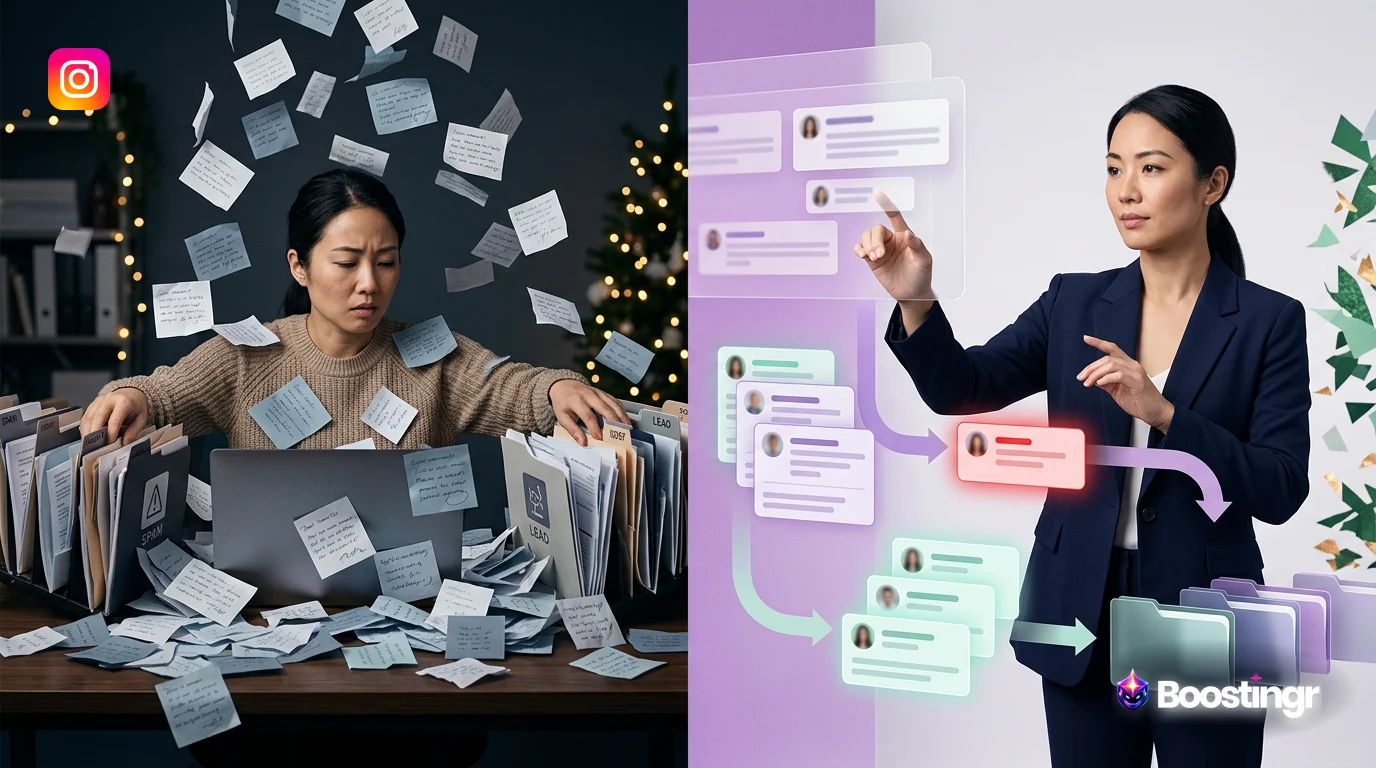
Sentiment analysis for social media comments is an AI-powered process that goes beyond classifying comments as positive or negative. It understands the emotion, urgency, and nuance within a comment, allowing brands to automatically prioritize critical customer issues, high-intent sales opportunities, and brand advocacy moments. This intelligent triage system ensures the most important comments are handled first, transforming a chaotic inbox into a strategic workflow.
The Problem with a Chronological Inbox: Why Sentiment Matters More Than Time
Your social media comments are a firehose of customer feedback, questions, complaints, and praise. For most brands, the default way to handle this influx is a chronological feed. The first comment in is the first one seen. This approach is simple, but it's also deeply flawed and increasingly dangerous for your brand's health.
Imagine this scenario: a high-profile post has just gone live. A comment from five minutes ago says, "Love this! 😍". A comment from two minutes ago says, "My order arrived broken and your support isn't responding! This is a scam!" In a chronological inbox, you might spend time replying to the happy fan while the angry customer's comment festers, gathering likes and poisoning the perception of your brand for every new visitor.
This is the fundamental failure of the chronological inbox: it treats all comments as equal. It has no concept of urgency, opportunity, or risk. A spam bot comment is given the same initial weight as a potential six-figure lead or a brewing PR crisis. In the attention economy, this isn't just inefficient—it's a liability. You're not just missing opportunities; you're actively letting risks go unmanaged.
This is where a workflow-first approach, powered by **sentiment analysis for social media comments**, changes the game. It shifts the paradigm from "first in, first out" to "most important, first up."
What is Sentiment Analysis for Social Media Comments? A Workflow-First Definition
Traditional sentiment analysis is a binary concept: positive, negative, or neutral. It's a blunt instrument in a world of nuanced human communication. At Boostingr, we see this differently. True **sentiment analysis for social media comments** isn't just about reading comments; it's about understanding the people behind them.
It's a system that deciphers the full spectrum of human emotion and intent expressed in text. It understands that "sick" can mean good or bad, that a string of laughing emojis can be genuine or sarcastic, and that the phrase "where can I buy this" carries a fundamentally different weight than "this is interesting."
A workflow-first definition of sentiment analysis is: **The automated process of categorizing comments by their emotional tone, urgency, and underlying meaning to trigger specific, predefined actions.**
Instead of a simple label, the output is a workflow. For example: * **Sentiment: Angry + Frustrated** -> Triggers -> **Workflow: Hide Comment, Escalate to Human Agent, Create Support Ticket.** * **Sentiment: Excited + Inquisitive** -> Triggers -> **Workflow: Route to Sales Team, Initiate Lead Capture Sequence.** * **Sentiment: Delighted + Appreciative** -> Triggers -> **Workflow: Queue for Brand-Safe AI Reply, Flag for Community Manager to Personalize.**
This is the core of Boostingr's philosophy. We don't just provide data; we provide an operating system for action. It's about turning a chaotic stream of comments into an organized, prioritized, and actionable intelligence hub.
The Prioritization Matrix: How to Triage Comments Using Sentiment
To effectively manage your community and protect your brand, you need to stop thinking about your comments as a single list and start thinking about them as a triage system. Here’s how to build a prioritization matrix using sentiment analysis.
Tier 1: Critical Priority (Act Immediately)
These are comments that pose an immediate risk or represent a time-sensitive opportunity. They require instant attention.
**1. Angry, Frustrated, & Urgent Comments** These are your five-alarm fires. A customer is publicly unhappy, and every second their comment remains unaddressed, the brand damage compounds. This category includes product failures, service complaints, billing issues, and accusations. * **Why they're critical:** Unchecked negative comments create negative social proof, deter potential customers, and can escalate into a full-blown PR crisis. * **Intelligent Workflow:** The goal is de-escalation and resolution.
* **Related Systems:** This workflow often runs in parallel with a troll detection for social media comments workflow to distinguish genuine customer frustration from bad-faith attacks.
- **Classify:** The AI identifies strong negative sentiment (anger, frustration) and keywords related to critical issues ('broken,' 'scam,' 'never received,' 'overcharged').
- **Act:** The system automatically hides the comment to contain the issue while a resolution is found. This is not deletion; it's a temporary measure to protect the public feed, compliant with platform APIs like the Instagram Graph API.
- **Route:** The comment and user details are immediately escalated to a human support agent or a dedicated Slack channel.
- **Engage:** The agent can then resolve the issue privately, turning a public critic into a satisfied customer.
**2. High-Intent & Purchase-Related Comments** These are your hottest leads. Someone is raising their hand in your comments section and asking to give you money. Leaving them waiting is like leaving a customer standing at an empty cash register. * **Why they're critical:** The window of purchase intent is short. A delay of a few hours can mean the difference between a sale and a lost customer who found an alternative. * **Intelligent Workflow:** The goal is conversion.
- **Classify:** The AI detects positive or neutral sentiment combined with purchase intent phrases ('how much?', 'where to buy?', 'link?', 'is this available in blue?').
- **Act:** Trigger an Instagram lead capture flow. This can involve an automated reply in the comments directing the user to their DMs, where an AI-powered chat sequence can answer their question, provide a link, or collect their information.
- **Route:** Simultaneously, the lead can be routed to the sales team's CRM or a dedicated channel for immediate follow-up.
Tier 2: High Priority (Engage & Amplify)
These comments are the building blocks of a strong community and brand reputation. While not as urgent as a crisis, they are incredibly valuable.
**1. Celebratory & Positive Comments** These are your brand advocates. They are doing your marketing for you. Ignoring them is a massive missed opportunity to amplify their voice and encourage more of the same. * **Why they're important:** They provide powerful social proof, build community, and create a positive environment on your posts. * **Intelligent Workflow:** The goal is amplification and relationship building.
- **Classify:** The AI identifies strong positive sentiment (joy, excitement, love).
- **Act:** Use a brand-safe AI reply to thank the user instantly. Boostingr's AI can be trained on your brand voice to generate varied, human-like responses that don't sound robotic.
- **Route:** Flag these comments for a community manager to add a personal touch, pin to the top of the comment section, or even feature in future marketing content (with permission).
Tier 3: Automated Management
This tier handles the noise, freeing up your team to focus on what matters.
**1. Neutral & General Questions** These are common, often repetitive questions about your product, shipping, or services. * **Why they're important to automate:** Answering them manually is a time-sink. Automating frees up hundreds of hours for your team. * **Intelligent Workflow:** The goal is efficient information delivery.
- **Classify:** The AI identifies neutral sentiment combined with an info-seeking intent.
- **Act:** Using Boostingr's Brand Memory, the AI can provide accurate, instant answers to frequently asked questions. For example, if a user asks "Do you ship to Canada?", the AI, knowing your shipping policies, can reply instantly.
- **Route:** If the question is novel or complex, the system can route it to the appropriate team member.
**2. Spam & Irrelevant Comments** This is the digital garbage that clutters your comments, harms your brand's credibility, and can even contain malicious links. * **Why they're important to automate:** Manual spam removal is a never-ending, low-value task. * **Intelligent Workflow:** The goal is silent, efficient removal.
- **Classify:** An AI spam comment detection system identifies spam based on patterns, keywords, user history, and other signals, far beyond simple keyword blocklists.
- **Act:** The system automatically hides or deletes the spam comment instantly, keeping your comment section clean and safe for your community.
Comparison Table: Traditional Moderation vs. AI-Powered Sentiment Analysis
| Feature | Traditional Moderation (Manual or Basic Filters) | AI-Powered Sentiment Analysis (Boostingr) |
|---|---|---|
| **Prioritization** | Chronological or keyword-based. All comments treated equally. | Sentiment and intent-based. Critical comments are surfaced instantly. |
| **Speed** | Slow. Limited by human bandwidth. Delays can be hours or days. | Instant. AI classifies and acts in milliseconds, 24/7. |
| **Scale** | Extremely difficult and expensive to scale. Requires hiring more people. | Infinitely scalable. Handles 100 or 1,000,000 comments with the same efficiency. |
| **Accuracy** | Prone to human error, fatigue, and bias. Basic filters miss nuance. | Learns and improves over time. Understands sarcasm, slang, and context. |
| **Insight Generation** | Anecdotal. Relies on moderators manually tagging or reporting trends. | Systematic. Provides dashboards and analytics on community sentiment over time. |
| **Cost** | High operational cost (salaries, training). | Lower, predictable SaaS fee. High ROI through efficiency and opportunity capture. |
| **Actionability** | Reactive. Team responds to what they see next in the queue. | Proactive. Triggers automated workflows for sales, support, and marketing. |
How Social Comment Sentiment AI Works: The Technology Behind the Understanding
At its core, **social comment sentiment AI** is a sophisticated application of Natural Language Processing (NLP) and Natural Language Understanding (NLU). Here’s a simplified breakdown of how platforms like Boostingr bring this technology to life:
- **Data Ingestion:** The process begins when a comment is posted on one of your connected social accounts (e.g., Instagram, Facebook, YouTube). The platform's API connection, governed by rules from providers like Facebook's Graph API, securely pulls the comment text, user data, and context into the system.
- **Text Pre-processing:** The raw text is cleaned up. This involves correcting common typos, expanding slang ('u' becomes 'you'), and, most importantly, interpreting emojis as emotional indicators.
* **Lexicon:** The emotional polarity of individual words (e.g., 'love' is positive, 'hate' is negative). * **Syntax:** The grammatical structure that can flip meaning (e.g., "I am *not* happy" vs. "I am happy"). * **Context:** The surrounding words and the topic of the post. The word "unreal" means something different on a post about a new video game versus a post about a billing error. * **Sarcasm & Nuance:** This is the frontier of NLU. By analyzing contradictions (e.g., positive words with a negative context, like "I just *love* waiting on hold for an hour"), the AI can detect sarcasm with increasing accuracy.
- **Feature Extraction & NLU:** This is where the magic happens. The AI doesn't just read words; it understands relationships. It uses large language models (LLMs) trained on billions of conversations to analyze:
- **Classification & Scoring:** Based on the analysis, the comment is assigned a multi-faceted classification. It's not just "negative." It's scored on a spectrum of emotions like Anger, Joy, Sadness, and Surprise, and tagged with potential intents like Purchase, Churn, or Support Request.
> **Boostingr Observation:** One of the biggest challenges we've solved is distinguishing between genuine customer anger and performative trolling. A genuine customer often references a specific order or product issue. A troll uses similar angry language but without substance. Our models are trained to spot these contextual differences, allowing brands to escalate real problems while automatically handling trolls, a distinction that simple keyword filters can never make.
- **Workflow Activation:** The final classification is then checked against the brand's predefined rules in Boostingr, triggering the appropriate workflow—be it an escalation, an AI reply, or a lead capture sequence.
Practical Examples and Use Cases
Let's move from theory to practice. Here’s how different businesses use sentiment-based prioritization.
**Use Case 1: The Fast-Fashion Ecommerce Brand** * **Post:** An Instagram Reel showing off a new dress. * **Comment A (Angry):** "I ordered this 3 weeks ago and it never came! You took my money! #scam" * **Comment B (High-Intent):** "OMG I NEED this for my vacation next month! Is it true to size?" * **Comment C (Advocacy):** "I have this dress and it's my absolute favorite, the quality is amazing!" * **The Workflow:**
- Boostingr instantly hides Comment A, flags it as "Urgent Support - Shipping," and routes it to the customer service team's high-priority queue.
- The AI simultaneously triggers an AI Instagram reply bot for Comment B, replying "We'll DM you with the sizing chart now!" and initiating a DM conversation to confirm the sale.
- Comment C is replied to with a brand-safe AI response like "So glad you love it! You have great taste! ✨" and is flagged for the community manager to potentially feature in their Stories.
**Mini Case Study: How a DTC Beverage Brand Handled a Viral Crisis**
A popular DTC seltzer brand launched a new flavor that, due to a manufacturing error, had a metallic taste for a small batch of customers. Their launch post went viral for the wrong reasons. * **The Problem:** The comment section was flooded. Chronological moderation was impossible. Legitimate complaints were mixed with spam and unrelated questions. The community team was overwhelmed and brand sentiment was plummeting. * **The Solution:** They implemented Boostingr's sentiment analysis workflow.
* **The Result:** Within an hour, the public firefight was contained. Angry comments were hidden from the public feed and customers were being proactively serviced in DMs. The brand was able to turn a potential disaster into a case study in excellent customer service. They prevented a massive recall by identifying the affected customers and reduced negative public exposure by 90% in the first 24 hours.
- They created a rule: **IF** sentiment is `Negative` **AND** comment contains keywords `('metallic', 'taste', 'bad', 'tinny')` **THEN** `Hide Comment` + `Auto-Reply in DM` + `Escalate to 'Crisis' Channel`.`
- The DM auto-reply was empathetic: "We are so sorry to hear you had this experience. We're aware of an issue with a small batch and want to make it right. Please reply with your order number so we can send you a replacement and a full refund immediately."
Building Your Sentiment Analysis Workflow in Boostingr
Setting up this intelligent system is a straightforward, workflow-first process within Boostingr.
- **Connect Your Accounts:** Securely link your Facebook, Instagram, YouTube, and other social profiles in a few clicks. This unifies your comment streams into a single intelligent dashboard.
- **Teach the AI Your Brand:** This is where Boostingr's **Brand Memory** comes in. You upload your brand guidelines, product information, FAQs, and past customer interactions. The AI learns your voice, your policies, and what's important to you. This is the foundation for both accurate classification and on-brand AI replies.
* `IF sentiment = 'Angry' AND intent = 'Support Request' -> THEN Escalate to Zendesk.` * `IF sentiment = 'Positive' AND intent = 'Purchase' -> THEN Trigger 'Lead Capture' flow.` * `IF classification = 'Spam' -> THEN Hide and add user to blocklist.`
- **Configure Your Prioritization Rules:** Using a simple, visual rule-builder, you define your workflows. It's like setting up email filters, but infinitely more powerful. For example:
- **Set Up Automated Actions & Replies:** For each rule, you define the action. This could be hiding, deleting, escalating, or replying. For replies, you can set guardrails to ensure the AI stays on-brand, using your Brand Memory to answer questions accurately.
- **Monitor & Refine:** Your work isn't done at setup. The Boostingr dashboard provides high-level insights into your community's overall sentiment. Are people happier this month than last? Is a specific ad campaign generating more angry comments? This data transforms your community management from a cost center into a vital source of business intelligence.
Beyond Sentiment: Combining with Intent Detection for Deeper Insights
Sentiment analysis is powerful, but it's only half the picture. Sentiment tells you *how a person feels*. Intent detection tells you *what they want to do*. The combination of the two is where true community intelligence is unlocked.
Consider these examples: * **Positive Sentiment + Purchase Intent:** "I love this so much! Where can I get one?" (This is a hot lead.) * **Positive Sentiment + No Intent:** "This looks great!" (This is a brand advocate.) * **Negative Sentiment + Churn Intent:** "I'm so fed up with this, I'm canceling my account tomorrow." (This is a critical retention opportunity.) * **Negative Sentiment + Support Intent:** "Ugh, I can't seem to get this feature to work." (This is a support ticket, not an unhappy customer about to leave.)
> **Boostingr Observation:** We've found that brands that only use sentiment analysis often misinterpret their community. They might treat a frustrated user seeking help with the same alarm as a user threatening to churn. By layering intent detection for comments on top of sentiment, our clients can apply the precise workflow needed for each situation, dramatically improving efficiency and customer satisfaction.
Boostingr's platform analyzes for both sentiment and intent simultaneously, allowing you to create hyper-specific workflows that address the user's complete context. This is how you move from simply managing comments to orchestrating customer journeys.
Checklist: Implementing Sentiment Analysis for Your Social Media Comments
[ ] **Audit Your Current Process:** How are you handling comments now? Identify the bottlenecks and risks of your chronological or manual workflow. [ ] **Define Your Priority Tiers:** What constitutes a crisis, an opportunity, and a general interaction for your brand? Document this. [ ] **Choose an AI-Powered Platform:** Select a tool like Boostingr that focuses on workflow automation, not just analytics. [ ] **Connect Your Social Accounts:** Unify all your comment sources into one system. [ ] **Build Your Brand Memory:** Feed the AI your brand guidelines, FAQs, and product info. [ ] **Configure Your Top 3 Workflows:** Start with the most critical ones: handling angry customers, capturing leads, and removing spam. [ ] **Set Up Escalation Paths:** Define where critical comments go. Who gets notified? What's the SLA? [ ] **Design Your Brand-Safe AI Replies:** Create templates and guardrails for automated engagement. [ ] **Go Live and Monitor:** Activate the system and watch the dashboard. Don't "set it and forget it" on day one. [ ] **Review and Refine Weekly:** Analyze the AI's performance and the sentiment trends. Adjust your rules and workflows as you gather more data.
Key Takeaways
* A chronological inbox is an inefficient and risky way to manage social media comments. It treats all interactions as equal, ignoring urgency and opportunity. * **Sentiment analysis for social media comments** is a workflow-first system that prioritizes comments based on emotional nuance, urgency, and intent. * A prioritization matrix allows you to triage comments into critical issues (angry customers), high-value opportunities (sales leads), brand advocacy moments, and automated noise (spam). * AI-powered platforms like Boostingr use NLU to understand context, sarcasm, and slang, enabling far more accurate classification than basic keyword filters. * Combining sentiment with intent detection provides a complete picture of the user, enabling hyper-specific and effective response workflows. * The goal of this technology is not to replace humans, but to augment them—handling the noise and flagging the critical few comments that require a human touch, transforming community management from a reactive chore to a strategic growth engine.
Original Diagrams
These original visuals explain the workflow in a faster, more defensible format than plain text alone and give the article first-party assets that are easier to understand and harder to copy.
Comment Processing Workflow
Instead of a single chronological feed, sentiment analysis sorts incoming comments into prioritized lanes like 'Urgent Issues,' 'Sales Leads,' and 'Brand Advocates.' This ensures the most critical messages are addressed first, transforming your reactive inbox into a proactive workflow.
AI Decision Tree
At its core, sentiment analysis AI uses a decision tree to triage comments. It asks a series of questions—Is it positive or negative? Is it urgent? Does it show purchase intent?—to accurately route each comment to the right team.
Moderation Pipeline
An AI-powered moderation pipeline automatically filters incoming comments, isolating spam, hate speech, and other harmful content for review. This allows your human moderators to focus their efforts on nuanced cases rather than sifting through every single comment.
Intent Classification Flow
Sentiment analysis goes beyond simple positive/negative labels by classifying the user's intent. The AI can distinguish between a user praising your brand, asking for a new feature, or signaling they are ready to make a purchase, enabling a more targeted response.
Brand Memory Diagram
Each classified comment and subsequent team action feeds back into a central AI model, creating a 'Brand Memory.' This allows the system to learn your brand's specific context, improving the accuracy of future sentiment and intent analysis over time.
FAQs
**What is the main benefit of sentiment analysis for social media comments?** The main benefit is intelligent prioritization. Instead of a chaotic, chronological feed, sentiment analysis allows your team to instantly identify and act on the most critical comments first—whether it's an angry customer needing support, a hot lead asking to buy, or a brand advocate worth celebrating. This transforms community management from reactive to proactive.
**How accurate is comment sentiment analysis?** Modern AI-powered systems like Boostingr are highly accurate, far surpassing basic keyword filters. They use Natural Language Understanding (NLU) to interpret context, sarcasm, slang, and emojis. While no system is 100% perfect, they continuously learn and improve, and their accuracy is sufficient to reliably automate the triage of millions of comments, flagging only the most nuanced cases for human review.
**What is the difference between sentiment analysis and intent detection?** Sentiment analysis identifies *how a person feels* (e.g., happy, angry, frustrated). Intent detection identifies *what they want to do* (e.g., make a purchase, get support, cancel a service). The most powerful systems use both. For example, an angry comment (sentiment) from a user wanting to cancel (intent) is a higher priority than an angry comment from a user who just needs help with a feature (support intent).
**Can sentiment analysis AI handle different languages?** Yes, advanced platforms like Boostingr are built on multilingual models. They can analyze the sentiment and intent of comments in dozens of languages, allowing global brands to maintain a consistent and intelligent moderation strategy across all their regional social media accounts.
**Will using AI to analyze comments feel robotic to my customers?** No, when used correctly. The goal of sentiment analysis isn't to have a robot talk to everyone. The goal is to use AI to handle the volume and identify the key moments. It automates the removal of spam, instantly answers simple questions, and most importantly, it flags the complex, emotional, or high-value comments for a *faster* and more focused human response. It makes your human team more effective, not obsolete.
**How does sentiment analysis help with lead capture?** By combining sentiment analysis with intent detection, the AI can identify comments that express both positive emotion and a desire to buy (e.g., "I love this! Where can I get it?"). Instead of waiting for a human to see this, the system can instantly trigger a lead capture workflow, sending the user a DM with a link to purchase or connecting them with a sales agent, capturing the opportunity at the peak of their interest.
**Is it difficult to set up a sentiment analysis workflow?** With a workflow-first platform like Boostingr, it's surprisingly simple. The process is guided, using visual rule-builders that don't require any coding. You define your priorities (e.g., "if a comment is angry, escalate to support"), and the platform handles the complex AI analysis and execution. You can set up your core workflows in an afternoon.
**How is this different from the moderation tools built into Facebook or Instagram?** Native tools are very basic. They primarily rely on simple keyword blocklists. They cannot understand nuance, sarcasm, or intent. They can't prioritize an angry customer over a spam comment, and they can't trigger intelligent workflows like routing a lead to your CRM. They are a blunt instrument, whereas a platform like Boostingr is a precision tool for community intelligence.
Evidence, Experience, and References
This article is based on Boostingr's experience processing billions of social media comments for leading global brands. Our insights are derived from real-world data on the effectiveness of AI-powered moderation, sentiment analysis, and intent detection workflows. The technical capabilities described are grounded in established principles of Natural Language Processing and are compliant with the terms of service of major social platforms.
* **Internal Resources:** Our analysis draws from our work in AI Comment Moderation, Brand Safe AI Replies, and Instagram Automation. * **Authoritative Sources:** We adhere to the guidelines and capabilities of official platform APIs, such as the Facebook Graph API and Instagram Graph API, to ensure all workflows are safe, compliant, and effective. * **SEO Best Practices:** This content is structured to be helpful and informative, following guidelines for creating useful content as outlined by Google's own SEO starter guide.
About the Author
The Boostingr team is composed of experts in AI, machine learning, and community management. With years of experience building and deploying AI solutions for enterprise-level brands, our focus is on transforming the chaotic world of social media comments into a source of strategic intelligence and business growth. We believe that the future of brand communication lies in understanding people, not just parsing text.
Last Updated
October 2023
Search Intent and Topic Map
This guide targets readers researching sentiment analysis for social media comments and maps the topic to practical evaluation and implementation decisions. Supporting concepts include comment sentiment analysis, social comment sentiment ai, sentiment analysis for comments, ai comment management, brand safe ai replies, comment moderation automation. These terms are used only where they clarify the reader's question, not as repeated ranking phrases.