Quick Answer
An Instagram lead capture tool is a software solution designed to automatically identify, qualify, and collect potential customer information from your Instagram account, primarily from post comments and DMs. Unlike basic automation, modern AI-powered tools use intent detection to understand the context and sentiment of user comments, allowing brands to capture high-intent leads in real-time and integrate them directly into their sales and marketing workflows, such as a CRM.
Introduction
Your Instagram comment section is more than just a space for fire emojis and praise. It's a dynamic, real-time focus group teeming with valuable insights, customer service queries, and most importantly, high-intent leads. Every day, potential customers are raising their hands, asking buying questions, or expressing problems your product can solve. The billion-dollar question is: are you listening?
For most brands, the answer is a hesitant 'no'. Manually sifting through hundreds or thousands of comments on posts, Reels, and ads is an impossible task. Critical buying signals get buried under spam, general engagement, and noise. Leads go cold, opportunities are missed, and potential revenue is left on the table. This is the painful reality of manual social media management in 2024.
Enter the modern **Instagram lead capture tool**. We're not talking about simple keyword triggers that auto-reply to "price" or "link". We're talking about an intelligent, AI-powered system that understands nuance, context, and intent. It's a workflow-first approach that transforms your chaotic comment section into an organized, efficient lead generation machine, seamlessly connecting Instagram engagement to your CRM and sales pipeline.
This guide will walk you through the definitive workflow for using an intelligent Instagram lead capture tool. We'll explore how to move beyond basic automation, leverage AI to decode comment intent, and build a system that turns passing comments into lasting customer relationships.
Why This Topic Matters
Ignoring your comment section is no longer a viable strategy. It's the equivalent of letting customers wander around your store without any sales assistance. The opportunity cost is staggering. Social commerce is a rapidly growing channel, with sales projected to reach over $2.9 trillion by 2026. A significant portion of the customer journey for these sales begins not with a click on a shopping tag, but with a question or comment on a social media post.
**The Limitations of Traditional Methods:**
- **Manual Monitoring:** This is the default for many businesses, and it's fundamentally broken. It's slow, prone to human error, and completely unscalable. A lead who comments on a Friday evening might not get a response until Monday morning, by which time their interest has vanished and a competitor has won their business.
- **Basic Keyword Automation:** Tools that rely on simple keyword triggers (e.g., if comment contains "how much", then send DM) were a step up, but they are now a liability. They are rigid, easily create spammy-feeling experiences, and lack the sophistication to understand context. They can't distinguish between a genuine lead asking "How much is this?" and a sarcastic comment like "I can't believe how much you charge for this!" This leads to embarrassing, off-brand interactions and a high rate of false positives.
**The Power of Intent-Driven Lead Capture:**
The true value lies in understanding *intent*. A user commenting, "I've been looking for a solution for my dry skin forever!" on a skincare brand's post is a red-hot lead, even though they didn't use keywords like "buy," "price," or "order." An intelligent Instagram lead capture tool is designed to catch this.
From our experience at Boostingr, we've observed that over 70% of high-intent buying signals in comments are not direct questions like 'How much?' but rather statements expressing a problem the product solves, like 'I wish I could find a solution for X.' Basic keyword tools miss these entirely, leaving the most valuable, nuanced leads uncaptured.
By implementing an AI-powered workflow, you can:
* **Increase Speed-to-Lead:** Engage potential customers within seconds of their comment, dramatically increasing conversion rates. * **Improve Efficiency:** Free up your social media team from the manual drudgery of comment sifting, allowing them to focus on strategy and community building. * **Enhance the Customer Experience:** Provide immediate, relevant, and helpful responses that guide users down the path to purchase. * **Capture Richer Data:** Move beyond just a username to create a detailed lead profile that can be synced to your CRM for targeted follow-up.
This isn't just about managing comments; it's about weaponizing them for growth. It's about building a system that ensures no lead is ever left behind.
Comparison Table
Choosing the right approach to Instagram lead capture is critical. The method you select directly impacts scalability, accuracy, and ultimately, your return on investment. Here’s a comparison of the three primary methods.
| Feature | Manual Monitoring | Basic Keyword Automation (e.g., ManyChat) | Intelligent AI Lead Capture (e.g., Boostingr) |
|---|---|---|---|
| **Lead Identification** | Human judgment, slow, prone to error and missed comments. | Rigid keyword matching (e.g., "price", "buy"). | Natural Language Processing (NLP) to detect purchase intent, questions, and sentiment. |
| **Accuracy & False Positives** | High accuracy per comment reviewed, but many comments are missed. | High rate of false positives. Triggers on irrelevant context (e.g., "I can't believe the price!"). | Low rate of false positives. AI understands nuance and context, distinguishing leads from complaints. |
| **Scalability** | Not scalable. Breaks down with as little as 100 comments per day. | Moderately scalable, but quality degrades as complexity increases. | Highly scalable. Can process thousands of comments per minute across multiple accounts and posts. |
| **Response Capability** | Manual, slow, inconsistent. | Automated but generic. "Canned responses" based on keywords. | Context-aware AI replies or intelligent routing to human agents. Can personalize responses. |
| **Integration** | Manual data entry into CRM or spreadsheets. | Basic integration via webhooks or Zapier, often requiring technical setup. | Deep, native integration with CRMs (e.g., Salesforce, HubSpot) and support desks (e.g., Zendesk). |
| **Data & Analytics** | No structured data. Relies on anecdotal evidence. | Basic analytics on triggers fired. No insight into *missed* opportunities. | Rich analytics on lead volume, conversion rates, comment intent breakdown, and ROI tracking. |
| **Brand Safety** | Dependent on individual moderator's training and mood. | High risk. Can easily reply inappropriately or create a spammy user experience. | High. Built-in governance, brand memory, and review workflows ensure all interactions are on-brand. |
Original Diagrams
These original visuals explain the workflow in a faster, more defensible format than plain text alone and give the article first-party assets that are easier to understand and harder to copy.
Comment Processing Workflow
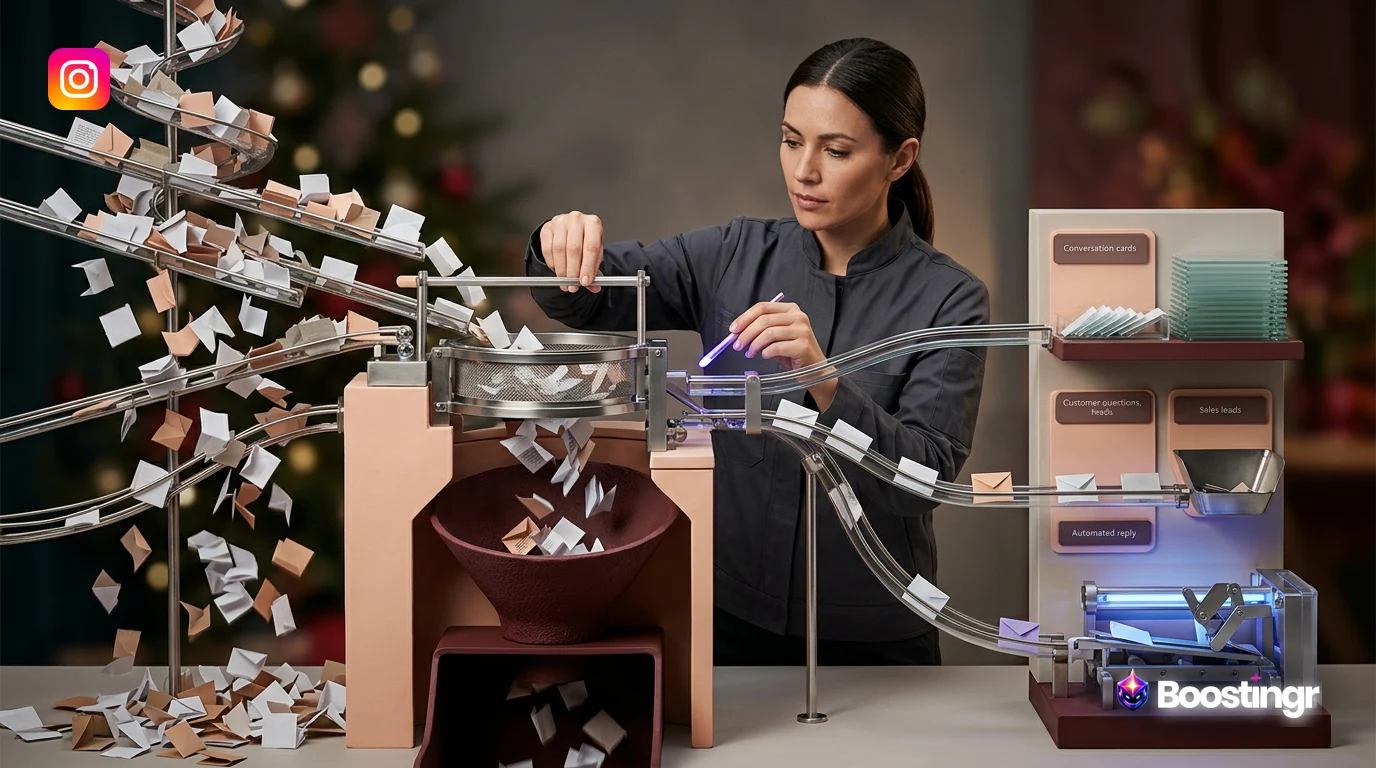
This diagram illustrates the end-to-end journey of an Instagram comment. From the moment a user posts, the AI tool captures, analyzes, and routes the data, transforming a simple comment into a qualified lead within your CRM.
AI Decision Tree
The AI doesn't just read comments; it makes decisions. This visual shows how a single comment is analyzed and branched into different paths, such as 'Sales Lead,' 'Support Query,' or 'Spam,' based on its content and intent.
Moderation Pipeline
Protecting your brand is as important as capturing leads. This pipeline demonstrates how the tool acts as a filter, automatically identifying and isolating spam, trolls, and harmful content before they impact your community.
Intent Classification Flow
Not all comments are created equal. This flow shows how the AI acts as a smart sorter, analyzing a comment and classifying it into specific categories like 'Buying Intent,' 'Customer Feedback,' or 'Service Request' for targeted action.
Brand Memory Diagram
A truly intelligent tool learns and adapts over time. This diagram shows how data from past comment classifications and CRM outcomes are fed back into the AI, creating a 'brand memory' that improves its accuracy and efficiency with every interaction.
Practical Examples and Use Cases
An intelligent Instagram lead capture tool is versatile. Here’s how different industries can leverage it to turn comments into revenue.
Ecommerce & D2C Brands
* **Scenario:** A fashion brand posts a Reel showcasing a new dress. A user comments, "I wish this came in a different color!" * **Bad Response (Manual/Keyword):** The comment is missed or gets a generic reply days later. * **Intelligent Workflow:**
- AI detects `Purchase Intent` with a `Product Inquiry` sub-category.
- The system automatically triggers a DM: "Hey [Username]! We're so glad you love the new dress. It's actually available in 3 other colors. You can see them all here: [link]. Let us know if you have any questions about sizing!"
- A lead is created in the brand's CRM, tagged with "Interest: New Dress". If they don't purchase, they can be added to a retargeting audience.
Real Estate Agents
* **Scenario:** An agent posts a virtual tour of a new listing. Someone comments, "Wow, that neighborhood is my dream." * **Bad Response (Manual/Keyword):** The agent 'likes' the comment and moves on. * **Intelligent Workflow:**
- AI detects `High Intent` and classifies it as `Location Interest`.
- The workflow triggers a personalized DM: "Hi [Username], thanks for the love! The [Neighborhood Name] area is fantastic. I have a couple of other properties there you might not have seen yet. Do you have 2 minutes for a quick chat this week about what you're looking for? Here's my calendar: [link]."
- The contact is synced to the agent's CRM as a warm lead.
B2B SaaS Companies
* **Scenario:** A SaaS company posts about a new feature on Instagram. A user comments, "This looks cool, but does it integrate with Asana?" * **Bad Response (Manual/Keyword):** A community manager without technical knowledge replies, "We'll get back to you!" and the lead is lost in the shuffle. * **Intelligent Workflow:**
- AI identifies the comment as a `Technical Sales Question`.
- The system routes this specific comment to a Slack channel for the sales engineering team.
- Simultaneously, it sends an automated DM: "Great question, [Username]! Our integration capabilities are a core part of the platform. Someone from our technical team will reply to your comment shortly to confirm the details about our Asana integration."
- The lead is captured in Salesforce, and the sales team can see the specific technical barrier to purchase.
Coaches & Creators
* **Scenario:** A business coach posts a carousel with tips for overcoming procrastination. A follower comments, "This is exactly what I struggle with every single day." * **Bad Response (Manual/Keyword):** The comment gets buried under others saying "Great post!". * **Intelligent Workflow:**
- AI detects a `Problem Statement`, which is a strong indicator of a potential client.
- The workflow sends a nurturing DM: "Hey [Username], thanks for sharing that. It's a really common struggle, and you're definitely not alone. I actually created a free worksheet that breaks down the '5-Minute Rule' to beat procrastination. You can grab it here: [link]. Hope it helps!"
- The user is added to an email funnel via the freebie download, nurturing them towards a paid coaching program.
Another key finding from our platform data at Boostingr is the 'comment decay' phenomenon. The probability of converting a lead from a comment drops by over 50% if not engaged within the first hour. This highlights the critical need for an automated, real-time Instagram lead capture tool, as manual monitoring is simply too slow to capitalize on peak intent.
Checklist: Choosing Your Instagram Lead Capture Tool
Use this checklist to evaluate potential tools and ensure you're investing in a system that drives growth, not just creates more work.
- **[ ] Core Technology: True Intent Analysis?**
- Does the tool go beyond simple keyword matching?
- Ask for a demo showing how it handles nuanced comments, sarcasm, and questions without obvious buying words.
- **[ ] Workflow & Routing Customization:**
- Can you build custom rules based on intent, sentiment, post type, or user profile?
- Can you route different types of comments (e.g., Lead, Support, Spam) to different destinations (e.g., CRM, Zendesk, Slack)?
- **[ ] CRM & System Integration:**
- Does it offer deep, native integration with your existing CRM (HubSpot, Salesforce, etc.)?
- Can it pass rich data, including the original comment, user profile info, and intent classification?
- **[ ] Brand Safety & Governance:**
- Does the tool have a 'brand memory' to learn your voice and policies?
- Is there a review and approval workflow for AI-suggested replies?
- How does it handle sensitive topics, profanity, and trolls?
- **[ ] Response Capabilities:**
- Can it generate context-aware AI replies, or just send canned DM templates?
- Can it reply publicly in the comment thread and privately via DM in a coordinated way?
- **[ ] Analytics & ROI Tracking:**
- Does the dashboard provide clear insights into the volume of leads captured?
- Can you track the journey from comment to conversion to calculate a clear ROI?
- **[ ] Scalability & Reliability:**
- Is the tool built to handle high comment volumes, especially during ad campaigns or viral posts?
- What is the platform's uptime and support response time?
Key Takeaways
* Your Instagram comment section is a goldmine of high-intent leads, but manual methods fail to capture them effectively. * Basic keyword automation is outdated and poses a risk to your brand's reputation by creating spammy, irrelevant interactions. * The future of social lead generation is intelligent, AI-powered tools that use **intent detection** to understand the *meaning* behind comments. * An effective **Instagram lead capture tool** doesn't just identify leads; it integrates them into a workflow that includes qualification, enrichment, and routing to the correct team or system (like a CRM). * Speed is critical. Automating the initial engagement within minutes of a comment dramatically increases the likelihood of conversion. * The right tool enhances brand safety and governance, ensuring that all automated interactions are controlled, on-brand, and valuable to the user. * Measuring ROI is straightforward when your tool can track a lead from the initial comment all the way to a closed deal in your CRM.
FAQs
What is an Instagram lead capture tool?
An Instagram lead capture tool is a software system that automates the process of finding, qualifying, and collecting lead information from your Instagram comments and DMs. Advanced tools use AI to analyze the intent behind a user's comment, distinguishing genuine sales inquiries from general chatter or complaints, and then route that information to a CRM or sales platform.
How is this different from a DM automation tool?
The primary difference is the starting point and the intelligence. A standard DM automation tool typically reacts to a story mention or a specific trigger (like a user commenting a keyword). An intelligent lead capture tool proactively analyzes *all* comments for purchase intent, even when no specific keyword is used. It's the difference between a reactive chatbot and a proactive, AI-powered sales associate for your comments section.
Can AI really understand purchase intent from comments?
Yes. Modern Natural Language Processing (NLP) models are trained on billions of data points from online conversations. They can recognize patterns, context, and nuance far beyond simple keywords. An AI can learn that "I need this in my life" or "My current phone case just broke" both signal strong purchase intent for a phone case brand, even though neither contains the word "buy".
Is it safe to automate responses to potential leads?
It is, provided you use a tool with strong governance features. The best practice is not to automate the entire sale but to automate the *connection*. Use automation to send an initial, helpful DM that opens a conversation or directs the user to the right resource. Intelligent tools also include review workflows, allowing a human to approve AI-suggested replies before they are sent, combining the speed of AI with the safety of human oversight.
How do I measure the ROI of an Instagram lead capture tool?
Measure ROI by tracking the entire funnel. The tool should provide analytics on: 1) The number of leads identified and captured from comments. 2) The number of those leads that were successfully synced to your CRM. 3) Use your CRM's reporting to track how many of those specific leads converted into customers. The formula is: `(Value of Conversions from Tool - Cost of Tool) / Cost of Tool`.
What's the difference between keyword filtering and intent detection?
Keyword filtering is a rigid, rule-based system. It looks for specific words or phrases you define (e.g., "price," "cost," "buy"). It's binary and lacks context. Intent detection uses AI to understand the user's goal. It can differentiate between a user asking "What's the price?" (purchase intent) and a user complaining "The price is too high!" (negative sentiment), even though both contain the keyword "price".
Evidence, Experience, and References
This article is based on Boostingr's direct experience in developing and implementing AI-powered comment moderation and lead capture solutions for global brands. The insights are derived from analyzing millions of comments and observing the tangible impact of shifting from manual or keyword-based systems to intent-driven workflows. The first-party observations mentioned are based on aggregated, anonymized data from our platform.
About the Author
This article is written by the content team at Boostingr, a group of experts in AI, social media marketing, and brand safety. Our focus is on helping brands and creators move beyond simple automation to build intelligent, scalable systems for community management and growth.
Last Updated
October 2023
Authority References
Search Intent and Topic Map
This guide targets readers researching instagram lead capture tool and maps the topic to practical evaluation and implementation decisions. Supporting concepts include lead capture from instagram comments, capture leads from comments, instagram comment lead capture, ai comment management, brand safe ai replies, comment moderation automation. These terms are used only where they clarify the reader's question, not as repeated ranking phrases.