Introduction
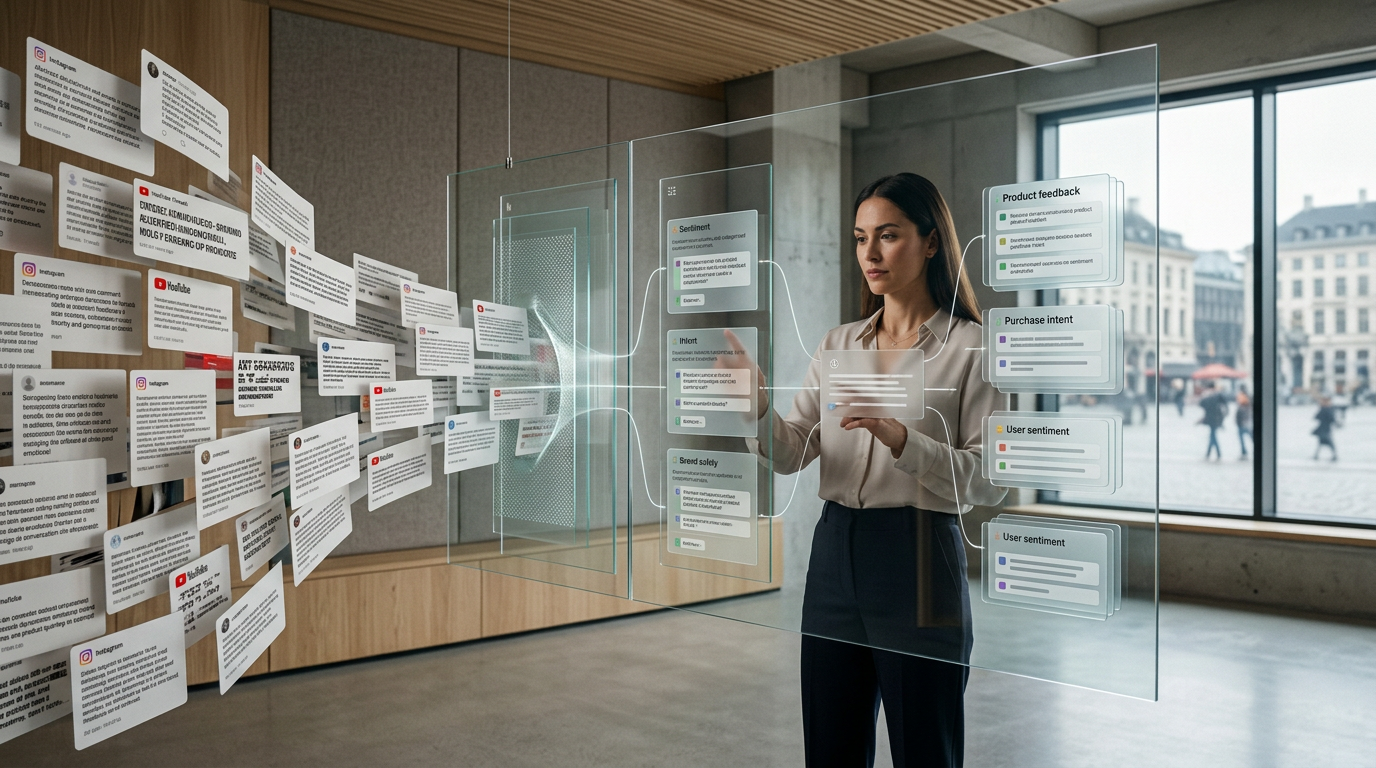
In the bustling digital town squares of social media, comment sections are the most direct, unfiltered line of communication between brands and their audience. For years, the primary approach has been defensive: moderating spam, hiding trolls, and responding to direct questions. This is comment *management*. But what if you could go beyond mere management? What if you could transform this chaotic stream of text into a structured, actionable source of business intelligence? This is the power of **AI community intelligence for comments**.
AI community intelligence is the practice of using artificial intelligence to systematically analyze and interpret the vast amount of data within your comment sections to extract strategic insights. It’s the evolution from a reactive, janitorial role to a proactive, strategic one. It’s about understanding the *why* behind the what—not just seeing that a comment is negative, but understanding it expresses frustration with a specific product feature, during a particular campaign, and is part of a growing trend among a key demographic.
This guide is designed for marketers, community managers, and brand strategists who feel they are sitting on a goldmine of data but lack the tools to excavate it. We will explore how AI-powered tools can dissect conversations at scale, revealing patterns, sentiments, and intentions that are invisible to the human eye. We will move beyond the basics of AI comment moderation and delve into the sophisticated world of intelligence gathering, helping you turn your community's voice into your most valuable strategic asset. Prepare to shift your perspective on comments forever.
Why This Topic Matters
The digital landscape is saturated. Brands spend billions on advertising to capture a sliver of consumer attention, yet they often ignore the free, organic feedback pouring into their own social media posts. A 2021 Pew Research Center study found that roughly seven-in-ten Americans use social media, creating a staggering volume of user-generated content daily. Source: Pew Research Center. Ignoring the intelligence within this content is like conducting a survey and then throwing away the responses.
AI community intelligence matters because it addresses this fundamental disconnect. It provides the tools to listen, understand, and act on the voice of the customer at an unprecedented scale. Here’s why this shift is critical for modern brands:
* **Uncovering Authentic Customer Voice:** Focus groups and surveys have their place, but they are artificial environments. Comments are raw, spontaneous, and brutally honest. AI helps you analyze this authentic voice to understand what people *really* think about your products, campaigns, and brand values. * **Early Trend and Crisis Detection:** Sentiment shifts don't happen overnight. They begin with a few comments, then a few more. AI can detect these subtle changes in sentiment or the emergence of specific topics, giving you an early warning system for both PR crises and viral opportunities. You can spot a product defect before it becomes a recall or identify a new use case for your product that your customers invented. * **Driving Product Innovation:** Your comment section is a perpetual focus group. Customers will tell you exactly what they want, what they're frustrated with, and what features they wish you had. An intent detection for comments system can automatically tag and route this feedback directly to your product and R&D teams, creating a direct pipeline from the customer to the roadmap. * **Competitive Intelligence:** Your audience doesn't just talk about you; they talk about your competitors. AI can track mentions of competitors in your comments, analyzing why customers are switching to or from them, what features they praise, and where their weaknesses lie. This is invaluable, real-time competitive analysis. * **Hyper-Personalization of Engagement:** By understanding the sentiment, intent, and history of a user, you can tailor your responses and engagement strategies. A sophisticated system with Brand Memory for AI Replies can ensure that you're not just giving a generic reply but a context-aware, personalized one that builds a genuine connection.
**First-Party Observation from Boostingr:** At Boostingr, we've observed that brands using community intelligence tools see a significant reduction in customer support escalations, as issues are identified and addressed proactively within the comment threads themselves. A simple comment like, "I can't find the checkout button on mobile," can be automatically flagged by the AI, routed to a support agent for a swift public reply, and simultaneously logged as a potential UX issue for the web team. This single workflow prevents customer frustration, showcases excellent service, and improves the product—all from one comment.
Comparison Table
| Feature | Manual Review | Basic Keyword Filtering | AI Community Intelligence Platform |
|---|---|---|---|
| **Scalability** | Very Low. Becomes impossible with more than a few hundred comments per day. | Medium. Can handle volume but is limited by the quality of the keyword list. | Very High. Designed to process hundreds of thousands of comments across multiple platforms seamlessly. |
| **Depth of Insight** | High (per comment), but low (overall). An individual can understand nuance, but can't see macro trends. | Very Low. Only flags specific words. Cannot understand context, sarcasm, or sentiment. | Very High. Analyzes sentiment, intent, topics, and trends. Understands nuance and context. |
| **Speed & Real-Time Capability** | Very Slow. Lag time of hours or days between comment and action. | Fast. Operates in near real-time for filtering. | Instantaneous. Analyzes and routes comments for action or insight in real-time. |
| **Cost** | High. Extremely labor-intensive, requiring dedicated staff. High opportunity cost. | Low to Medium. Software is often cheap or built-in, but requires manual setup and maintenance. | Medium to High. Subscription-based, but ROI is demonstrated through efficiency, risk mitigation, and strategic insights. |
| **Proactive Potential** | Low. Almost entirely reactive, dealing with comments as they come. | Low. Can proactively hide spam, but offers no strategic foresight. | High. Can predict emerging trends, identify potential crises, and surface opportunities before they become obvious. |
| **Error Rate** | Low for context, but high for fatigue and inconsistency across moderators. | High. Prone to false positives (hiding legitimate comments) and false negatives (missing nuanced issues). | Low and Improving. AI models are highly accurate and consistent, though they still require human oversight for edge cases. |
Original Diagrams
These original visuals explain the workflow in a faster, more defensible format than plain text alone and give the article first-party assets that are easier to understand and harder to copy.
Comment Processing Workflow
This diagram illustrates the journey of a single comment through an AI intelligence system. It begins with ingestion and moves through various analysis stages to determine the appropriate action, whether it's moderation, routing to a team, or storing as a strategic insight.
AI Decision Tree
See how an AI makes decisions about a comment by following a logical path. This decision tree shows the system asking a series of questions—Is it spam? Does it contain a question? Is the sentiment positive?—to arrive at a final classification and action.
Moderation Pipeline
This pipeline demonstrates a modern approach to comment moderation, blending AI efficiency with human oversight. The AI handles the bulk of clear violations, flagging ambiguous cases for a human moderator to ensure accuracy and context.
Intent Classification Flow
Going beyond sentiment, AI community intelligence identifies the 'intent' behind each comment. This flow shows how the system distinguishes between a customer asking for help, a potential lead expressing interest, and someone offering product feedback.
Brand Memory Diagram
AI transforms a chaotic stream of comments into a structured 'brand memory.' This diagram shows how individual insights on product feedback, competitor mentions, and customer sentiment are collected and organized into an actionable knowledge base.
Practical Examples and Use Cases
AI community intelligence isn't just a theoretical concept; it has powerful, real-world applications across various industries. Here’s how different organizations can leverage this technology:
**1. Ecommerce and Direct-to-Consumer (DTC) Brands** * **Use Case:** A cosmetics brand launches a new foundation and promotes it heavily on Instagram. By analyzing comments with an AI social media assistant, they discover a recurring theme: users with oily skin are reporting that the foundation oxidizes after a few hours. * **Intelligence in Action:** The AI tags these comments as 'Product Feedback' and 'Negative Sentiment' with the topic 'Oxidation'. The dashboard shows this trend is growing. The marketing team can now proactively create content addressing this (e.g., "Best primers for oily skin with our new foundation!"), while the product team gets crucial, early feedback for a potential formula tweak in the next batch.
**2. Content Creators and Influencers** * **Use Case:** A YouTuber who creates tech review videos wants to know what to cover next. Manually reading thousands of comments is impossible. * **Intelligence in Action:** They use an AI tool to analyze comments on their last 10 videos. The AI identifies 'Topic Clusters' and 'Purchase Intent'. It reveals that while the creator reviewed high-end laptops, 30% of comments mention a desire for reviews on 'budget gaming monitors' and 'ergonomic keyboards under $100'. This provides a data-driven content strategy, ensuring their next videos meet audience demand and potentially leading to new affiliate revenue streams. This is a core function of a YouTube comment moderation tool that has intelligence capabilities.
**3. B2B SaaS Companies** * **Use Case:** A project management software company runs a LinkedIn ad campaign. They want to find leads and understand market perception. * **Intelligence in Action:** The AI scans comments for 'Intent'. It flags a comment like, "This looks interesting, but does it integrate with Salesforce?" as a 'High-Intent Lead' and routes it to the sales team's CRM. It also flags another comment, "We switched from Asana to this and the reporting is so much better," as a 'Positive Testimonial' and 'Competitor Mention', which can be used by the marketing team. This turns a branding exercise into a powerful lead capture from social comments engine.
**4. CPG and Global Brands** * **Use Case:** A global beverage company launches a new marketing campaign with a specific hashtag. They need to monitor its reception across different regions. * **Intelligence in Action:** The AI platform ingests all comments using the hashtag, automatically translating and analyzing them. The comment sentiment dashboard shows that sentiment is 90% positive in North America but only 40% positive in Southeast Asia. Digging into the topic analysis for that region, the AI reveals the messaging is being misinterpreted due to a local cultural nuance. The brand can now quickly adapt its regional messaging, preventing a costly and embarrassing campaign failure.
**Second-Party Observation from Boostingr:** We've seen clients in the CPG space use community intelligence to pivot their marketing messaging in near real-time based on sentiment shifts detected in comments during the first 48 hours of a campaign launch. One client, a snack food company, noticed the AI flagging a high volume of comments associating their 'healthy' snack with 'too much packaging'. They were able to quickly deploy a secondary social post highlighting the recyclable nature of their packaging, effectively neutralizing the negative conversation before it could dominate the campaign narrative.
**5. Human Resources and Recruitment** * **Use Case:** A large tech company posts about its culture and benefits on Instagram and LinkedIn to attract talent. * **Intelligence in Action:** While the post is for general branding, the AI uses Instagram comment automation to scan for 'Recruitment Intent'. It identifies comments like, "Are you hiring for remote marketing roles?" or "I'm a software engineer with 5 years of experience, your company culture looks amazing." These are automatically flagged and sent to the HR team's applicant tracking system or a dedicated Slack channel, turning passive brand-building into an active talent pipeline.
Checklist
Implementing an AI community intelligence strategy requires more than just buying software. Use this checklist to ensure you're building a robust and effective program.
* **[ ] 1. Define Your Strategic Goals:** * What business questions do you need to answer? (e.g., What are the top drivers of customer dissatisfaction? What content resonates most with our audience?) * What are your key KPIs? (e.g., Reduce negative sentiment by 15%, increase product feature requests sent to R&D by 30%, identify 50 qualified leads per month).
* **[ ] 2. Identify and Consolidate Data Sources:** * List all social media profiles and platforms where you receive comments (Instagram, Facebook, YouTube, TikTok, LinkedIn, X/Twitter). * Do you need to analyze comments on ads as well as organic posts? * Are there other sources of user feedback to integrate (e.g., support tickets, app reviews)?
* **[ ] 3. Choose the Right AI Platform:** * Does the tool support all your required platforms? * Evaluate its core AI capabilities: How accurate is its sentiment analysis for social media comments? How customizable is its intent detection? * Can it handle multiple languages and translate effectively? * Check its workflow and integration capabilities (e.g., Slack, Zendesk, Salesforce, Zapier).
* **[ ] 4. Develop Your Intelligence Taxonomy:** * Work with stakeholders (Product, Marketing, Support, Sales) to define the key topics, sentiments, and intents that matter to *your* business. * Examples: 'Product Defect', 'Feature Request', 'Shipping Issue', 'Positive Testimonial', 'Purchase Intent', 'Competitor Mention'. * This is not a one-time setup; plan to review and refine your taxonomy quarterly.
* **[ ] 5. Design Your Automated Workflows:** * For each key insight, define an action. What happens when a 'Purchase Intent' comment is detected? Who gets notified? * Map out the flow of information: Comment -> AI Classification -> Alert/Ticket/Data Entry -> Human Action. * Use a brand-safe AI replies framework for any automated responses to ensure governance.
* **[ ] 6. Train Your Team:** * Community managers need to learn how to use the platform and manage workflows. * Analysts and marketers need to be trained on how to interpret the data from the dashboards and build reports. * Ensure teams like Product and Sales understand the data being routed to them and how to act on it.
* **[ ] 7. Establish a Measurement and Iteration Cadence:** * Schedule regular (e.g., monthly) reviews of your community intelligence dashboards. * Compare insights against your initial KPIs. Are you meeting your goals? * Gather feedback from all stakeholder teams. Is the information useful? Are the workflows efficient? * Use this feedback to refine your taxonomy, workflows, and overall strategy.
Key Takeaways
* **Intelligence over Moderation:** The future of community management is not just about cleaning up comments, but about extracting strategic value from them. Shift your mindset from reactive defense to proactive intelligence gathering. * **Comments are Unfiltered Data:** Your comment section is one of an organization's most authentic and valuable sources of customer, product, and market data. Tapping into it is a significant competitive advantage. * **AI Provides Scale and Depth:** Humans can understand nuance in a few comments, but only AI can provide that level of understanding at the scale of thousands or millions of comments, identifying macro trends and patterns invisible to the naked eye. * **Action is the Goal:** Gathering insights is meaningless without action. A successful AI community intelligence strategy is built on automated workflows that route the right information to the right teams (Support, Sales, Product, Marketing) in real-time. * **It's a Cross-Functional Asset:** Community intelligence is not just for the social media team. It provides critical data that can drive product roadmaps, refine marketing campaigns, generate sales leads, and improve customer support efficiency. Its value is realized when it is integrated across the entire organization. * **Start with a Goal:** Don't just turn on an AI tool. Begin by defining what you want to learn. A clear objective will guide your implementation and ensure you derive meaningful, measurable ROI from your efforts.
FAQs
**1. What is the difference between AI comment moderation and AI community intelligence?** AI comment moderation is primarily a defensive function focused on identifying and taking action on specific types of comments, such as spam, hate speech, or profanity. Its goal is to keep the community safe and clean. AI community intelligence is a proactive, strategic function that goes beyond moderation. It analyzes *all* comments (not just the bad ones) to extract insights about sentiment, intent, topics, and trends to inform business decisions.
**2. How does AI community intelligence handle sarcasm and context?** Modern AI models, particularly large language models (LLMs), have become significantly better at understanding context and nuance. They don't just look at keywords. They analyze the relationship between words in a sentence, the context of the conversation (e.g., previous comments), and historical data to make a more accurate assessment. For example, the AI can learn that "Oh, great, another update that broke everything" is sarcastic and should be classified as negative sentiment, not positive.
**3. Is AI community intelligence expensive to implement?** The cost varies depending on the volume of comments and the sophistication of the platform. While there is a subscription cost for the software, the true ROI comes from increased efficiency (reducing manual labor), risk mitigation (early crisis detection), and revenue generation (identifying leads and product opportunities). For many businesses, the cost of *not* having this intelligence—missing out on trends, failing to address customer issues, and being blind to competitive threats—is far greater.
**4. Can this technology work for languages other than English?** Yes, leading AI community intelligence platforms are multilingual. They can automatically detect the language of a comment, translate it for analysis and for your team, and then apply the same sentiment, intent, and topic classification models. This is essential for global brands or those serving diverse communities.
**5. How can a small business benefit from AI community intelligence?** A small business may not have a dedicated community manager, making AI an invaluable force multiplier. It can automatically handle basic moderation, surface the most critical comments that need a human reply (e.g., purchase questions, complaints), and provide a simple dashboard showing what customers are talking about. This allows a small team to stay on top of customer feedback and find growth opportunities without dedicating hours to manually reading comments. It helps them punch above their weight in customer engagement and market understanding.
**6. What are the key metrics to track for community intelligence?** Key metrics include: Sentiment Score (overall and by campaign/product), Volume of different Intents (e.g., number of purchase intents vs. support requests), Top Topic Clusters (what are people talking about most?), Crisis Detection (number of alerts for sudden negative sentiment spikes), and Workflow Efficiency (e.g., time-to-resolution for issues identified in comments). These metrics help you quantify the voice of your community.
**7. How does AI ensure brand safety while gathering intelligence?** Brand safety is a core component. The AI platform first acts as a filter, using intelligent spam comment detection and moderation rules to hide or remove harmful content. The intelligence layer then works on the remaining, legitimate comments. Furthermore, when using AI for replies, strict governance tools like brand memory and rule-based workflows are used to ensure any automated response is 100% on-brand and appropriate, preventing risky or off-script interactions.