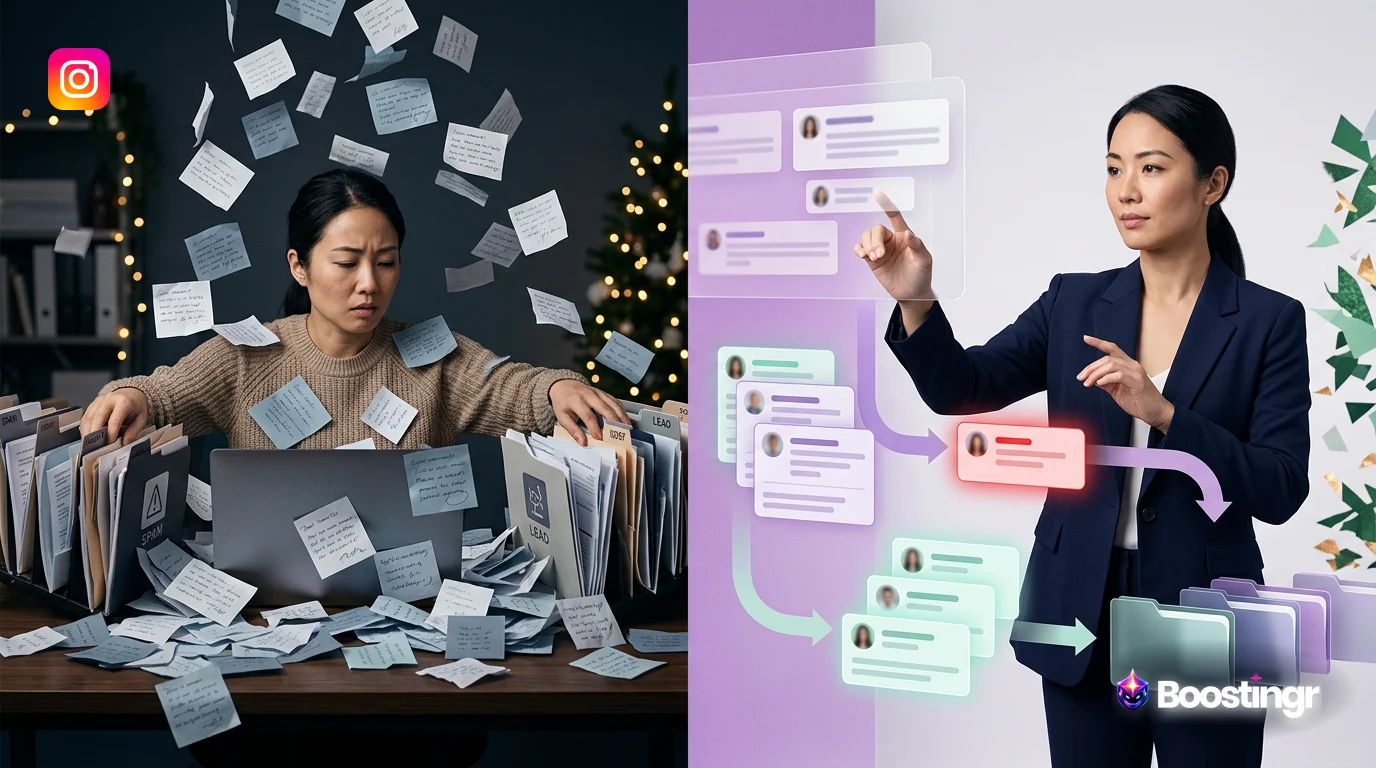
The Hidden Language of Social Media Comments
Your social media posts are buzzing. The comment count is climbing, engagement metrics look great, and your content is clearly resonating. But what are people *really* saying? Buried within that stream of emojis, questions, praise, and complaints is a goldmine of actionable intelligence that most brands are missing.
For years, the focus has been on volume and sentiment. Is the comment positive or negative? How many comments did we get? These are useful but shallow metrics. They tell you *what* the mood is, but not *why*. They don't reveal the commenter's underlying goal. This is where a more sophisticated approach is needed: **intent detection for comments**.
Intent detection is the next evolution in community management. It’s the art and science of understanding the purpose behind a comment. Is it a question? A complaint? A glowing review? A potential sales lead? Or is it spam?
Understanding this intent is the key to unlocking more efficient workflows, providing better customer experiences, protecting your brand, and even driving revenue directly from your comment section. This guide will explain everything you need to know about **intent detection for comments**, showing you how it drives smarter replies, proactive lead capture, and intelligent support escalation. We'll explore how platforms like Boostingr serve as the operating system for this new era of community intelligence.
What is Intent Detection for Comments? (And Why It's Not Just Sentiment Analysis)
To truly grasp the power of this technology, we must first distinguish it from its more common cousin, sentiment analysis. While related, they serve fundamentally different purposes.
* **Sentiment Analysis:** This technology analyzes text to determine the emotional tone behind it. It classifies a comment as positive, negative, or neutral. For example, it can tell you that "I'm so disappointed with my order" is a negative comment.
* **Intent Detection for Comments:** This goes a crucial step further. It analyzes text to determine the commenter's underlying goal or purpose. It answers the question, "What does this person want to achieve with their comment?"
Think of it this way: sentiment is the *feeling*, while intent is the *motivation*. A negative sentiment comment could be a customer support issue, a feature request disguised as a complaint, or a baseless attack from a troll. Each of these requires a completely different response. Relying on sentiment alone is like hearing someone's tone of voice without understanding the words they're saying.
The Core Categories of Comment Intent
AI-powered systems can categorize comments into various intent buckets, which can then trigger specific workflows. The most common intents include:
* *Examples:* "How much is this?", "Where can I buy one?", "Do you ship to Australia?", "Is the premium version available?"
- **Transactional Intent:** The commenter is expressing interest in making a purchase. These are high-value comments that are often missed.
* *Examples:* "My package never arrived.", "The app keeps crashing after the update.", "I'm having trouble logging in.", "This broke after one use."
- **Support Intent:** The commenter is experiencing a problem, has a complaint, or needs help with a product or service they've already purchased.
* *Examples:* "Does this work with an iPhone?", "What is it made of?", "Is it available in other colors?", "What's the difference between this and the last model?"
- **Informational Intent (Pre-Sale Questions):** The commenter is seeking more information before potentially making a purchase. They are researching and evaluating.
* *Examples:* "This is amazing!", "I love your brand so much.", "Great post, very helpful.", "😂🔥❤️"
- **Engagement & Praise Intent:** The commenter is sharing an opinion, offering praise, or simply engaging with the content and community.
* *Examples:* "Click my profile for a free gift!", "You guys are the worst.", "Follow me!", or comments with offensive language. Link to our guides on AI spam detection and troll detection.
- **Malicious Intent:** The commenter is a spammer, a troll, or is posting harmful/inappropriate content. The goal is to disrupt, scam, or damage the brand's reputation.
By automatically classifying every single comment into one of these categories, you can move from a reactive, chaotic moderation process to a proactive, strategic one.
The Core Pillars of Intent-Driven Comment Management
Understanding intent isn't just an academic exercise; it's the foundation for a revolutionary new way to manage your online community. It allows you to build automated workflows that handle comments with a level of precision and speed that is impossible for human teams alone. This approach rests on three powerful pillars.
Pillar 1: Crafting Smarter, More Relevant AI Replies
Generic replies like "Thanks for your comment!" are engagement killers. They show you're not really listening. Intent detection allows you to tailor your responses to the specific needs of the commenter, creating a more authentic and helpful interaction.
* **For Informational Intent:** Instead of a generic thanks, an AI Instagram reply bot can provide a direct answer. If a user asks, "Is this waterproof?", the AI can be configured to reply, "Yes, it's rated IP67 for water resistance! You can find more tech specs on our product page." * **For Praise Intent:** The AI can respond with more enthusiastic and appreciative language. "We're so happy you love it! Thanks for being part of our community." * **For Support Intent:** The AI can immediately de-escalate the situation publicly and move the conversation to a private channel. "We're so sorry to hear you're having this issue. We want to make it right. Please check your DMs for a message from our support team."
Platforms like Boostingr use a feature called **Brand Memory** to supercharge this process. You can feed the AI specific details about your products, policies, and brand voice. This ensures that every automated reply is not only relevant to the comment's intent but also perfectly on-brand and accurate.
Pillar 2: Unlocking Hidden Revenue with Proactive Lead Capture
Comments with transactional intent are sales opportunities knocking on your door. Manually sifting through hundreds of comments to find the one person asking "Where can I buy this?" is inefficient and prone to error. By the time a social media manager sees it, that potential customer may have already lost interest or bought from a competitor.
An intent-driven system transforms this process. Here's how an Instagram lead capture workflow powered by intent detection works:
* It can send an automated DM to the user: "Hi! We have that in a size medium. You can grab it here before your trip: [link to product]." * It can tag the comment in the moderation dashboard for a sales agent to follow up with personally. * It can even integrate with your CRM to create a new lead record.
- **Detection:** The AI scans incoming comments in real-time and identifies a comment like, "I need this for my vacation! Do you have it in a size medium?"
- **Classification:** It immediately classifies this comment with "Transactional Intent" or "Lead."
- **Action:** The system automatically triggers a pre-defined sequence:
This proactive approach turns your comment section from a simple engagement space into a powerful, automated lead generation engine, directly impacting your bottom line and boosting ecommerce sales.
Pillar 3: Streamlining Support and Escalation Workflows
Negative comments expressing support intent are time-sensitive landmines. If left unaddressed, they can escalate publicly, damage your brand's reputation, and deter potential customers. A manual process is often too slow to effectively manage this risk.
**Intent detection for comments** creates a robust, brand-safe workflow:
* **Containment:** The system can be configured to automatically hide the comment. This isn't about censorship; it's about taking the issue seriously and preventing a public pile-on while you resolve it. The user who posted it can still see their comment, so they don't feel ignored. * **Escalation:** The comment is automatically routed to the customer support team's queue, perhaps by creating a ticket in Zendesk or flagging it in a dedicated Slack channel. * **Communication:** An automated reply is posted (or sent via DM): "We are so sorry for the delay and frustration this has caused. This is not the experience we want for our customers. We've escalated your case to our support lead and will be in touch via DM shortly to get your order details."
- **Detection:** The AI identifies a comment like, "I'm so frustrated. My order from last week is still missing and customer service won't reply."
- **Classification:** The system flags this as "Urgent Support Intent."
- **Automated Action Sequence:**
This workflow, a core part of a comprehensive AI comment moderation strategy, turns a potential PR crisis into a positive customer service interaction, demonstrating that your brand is responsive and cares about its customers.
Comparison Table: Manual vs. Sentiment-Only vs. Intent-Based Moderation
To visualize the difference, let's compare the three main approaches to comment management. The advantages of an intent-driven system become immediately clear.
| Feature / Capability | Manual Moderation | Sentiment-Only Automation | Intent-Based Automation (with Boostingr) |
|---|---|---|---|
| **Speed** | Very Slow (hours to days) | Fast (seconds to minutes) | Instantaneous (real-time) |
| **Accuracy** | High (but prone to human error/bias) | Low (confuses sarcasm, mixes up intents) | Very High (understands context, slang, emojis) |
| **Lead Capture** | Ad-hoc and unreliable. Many leads are missed. | Ineffective. Cannot distinguish a lead from general praise. | Highly effective. Automatically identifies and actions transactional intent. |
| **Support Escalation** | Slow and manual. High risk of missed issues. | Unreliable. Flags all negative comments the same, creating noise. | Precise. Identifies specific support issues and routes them to the correct team. |
| **Spam/Troll Handling** | Tedious and time-consuming. | Decent, but can misidentify genuine negative feedback as trolling. | Excellent. Accurately identifies and hides/deletes malicious content while protecting genuine feedback. |
| **Scalability** | Poor. Requires hiring more people as volume grows. | Good. Can handle high volume. | Excellent. Scales infinitely without additional headcount. |
| **Community Manager Effort** | Extremely High. Focused on repetitive, low-value tasks. | Medium. Focused on correcting the AI's mistakes. | Low. Focused on high-value conversations and strategy. |
| **Community Intelligence** | Anecdotal. Based on what the manager happens to see. | Basic. Provides top-level positive/negative trends. | Deep and Actionable. Provides trends on specific intents (e.g., product issues, sales interest). |
How AI and NLP Power Modern Intent Detection
This sophisticated understanding of human language is made possible by advancements in Artificial Intelligence, specifically in the fields of Natural Language Processing (NLP) and Natural Language Understanding (NLU).
* **Natural Language Processing (NLP):** This is the broader field of AI that deals with the interaction between computers and human language. It involves processing text, breaking it down into its core components (like words and sentences), and analyzing its structure. * **Natural Language Understanding (NLU):** This is a subfield of NLP that focuses on reading comprehension. NLU is what allows the AI to go beyond a literal interpretation and grasp the context, nuance, and, most importantly, the *intent* of the text. It's how an AI can tell that "This is sick!" is high praise for a skateboard brand but a serious complaint for a restaurant.
Modern intent detection models, like those used by Boostingr, are trained on massive datasets comprising billions of social media comments. This training allows them to understand slang, evolving emoji usage, sarcasm, and the subtle contextual clues that a simple keyword filter would miss. They learn to recognize the patterns that differentiate a pre-sale question from a post-sale support request, even when they use similar words.
Platforms like Boostingr leverage official APIs, such as the Instagram Graph API, to access comment data in a secure and compliant way. However, these APIs simply provide the raw data. The real magic happens in Boostingr's AI engine, which acts as an intelligent layer on top. It ingests the stream of comments and enriches it with sentiment and intent classification, turning a firehose of text into a structured, actionable database for brands.
This process is also critical for a healthy digital ecosystem, as it helps brands maintain high-quality user interactions, a factor that search engines like Google consider important. As noted in their SEO Starter Guide, fostering a positive user experience is key to long-term success online.
Practical Examples and Use Cases
Let's move from theory to practice. Here’s how **intent detection for comments** plays out in real-world scenarios for different types of businesses.
Use Case 1: The Direct-to-Consumer (DTC) Ecommerce Brand
A popular online clothing store posts a video of a model wearing a new summer dress. The comment section explodes.
* **Comment:** "OMG I need this for my trip next month! How much is it?" * **Intent Detected:** Transactional * **Boostingr Workflow:** The comment is tagged as a "Hot Lead." An automated DM is sent: "We'd love for you to have this for your trip! It's $89 and you can find it here: [link]. We offer express shipping!"
* **Comment:** "Does the fabric wrinkle easily?" * **Intent Detected:** Informational (Pre-Sale) * **Boostingr Workflow:** The AI, using Brand Memory, replies publicly: "Great question! It's made from a wrinkle-resistant linen blend, perfect for travel."
* **Comment:** "I ordered this two weeks ago and it arrived with a tear in the seam!" * **Intent Detected:** Urgent Support * **Boostingr Workflow:** The comment is automatically hidden. A ticket is created in the brand's helpdesk software. An automated DM is sent: "We are so sorry to hear that. Please reply with your order number and a photo of the damage so we can send you a replacement right away."
* **Comment:** "BUY CHEAP DRESSES -> [spam link]" * **Intent Detected:** Spam/Malicious * **Boostingr Workflow:** The comment is automatically deleted, and the user is blocked.
Use Case 2: The B2B Software (SaaS) Company
A SaaS company announces a new integration with a popular CRM on their LinkedIn page.
* **Comment:** "This is exactly what we've been waiting for. Can we see a demo of how it works with enterprise accounts?" * **Intent Detected:** Transactional (Lead) * **Boostingr Workflow:** The comment is tagged as "Demo Request" and an alert is sent to the sales team's Slack channel with the commenter's profile details. An AI-powered reply is posted: "Absolutely! We'd be happy to show you. Our team will be reaching out to you via direct message shortly to schedule a time."
* **Comment:** "The new update seems to have broken our custom dashboards. Is there a fix?" * **Intent Detected:** Technical Support * **Boostingr Workflow:** The comment is flagged for the Customer Success team. The AI replies: "We're sorry for the trouble. We're aware of an issue affecting some custom dashboards and our engineering team is deploying a fix now. We've created a support ticket for you and will notify you once it's resolved."
Use Case 3: The Agency Managing Multiple Clients
An agency uses an Instagram automation blueprint to manage several client accounts, from restaurants to real estate agents.
* **Client:** A restaurant. * **Comment:** "Do you guys take reservations for a party of 8?" * **Intent Detected:** Informational/Transactional * **Boostingr Workflow:** The AI replies with the restaurant's reservation policy and a link to their booking platform, a task that would have previously required the agency's account manager to look up and reply manually.
* **Client:** A real estate agent. * **Comment:** "What's the price on this listing?" * **Intent Detected:** Lead * **Boostingr Workflow:** The comment is immediately forwarded to the agent's email and cell phone. An automated reply is posted: "Thanks for your interest! Our agent has been notified and will send you the full details in a private message."
In all these cases, the workflow is faster, more consistent, and more efficient, freeing up human managers to focus on strategy and high-touch engagement.
Checklist: Implementing an Intent-Driven Comment Strategy
Ready to harness the power of **intent detection for comments**? Follow this step-by-step checklist to build a smarter, more automated comment management system.
- [ ] **1. Audit Your Current Process:** Document how your team currently handles comments. Where are the bottlenecks? What types of comments take the most time? How many high-value comments (leads, support issues) are you potentially missing?
- [ ] **2. Define Your Brand's Key Intents:** While the standard categories are a good start, identify the specific intents most relevant to your business. For a software company, this might include "Feature Request" or "Integration Question." For a retailer, it might be "Sizing Question" or "Restock Request."
* *Example:* Intent = "Lead" -> Action = Tag user, send DM with product link, notify sales team. * *Example:* Intent = "Complaint" -> Action = Hide comment, create support ticket, send empathetic DM.
- [ ] **3. Map Intents to Automated Actions:** For each intent you've defined, create a clear workflow. What is the ideal outcome?
- [ ] **4. Choose the Right Technology:** Select a platform built for this purpose. Basic schedulers or inbox tools lack the sophisticated AI needed for true intent detection. Look for a dedicated comment management system like Boostingr. You can explore our pricing and plans here.
- [ ] **5. Configure Your Automation Rules:** In your chosen tool, set up the rules that bring your workflows to life. This involves linking specific intents to the actions you defined in step 3. This is the core of your Instagram comment automation strategy.
- [ ] **6. Build Your Brand Memory:** Populate the AI with your brand's unique knowledge. Add product details, FAQs, return policies, brand voice guidelines, and any other information the AI needs to reply accurately and authentically.
- [ ] **7. Establish Clear Escalation Paths:** Ensure that when the AI flags a comment for human review (like a complex support issue or a hot sales lead), it's routed to the right person or team instantly.
- [ ] **8. Monitor, Refine, and Learn:** No AI is perfect out of the box. Regularly review the AI's classifications and replies. Refine your rules and update your Brand Memory based on performance. Use the analytics dashboard to spot trends in comment intents.
- [ ] **9. Train Your Human Team:** Your community managers are still essential. Train them on the new workflow. Their role will shift from manual, repetitive moderation to overseeing the AI, handling exceptions, and engaging in the highest-value conversations.
The Broader Impact: From Comment Moderation to Community Intelligence
The ultimate goal of implementing **intent detection for comments** is to graduate from simple moderation to true community intelligence. Your comment section becomes a real-time, unsolicited focus group.
By analyzing the trends in comment intent over time, you can uncover invaluable insights that can inform business strategy across your entire organization:
* **Product Development:** Is there a sudden spike in "Support Intent" comments mentioning a specific feature? That's a signal to your product team that there might be a bug. Are you seeing a lot of "Informational Intent" questions about a feature you don't have? That's a validated feature request for your roadmap.
* **Marketing & Content:** Are people constantly asking the same questions about your product? That's a sign that your marketing copy or product pages are unclear and need to be updated. What topics generate the most "Praise Intent"? Create more content like that.
* **Sales:** Which posts are generating the most "Transactional Intent"? This data tells your sales and marketing teams what messaging is most effective at driving purchase consideration. You can double down on what works.
* **Customer Support:** Are you seeing a rise in complaints about shipping times? You can proactively address the issue with your logistics partner before it becomes a widespread problem.
A platform like Boostingr doesn't just manage comments; it aggregates and analyzes this data, presenting it in an easy-to-understand dashboard. It turns the chaotic noise of social media into a clear signal, providing actionable intelligence that was previously impossible to obtain at scale. For more guides on leveraging these insights, visit our blog.
Key Takeaways
For those ready to level up their community management, here are the essential points to remember:
* **Intent is Deeper Than Sentiment:** Sentiment tells you the mood; **intent detection for comments** tells you the motivation. Understanding the *why* is crucial for an effective response.
* **Automation Drives Efficiency and Revenue:** By mapping intents to automated workflows, you can proactively capture leads, de-escalate support issues, and filter out noise, all in real-time.
* **AI is the Engine:** Modern NLP and NLU models are required to understand the nuance of human language at scale. Simple keyword filters are no longer sufficient.
* **It's a Strategic Workflow:** Success isn't just about buying a tool. It's about defining your intents, mapping them to actions, and creating clear escalation paths for your team.
* **The Goal is Intelligence:** The ultimate power of this technology lies in its ability to transform your comment section from a moderation chore into a rich source of community intelligence that can inform your entire business strategy.
FAQs
**Q1: What's the difference between intent detection and keyword filtering?**
A1: Keyword filtering is a rigid, rule-based system. It can only find comments that contain specific words you've programmed (e.g., flag any comment with the word "price"). Intent detection, powered by AI, understands context, slang, and sentence structure. It can identify a comment like "How much for this one?" as having transactional intent, even if the word "price" isn't used. It's far more accurate and flexible.
**Q2: Can AI really understand slang and emojis in comments?**
A2: Yes. Modern AI models, like those used in Boostingr, are trained on billions of real-world social media comments. This vast dataset includes slang, acronyms, and a deep understanding of how emojis are used in context. It knows that "🔥" is praise and "🤔" often indicates a question or skepticism.
**Q3: Is intent detection only for large brands with huge comment volumes?**
A3: Not at all. While it's essential for managing high volume, it's incredibly valuable for small businesses and creators too. For a small team, missing a single sales lead or a critical complaint can have a huge impact. Automation ensures these crucial comments are never missed, allowing a small team to operate with the efficiency of a much larger one.
**Q4: How does Boostingr's intent detection work?**
A4: Boostingr uses a multi-layered approach. When a comment comes in, it's processed by our proprietary AI engine. This engine analyzes the text, context, and user history to classify the comment with both a sentiment (positive, negative, neutral) and a primary intent (e.g., transactional, support, spam). This classification then triggers the custom workflows you've set up in your dashboard.
**Q5: Will using AI for comment replies make my brand sound robotic?**
A5: It won't if you use the right tools and strategy. A key feature in Boostingr is Brand Memory, where you define your brand's specific voice, tone, and information. You can also create multiple reply variations for each intent, so the AI doesn't repeat itself. The goal is to automate the predictable replies to free up your time for the more nuanced, human-led conversations.
**Q6: How accurate is AI-powered intent detection for comments?**
A6: Leading platforms achieve very high accuracy rates, often exceeding 95% for well-defined intents. The accuracy is constantly improving as the models are trained on more data. Furthermore, systems like Boostingr allow for a human-in-the-loop approach, where you can easily correct any misclassifications, which helps the model learn and improve for your specific account.
**Q7: How do I get started with intent detection for my social media comments?**
A7: The easiest way to start is by using a platform designed for it. You can follow the checklist in this article to map out your strategy. Then, sign up for a platform like Boostingr, connect your social accounts, and begin configuring your intent-based automation rules. You can start small with one or two key workflows, like lead capture and spam filtering, and expand from there.
Conclusion: Your Comments Are Talking. It's Time to Listen.
The days of simply counting comments or giving every commenter a generic thumbs-up are over. The most successful brands of tomorrow will be those that listen deeply to their communities, understanding not just what is being said, but why. They will use this understanding to build relationships, solve problems, and create better products.
**Intent detection for comments** is the technology that makes this possible at scale. It transforms a chaotic, time-consuming moderation queue into a streamlined, intelligent system that protects your brand, delights your customers, and drives measurable business growth. It's time to stop just managing your comments and start understanding them.
Ready to unlock the intelligence hidden in your comment section? Explore how Boostingr can become your central operating system for community intelligence and sign up for a free trial today.