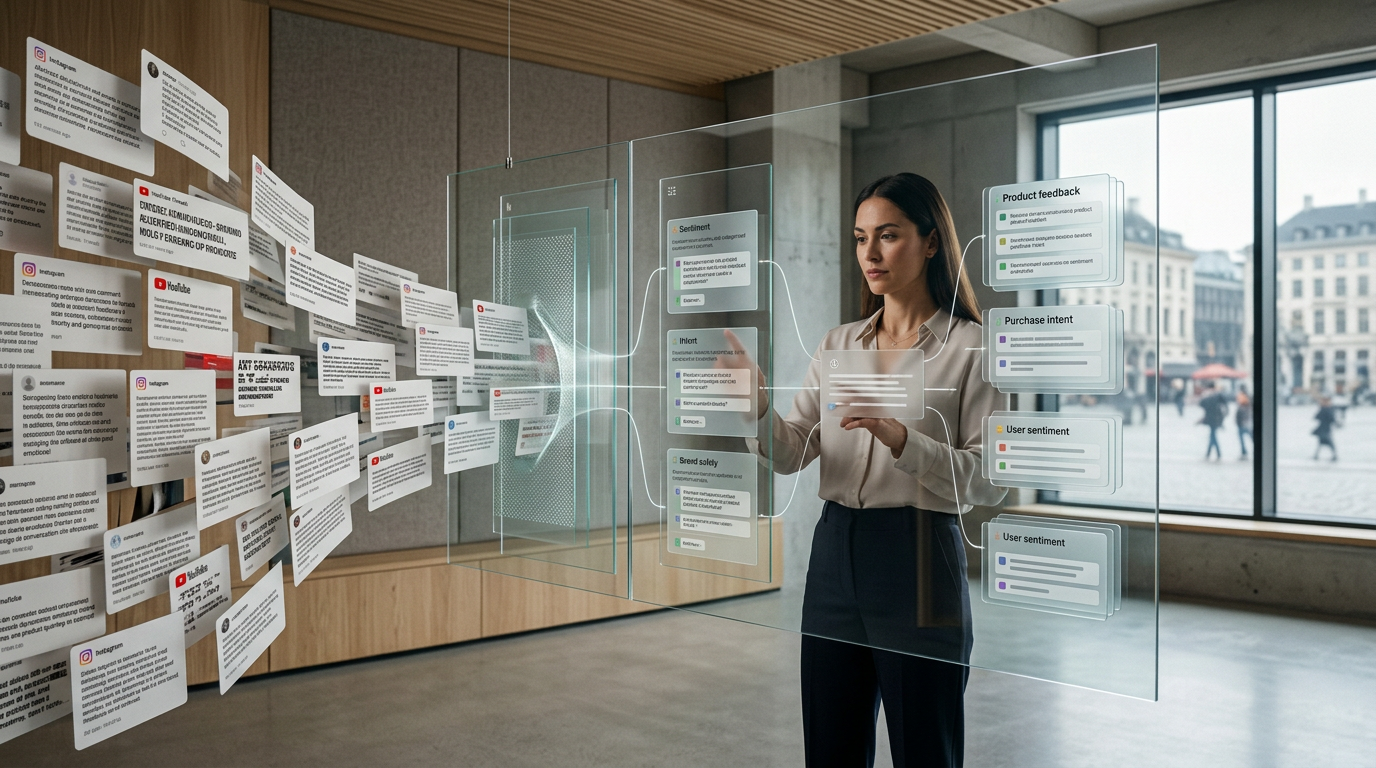
The Unseen Engine of Community Growth: AI Community Intelligence for Comments
Every day, your brand's social media posts attract a torrent of comments. They are a chaotic, high-velocity mix of praise, questions, complaints, spam, and invaluable feedback. For most brands, this comment section is a battlefield—a place for reactive firefighting, manual deletion, and typing the same replies over and over. Your team is spending hours just to keep your head above water, suffering from decision fatigue and burnout, all while strategic opportunities are buried under the noise.
This manual, reactive approach is not scalable. It actively damages brand reputation through inconsistent moderation and slow response times. It's a liability that drains resources and morale.
But what if you could change the entire paradigm? What if, instead of a chaotic liability, your comment section became your single greatest source of strategic intelligence and predictable growth? This is the promise of **AI community intelligence for comments**. It's not just another automation tool; it's a complete operating system that transforms raw comment data into a powerful engine for moderation, engagement, and sustainable growth. It's the central nervous system for your digital community.
This guide will walk you through how this technology works, moving far beyond basic keyword filtering and canned responses to show you how AI truly understands the people behind the comments. We'll explore how platforms like Boostingr serve as this operating system, enabling you to moderate at scale, reply with a humanized brand voice, and uncover revenue-generating opportunities you're currently missing.
What Exactly Is AI Community Intelligence for Comments?
At its core, **AI community intelligence for comments** is the process of using sophisticated artificial intelligence to analyze social media comments at scale, understand their meaning and intent, and trigger intelligent actions. It’s a significant leap beyond traditional social media management tools that rely on simple keyword filtering or basic, rigid chatbots.
Think of the difference in terms of human roles: * **Basic Moderation (Keyword Filters):** This is like a security guard with a list of banned words. They're rigid, easily fooled by creative misspellings or sarcasm, and lack any real understanding. They might block a customer saying "This product is the bomb!" while letting a sophisticated scammer through. * **AI Community Intelligence (e.g., Boostingr):** This is like a team of seasoned community strategists, sales reps, and support agents working in perfect sync. It understands the *intent* (is this a sales question?), *sentiment* (is the customer happy or frustrated?), and *context* (what product are they talking about?) behind the words, even when they're sarcastic, misspelled, or use complex slang.
This deeper understanding is powered by a suite of advanced AI technologies, primarily Natural Language Processing (NLP) and Natural Language Understanding (NLU). NLP allows the machine to read and parse human language, while NLU allows it to comprehend the meaning, intent, and sentiment. This is what separates a simple tool from a true intelligence platform. The system learns your brand, your audience, and your goals, creating a sophisticated workflow that turns noise into signal.
The entire operating system is built on three foundational pillars: Intelligent Moderation, Humanized AI Replies, and Strategic Growth Insights.
Pillar 1: Intelligent Moderation at Scale
The first challenge every brand faces is maintaining a safe, positive, and on-brand community space. Manual moderation is slow, emotionally taxing, and financially impossible to scale effectively across multiple platforms. AI community intelligence automates this process with a level of sophistication that keyword blacklists can't begin to match.
* **Advanced Spam & Troll Detection:** AI models are trained on vast datasets containing millions of examples of spam, scams, hate speech, and trolling. They can identify and hide comments promoting crypto scams, phishing links, or 'follow-for-follow' spam, even when the text is intentionally obfuscated with special characters (`l!nk in b1o`), emojis, or zero-width spaces. The AI also detects trolling behavior—comments designed to provoke rather than contribute—by analyzing patterns, user history, and context, not just specific words. A robust AI comment moderator acts as a vigilant, 24/7 guardian of your community. * **Contextual Nuance:** A simple keyword filter is a blunt instrument. It might hide a comment saying, "This policy is killing me!" because it contains the word "killing." An intelligent system understands this is likely a frustrated customer expressing negative sentiment, not a genuine threat. It can flag it for human review instead of blindly hiding it. Conversely, it can identify passive-aggressive or sarcastic negative comments that don't contain any obvious profanity, like "Wow, another 'amazing' feature that doesn't work." * **Customizable Workflows:** True power comes from control. With a platform like Boostingr, you define the rules of engagement. You can create granular workflows: automatically hide comments with a toxicity score above 90%; flag comments with moderate negativity for human review; prioritize comments from known brand advocates; and even set different moderation policies for different social accounts (e.g., stricter rules on Facebook than on LinkedIn). This creates a powerful AI comment moderation workflow that is both efficient and perfectly tailored to your brand's specific tolerance levels.
Pillar 2: Humanized AI Replies with Brand Memory
One of the biggest fears brands have about automation is sounding robotic and impersonal, which can damage customer relationships. This is where the concept of "Brand Memory" becomes a game-changer. Brand Memory is a centralized, dynamic knowledge base that you teach the AI, ensuring every reply is consistent, accurate, and perfectly aligned with your brand's unique personality.
This is the essence of Boostingr's "Teach once, engage everywhere" philosophy. You provide the AI with a deep understanding of your brand by feeding it: * **Brand Voice & Tone Guidelines:** Is your brand witty and playful, formal and professional, or empathetic and supportive? You provide examples and the AI learns to mimic your style. * **Product & Service Information:** Detailed specifications, pricing, availability, and features for your entire catalog. * **Policies & Procedures:** Your shipping policy, return process, warranty information, and terms of service. * **Frequently Asked Questions:** A comprehensive list of answers to common queries like "Do you ship to Canada?" or "Is this available in blue?" * **Historical Interactions:** The AI learns from how your human team has previously answered unique questions, constantly expanding its knowledge base.
With this Brand Memory, the AI can generate context-aware, humanized replies. It doesn't just spit out a pre-written response. It can handle a complex query like, "Hey, love this new jacket! Is it fully waterproof for hiking, does the black version come in XL, and what's your return policy if it doesn't fit?" by checking its knowledge base for all three attributes and composing a single, natural-sounding answer. This is how a brand voice AI frees up your human team to focus on building relationships and handling the most complex, high-value conversations.
Pillar 3: Strategic Growth Insights from Comment Data
This is where **AI community intelligence for comments** moves from a cost-saving tool to a revenue-generating engine. By analyzing the content, sentiment, and intent of every single comment, you can uncover a goldmine of strategic business intelligence that was previously impossible to access.
* **Automated Lead Capture:** The AI can be trained to identify purchase intent with incredible accuracy. Comments like "I need this!", "How much is it?", "Where can I get one?", or even more subtle cues like "I wish my current provider did this" are automatically flagged as leads. You can configure a workflow to reply with a direct link to the product, send a DM with a discount code, or route the lead and the user's details directly to your sales team's CRM or Slack channel. This transforms your comment section from a simple engagement space into a powerful, automated Instagram lead capture funnel. * **Actionable Product Feedback:** Your customers are constantly giving you free market research. AI can categorize thousands of comments into feedback themes. You might discover a recurring request for a new feature, a common complaint about a product's sizing, praise for your new packaging, or confusion about your pricing model. This structured data, presented in an easy-to-read report, is invaluable for your product development, marketing, and UX teams, allowing them to make data-driven decisions based on real customer voices. * **Sentiment & Trend Analysis:** A sentiment dashboard gives you a real-time pulse on your community's health. Did your latest campaign resonate positively or negatively? Is sentiment trending up or down over time? You can even track sentiment specifically related to competitor mentions. By tracking these metrics, you can measure the impact of your content, preempt PR crises, and make strategic adjustments to improve your brand perception. * **Competitor Intelligence:** The AI can be configured to specifically identify and tag any comments that mention your competitors. Analyzing these comments provides raw, unfiltered insights. Are customers complaining about a competitor's price increase? Are they praising a feature your product lacks? This intelligence can directly inform your sales, marketing, and product strategy.
How AI Transforms Raw Comment Data: A Step-by-Step Workflow
Turning a raw comment into an intelligent action involves a sophisticated, multi-stage process that happens in milliseconds. Here’s a look under the hood of an AI community intelligence platform like Boostingr.
**Step 1: Secure, Real-Time Data Ingestion** The process begins the instant a user posts a comment on one of your connected social media accounts (e.g., Instagram, Facebook, YouTube, TikTok). Using official, secure APIs like the Instagram Graph API, the platform ingests the comment text, username, timestamp, and other metadata in real-time. This speed is critical for immediate moderation of harmful content and timely replies to customer inquiries.
**Step 2: Multi-Layered AI Processing & Classification** This is the core of the intelligence engine. The raw comment is passed through a series of specialized, parallel AI models: * **Sentiment Analysis:** The model determines the emotional tone of the comment, classifying it as Positive, Negative, Neutral, or Mixed. * **Intent Detection:** This is crucial. The AI identifies the user's underlying goal. Is it a *Purchase Inquiry*, a *Customer Support Question*, *General Feedback*, *Spam*, *Trolling*, or a simple *Positive Reaction*? Each intent can trigger a different workflow. * **Toxicity & Harm Detection:** A separate model, trained on millions of examples from sources like the Jigsaw dataset, scans for profanity, hate speech, bullying, and other harmful content, assigning a precise toxicity score from 0 to 100. * **Entity Recognition:** The AI identifies and extracts key entities mentioned in the comment, such as your product names, specific features, competitor brands, locations, or even names of your support agents.
**Step 3: The Decision Engine & Rule Application** Once the comment is fully classified and tagged with data from the AI models, it's passed to the decision engine. This is where your pre-defined rules and workflows come into play. The system executes a logic tree based on the AI's analysis: * *If* the toxicity score is > 90%, *then* automatically hide the comment and log the user for monitoring. * *Else if* the intent is 'Purchase Inquiry' AND sentiment is 'Positive', *then* tag it as 'Hot Lead', trigger the 'Sales Reply' AI workflow to generate a response with a product link, and post the reply. * *Else if* the intent is 'Customer Support' AND sentiment is 'Negative', *then* assign it to a human agent in the support queue, tag it for urgent review, and automatically create a ticket in your integrated helpdesk software. * *Else if* the intent is 'FAQ', *then* query the Brand Memory, generate a humanized AI reply, and post it.
**Step 4: Action, Engagement, and Routing** Based on the decision engine's output, the platform takes a specific, automated action: * **Automated Moderation:** Hiding or deleting comments that violate your policies, often before they are seen by other users. * **Automated Replies:** Posting AI-generated, on-brand responses to common questions, freeing up human agents. * **Intelligent Escalation:** Routing complex, sensitive, or high-value comments to the appropriate team member with all the AI-generated context attached (sentiment, intent, user history, suggested reply). This allows your team to act with full information. * **Data Tagging & Analytics:** Labeling each comment with its sentiment, intent, and any other relevant tags for future reporting and analysis. This builds a rich database of community intelligence over time.
**Step 5: Continuous Learning and Human-in-the-Loop Refinement** The system is not static; it's a learning organism. It learns from every interaction. When a human agent edits an AI-suggested reply, corrects a misclassified intent, or answers a new type of question, that information is fed back into the system. This human-in-the-loop process is used to refine the Brand Memory and improve the accuracy of the AI models, creating a virtuous cycle where the AI becomes progressively smarter, more accurate, and more aligned with your brand over time.
Comparison Table
Not all comment management solutions are created equal. Here’s how **AI community intelligence for comments** stacks up against traditional methods and basic automation tools.
| Feature | Traditional Manual Moderation | Basic Automation (e.g., ManyChat) | Advanced AI Intelligence (e.g., Boostingr) |
|---|---|---|---|
| **Moderation** | Manual, slow, based on human judgment. Prone to burnout and inconsistency. | Keyword-based filtering. Easily fooled by slang, sarcasm, and misspellings. | AI-powered spam, troll, and harm detection. Understands context and nuance for >95% accuracy. |
| **Reply Capability** | Manual replies for every comment. Not scalable, often inconsistent. | Pre-defined, rigid replies triggered by keywords. Sounds robotic and impersonal. | Context-aware, humanized replies powered by a dynamic Brand Memory. Handles complex, multi-part questions. |
| **Insight Generation** | Anecdotal. Relies on community managers manually spotting trends in a spreadsheet. | Basic analytics on trigger words. No deep understanding of sentiment or intent. | In-depth sentiment analysis, intent detection, and trend reporting. Uncovers leads, product feedback, and strategic insights automatically. |
| **Scalability** | Very poor. Directly tied to team headcount and budget. Breaks at high volume. | Good for simple, high-volume tasks. Fails with complex or nuanced conversations. | Excellent. Scales effortlessly with comment volume while maintaining high-quality moderation and engagement 24/7. |
| **Brand Consistency** | Dependent on individual team members. Varies by person, time of day, and mood. | Consistent but robotic. Lacks brand personality and adaptability. | Highly consistent and perfectly on-brand across all channels, thanks to a centralized Brand Memory and brand voice AI. |
| **Business ROI** | A cost center. Value is difficult to quantify beyond 'brand safety'. | Limited to simple conversion tracking on keyword triggers. | A profit center. Delivers measurable ROI through automated lead capture, churn reduction, and actionable business intelligence. |
Original Diagrams
These original visuals explain the workflow in a faster, more defensible format than plain text alone and give the article first-party assets that are easier to understand and harder to copy.
Comment Processing Workflow
This workflow illustrates how the AI ingests raw comments from various platforms, processes them through analysis layers, and outputs a specific, actionable task. It's the core engine that turns a chaotic comment section into an organized system.
AI Decision Tree
This decision tree shows the AI's logic, branching from an initial comment to classifications like 'spam,' 'question,' or 'praise,' and then to a final recommended action. This is how the system automates the complex decision-making that human moderators perform manually.
Moderation Pipeline
This pipeline demonstrates the trust and safety workflow, where the AI first filters comments for obvious spam and hate speech for automatic removal. It then flags borderline or sensitive comments for human review, ensuring both efficiency and nuanced oversight.
Intent Classification Flow
This flow shows how the AI moves beyond simple sentiment to classify the specific intent of a comment, such as a purchase inquiry, a customer support issue, or positive feedback. This classification is crucial for routing the comment to the right team or triggering the correct response.
Brand Memory Diagram
This diagram illustrates the 'Brand Memory,' a centralized knowledge base that the AI uses to answer frequently asked questions and maintain a consistent brand voice. This ensures that all replies are accurate and on-brand, preventing repetitive manual work.
Practical Examples and Use Cases
Theory is great, but how does **AI community intelligence for comments** deliver value in the real world? Here are a few practical applications across different industries.
**Use Case 1: The Direct-to-Consumer Ecommerce Brand** * **Problem:** A fast-growing fashion brand launches a new collection on Instagram. They are inundated with thousands of comments. Their small team can't keep up with questions about price, availability, sizing, and materials, all mixed with spam, bot comments, and genuine praise. * **Solution:** Using Boostingr, they set up a multi-layered workflow. Spam and bot comments are instantly hidden, cleaning the feed. The AI, using its Brand Memory, automatically answers 70% of the repetitive questions like "Is this real leather?" and "Do you ship to Australia?". Most importantly, the intent detection model flags comments like "I need this for a wedding next month!" and "OMG where can I buy the green one?" as high-intent leads. The system automatically replies with a direct product link and uses an integration to tag the user in their CRM, creating a seamless, measurable path from comment to conversion.
**Use Case 2: The High-Volume Content Creator** * **Problem:** A popular YouTuber with millions of subscribers is overwhelmed. Their comment section is a mix of valuable fan engagement, thousands of repetitive questions ("What camera do you use?", "What's the song at 5:12?"), and a constant barrage of hateful, toxic comments that harm the community and affect the creator's mental health. * **Solution:** They implement an AI community intelligence platform. The AI immediately hides over 95% of the spam and toxic comments, detoxifying the community space. It uses Brand Memory to instantly answer the top 20 most frequently asked questions, saving the creator and their team hours every single day. This allows the creator to use the platform's dashboard to find and engage with the most thoughtful, constructive comments from their true fans, strengthening their core community.
> **Boostingr First-Party Observation:** We've observed that brands and creators using AI to handle the top 20% of their most frequent, repetitive questions see a 30-40% reduction in their community managers' manual workload within the first month. This time is almost always reallocated to more strategic, high-touch engagement, content creation, and analyzing the rich data the AI uncovers.
**Use Case 3: The B2B Software Company** * **Problem:** A SaaS company uses LinkedIn and Facebook Ads to share content and generate leads. Their comments contain a mix of high-value sales inquiries, technical support questions from existing customers, and feedback on their articles. Manually sorting and routing these is slow, leading to lost leads and frustrated customers. * **Solution:** Their AI system is configured to differentiate between these critical intents. A comment on a LinkedIn ad like, "Does this integrate with Salesforce and what's the pricing for a team of 50?" is identified as a pre-sales question and routed directly to the sales team's Slack channel with all context. A comment from a known customer saying, "I'm getting an error when I try to export a report," is identified as a support issue and automatically creates a high-priority ticket in their Zendesk. This ensures every comment gets to the right person in minutes, not hours, dramatically improving both sales velocity and customer satisfaction.
> **Boostingr First-Party Observation:** An interesting pattern we've seen is that the most valuable purchase intent signals are often subtle and comparative. Comments like 'Wow, I wish my current software could do this' or 'We're re-evaluating our stack and this looks promising' are frequently missed by manual moderation but are easily flagged by our intent detection models. These comments have led directly to high-value competitive sales conversations for our clients, which we track in our case studies.
Checklist: Implementing AI Community Intelligence for Comments
Ready to get started? Follow this checklist to successfully deploy an AI-powered operating system for your community.
- [ ] **Audit & Define Goals:** Analyze your current comment volume, moderation challenges, and average response times. Define clear, measurable KPIs (e.g., reduce response time by 50%, increase lead capture from comments by 20%, reduce manual moderation time by 10 hours/week).
- [ ] **Document Your Brand DNA:** Compile your brand voice guidelines, tone, and answers to at least 20-30 frequently asked questions. Crucially, also document 'what not to say'—topics to avoid or escalate immediately. This will form the initial core of your AI's Brand Memory.
- [ ] **Establish Moderation Policies:** Define precisely what constitutes spam, hate speech, or a sensitive issue for your brand. Create clear rules for what to hide automatically, what to flag for review, and what to escalate immediately to a human.
- [ ] **Choose a Platform & Connect Accounts:** Select a robust platform like Boostingr and securely connect your social media profiles through their official API integrations. Ensure the platform is fully compliant with network terms of service.
- [ ] **Configure Initial AI Workflows:** Set up your first automated reply workflows for different intents (e.g., FAQs, price inquiries). Configure your lead capture and support escalation pathways to your existing tools (CRM, Slack, Helpdesk).
- [ ] **Train Your Team:** Onboard your community managers. Train them on their new role: managing the AI system, not just individual comments. Focus on handling the AI-flagged review queue, providing feedback to the AI, and analyzing the insight reports.
- [ ] **Go Live & Monitor Closely:** Activate the system on one or two accounts first. Closely monitor the AI's performance in the first few weeks. Review the analytics dashboard to track moderation rates, response times, and sentiment trends against your KPIs.
- [ ] **Refine, Optimize, and Expand:** Continuously update your Brand Memory with new information and answers. Tweak your moderation rules and reply workflows based on performance data. Once optimized, roll the system out across all your social channels.
Key Takeaways
If you remember nothing else from this guide, let it be these key points:
* **Intelligence Over Automation:** True **AI community intelligence for comments** goes far beyond simple keyword triggers. It's about understanding context, sentiment, and intent to make smarter, more human decisions at scale. * **The Three Pillars are Essential:** A complete solution is built on Intelligent Moderation (safety), Humanized AI Replies (engagement), and Strategic Growth Insights (ROI). Lacking any one of these leaves significant value on the table. * **Brand Memory is Non-Negotiable:** To avoid sounding robotic and to maintain brand integrity, an AI must be powered by a robust, up-to-date Brand Memory. This is the key to scaling authentic engagement. * **Comments are a Data Goldmine:** Your comment section is an untapped, real-time source of sales leads, product feedback, and market research. AI is the key to unlocking this value. * **It's an Operating System, Not Just a Tool:** Think of platforms like Boostingr as the central operating system for your entire community engagement strategy. It helps you build a better, more valuable, and safer online presence, which can be a positive signal for brand authority recognized by search engines like Google, as noted in their SEO starter guide.
The Future of Community Management is Intelligent
The era of manually sifting through thousands of comments is over. The sheer volume, velocity, and complexity of social media have made it an impossible task. Brands that cling to outdated, manual methods will inevitably fall behind, plagued by toxic communities, missed revenue opportunities, and burnt-out, inefficient teams.
The future belongs to those who embrace intelligence. By implementing an AI-powered operating system for your comments, you can not only solve your biggest moderation headaches but also turn your community into a predictable engine for growth. You can finally stop reacting and start strategizing, transforming a cost center into a profit center.
Ready to transform your comments from noise into your brand's most valuable asset? Explore Boostingr's pricing, browse our full suite of blog resources, request a personalized demo, or sign up today to see the power of AI community intelligence firsthand.
FAQs
Supplemental Workflow Diagrams
These original diagram briefs are placeholders for generated visual workflow assets and explain what each final diagram should teach the reader.
Comment Processing Workflow
Show the end-to-end flow from incoming public comment to classification, moderation decision, reply path, and retained community learning for Ai Community Intelligence For Comments.
AI Decision Tree
Visualize how the system distinguishes low-risk, ambiguous, and high-risk comments before choosing reply, review, hide, or escalate.
Moderation Pipeline
Illustrate how spam, abuse, policy checks, priority scoring, and review layers work together before a public action goes live.
Intent Classification Flow
Explain how comment text, post context, intent, sentiment, and policy signals combine to produce the next best action.
Brand Memory Diagram
Show how approved offers, tone rules, support boundaries, and campaign context feed one brand-safe reply system across connected accounts.