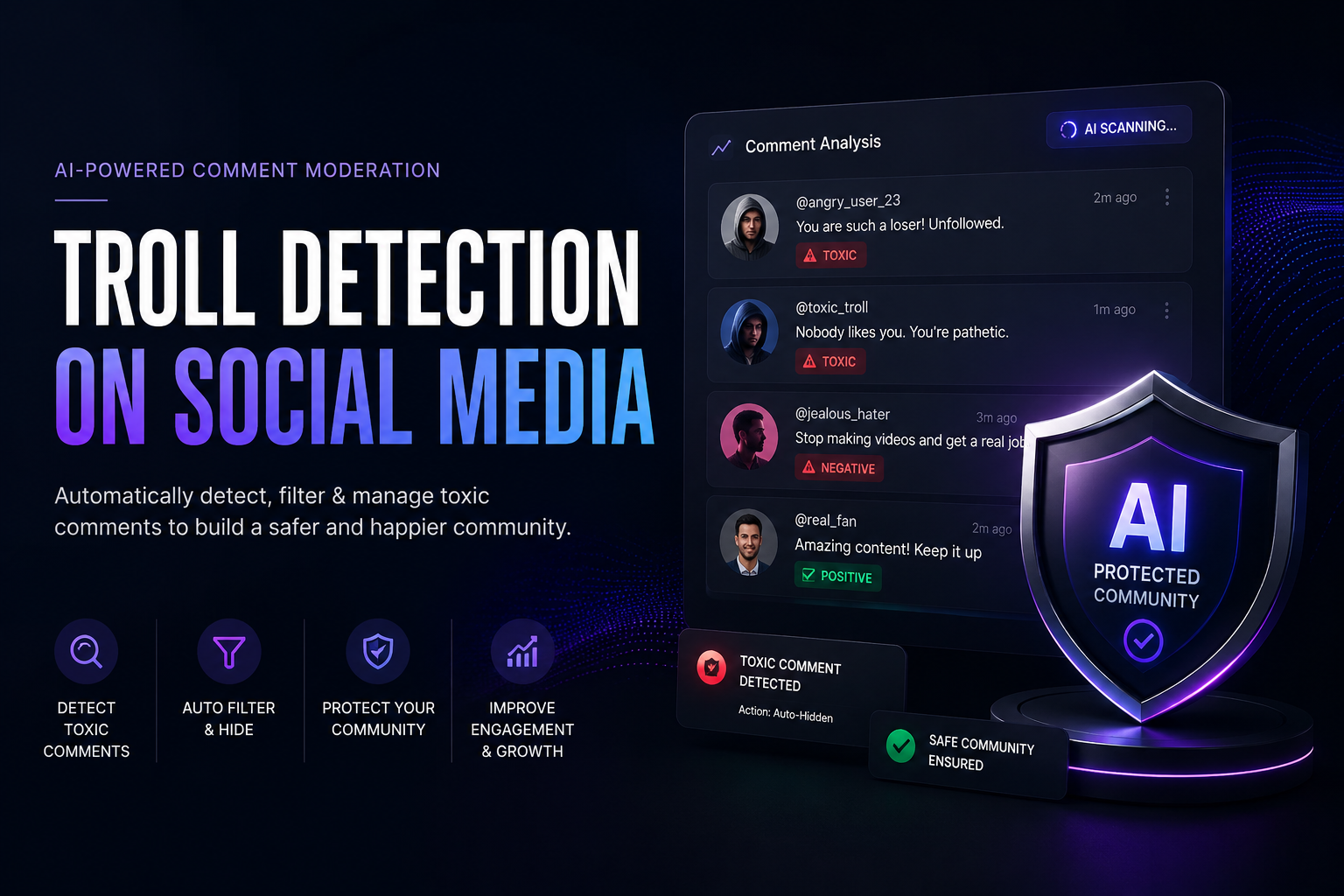
The Hidden Cost of Unchecked Trolls
Every social media manager knows the feeling: a pit in your stomach when you see a notification flurry on a popular post. Is it a wave of positive engagement, or has the tide turned? In today's digital landscape, the latter often means the arrival of trolls. These aren't just disgruntled customers; they are malicious actors dedicated to derailing conversations, poisoning community sentiment, and damaging your brand's reputation. The cost isn't just measured in hurt feelings—it's measured in wasted hours, customer churn, and a tangible decline in brand safety.
Manual moderation, the traditional line of defense, is no longer sufficient. It's a game of whack-a-mole where moderators are outnumbered, outmaneuvered, and emotionally exhausted. Basic keyword filters are easily bypassed with clever misspellings, sarcasm, and coded language. To truly protect your online community, you need a more intelligent, scalable, and strategic approach. This is where AI-powered **troll detection for social media comments** becomes not just a tool, but a foundational element of your community management strategy.
This guide moves beyond the basics. We will dissect the anatomy of modern trolling, explore the limitations of outdated methods, and build a comprehensive, AI-driven workflow. You'll learn how to leverage advanced AI to identify troll patterns, implement a nuanced decision matrix for responding, hiding, or muting, and create an automated escalation logic. We'll show you how a platform like Boostingr acts as the central operating system for this entire process, transforming your comment section from a liability into a thriving, safe community.
Deconstructing the Troll: From Simple Insults to Strategic Sabotage
To effectively combat trolls, you must first understand them. The stereotypical image of a troll as someone hurling simple insults is dangerously outdated. Modern trolls employ sophisticated, often subtle, tactics designed to provoke a reaction and sow discord. Effective **troll detection for social media comments** requires recognizing these varied personas and their distinct methods.
**Common Troll Archetypes:**
* **The Provocateur:** This is the classic troll. Their goal is to get a rise out of you or your community members. They use inflammatory statements, personal attacks, and off-topic rants to hijack threads and incite arguments. * **The Concern Troll:** This is a more insidious variant. They mask their malicious intent with a veneer of feigned concern. They might say, "I'm just worried that your new product might have safety issues..." or "As a loyal customer, I'm just disappointed to see you supporting [unrelated controversial topic]." Their goal is to plant seeds of doubt and create negative associations with your brand under the guise of constructive feedback. * **The Sealion:** Named after a webcomic, this troll endlessly demands evidence and asks bad-faith questions. They feign a desire for debate but their actual goal is to exhaust their target by monopolizing their time and energy. They will ignore evidence provided and continuously move the goalposts. * **The Dogpiler:** This isn't a single troll but a coordinated group. When one troll attacks, others quickly join in, creating an overwhelming flood of negativity. This tactic is designed to intimidate the target brand and its community, creating the illusion of a widespread negative consensus. * **The Spammer/Scammer:** While often categorized separately, these actors share the troll's goal of disrupting the user experience for personal gain. They post deceptive links, promote scams, or flood comments with repetitive, irrelevant content. An effective moderation strategy must handle them with the same efficiency. You can learn more about this in our guide to AI spam comment detection.
The impact of these activities is severe. They degrade the quality of conversation, chase away genuine customers, and create a toxic environment that reflects poorly on your brand. Furthermore, they skew your social media metrics, making it difficult to gauge true customer sentiment and identify real issues. Your team's time is drained dealing with these bad-faith actors instead of engaging with real customers and nurturing valuable leads.
The Breaking Point: Why Manual Moderation and Keyword Filters Fail
The sheer volume and sophistication of modern trolling have pushed traditional moderation methods to their breaking point. Relying solely on human moderators and basic filters is like trying to stop a flood with a bucket.
**The Human Cost of Manual Moderation:**
* **Scalability:** A single popular post can generate thousands of comments in hours. A human team simply cannot keep up, leading to long response times and missed violations. * **Moderator Burnout:** Constantly being exposed to negativity, hate speech, and abuse takes a significant psychological toll. This leads to high turnover rates and inconsistent enforcement of community guidelines. * **Inconsistency:** Different moderators may interpret guidelines differently. What one person sees as light-hearted sarcasm, another might flag as a personal attack. This inconsistency can lead to accusations of bias from your community. * **24/7 Demand:** Trolls don't operate on a 9-to-5 schedule. Without around-the-clock moderation, your comment sections are vulnerable overnight and on weekends.
**The Inadequacy of Basic Keyword Filters:**
Keyword blocklists were the first attempt at automating moderation, but they are a blunt instrument in an era that requires surgical precision.
* **Lack of Context:** A filter that blocks the word "sucks" might be useful for insults, but it will also hide a legitimate customer comment like, "This vacuum cleaner really sucks up the dirt!" This creates false positives and censors genuine engagement. * **Easily Bypassed:** Trolls are adept at circumventing filters. They use l33tsp3ak (e.g., "h@te"), intentional misspellings, emojis, and other creative methods to get their messages through. * **Inability to Detect Nuance:** Keyword filters cannot understand sarcasm, irony, or the subtle negativity of a concern troll. A comment like, "Wow, another brilliant marketing decision," would sail right past a keyword filter but is clearly negative in context.
These limitations make it clear that a new paradigm is needed—one that combines the scalability of automation with the nuanced understanding of human intelligence. This is the domain of AI.
The AI Advantage: Understanding Context, Intent, and Patterns
True AI-powered **troll detection for social media comments** goes far beyond simple word matching. It employs complex machine learning models to analyze comments holistically, much like a human would, but at a massive scale. This is the core of platforms like Boostingr, which serve as an intelligent layer between your brand and the public conversation.
Here’s how AI dissects a comment to identify a troll:
- **Sentiment Analysis:** The first step is to gauge the emotional tone. Is the comment positive, negative, or neutral? While a negative comment isn't automatically a troll, a high-negativity score is a primary flag for further analysis. This helps prioritize which comments need immediate attention. For a deeper dive, explore our guide to sentiment analysis for social media comments.
* **Asking a Question?** (Potential customer support issue) * **Expressing a Complaint?** (Legitimate negative feedback) * **Giving Praise?** (Brand advocacy) * **Showing Purchase Intent?** (A valuable lead) * **Attempting to Troll?** (Bad-faith engagement)
- **Intent Detection:** This is where AI truly shines. It seeks to understand the *purpose* behind the comment. Is the user...
By classifying intent, an AI system can differentiate a frustrated customer who needs help from a provocateur who needs to be hidden. This is crucial for taking the right action. Learn more about how this works in our ultimate guide to intent detection.
* Has this user repeatedly posted off-topic comments on multiple posts? * Is this user part of a group of accounts that suddenly appeared and are all posting similar negative messages (dogpiling)? * Does this user have a history of having their comments hidden for guideline violations?
- **Pattern Recognition & User History:** A single comment might be ambiguous, but AI can analyze patterns over time. Boostingr's **Brand Memory** feature is key here. It tracks a user's interaction history with your brand. The AI can then ask:
This historical context allows the AI to identify persistent troublemakers with much higher accuracy than analyzing comments in isolation.
- **Toxicity & Threat Scoring:** Advanced models are trained on vast datasets of toxic language, hate speech, and threats. They can assign a "toxicity score" to a comment, even if it doesn't contain obvious slurs. This helps flag the most dangerous and brand-damaging content for immediate action, often without needing human review.
By combining these layers of analysis, an AI-powered system like Boostingr builds a rich, multi-dimensional understanding of every single comment, enabling a level of moderation that is both precise and scalable.
Building Your AI-Powered Moderation Workflow
Having a powerful AI is only half the battle. You need to channel its capabilities into a clear, strategic workflow. This workflow automates the mundane, flags the ambiguous for human review, and ensures every comment is handled according to a consistent, predefined logic.
Step 1: Automated Triage and Classification
Think of this as the digital sorting hat for your comments. As soon as a comment is posted, Boostingr's AI analyzes it and places it into a category. A typical triage system looks like this:
* **Green Bucket (Safe):** Positive comments, neutral remarks, and simple questions. These can be left visible, and you can even use an AI Instagram reply bot to automatically thank users or answer common questions. * **Yellow Bucket (Review Needed):** Legitimate negative feedback, complex questions, or comments with ambiguous sentiment. These are routed to a human moderator's inbox for a nuanced response. The AI has done the heavy lifting of filtering out the noise, so your team can focus on these high-value interactions. * **Red Bucket (Action Required):** Comments identified with high confidence as trolls, spam, hate speech, or severe policy violations. This is where your automated rules kick in.
Step 2: The Decision Matrix: Hide, Mute, or Ban?
For comments in the "Red Bucket," you need a clear and consistent action plan. The goal is not always to bring down the ban hammer, as this can sometimes escalate the situation. A nuanced approach is far more effective.
* **When to Hide (The Default for Trolls):** Hiding is the single most powerful tool against most trolls. When you hide a comment on platforms like Instagram and Facebook (via their official APIs like the Instagram Graph API), the comment becomes invisible to everyone except the person who posted it and their direct friends. The troll thinks their comment is still live and that they are being ignored. They don't get the angry reaction they crave, nor do they get the satisfaction of being publicly banned, which they might wear as a badge of honor. This quietly de-platforms them without confrontation.
* **When to Mute:** Muting is a step up from hiding. This action, available on some platforms, prevents a specific user from commenting on your posts in the future. It's best used for persistent, low-level trolls who, despite having their comments hidden, continue to try and engage. It's a clean way to remove a recurring problem user from your community space.
* **When to Ban/Block:** This is the final resort, reserved for the most severe cases: explicit threats, hate speech, doxxing, or illegal content. Banning a user makes it clear that their behavior is unacceptable. However, be aware that a determined troll may simply create a new account to continue their harassment. This is why hiding and muting are often preferred for standard trolling behavior.
Step 3: Automated Escalation Logic
With a platform like Boostingr, you can automate this decision-making process based on your brand's specific tolerance levels.
* **Rule 1 (First Offense):** If a comment's troll score is > 90%, automatically hide the comment. * **Rule 2 (Repeat Offender):** If a user who has had 2+ comments hidden in the past 30 days posts another comment with a troll score > 75%, automatically hide the new comment and add the user to a "watchlist" for human review. * **Rule 3 (Severe Violation):** If a comment contains hate speech or a direct threat (as identified by the AI), automatically hide the comment, ban the user, and flag the incident for mandatory human review and reporting to the platform.
This automated workflow ensures that your community is protected 24/7, your guidelines are enforced consistently, and your team's time is reserved for what matters most: building relationships with your real audience.
Comparison Table
To put the benefits into perspective, here’s how an AI-powered comment management platform like Boostingr stacks up against traditional methods.
| Feature | Manual Moderation | Basic Keyword Filters | AI-Powered Management (Boostingr) |
|---|---|---|---|
| **Scalability** | Very Low. Limited by team size and budget. | High. Can process infinite comments. | Very High. Scales instantly with comment volume. |
| **Accuracy** | Moderate to High, but prone to human error and bias. | Very Low. High rates of false positives and negatives. | Very High. Learns and adapts to new tactics. |
| **Context Awareness** | High. Humans understand nuance and sarcasm. | None. Cannot understand context or intent. | High. Analyzes sentiment, intent, and user history. |
| **Moderator Burnout** | Very High. Emotionally and mentally taxing. | Low. It's an automated system. | Very Low. Automates removal of toxic content. |
| **Speed** | Slow. Can take hours to review comments. | Instant. | Instant. Analyzes and acts in real-time. |
| **Cost-Effectiveness** | Low. Requires significant staffing costs. | Moderate. Often included in other tools but is ineffective. | High. Reduces staffing needs and protects brand value. |
Original Diagrams
Visualizing these workflows can help clarify how AI transforms comment moderation from a reactive task into a proactive system.
Comment Processing Workflow
This diagram shows the initial triage process for every incoming comment.
AI Decision Tree
This flowchart illustrates the logic the AI uses to make a nuanced decision.
Moderation Pipeline
A more detailed, technical view of the end-to-end process within a system like Boostingr.
sequenceDiagram
    participant User
    participant SocialPlatform
    participant Boostingr
    participant Moderator

    User->>SocialPlatform: Posts a comment
    SocialPlatform->>Boostingr: Sends comment via API
    Boostingr->>Boostingr: 1. Pre-process Text
    Boostingr->>Boostingr: 2. AI Analysis (Sentiment, Intent, Troll Score)
    Boostingr->>Boostingr: 3. Apply Rule Engine
    alt High Troll Score
        Boostingr->>SocialPlatform: API Call: Hide Comment
    else Legitimate Complaint
        Boostingr->>Moderator: Notify: Review Needed
    else Positive Comment
        Boostingr->>SocialPlatform: API Call: Post AI Reply
    end
Intent Classification Flow
This shows how a comment is routed based on the user's underlying intent.
Brand Memory Diagram
This illustrates how Boostingr uses historical data to make smarter decisions.
Practical Examples and Use Cases
Let's see how this AI-powered workflow plays out in real-world scenarios.
Use Case 1: The E-commerce Product Launch
* **Scenario:** An apparel brand launches a new sustainable clothing line. The announcement post on Instagram is targeted by a competitor or activist group with a coordinated dogpiling attack. Dozens of accounts begin posting comments like, "This is greenwashing!" and "Your factory conditions are terrible," regardless of their validity. * **Without AI:** The social media manager frantically tries to delete comments, but they keep coming. The post's sentiment plummets, genuine customer questions are buried, and the launch's momentum is hijacked. * **With Boostingr's AI Workflow:** The AI detects a sudden spike in high-negativity comments from new or low-activity accounts, all using similar keywords. It recognizes this as a coordinated pattern. The pre-set rule (`IF troll_score > 85% AND part_of_spike_pattern, THEN hide`) kicks in automatically. The troll comments are hidden in real-time, preserving the integrity of the comment section. The social media manager receives a summary report of the action taken and can focus on highlighting positive comments and answering questions from potential customers, turning a potential crisis into a successful launch. This is a core part of how an AI social media assistant can boost e-commerce sales.
Use Case 2: The SaaS Company and the "Concern Troll"
* **Scenario:** A B2B software company posts a case study about a client's success. A single user begins a campaign of "sealioning" in the comments. They post endless, nuanced, bad-faith questions: "But can you prove causation and not just correlation? What was the exact p-value? Have you considered these 15 alternative explanations?" The goal is to exhaust the team and make the company look evasive. * **Without AI:** The community manager spends hours trying to politely answer the questions, pulling in data analysts and product managers. This drains internal resources and distracts from engaging with actual sales leads in the comments. * **With Boostingr's AI Workflow:** After the first few comments, the AI's Brand Memory flags the user's pattern of asking incessant, argumentative questions without acknowledging answers. The system assigns a high troll probability score based on this behavior, not just the words used. The next time the user posts, their comment is automatically hidden. The community manager is freed up to spot a different comment that says, "This looks like exactly what our team needs. Can it integrate with Salesforce?"—a clear buying signal that can be routed for Instagram lead capture.
Checklist: Implementing Your Troll Detection Strategy
Ready to build your fortress? Follow this checklist to implement a robust strategy for **troll detection for social media comments**.
- [ ] **Define Your Castle Rules:** Create and publish clear, concise community guidelines. What is and isn't acceptable? Be specific about hate speech, spam, and off-topic comments.
- [ ] **Distinguish Critics from Trolls:** Train your team and configure your AI to understand the difference. A critic has a problem; a troll *is* the problem. Criticism should be addressed, trolling should be removed.
- [ ] **Establish Your Escalation Policy:** Document your Hide -> Mute -> Ban workflow. Ensure it's applied consistently.
- [ ] **Choose the Right AI:** Select a platform like Boostingr that offers contextual AI (sentiment, intent, user history) and not just basic keyword filtering. Review its capabilities for AI comment moderation.
- [ ] **Configure Your Automation Rules:** Set up the automated workflows in your chosen platform. Start with conservative rules (e.g., auto-hide comments with >95% troll probability) and adjust as you gain confidence in the system.
- [ ] **Segment Your Workflows:** Create different automated paths for different comment intents. Troll comments get hidden, support questions create a ticket, and sales leads notify your team.
- [ ] **Review and Refine:** Periodically review the AI's actions. Use the platform's dashboard to see what was hidden and why. Fine-tune your rules to improve accuracy and reduce the need for manual oversight. This is a key part of an effective Instagram comment automation workflow.
- [ ] **Empower Your Team:** Train your human moderators on the new system. Their role will shift from manual deletion to strategic oversight, handling exceptions, and high-value engagement.
Key Takeaways
If you remember nothing else from this guide, let it be these key points:
* **Trolling is Strategic:** Modern trolling is a calculated tactic designed to disrupt and damage your brand, not just random insults. * **Manual Moderation is Obsolete:** It is not scalable, sustainable, or effective against the volume and sophistication of today's online toxicity. * **Context is King:** Effective **troll detection for social media comments** requires AI that understands context, sentiment, intent, and user history, not just keywords. * **Hide, Don't Fight:** Hiding a troll's comment is the most effective way to neutralize them without escalating the conflict. * **Workflows Beat Whack-a-Mole:** A structured, automated workflow for triaging, deciding, and acting on comments is essential for consistent and scalable community protection. * **An Operating System is Required:** A comprehensive platform like Boostingr provides the end-to-end system to implement this strategy, from AI analysis and automated actions to brand-safe AI replies and community intelligence.
FAQs
Here are some frequently asked questions about implementing AI for troll detection.
**1. What's the difference between a troll and an unhappy customer?** An unhappy customer has a legitimate issue with your product or service and is seeking a resolution. Their criticism, while negative, is typically specific and constructive. A troll's goal is not resolution but disruption. They engage in bad faith, use personal attacks, make off-topic statements, and are not interested in a solution. AI helps differentiate them by analyzing intent and behavior patterns.
**2. Will AI-powered troll detection censor my community?** No, when configured correctly. The goal isn't censorship, but safety. A good AI system is configured to remove only what violates your specific community guidelines (hate speech, spam, clear trolling). Legitimate criticism and negative feedback are routed to your team for authentic engagement. This actually *protects* free expression for genuine community members by removing the noise and abuse from bad actors.
**3. How does the AI learn to identify new trolling tactics?** AI models, especially those on platforms like Boostingr, are constantly being updated. They learn from new data across thousands of accounts. When a new trolling method emerges (like a new combination of emojis or a new style of bad-faith question), the models are retrained on this data to recognize the new pattern, ensuring the system stays effective over time.
**4. Is it better to hide or delete a troll's comment?** Hiding is almost always better. Deleting a comment notifies the user that their comment was removed, which can provoke them to post again. Hiding the comment makes it invisible to the public, but the troll often doesn't realize it's been hidden. This starves them of the attention they crave and is a much more efficient and less confrontational way to clean up your comment section.
**5. Can troll detection actually help me find business opportunities?** Yes, indirectly. By automatically filtering out the trolls and spam, an AI system clears the way for you to see the comments that truly matter. When your moderation inbox isn't cluttered with abuse, it's much easier to spot the user asking a pre-sale question or expressing strong purchase intent. This turns your comment section from a defensive chore into a proactive channel for lead capture.
**6. How do I get started with a platform like Boostingr?** Getting started is straightforward. You can typically sign up for a trial, connect your social media accounts securely via the official platform APIs, and begin configuring your moderation rules. The best approach is to start with the recommended default settings for troll and spam detection and then customize them over time based on your brand's specific needs and tolerance levels. You can explore the options on our pricing page or sign up to see it in action.
From Defense to Offense: Building a Thriving Community
Ultimately, effective **troll detection for social media comments** is about more than just playing defense. It's about taking control of your online environment to create a space where your brand and your true community can thrive. By automating the removal of toxic, disruptive content, you free up your team's valuable time and energy.
Instead of fighting trolls, they can focus on delighting customers, answering questions, identifying leads, and gathering valuable feedback. This transforms community management from a cost center into a powerful engine for growth, loyalty, and brand advocacy. For more on this holistic approach, see our guide to AI community management.
The internet doesn't have to be a toxic battlefield. With the right strategy and the right technology, you can build and protect a vibrant, safe, and productive community around your brand. It's time to move beyond the ban hammer and embrace an intelligent, automated workflow that works for you 24/7.
Ready to see how Boostingr can safeguard your community and unlock its true potential? Sign up for free and experience the future of comment management.