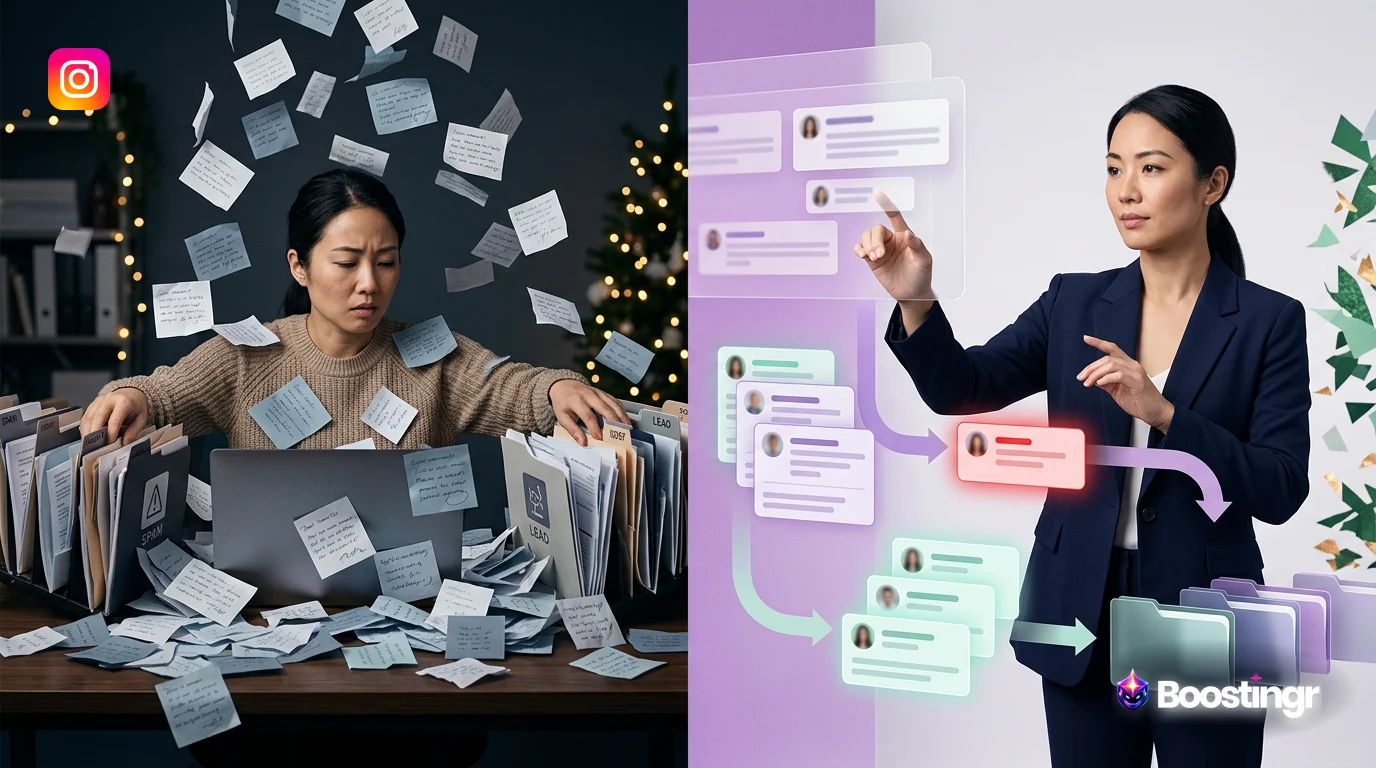
Quick Answer
Sentiment analysis for social media comments is an AI-powered process that automatically identifies the emotional tone behind user comments, categorizing them as positive, negative, or neutral. This allows brands to triage their comment sections, prioritizing urgent negative feedback for customer support, high-intent inquiries for sales, and positive mentions for community engagement, turning raw feedback into strategic action instead of just a vanity metric.
---
Your social media comment section is a digital town square—a firehose of customer feedback, questions, complaints, praise, and random noise. For brands with active communities, manually sifting through thousands of comments is not just inefficient; it's impossible. Important messages get buried, high-intent leads are missed, and potential PR crises simmer unnoticed. According to the Sprout Social Index™, 77% of consumers expect a response from a brand in less than 24 hours on social media, but the reality is that critical comments can easily get lost in the flood.
While many native social media tools offer basic dashboards, they often treat all engagement equally, failing to distinguish between a five-alarm fire and a friendly high-five. This forces teams into a reactive, chaotic cycle of firefighting, where the loudest comment gets attention, not necessarily the most important one.
This is where the strategic application of **sentiment analysis for social media comments** transforms community management from a reactive chore into a proactive intelligence engine. It’s not about simply measuring how many people are “happy” or “sad.” It’s about building an intelligent triage system that understands the emotional context and intent of every comment, then routes it for the appropriate action. With an AI comment management platform like Boostingr, you can teach the AI to prioritize comments based on their sentiment, ensuring that an angry customer receives immediate attention, a high-intent lead is captured instantly, and a brand advocate is celebrated publicly. This guide will provide a comprehensive walkthrough of the strategic workflow for using sentiment analysis to not just manage comments, but to understand the people behind them and drive tangible business growth.
Beyond Likes and Shares: Why Comment Sentiment is the Ultimate Engagement Metric
For years, marketers have been conditioned to chase vanity metrics: likes, shares, and follower counts. While these numbers provide a surface-level view of reach, they reveal very little about the actual health of your community or the perception of your brand. A post can go viral for all the wrong reasons, accumulating thousands of angry comments that traditional analytics might simply register as “high engagement.”
Comment sentiment provides the missing layer of context. It moves beyond the *quantity* of interactions to uncover the *quality* and *emotion* driving the conversation. Understanding this emotional landscape is critical for several key business functions:
* **Real-Time Brand Health Monitoring:** A sudden spike in negative sentiment is the canary in the coal mine for a product issue, a service failure, or a brewing PR crisis. For example, if comments on an ad suddenly shift from positive to angry mentions of “doesn’t work” or “arrived broken,” a sentiment analysis system can flag this trend in minutes, not days. This allows you to get ahead of the problem before it dominates the public narrative and requires costly damage control. * **Actionable Customer Experience (CX) Insights:** Comments are a goldmine of unfiltered feedback for your Voice of the Customer (VoC) program. Sentiment analysis helps you categorize this feedback at scale. Are customers consistently frustrated with shipping times? Delighted with a new feature? Confused by your pricing page? This data is invaluable for product development, marketing, and operations teams, providing direct, qualitative insights that surveys often miss. * **Authentic Competitive Intelligence:** Customers rarely hesitate to mention competitors in comments. Analyzing the sentiment of these mentions provides powerful, real-world insights. A comment like, “I switched from Brand X and am so much happier!” is a powerful testimonial. Conversely, “This is just as bad as Brand X” is a critical piece of feedback about market perception. An AI system can track sentiment trends associated with competitor names over time, giving your strategy team a live look at your position in the market. * **Identifying and Mobilizing Advocates and Detractors:** Sentiment analysis automatically flags your biggest fans and your most vocal critics. This allows you to build a systematic process for relationship management. You can nurture your advocates with exclusive content or early access, turning them into a powerful volunteer marketing force. For detractors, you can implement a structured escalation path to resolve their issues, potentially turning a negative experience into a positive one.
At Boostingr, we've observed that brands without a sentiment triage system often over-index on responding to neutral or low-impact comments, while critical negative feedback can sit for hours or days, causing significant brand damage. The goal isn't just to measure sentiment; it's to act on it with precision and speed, turning a potential liability into a strategic asset.
How AI-Powered Sentiment Analysis for Social Media Comments Works
Modern sentiment analysis goes far beyond simple keyword matching. A comment containing the word “sick” could mean “this is amazing” or “this made me ill.” A basic system can't tell the difference, but a sophisticated AI can. This is where the power of a true **social comment sentiment AI** comes into play, leveraging complex models to understand language like a human.
From Keywords to Context: The Evolution of Comment Sentiment Analysis
Early attempts at **sentiment analysis for comments** relied on dictionaries of positive and negative words, a method known as a lexicon-based approach. This approach was brittle, easily confused, and ultimately ineffective for the dynamic nature of social media.
* **Keyword-Based (Legacy):** This method flags comments containing words like “bad,” “hate,” or “broken.” It fails to understand critical linguistic nuances like sarcasm (“Yeah, *great* job losing my package”), negation (“Not bad at all”), or context-dependent words (“The plot was insane!” could be positive or negative). It's a blunt instrument in a world that requires surgical precision. * **AI-Powered (Modern):** This approach uses Natural Language Processing (NLP) and machine learning models, often based on transformer architectures like BERT, to understand the relationships between words, sentence structure, and conversational context. It can decipher sarcasm, identify mixed emotions within a single comment (“The product is great, but the shipping was a nightmare”), and grasp the nuance of slang, emojis, and even community-specific memes. An advanced AI doesn't just read comments; it understands the intent and feeling behind them.
The Core Components: NLP, Machine Learning, and Brand-Specific Training
An effective **social comment sentiment AI** is built on three pillars that work in concert to deliver accurate, actionable insights.
- **Natural Language Processing (NLP):** This is the branch of AI that enables computers to comprehend human language. As explained by leading research institutions like the Stanford NLP Group, NLP involves breaking down comments into their grammatical components (a process called tokenization and parsing), identifying key entities (like products, people, or locations), and understanding the relationships between them. This allows the AI to differentiate between “My phone is broken” and “The competition’s phone is broken.”
- **Machine Learning (ML):** The AI models are trained on vast datasets containing millions or even billions of labeled comments from across the internet. Through this training, they learn to associate complex patterns of language with specific sentiments. The more diverse and high-quality the training data, the more accurate the model becomes at predicting sentiment on new, unseen comments. This is why a general-purpose AI is far more powerful than a simple, rule-based system.
- **Brand-Specific Training (Brand Memory):** The most advanced platforms, like Boostingr, don't stop at general models. They incorporate a feature we call **Brand Memory**, which allows the AI to be fine-tuned on your unique business context. You can teach the AI your product names, common customer issues, industry jargon, and community norms. This ensures the AI's sentiment classification is highly relevant. For example, it can learn that for a gaming company, “broken” might refer to an overpowered character (a neutral or even positive observation), not a defective product. This level of customization is crucial for building a truly brand-safe AI replies workflow and avoiding embarrassing mistakes.
The Triage System: Prioritizing Comments Based on Sentiment
Once the AI has accurately classified the sentiment of each comment, the real work begins. The goal is to create an automated triage system that sorts comments into different workflows, ensuring the right action is taken for every type of feedback with maximum efficiency.
Red Alert: Handling Negative and Angry Comments with Speed and Empathy
Negative comments pose the biggest immediate threat to your brand's reputation. They can discourage potential customers, escalate into wider crises, and damage community morale. A sentiment-driven workflow for negative comments is non-negotiable for any serious brand.
**The Workflow:**
- **Identify & Classify:** The AI instantly detects comments with strong negative sentiment (e.g., anger, frustration, disappointment) and can even classify the specific emotion.
- **Sub-Categorize by Severity:** A sophisticated system will differentiate between types of negativity. A comment about a late shipment is important, but a comment alleging a product safety issue or containing a legal threat is a critical priority. The AI can be trained to recognize these different levels of risk.
- **Automated Action (Hide/Triage):** Depending on the severity and your brand's policies, the system can take immediate, pre-approved action. Profane, hateful, or abusive comments can be automatically hidden to protect the community, a process that goes beyond simple blocklists by using intelligent troll detection for social media comments. Critically negative comments (e.g., product safety concerns) are automatically flagged as “Urgent” and escalated.
- **Route to the Right Team:** Urgent comments are routed directly to a human agent or a specific support channel (e.g., a private Slack channel for the crisis team, a Zendesk ticket for the support lead). This bypasses the general marketing inbox, cutting response times from hours to minutes.
- **Draft a Humanized Reply:** For less severe negative comments, Boostingr's AI can draft an empathetic, on-brand reply for a human to review, edit, and post. This combines the speed of AI with the final touch of human oversight, ensuring a perfect, brand-safe AI reply that acknowledges the customer's frustration without making unapproved promises.
Green Light: Capitalizing on Positive and Celebratory Comments
Positive comments are a gift. They are social proof, user-generated content (UGC), and a source of motivation for your team. Yet, most brands let them sit unanswered, missing a massive opportunity to build community and loyalty.
**The Workflow:**
- **Identify & Classify:** The AI flags comments expressing joy, excitement, satisfaction, and brand love.
- **Automated, Personalized Engagement:** The system can automatically reply with a pre-approved, humanized thank you. Using generative AI with Brand Memory, these replies can be varied and personalized (“So glad you love the new shade, [Username]!”), avoiding the robotic feel of basic automation.
- **Identify and Nurture Brand Advocates:** The AI can track users who consistently leave positive comments, flagging them as potential brand ambassadors. These users can be added to a special list for future collaborations, loyalty programs, or early access to new products.
- **Surface and Organize User-Generated Content (UGC):** Positive comments that praise a specific product feature or showcase the product in use can be automatically tagged as “UGC Potential” and sent to a content marketing dashboard. This creates a steady stream of authentic testimonials for your marketing team to leverage (with permission).
**First-Party Observation:** From our experience at Boostingr, we've seen that brands that consistently and personally acknowledge positive comments experience a 'virtuous cycle' of engagement. Their recognized advocates become more vocal, and other community members, seeing that positive feedback is valued, are more likely to share their own good experiences. This can increase the ratio of positive to negative comments by as much as 15-20% over a few months, fundamentally improving the health of the community.
Yellow Flag: Navigating Neutral and Inquisitive Comments
Neutral comments are often the most overlooked but can be the most valuable. They typically contain questions, suggestions, or objective feedback. This is where sentiment analysis must be paired with intent detection to unlock its full potential.
**The Workflow:**
* **Purchase Intent:** These comments are gold. The system can automatically reply with a link to the product page or trigger an Instagram lead capture workflow to collect the user's information via DM. This turns your comment section from a branding channel into a powerful sales channel. * **Support Intent:** These are routed directly to the customer support queue or knowledge base, ensuring users get timely help without having to search for a separate support page. * **Feedback/Suggestions:** These can be compiled, tagged by topic (e.g., 'UI Feedback', 'Feature Request'), and sent in a weekly digest to the product team, creating a direct line from the user to the developers.
- **Identify & Classify Sentiment:** The AI first identifies a comment as sentiment-neutral.
- **Detect User Intent:** The system then analyzes the comment for its underlying purpose. Is it a **Purchase Intent** question (“How much is this?”), a **Support Intent** question (“How do I reset my password?”), a **Feedback Intent** statement (“The button should be bigger”), or something else?
- **Route Accordingly for Maximum Value:**
**First-Party Observation:** A common pattern we see is that the most valuable leads don't come from comments that are explicitly positive, but from neutral, inquisitive comments. For example, 'Does this come in blue?' has a higher immediate conversion potential than 'I love this brand!', but traditional systems might miss it. This is where combining sentiment with intent detection becomes a game-changer for platforms like our Instagram lead capture tool.
Practical Examples and Use Cases
Let's see how this intelligent triage system works in the real world across different industries.
Ecommerce: Turning Product Feedback into Sales and Insights
An apparel brand, “Urban Threads,” posts a new jacket on Instagram. The comments roll in: * **Comment A (Negative Sentiment, Urgent):** “I ordered from you last week and my package is still missing! This is ridiculous. Tracking number 12345.” * **Workflow:** Boostingr detects the negative sentiment and keywords like “missing package.” It automatically hides the comment to prevent public panic and protect the user's privacy (since they posted a tracking number). It flags the comment as “Urgent Support,” and notifies the logistics team on Slack with all the details. An AI-drafted reply like, “We’re so sorry to hear this! We've located your order and see there's a delay. Please check your DMs so we can resolve this for you immediately,” is prepared for one-click approval. * **Comment B (Positive Sentiment, UGC):** “OMG I just got mine and I’m obsessed! The quality is amazing 😍 I wore it out last night and got so many compliments.” * **Workflow:** The AI detects strong positive sentiment. It automatically posts a varied, on-brand reply: “We’re so happy you love it! Thanks for being part of the Urban Threads family.” The comment is also tagged as “UGC Potential” and sent to a content marketing dashboard. The community manager can then follow up to ask for permission to feature the comment. * **Comment C (Neutral Sentiment, Purchase Intent):** “Does this run true to size? I'm usually between a M and L.” * **Workflow:** The AI detects neutral sentiment but high purchase intent. It uses an AI Instagram reply bot to post a public reply: “Great question! It runs true to size, but we recommend sizing up if you're between sizes for a more relaxed fit. We’ll DM you a detailed size chart to be sure.” Simultaneously, it sends a DM with the chart and a direct link to purchase the jacket, converting the inquiry into a potential sale within seconds.
B2B SaaS: Identifying High-Intent Leads and Competitive Threats
A software company, “InnovateHQ,” runs a LinkedIn ad for its project management tool. * **Comment A (Negative Sentiment, Competitive Mention):** “The UI looks just as clunky as Asana. We're looking for something more intuitive.” * **Workflow:** The AI detects negative sentiment and the competitor entity “Asana.” The comment is routed to the product marketing team's competitive analysis channel in Slack. This is a valuable, if harsh, piece of feedback that directly informs them about market perceptions and a competitor's perceived weakness (clunky UI) that they might be getting lumped in with. * **Comment B (Positive Sentiment, Advocate):** “We switched to InnovateHQ from Jira last quarter and our team’s productivity is way up. The reporting feature is a game changer.” * **Workflow:** The AI detects positive sentiment and tags the user as a “Brand Advocate.” The marketing team is notified to reach out and ask the user for a formal testimonial or a G2/Capterra review, leveraging the positive moment to build social proof. * **Comment C (Neutral Sentiment, High-Intent Lead):** “Can this integrate with the Google Search Console API and pull data into custom dashboards?” * **Workflow:** The AI detects a neutral, highly technical question that signals strong purchase intent from a qualified, knowledgeable user. The comment is immediately routed to the sales engineering team’s inbox with a “High-Intent Lead” tag. An AI-powered reply is posted: “It absolutely can! Our API integration is quite flexible. Our team can walk you through the specifics. We’ve sent you a DM to connect you with a specialist.”
Comparison Table: Sentiment Analysis Approaches
Not all comment management tools are created equal. The difference between a basic inbox and a true AI intelligence platform is vast. Here’s how different solutions handle sentiment analysis:
| Feature / Capability | Basic Inbox (e.g., Meta Business Suite) | All-in-One Suites (e.g., Sprinklr, Sprout) | Boostingr (AI Comment Intelligence) |
|---|---|---|---|
| **Sentiment Granularity** | None. All comments are in a single, undifferentiated feed. | Basic (Positive, Negative, Neutral). Often keyword-based and struggles with nuance like sarcasm or mixed emotions. | Advanced (e.g., Angry, Frustrated, Joyful, Inquisitive, Spam). Understands sarcasm, context, and industry-specific jargon. |
| **Intent Detection** | None. Cannot distinguish a question from a statement, or a lead from a complaint. | Limited. May flag keywords like “buy” or “help,” but often misses non-obvious intent and requires manual review. | Core feature. Natively distinguishes Purchase, Support, Feedback, and other custom intents, even in neutral comments. |
| **Automated Triage** | Manual filtering only. Extremely time-consuming and prone to human error. | Rule-based routing (e.g., “if comment contains ‘broken’, assign to support”). Brittle and requires constant maintenance. | AI-driven dynamic routing based on combined sentiment, intent, and risk analysis. Adapts automatically to new conversation patterns. |
| **Brand-Safe AI Replies** | No AI reply capability. All responses are manual. | Limited generative replies, often requiring heavy manual oversight and lacking deep brand context. Can sound generic. | Humanized, generative AI replies guided by **Brand Memory** for consistent tone, accuracy, and adherence to brand policies. |
| **Spam & Troll Detection** | Basic keyword blocklists that are easily circumvented. | Advanced keyword and user-based blocking. Still struggles with sophisticated, non-keyword-based spam. | AI-powered behavioral analysis that identifies spam, trolls, and bots even without specific keywords. See our AI spam detection guide. |
Boostingr Mini Case Study: How a D2C Brand Reduced Response Time for Critical Comments by 90%
**The Challenge:** A fast-growing cosmetics brand, “GlowUp Beauty,” was launching a highly anticipated new serum. Their Instagram ads were a huge success, generating over 5,000 comments per week. Their two-person social media team was completely overwhelmed, spending their entire day manually deleting spam and trying to find legitimate customer service issues within the flood of emoji-filled comments.
**The Problem:** A small batch of the new serum had a packaging defect, causing the pump to fail after a few uses. Angry comments started appearing on their ads: “The serum is great but the bottle is TRASH,” and “Used it twice and the pump broke. What a waste of $50.” Buried under hundreds of positive and neutral comments, the team didn't see this emerging trend for 48 hours. By then, the negative comments had been seen by thousands of potential customers, and a beauty micro-influencer had posted a story about the issue.
**The Solution:** GlowUp Beauty implemented Boostingr. They set up a workflow specifically for **sentiment analysis for social media comments**.
- **Sentiment & Intent Triage:** They configured the AI to immediately flag any comment with strong negative sentiment combined with keywords like “leak,” “broken,” “pump,” or “defective.”
- **Automated Escalation:** These flagged comments were automatically routed to a dedicated #social-crisis channel in Slack, alerting the Head of Product and Head of Customer Service in real-time with a summary of the issue.
- **Intelligent Response & Containment:** The system automatically hid the most inflammatory comments to contain the issue while the team investigated. For others, it drafted an empathetic reply for the team to approve: “We are so sorry to hear about your experience with the pump. This is not our standard, and we're already investigating this with our production team. We are sending you a DM right now to make this right with a replacement and a full refund.”
**The Results:** * **90% Reduction in Response Time:** The response time for critical product complaints dropped from an average of 48 hours to under 15 minutes. * **Crisis Averted & Insight Gained:** The team was able to identify the faulty batch number within hours and proactively address the problem. They turned a potential disaster into a display of excellent customer service. The feedback was also used to improve packaging for the next production run. * **Increased Efficiency and Focus:** The social media team was freed from manually hunting for problems. They could now focus on high-value activities like engaging with positive comments and identifying UGC, which was also automatically surfaced by Boostingr. This shifted their role from reactive moderators to proactive community builders.
This case study demonstrates that sentiment analysis isn't an academic exercise; it's a vital business continuity and intelligence tool. You can explore our pricing to see how this can be implemented for your brand.
Checklist: Implementing a Sentiment Analysis Workflow
Ready to build your own intelligent triage system? Here’s a checklist to get started on the right foot.
* [ ] **Define Your Sentiment Categories:** Go beyond positive/negative. Consider granular categories that map to business actions: Urgent Negative (product safety, PR risk), Standard Negative (shipping delay), Inquisitive (pre-sale question), Celebratory (superfan), and Neutral Feedback. * [ ] **Map Sentiments to Actions:** For each category, define a clear, automated workflow. Example: Urgent Negative → Hide & Escalate to Crisis Team via Slack. Inquisitive → Route to Community Manager & draft a helpful reply. Celebratory → Auto-reply & Tag for UGC. * [ ] **Configure Your AI Platform:** Set up your rules and automations in a platform like Boostingr. Connect it to your team’s communication tools (Slack, Teams) and systems of record (Zendesk, Salesforce) to create a seamless flow of information. * [ ] **Establish Clear Escalation Paths:** Ensure there is a clear, documented path for who handles what. Who gets the alert for a legal threat vs. a simple product complaint? A well-defined governance framework is essential for this. * [ ] **Teach Your AI (Build Brand Memory):** This is the most critical step. Feed the AI with examples of your brand's unique language, product names, common issues, and past successful replies. The more you teach it, the smarter and more autonomous it becomes. * [ ] **Set Up Your Reply Library and Voice Guidelines:** Create a bank of pre-approved replies for common scenarios. For generative AI, establish clear brand voice guidelines within the system (e.g., tone, emoji usage, sign-offs) to ensure consistency. * [ ] **Monitor, Refine, and Learn:** Your community evolves, and so should your AI. Regularly review the AI’s classifications and decisions in the analytics dashboard. Use these insights to refine your rules and spot new trends in sentiment over time. * [ ] **Integrate with Intent Detection from Day One:** Don't stop at sentiment. Layer in intent detection to find the sales leads and support tickets hidden in neutral comments. This is how you maximize the ROI of your comment management strategy. Start your journey with a free signup.
Original Diagrams
These original visuals explain the workflow in a faster, more defensible format than plain text alone and give the article first-party assets that are easier to understand and harder to copy.
Comment Processing Workflow
This diagram illustrates the initial triage process. Raw comments from various social media platforms are fed into an AI engine, which then categorizes them by sentiment to enable prioritized responses.
AI Decision Tree
Sentiment analysis isn't magic; it's a logical process. This decision tree shows how an AI might analyze a comment, branching its decision based on specific words to arrive at a final positive, negative, or neutral classification.
Moderation Pipeline
Prioritizing brand safety is a key use case for sentiment analysis. This pipeline shows how comments flagged as 'Negative' are further analyzed for urgency or policy violations, with the most critical ones being escalated to a human moderation team.
Intent Classification Flow
Beyond emotion, sentiment analysis helps uncover a user's intent. This flow shows how a 'Positive' comment might be identified as a sales lead, while a 'Negative' comment is classified as an urgent support ticket, routing each to the correct team.
Brand Memory Diagram
Every analyzed comment contributes to a larger understanding of your audience. This visual represents how individual data points from comments accumulate into a central 'Brand Intelligence' database, fueling long-term strategy and product improvements.
Key Takeaways
* **Sentiment is a Strategic Tool, Not a Vanity Metric:** Don't just measure sentiment; use it to build an intelligent triage system that prioritizes comments for immediate, specific action. * **Prioritization is the Key to Efficiency and Safety:** Not all comments are equal. Negative comments require immediate attention, positive comments are amplification opportunities, and neutral questions are often hidden sales leads. A workflow-first approach is essential. * **AI is Essential for Scale and Speed:** Manual sentiment analysis is impossible for active brands. A **social comment sentiment AI** is necessary to process feedback in real-time, 24/7, and respond within customer expectations. * **Sentiment + Intent = Total Understanding:** The most powerful workflows combine sentiment (how a user feels) with intent (what a user wants). This unlocks the full value of your comment section, turning it into a source of leads, insights, and customer loyalty. * **Workflow is Everything:** The right tool enables a strategic workflow. It automates hiding, routing, escalating, and replying, freeing your human team to focus on high-value interactions that require a personal touch. Check out our other guides on the Boostingr blog for more deep dives into AI comment management.
By implementing a robust strategy for **sentiment analysis for social media comments**, you can transform your chaotic comment section from a brand liability into your greatest source of community intelligence and business growth.
Evidence, Experience, and References
This article is based on Boostingr's direct experience in developing and implementing AI-powered comment management solutions for hundreds of brands, from fast-growing D2C companies to global enterprises across retail, CPG, SaaS, and media. Our insights are derived from analyzing billions of comments across platforms like Instagram, Facebook, YouTube, and TikTok. We have observed firsthand the transformative impact of shifting from manual moderation to an AI-driven, workflow-first approach. The technical concepts discussed are grounded in established principles of Natural Language Processing and Machine Learning, and our strategic recommendations are validated by the real-world results of our clients. All platform capabilities mentioned are features of the Boostingr AI comment management system.
About the Author
The Boostingr team is composed of experts in AI, machine learning, and community management. With years of experience building solutions for brand safety, social commerce, and community intelligence, our goal is to help brands move beyond simple automation and unlock the strategic value hidden within their social media comments. We believe that the future of community management lies in AI that understands people, not just keywords, and empowers human teams to do their best work.
Last Updated
October 2023
FAQs
Search Intent and Topic Map
This guide targets readers researching sentiment analysis for social media comments and maps the topic to practical evaluation and implementation decisions. Supporting concepts include comment sentiment analysis, social comment sentiment ai, sentiment analysis for comments, ai comment management, brand safe ai replies, comment moderation automation. These terms are used only where they clarify the reader's question, not as repeated ranking phrases.