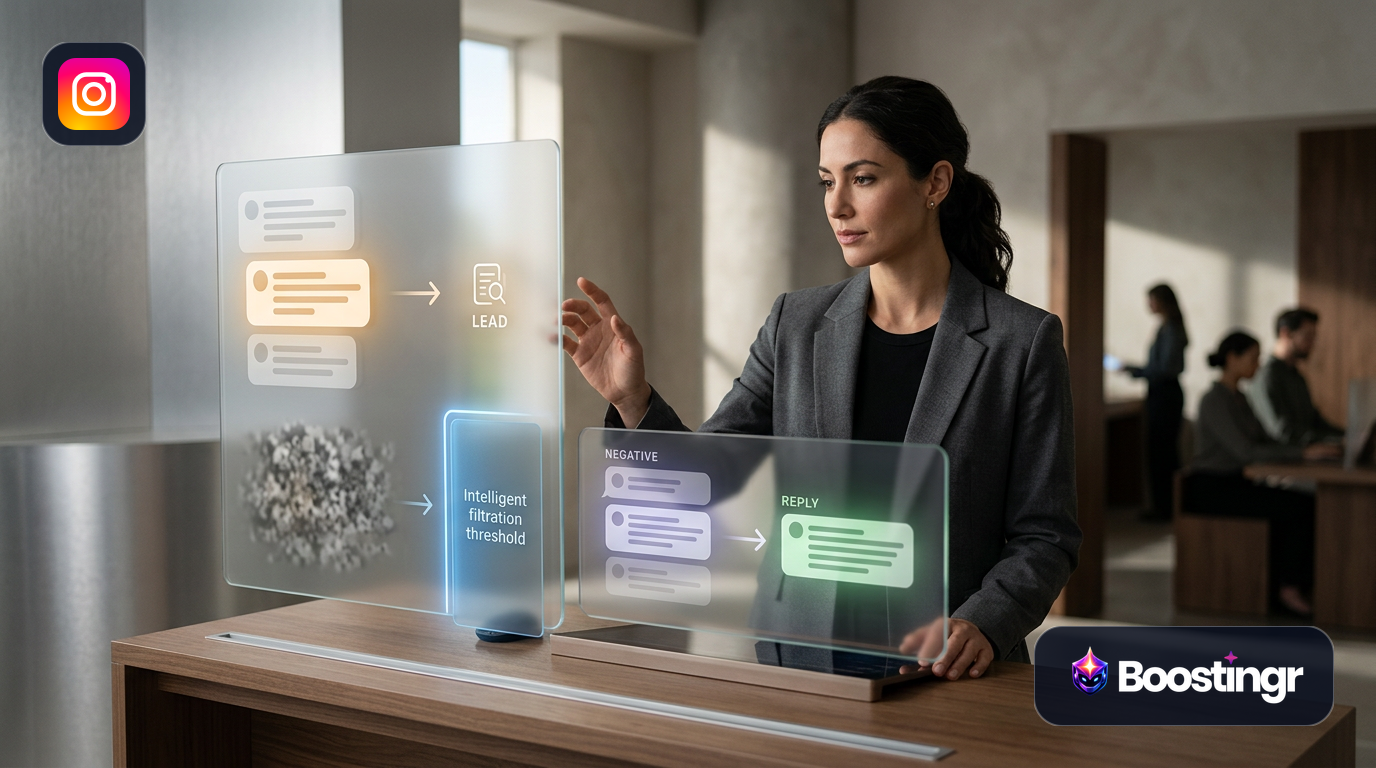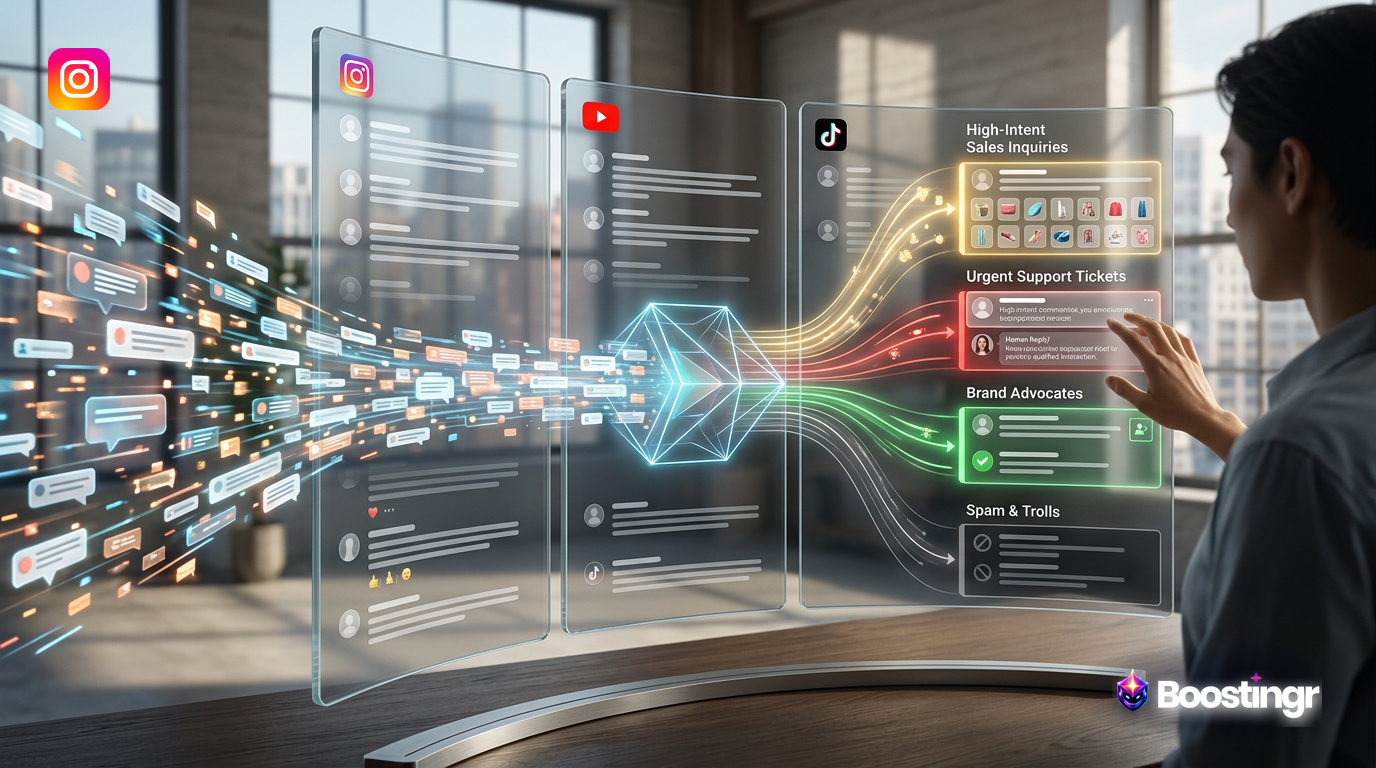
The Unseen Cost of 'Good Enough' Comment Management
Your social media comments are a firehose of customer interaction. Every day, hundreds, if not thousands, of questions, complaints, praises, and sales inquiries flood your posts on Instagram, Facebook, YouTube, and TikTok. For a growing brand, the standard response has been to adopt some form of automation. You set up a few keyword triggers, create a blocklist for spam, and maybe an auto-reply that says, "Thanks for your comment! We'll get back to you soon."
This is basic inbox automation. And while it feels productive, it's a leaky bucket strategy that costs you more than you think. This approach is the digital equivalent of using a filing cabinet with only two folders labeled "Good" and "Bad." It lacks nuance, misses critical opportunities, and ultimately fails to scale. In an era where speed is paramount—the Sprout Social Index reports that 40% of consumers expect a response from brands within the first hour—a generic, delayed response is a missed connection.
True **social media comment automation** isn't about just filtering comments; it's about understanding the people behind them. It's about intelligently triaging every interaction to capture leads, solve problems, and build loyalty at scale. The unseen cost of a 'good enough' system is measured in lost sales from unanswered buying questions, brand damage from festering complaints, and invaluable product feedback that gets buried under a mountain of spam.
This guide moves beyond the simplistic view of inbox automation. We will explore the profound difference between rudimentary rule-based systems and an intelligent, AI-powered operating system for comments. You'll learn how modern platforms like Boostingr don't just *read* comments—they *understand* them, enabling you to moderate, engage, and extract value across all your social channels from a single, intelligent core. It's time to graduate from basic replies to intelligent community management.
What is Social Media Comment Automation (And What It's Not)?
At its core, **social media comment automation** refers to using software to manage and respond to comments on social platforms without manual intervention for every single interaction. However, the term has been diluted, often used to describe two vastly different technological approaches that yield dramatically different results.
The Old Way: Basic, Rule-Based Automation
This is what most people think of when they hear "automation." It operates on simple `If-This-Then-That` (IFTTT) logic, which is rigid and lacks any real intelligence. It's a system of hardcoded instructions.
* **Keyword Triggers:** If a comment contains the word "price," reply with a link to the pricing page. If it contains a curse word from a predefined list, hide it. * **Simple Filtering:** Automatically hiding or deleting comments that contain any link or match a static spam wordlist. * **Generic Replies:** Sending the exact same pre-written response to every comment or every first-time commenter.
**The Limitations are Glaring and Dangerous:**
- **Lack of Context:** A rule-based system is blind to context. It can't differentiate between "This price is amazing!" and "This price is outrageous!" It sees the keyword "price" and triggers the same robotic reply, potentially alienating a happy customer or infuriating an unhappy one. This creates a jarring and negative user experience.
- **Inability to Understand Nuance:** Sarcasm, idioms, slang, and complex questions are completely lost. A comment like, "Great, another feature that probably doesn't work," might be misinterpreted as positive feedback based on the word "Great." This leads to embarrassing and reputation-damaging public replies.
- **Platform-Siloed:** The automation you set up for Instagram doesn't talk to your YouTube setup. You're forced to duplicate rules and workflows across platforms, leading to inconsistencies and massive administrative overhead. A policy update requires changing the rules in five different places, a recipe for human error.
- **Brittle and Unscalable:** As your brand grows, so does the complexity of your comment section. A system built on hundreds of manual keyword rules becomes a tangled, unmanageable mess. A single new product launch or marketing campaign can render your entire rule set obsolete, forcing you back to square one.
This approach treats comments as a nuisance to be deflected, not an opportunity to be seized.
The New Way: Intelligent, AI-Powered Automation
This is the paradigm shift. Intelligent **social media comment automation** moves from rigid rules to flexible understanding. It's powered by advanced Artificial Intelligence, including Natural Language Processing (NLP) and machine learning models, to interpret the meaning, sentiment, and intent behind the words. This is the core philosophy of Boostingr—to provide an AI that understands people.
* **Advanced Sentiment Analysis:** The AI reads a comment and classifies its emotional tone with high accuracy. It goes beyond simple positive/negative/neutral to understand mixed emotions or specific feelings like 'Urgent,' 'Confused,' or 'Excited.' This allows you to prioritize responding to frustrated customers or amplifying your biggest fans. Learn more about how this works with our sentiment analysis features. * **Deep Intent Detection:** The system goes beyond sentiment to understand the commenter's goal. Is it a `Purchase Intent` comment ("Where can I buy this?"), a `Support Question` ("How do I reset my password?"), `General Praise`, a `Product Complaint`, a `Feature Request`, or a `Competitor Mention`? Each intent can trigger a unique, highly relevant workflow, ensuring the right action is taken every time. * **Brand Memory:** This is the game-changer that separates intelligent AI from generic chatbots. The AI is trained on your specific brand information—product details, FAQs, return policies, brand voice guidelines, and even past successful human replies. It doesn't just give a generic answer; it gives *your* answer, consistently and accurately. This embodies the "Teach once, engage everywhere" principle, creating a scalable source of truth for all your public engagement. * **Humanized, Contextual Replies:** By combining intent detection and Brand Memory, the AI can generate replies that are not only accurate but also sound human and align with your brand's tone. It can answer a specific question about a feature on your new product because it has learned about that product. It can also generate multiple variations of the same answer to avoid sounding repetitive and robotic. * **Unified Cross-Platform Management:** A single, centralized AI brain is trained once on your brand. That intelligence is then applied consistently across Instagram, Facebook, YouTube, TikTok, and other connected accounts. Your brand voice, moderation policies, and product knowledge are consistent everywhere, automatically, without duplicating work.
This intelligent approach transforms comment management from a defensive chore into a proactive engine for growth, brand safety, and deep community intelligence.
Comparison Table: Basic Inbox Automation vs. Intelligent Comment Management
To truly grasp the difference, let's compare the capabilities of traditional social media management tools with a dedicated AI comment management platform like Boostingr.
| Feature | Basic Automation (e.g., Hootsuite, Sprout Social, ManyChat) | Intelligent Automation (e.g., Boostingr) |
|---|---|---|
| **Core Logic** | `If-This-Then-That` keyword triggers and predefined rules. | AI, Natural Language Processing (NLP), and machine learning models that understand context. |
| **Moderation** | Hides/deletes comments based on static keyword blocklists. Prone to false positives and censorship accusations. | Intelligently detects spam, trolls, and hate speech based on context and user behavior. Reduces false positives and manual review. |
| **Sentiment Analysis** | Rudimentary or non-existent. Cannot reliably detect sarcasm or mixed emotions. | Advanced, multi-label sentiment analysis classifies comments as positive, negative, neutral, or urgent, allowing for response prioritization. |
| **Intent Detection** | Not available. Treats a sales question the same as a general comment. | Accurately classifies user intent (e.g., purchase, support, feedback, spam) to trigger specific, relevant workflows. |
| **Reply Generation** | Sends pre-written, static canned responses. Feels robotic and impersonal. | Generates dynamic, contextual, and humanized replies using Brand Memory to ensure accuracy and on-brand tone. |
| **Multi-Platform Sync** | Requires separate rule setup for each platform. Inconsistent and inefficient. | "Teach once, engage everywhere." A single AI brain applies its knowledge consistently across all connected social accounts. |
| **Lead Capture** | Misses buying signals unless they contain specific keywords like "buy" or "price." | Proactively identifies high-intent comments (e.g., "I need this!") and routes them to a lead capture or sales-assist workflow. |
| **Crisis Management** | Relies on simple keyword alerts, often creating a high volume of false positives and alert fatigue. | Detects spikes in negative sentiment velocity and concentration, providing early warnings for potential PR crises. |
| **Community Insights** | Basic comment counting and tagging. Provides little strategic value. | Transforms comment data into a strategic asset, revealing trends in customer sentiment, product feedback, and emerging issues. |
| **Scalability** | Brittle. Manual rule sets break easily and become unmanageable as comment volume grows. | Elastic and self-improving. The AI learns from new interactions and scales effortlessly from hundreds to millions of comments. |
While tools like Hootsuite and Sprout Social are excellent for scheduling posts and high-level analytics, their automation capabilities are typically built for inbox management, not for the nuanced, high-volume challenge of public comments. They lack the deep AI specialization required for true **social media comment automation**.
The Psychology of Commenting: Why Bad Automation Fails
To understand why intelligent automation is so critical, we must first understand the psychology of the person commenting. People leave comments for a few core reasons:
* **To Be Heard:** They want acknowledgment from the brand or community. * **To Get Help:** They have a problem or a question that needs a solution. * **To Share an Opinion:** They want to express praise, criticism, or a general thought. * **To Connect:** They want to be part of the conversation and community around a brand.
Basic, rule-based automation violates these psychological drivers. A generic, robotic reply to a heartfelt compliment makes the user feel dismissed, not heard. An irrelevant, keyword-triggered response to a support question causes frustration, it doesn't help. Hiding a comment with mild criticism because it contains a 'negative' keyword silences a user's opinion and can breed resentment.
As research from sources like Harvard Business Review highlights, customers often crave efficiency and connection. Intelligent automation is designed to deliver both. By providing a fast, *accurate*, and *contextually relevant* response, it satisfies the user's need for help and acknowledgment efficiently. The AI handles the immediate need, which builds trust and goodwill, allowing human managers to step in for more complex, relationship-building interactions. It's not about replacing humans; it's about making the human connection more meaningful by filtering out the noise.
Practical Examples and Use Cases
Theory is one thing; real-world application is another. Here’s how different types of organizations leverage intelligent **social media comment automation** to achieve specific goals.
Use Case 1: The Global Ecommerce Brand
* **Challenge:** A fashion brand launches a new collection and is inundated with thousands of comments across Instagram Reels and Facebook Ads. The comments are a mix of praise, sizing questions, complaints about a previous order, and sophisticated spam. * **Basic Automation's Failure:** A keyword filter for "size" would reply with a generic size chart link to everyone, ignoring those complaining that the sizing runs small. Spam filters would be overwhelmed by bots using clever phrasing. * **Intelligent Automation with Boostingr:**
* Comments like "Do you have this in blue?" or "How much is the jacket?" are identified as `Purchase Intent`. The AI checks the Brand Memory for product details and replies, "We do! The jacket is $129 and comes in three colors. You can see them all here: [link]. Let us know if you have other questions!" This is a direct sales assist. * Comments like "My last order was wrong" are identified as `Customer Support` issues. The AI replies empathetically, "We're so sorry to hear that. We want to make this right. Please check your DMs for a message from our team so we can get your details securely," while simultaneously creating a ticket in the support queue. * Comments like "OMG I love this!" are identified as `Praise`. The AI can be configured to send a warm, appreciative reply that matches the brand's fun voice, or simply "like" the comment to acknowledge the fan.
- **Proactive Moderation:** The AI instantly hides spam and hateful comments with over 99% accuracy, protecting the brand's ad spend and reputation. It flags comments with intensely negative sentiment for immediate review by the support team, preventing issues from escalating publicly. This is a core part of our brand safety promise.
- **Intent-Based Sales & Support:**
- **Automated Lead Capture:** The system automatically identifies high-intent comments ("I need this for my vacation!") and can use a workflow like our Instagram Lead Capture tool to send a DM, ask for an email address in exchange for a 10% discount code, and add the user to a marketing funnel.
Use Case 2: The High-Growth Creator
* **Challenge:** A YouTube creator with millions of subscribers is struggling to engage with their community. Their comment section is a valuable asset but is filled with genuine questions, repetitive queries, and relentless spam promoting crypto scams. * **Basic Automation's Failure:** The creator could only turn on YouTube's basic "hold potentially inappropriate comments for review," which is a blunt instrument that catches legitimate comments and requires hours of manual sifting. * **Intelligent Automation with Boostingr:**
- **Community Safety:** The AI acts as a 24/7 moderator, instantly removing spam and hateful comments, creating a safer, more positive community space. It can identify and block users in a coordinated harassment campaign, protecting the creator and their audience. This is a key focus of our AI comment moderation for creators guide.
- **Answering Repetitive Questions:** The creator spends 30 minutes training the AI's Brand Memory with answers to FAQs like "What camera do you use?", "What's your editing software?", and "Where is your merch store?" The AI now handles these hundreds of daily questions with accurate, slightly varied, human-sounding replies, freeing up the creator's time.
- **Prioritizing Engagement:** The system filters out the noise, allowing the creator to focus their limited time on engaging with the most thoughtful questions and positive comments from their top fans. The AI can surface comments from channel members or frequent commenters, ensuring the most loyal fans feel seen.
- **Content Idea Generation:** By analyzing comment trends, the AI can identify what the community is asking for next. A report showing a spike in questions about "lighting setup" gives the creator a data-backed idea for their next hit video. Our guide to YouTube comment moderation covers this in more detail.
Use Case 3: The Fortune 500 Enterprise
* **Challenge:** A large corporation needs to monitor brand health and manage its reputation across a dozen brand pages on Facebook, LinkedIn, and Instagram. They need to catch potential PR crises before they explode and gather authentic customer feedback. * **Basic Automation's Failure:** Keyword alerts for "fail" or "broken" would create a storm of false positives, burying the real threats in noise and leading to alert fatigue for the communications team. * **Intelligent Automation with Boostingr:**
- **Real-Time Sentiment Monitoring:** The platform provides a real-time dashboard showing the sentiment trend across all channels. A sudden spike in negative sentiment on a specific post or platform triggers an immediate, high-priority alert to the communications team, complete with sample comments.
- **Crisis Detection:** The AI is trained to distinguish between a single user complaint and a coordinated campaign or a comment indicating a serious product flaw (e.g., "My new phone's battery is overheating"). It analyzes the velocity, volume, and concentration of negative comments to flag emerging crises before they hit the news.
- **Actionable Community Intelligence:** By analyzing thousands of comments, the enterprise gains invaluable, unsolicited feedback. The AI identifies recurring themes, such as customers in a specific region complaining about a service outage or consistently asking for a specific feature. This data, detailed in our guide to AI community intelligence, becomes a direct line to the voice of the customer, informing product development, marketing strategy, and operational improvements.
How Boostingr Functions as an Operating System for Comments
Thinking of Boostingr as just another "tool" is a limiting perspective. It's more accurate to call it an **Operating System (OS) for AI Community Intelligence**. It doesn't just perform a single task; it provides the fundamental infrastructure for your entire comment management strategy, from moderation to engagement to insight.
Like a computer's OS manages the CPU, memory, and peripherals, Boostingr manages the flow of comments, AI analysis, and actions across all your social platforms. This is made possible through official, secure integrations with platform APIs like the Facebook Graph API, ensuring reliability and data privacy.
Here’s the step-by-step process:
* The first layer is a powerful moderation filter, identifying and neutralizing obvious spam, trolls, and hate speech with near-perfect accuracy. * The second layer performs **Sentiment Analysis**, gauging the emotional tone and urgency. * The third layer conducts **Intent Detection**, figuring out *why* the person is commenting (e.g., sales, support, praise). * The fourth layer uses **Entity Recognition** to identify specific products, locations, or people mentioned in the comment, adding crucial context.
* **Automate:** Generate and post a contextual, on-brand reply using the AI and Brand Memory. * **Moderate:** Hide or delete the comment based on your brand safety rules. It can also restrict the user. * **Escalate:** Flag the comment and route it to the correct human team member (e.g., sales, support, legal) via Slack, email, or CRM integration. * **Capture:** Log the comment as a lead, a piece of product feedback, or a positive testimonial in the community intelligence database.
- **Ingestion:** Comments from all connected accounts (Instagram, Facebook, YouTube, TikTok, etc.) flow into Boostingr in real-time via secure, official API connections.
- **Classification & Analysis:** Each comment is instantly processed by a multi-layered AI engine. This is where the magic happens in milliseconds.
- **Decision & Routing:** Based on the comprehensive analysis and a confidence score, the OS decides the next step according to your pre-configured workflows. The AI asks: Is this a sales lead? A support ticket? A simple question? A threat to brand safety? Is the confidence score over 95% for full automation, or should it be routed for human review?
- **Action:** The system executes the appropriate action with precision:
From our experience at Boostingr, we've seen this OS approach yield powerful results. **One key observation is that brands moving from basic keyword filters to our intent detection model typically see a 40-50% reduction in manual review time for negative comments, as the AI can accurately distinguish between actual criticism, harmless sarcasm, and support requests.** This frees up community managers to focus on valuable, relationship-building conversations.
Furthermore, **our platform data shows that AI-generated replies which reference specific product details learned via Brand Memory have a 15-20% higher positive engagement rate (likes, positive follow-up comments) than generic AI replies.** This proves that intelligence and context directly translate to better community engagement and brand perception.
Original Diagrams
These original visuals explain the workflow in a faster, more defensible format than plain text alone and give the article first-party assets that are easier to understand and harder to copy.
Comment Processing Workflow
This diagram illustrates the journey of a social media comment from the moment it's posted to how an intelligent system processes, categorizes, and acts upon it. It shows the shift from a simple inbox to a dynamic, multi-stage workflow.
AI Decision Tree
Unlike basic keyword triggers, an AI decision tree evaluates multiple layers of a comment, including sentiment, user history, and context. This allows for nuanced responses that distinguish a sarcastic compliment from genuine praise.
Moderation Pipeline
This visual represents an automated moderation pipeline that goes beyond simple blocklists. It intelligently identifies and filters spam and harmful content while ensuring that legitimate negative feedback is escalated for human review.
Intent Classification Flow
This flow demonstrates how AI deciphers the 'why' behind a comment, classifying it into actionable categories. Understanding if a comment is a sales lead or a support issue allows the system to route it to the correct team or workflow.
Brand Memory Diagram
Intelligent automation builds a 'brand memory,' learning from every interaction to understand your brand’s voice, product details, and common questions. This allows the AI to provide consistent and context-aware responses that improve over time.
Checklist: Implementing Intelligent Social Media Comment Automation
Ready to move beyond basic automation? Follow this checklist to implement a truly intelligent system that drives results.
* [ ] **Audit Your Current State:** Analyze your average daily comment volume, the types of comments you receive most (questions, spam, praise), and your team's current average response time. This baseline will help you measure ROI. * [ ] **Define Brand Safety Policies:** Create clear, written guidelines for what constitutes unacceptable content. Be specific: what is your policy on profanity, hate speech, spam, or mentioning competitors? This will be the rulebook for your AI moderator. Our guide on how to handle negative comments with AI can help. * [ ] **Document Your Brand Voice:** Is your brand witty, formal, empathetic, or fun? Document this with examples so the AI can learn to match your tone perfectly. Our guide on the AI Instagram Reply Bot has tips on this. * [ ] **Build Your Knowledge Base (Brand Memory):** Compile a document or list of links with answers to your most frequently asked questions, product specs, return policies, and store hours. This will be the foundation of your AI's intelligence. * [ ] **Map Key Comment Workflows:** Identify the most important comment journeys. Common ones include `Lead Capture` (tag in CRM, send DM), `Customer Support Escalation` (create ticket, notify team), and `Positive Feedback Amplification` (reply with thanks, ask for review). * [ ] **Select an Intelligent Platform:** Choose a system built on AI, not just keywords. Look for features like intent detection, Brand Memory, and unified multi-platform support. Explore Boostingr's pricing and features to see if it's a fit. * [ ] **Connect and Configure:** Securely connect your social accounts via official APIs. Set up your initial moderation rules and reply workflows based on your defined strategy. * [ ] **Teach and Train the AI:** Upload your knowledge base to the AI's Brand Memory. The system will begin learning immediately, but the real magic comes from ongoing training. * [ ] **Activate with Human-in-the-Loop:** Go live, but start by having the AI suggest replies or actions for human approval. Use the platform's dashboard to review AI decisions, approve or edit replies, and provide feedback. This continuous training loop makes the AI smarter over time. * [ ] **Analyze and Optimize:** Use the community intelligence dashboards to track performance (response time, sentiment trends, common questions) and gain insights. Refine your workflows based on real-world data. * [ ] **Scale Across Channels:** Once you've perfected the process on one platform (like Instagram), extend your intelligent automation system to all your other social channels (like YouTube and Facebook) for consistent, efficient management.
Key Takeaways
If you remember nothing else from this guide, let it be these core points:
* **Not All Automation is Equal:** Basic, rule-based automation is fundamentally different from intelligent, AI-powered systems. The former is reactive and rigid; the latter is proactive, contextual, and flexible. * **Understanding is the Goal:** True **social media comment automation** focuses on understanding the sentiment and intent behind a comment, not just matching keywords. * **Brand Memory is Your Moat:** An AI's ability to learn and recall specific information about your brand (products, policies, voice) is what separates a robotic reply from a humanized, helpful one. It's a competitive advantage. * **A Unified OS is Superior:** Managing automation across siloed platforms is inefficient and inconsistent. A centralized "Teach once, engage everywhere" model, like our Brand Memory system, saves time and strengthens brand consistency. * **The Purpose is Augmentation, Not Replacement:** The best systems handle the 80% of high-volume, repetitive interactions, freeing up your human team to focus on the 20% of high-value, strategic conversations that build deep customer relationships. * **Comments are a Data Goldmine:** With the right AI, your comment section transforms from a moderation queue into a real-time source of AI community intelligence, driving business growth and product innovation.
Conclusion: From Comment Chaos to Community Intelligence
The conversation around **social media comment automation** is evolving. It's no longer a question of *if* you should automate, but *how*. Sticking with basic inbox automation is a strategic liability in today's fast-paced digital world. It creates poor user experiences, misses sales opportunities, leaves your brand vulnerable to reputational risk, and ignores a wealth of free customer insight.
The future belongs to brands that embrace intelligent automation—systems that understand nuance, context, and intent. By adopting an AI-powered operating system for comments like Boostingr, you can protect your brand 24/7, engage your community at scale with a humanized touch, and unlock a treasure trove of data that was previously buried in noise. This user-generated content is not only valuable for engagement but can also be viewed positively by search engines, as noted in Google's own documentation on the topic.
Stop just managing comments. Start understanding the people and the opportunities within them. Transform your comment section from a cost center into a powerful engine for sales, support, and strategy.
**Ready to see what true intelligent automation can do for your brand? Explore our use cases or sign up for Boostingr today and turn your comment chaos into a powerful growth engine.**