


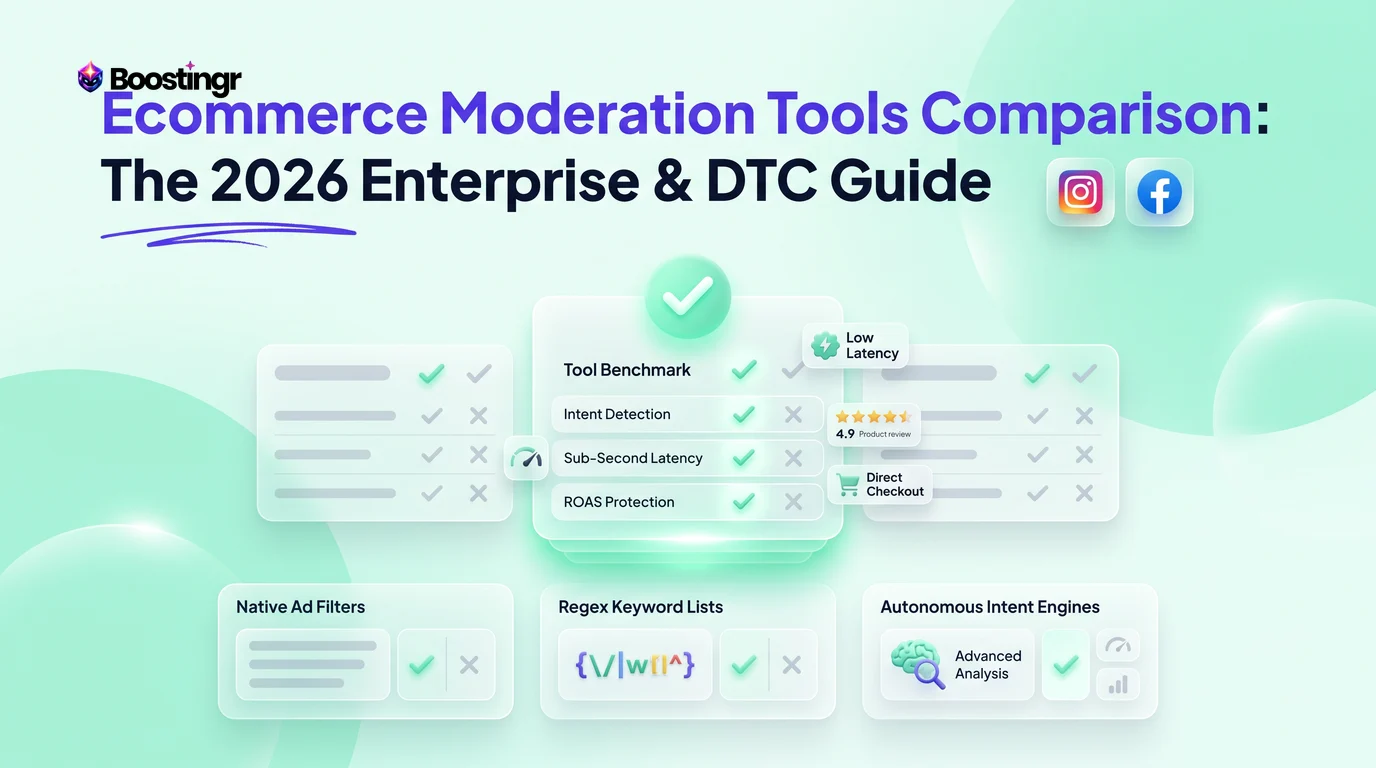
The Dual-Funnel Moderation Dilemma: Pre-Purchase Ads vs. Post-Purchase Reviews
For direct-to-consumer (DTC) operators and ecommerce marketing directors, content moderation has fractured into two fundamentally separate operational arenas:
- Post-Purchase Social Proof Governance (On-Site Reviews): Tools like Yotpo, Judge.me, and Okendo manage post-purchase ratings, photo submissions, and structured site widgets. Their operational mandate is trust validation, user-generated content (UGC) syndication, and strict adherence to regulatory standards like the FTC Endorsement Guides and EU Omnibus Directive.
- Pre-Purchase Traffic Protection (Paid Social Ad Comments): Social commerce environments—principally Meta Ads (Facebook & Instagram) and TikTok Ads—represent where performance marketing budgets live. When an ad scales, comment sections become public customer service channels and open battlefields where competitor link-drops, phishing bots, and angry delivery complaints directly erode conversion rates.
   PRE-PURCHASE FUNNEL (High CAC Risk)          POST-PURCHASE FUNNEL (Retention)
┌─────────────────────────────────────────┐    ┌───────────────────────────────────┐
│ Paid Ads (Meta, TikTok, Instagram)      │    │ Product Detail Pages (PDP)        │
│ • Threat: Competitor links, ROAS killer │    │ • Threat: Fake reviews, spam      │
│ • Opportunity: Sizing & purchase intent │    │ • Opportunity: SEO & social proof │
│ • Tech: Real-Time Webhook AI Moderation │    │ • Tech: Batch Review Moderation   │
└────────────────────┬────────────────────┘    └─────────────────┬─────────────────┘
                     │                                           │
                     ▼                                           ▼
              [ Boostingr ]                                [ Yotpo / Okendo ]
       (Speed: Sub-5s Webhooks)                    (Speed: Periodic / Manual Review)
Most software comparisons fail because they lump infrastructure developer APIs (like Microsoft Azure Content Safety or Hive AI) together with post-purchase review widgets. In doing so, they miss the high-stakes middle ground: social commerce moderation tools built specifically for active ad units.
When a DTC brand allocates $100,000 monthly to paid social acquisition, an unmoderated comment thread containing shipping complaints or phishing redirects doesn't just look messy—it actively degrades ad performance metrics and inflates acquisition costs. Conversely, a prospective customer asking "Does this fit true to size for someone who is 6'2"?" represents qualified checkout intent. If left unanswered for six hours, that prospect exits the conversion window. If answered in three seconds with an exact product recommendation, it converts immediately.
Evaluating the best ecommerce comment moderation tool requires auditing how well a platform bridges brand safety and automated revenue acceleration.
Core Software Categories: Architectural Archetypes
Choosing the right solution begins with understanding the technical and functional trade-offs between the four primary software categories serving ecommerce brands today.
1. Dedicated AI Comment Management Platforms (e.g., Boostingr)
These platforms sit between your social channels and customer interactions. Operating through native integrations with the Meta Graph API and Instagram Graph API, they ingest public interactions via real-time webhooks.
- Primary Function: Continuous protection of organic posts, dark ads, and paid campaigns; contextual spam/troll mitigation; automated sales routing via direct messages (DMs).
- Core Strengths: Sub-second to 5-second action latency, contextual sentiment evaluation, humanized brand voice generation, and deep catalog intelligence.
- Weaknesses: Engineered specifically for conversational social commerce; not designed to serve as on-site PDP review display widgets.
2. Traditional Social Media Management Suites (e.g., Sprout Social, Hootsuite, Sprinklr)
Enterprise social suites treat moderation as a subset of scheduled posting, cross-channel social listening, and customer support ticketing.
- Primary Function: Unified multi-platform scheduling, corporate governance, and team inbox workflows.
- Core Strengths: Mature role-based permissions, advanced enterprise audit logging, and legacy CRM connections.
- Weaknesses: Highly manual. Automated moderation features are typically restricted to basic keyword filters or add-on modules with high cost-per-seat pricing models. They rarely support automated revenue-generating DM funnels.
3. Rule-Based Comment Automation Tools (e.g., NapoleonCat, CommentGuard, ManyChat)
These tools provide mechanical execution for social comment handling, utilizing regex pattern-matching, blocklists, and pre-programmed chatbot conversation trees.
- Primary Function: Hiding comments matching specific text strings or firing pre-scripted static auto-replies.
- Core Strengths: Predictable execution for known spam domains, direct keyword matching, and structured bot flows.
- Weaknesses: High configuration maintenance, frequent false positives (hiding positive comments), inability to interpret context or sarcasm, and zero autonomous reasoning.
4. Enterprise Vision & Infrastructure APIs (e.g., Hive, AWS Rekognition, Azure AI Content Safety)
Developer-first platforms that evaluate media payloads (images, video streams, OCR text) against safety taxonomies like hate speech, adult content, and platform fraud.
- Primary Function: Raw moderation pipelines for multi-vendor marketplaces, gaming networks, and custom apps.
- Core Strengths: Deep multimodal detection, compliance at massive volume, and high technical configurability.
- Weaknesses: Require dedicated engineering teams to integrate, lack native Meta/TikTok ad workflows, offer no out-of-the-box ecommerce catalog synchronization, and cannot execute conversational revenue actions.
Keyword vs. Intent Nuance Comparison: The Hidden Cost of Regex
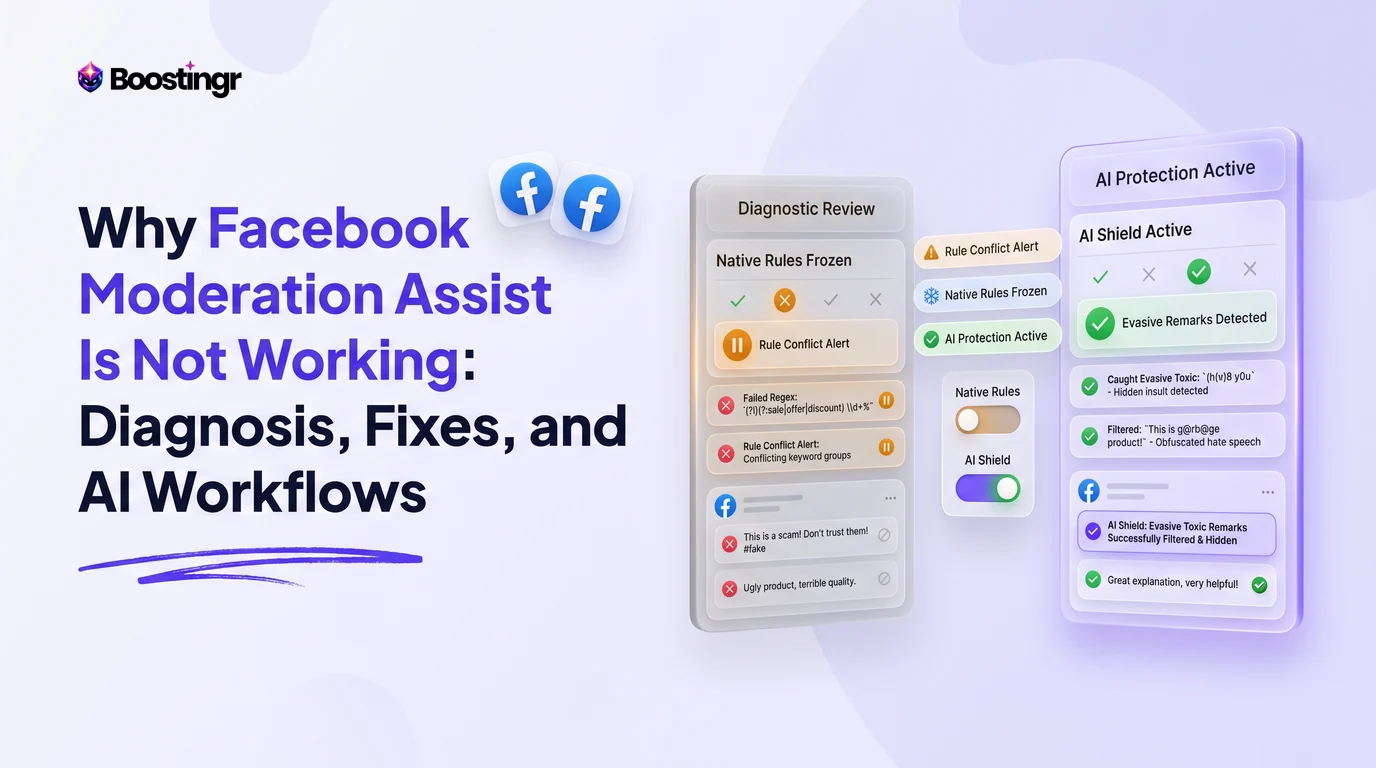
Many brands rely on basic keyword blocklists or built-in channel tools like Meta Moderation Assist. While simple, relying on raw keyword matching introduces severe operational blind spots. For an in-depth breakdown of native platform limitations, review our analysis on why Facebook Moderation Assist is not working.
Modern buyers express purchase enthusiasm, constructive product feedback, and frustration using slang, punctuation variations, typos, and multimodal phrasing. String matching fails because it evaluates characters rather than intent.
| Incoming User Comment | Keyword Filter Evaluation (Regex) | AI Intent & Context Engine Evaluation (Boostingr) | Real-World Business Outcome |
|---|---|---|---|
| "This moisturizer is the absolute bomb, my acne cleared up in 3 days!!" | Trigger: "bomb", "acne"Action: Hides comment | Intent: Ecstatic advocacy, social proofAction: Retains comment, replies with brand gratitude | Keyword Failure: Suppresses peak social proof on a paid scaling ad. AI retains conversion-driving UGC. |
| "Fake product. Looks nothing like the photos and took 3 weeks." | Trigger: "Fake"Action: Deletes comment | Intent: Legitimate post-purchase fulfillment failureAction: Retains visibility (or soft-hides to protect ROAS), routes customer service ticket via DM | Keyword Failure: Censorship triggers public backlash. Intent engine stabilizes the customer without PR risk. |
| "Stop wasting money here, buy from [CompetitorSite].com instead 🔥" | Trigger: Matches domain if explicitly blacklisted; fails if obfuscated (e.g., "c-o-m-p-e-t-i-t-o-r") | Intent: Hostile competitor hijacking / brand deflectionAction: Instantly hides comment within 3 seconds | Keyword Failure: Competitor steals traffic on paid impressions. Intent engine neutralizes link theft automatically. |
| "Is this cruelty-free? I want to buy the bundle but need to know first!" | Trigger: No blocklist triggerAction: None (Sits idle until manual team shift) | Intent: High-intent pre-purchase queryAction: Detects buying question, confirms certification, delivers bundle checkout link in public reply & DM | Keyword Failure: Buyer exits after waiting hours. Intent engine converts prospect in real time. |
The Operational Danger of False Positives
When a regex filter encounters modern colloquial praise—such as "This serum is insane, kills all redness"—a blocklist containing "kills" or "insane" automatically scrubs the comment. You end up spending ad budget to acquire a warm prospective buyer, who then sees that your system censored enthusiastic organic support.
Conversely, bad actors continuously adapt to keyword blocklists. Scammers employ zero-width spaces, Cyrillic homoglyphs (e.g., using Greek or Russian characters that appear identical to Latin letters), or spaced-out text ("f.r.e.e--s.h.i.p.p.i.n.g") to bypass filters. Contextual natural language processing evaluates the semantic trajectory of the comment, recognizing evasion tactics instantly without requiring thousands of manually updated regex rules.
To understand the deeper technical differences between static filtering rules and intelligent parsing, see our comparison on moderation software vs. basic comment filtering.
Ad Account Safety & Stealth Degradation: How Toxic Comments Kill Meta ROAS
Ecommerce operators routinely audit bids, creative assets, and landing page load speeds, yet overlook how comment sections influence auction economics. On platforms like Meta and TikTok, comments are an active variable in ad delivery performance.
[ Paid Ad Impression Served ]
             │
             ▼
[ Prospect Reads Comment Section ]
             │
    ┌────────┴───────────────────────────┐
    ▼                                    ▼
[ Toxic/Spam Comments Visible ]   [ Clean, Moderated Thread + Instant Answers ]
    │                                    │
    ▼                                    ▼
• Prospect Bounces                   • Friction Removed / Trust Validated
• Ad Marked "Irrelevant"/Negative    • Buyer Enters DM or Checkout Funnel
• Machine Learning Increases CPM     • Algorithmic Relevance Score Improves
    │                                    │
    ▼                                    ▼
[ ROAS Plummets 30-50% ]             [ Higher Conversion Rates at Lower CPA ]
The Direct Algorithmic Penalty
Meta's auction algorithm incorporates an internal Quality Ranking and Engagement Rate Ranking as part of its total ad value equation. When users encounter unmoderated fraud links, deceptive claims, or spam on your ads, several algorithmic penalties trigger:
- Negative Feedback Weighting: Prospects who see unmoderated scams frequently tap "Hide ad" or "Report ad -> Misleading or Scam". Meta's delivery system uses these signals to gauge ad quality. High negative feedback suppresses ad delivery and increases costs.
- Auction Liquidity Loss: As your quality ranking falls below the median of competing advertisers targeting the same audience, Meta compensates by demanding a higher bid to win auctions. Your cost per thousand impressions (CPM) climbs, eroding campaign margins.
- Conversion Window Churn: The vast majority of buyers read comments before completing a mobile purchase from an unfamiliar brand. Unaddressed shipping complaints or aggressive competitor claims introduce friction at the point of conversion, elevating your cost per acquisition (CPA).
For tactical playbooks on dealing with malicious campaigns, read our guide on how to stop competitors commenting on Facebook ads and learn when to hide vs. delete comments on Facebook without triggering public blowback.
The Moderation-to-Revenue Bridge: Turning Comments into Direct Checkouts
Traditional brand safety tools treat moderation exclusively as defensive cost-center management. Modern ecommerce comment platforms treat moderation as an offensive growth driver.
Every day, high-intent prospective customers post pre-purchase questions in social media comment sections:
- "Do you ship to Canada?"
- "Is this suitable for oily skin?"
- "What size should I get if I'm between a Medium and a Large?"
- "Is there a discount code for first-time buyers?"
If these comments sit unaddressed for hours, the customer's purchase impulse fades. However, by deploying AI Instagram reply bots and Instagram comment automation, brands can automate immediate, brand-safe conversions.
The Four-Step Revenue Workflow
- Intent Classification: The system ingests the comment via webhook, separating customer service questions, product inquiries, and spam.
- Brand Memory Synthesis: The platform accesses your brand knowledge base—including shipping timelines, product sizing charts, returns policies, and product details—to formulate an accurate, humanized response.
- Dual-Action Delivery:
- Public Reply: A concise, engaging response is posted publicly under the ad, signaling to all future viewers that the brand is attentive and active.
- Private DM Funnel: Simultaneously, the system opens an Instagram or Facebook DM with the prospect, providing an interactive answer and a direct checkout link that includes an auto-applied discount.
- Conversion Tracking: The prospect completes the transaction directly inside mobile webviews, attributing the conversion back to the ad interaction.
[ Prospect: "Is this bundle safe for sensitive skin?" ]
                       │
                       ▼
[ Boostingr Webhook Ingestion (<500ms) ]
                       │
        ┌──────────────┴──────────────┐
        ▼                             ▼
[ Intent: Pre-Purchase ]     [ Brand Memory: Consult Catalog ]
        │                             │
        └──────────────┬──────────────┘
                       │
                       ▼
[ Dual-Action Conversion Trigger (<3s) ]
       ┌───────────────┴───────────────┐
       ▼                               ▼
(Public Comment Reply)       (Private Direct Message)
"Yes! 100% hypoallergenic.   "Hey Sarah! We just sent over
Just sent full details to     the ingredient breakdown and
your DMs! ✨"                 a 10% checkout link to your inbox: [Link]"
To ensure your automated direct messaging flows operate smoothly without deliverability blocks, read our technical guides on fixing Instagram automated DMs going to spam and troubleshooting Instagram comment-to-DM failures.
Total Cost of Ownership (TCO) & Speed Analysis: Hidden Fees and Latency
When evaluating moderation platforms, marketing and engineering teams frequently encounter hidden operational costs and integration hurdles. A thorough evaluation requires examining how platforms handle usage limits and processing speed.
1. Pricing Structure & Hidden Fees
- Per-Comment or Consumption Billing: Many legacy tools charge on a tiered basis, such as $0.01 to $0.05 per processed comment. During seasonal volume spikes (like Q4 Black Friday/Cyber Monday sales) or viral ad campaigns, processing costs can surge unexpectedly. Look for platforms that offer transparent, flat-rate tiers based on connected accounts or predictable volume bands.
- Seat Licensing Costs: Enterprise social suites often lock advanced moderation and automation features behind expensive seat licenses ($150 to $300 per user/month). This model penalizes brands that need to grant cross-functional access to marketing, support, and agency teams.
- Pass-Through LLM Token Expenses: Some newer AI wrappers require brands to provide their own OpenAI API keys or bill separately for LLM tokens. This introduces volatile, unpredictable platform costs alongside standard subscription fees.
2. Processing Latency: Webhooks vs. Polling Sweeps
Latency defines whether moderation serves as a real-time shield or a delayed reaction.
- Polling Architectures (10–15 Minute Sweeps): Common in basic social tools, these systems ping the social network's APIs every 10 to 15 minutes to collect comments in batches. Under this approach, a competitor link, phishing attack, or hostile comment can remain live on your paid ad for up to 15 minutes, accumulating hundreds of impressions.
- Webhook-Driven Architectures (Sub-5-Second Action): Advanced platforms use event-driven webhooks. The moment a user submits a comment, the social network pushes an event payload to the platform. The comment is parsed, evaluated against brand safety rules, and hidden or answered within three to five seconds—neutralizing risks before audiences notice.
Comparison Table
The following matrix compares leading ecommerce moderation, social management, and customer interaction platforms across dimensions critical to scaling brands.
| Platform | Primary Focus | Moderation Engine | Meta & TikTok Dark Ad Support | Intent-to-DM Revenue Funnel | Latency Benchmark | Ideal Fit |
|---|---|---|---|---|---|---|
| Boostingr | Dedicated AI Comment Management | Contextual LLM Intent & Sentiment + Brand Memory | Full Dark Ad & Organic Coverage (Meta/Instagram/TikTok) | Built-In Automated DM Funnels with Catalog Integration | Sub-5 Seconds (Webhook-driven) | DTC Brands ($50k–$2M+ monthly ad spend) scaling social commerce |
| CommentGuard | Rule-Based Social Moderation | Advanced Regex, Blocklists, & Rule Triggers | Supported across Meta Ads | Limited (primarily basic auto-replies) | 5–30 Seconds | Performance marketers needing simple rule-based comment hiding |
| NapoleonCat | Social Inbox & Operations | Keyword Filters + Rule Logic + Human Inbox | Meta Ads supported | Basic comment-to-messenger sequences | 1–5 Minutes | Small agencies managing organic social calendars and basic support |
| ManyChat | Chatbot Automation & Lead Flows | Pre-scripted keyword automation and DM flow builder | Select comment triggers on Meta | Strong visual DM builder, weak nuanced sentiment filtering | Real-Time (Trigger-dependent) | Creators & lead-gen brands focused on structured keyword DM flows |
| Sprout Social | Enterprise Social Suite | Rule-based inbox tagging & manual review workflows | Supported via listening & inbox add-ons | None (Requires external CRM handoff) | 3–10 Minutes (Polling-dependent) | Mid-market to enterprise corporate teams needing governance and scheduling |
| Yotpo / Judge.me | On-Site Product Reviews | Post-purchase profanity and sentiment filters | None (On-site PDP widgets only) | Email/SMS review request flows only | Batch Processing (Minutes to hours) | Ecommerce store owners managing post-purchase review collection and display |
| Hive / Azure Safety | Developer Infrastructure APIs | Deep learning vision, audio, and raw text models | None (API only; requires custom code) | None | Sub-Second (API execution) | Enterprise marketplaces building custom internal moderation pipelines |
For specialized workflows targeting bad actors, explore our research on tools that identify social media trolls and fake accounts.
Deep Dive: Evaluating the Contenders
1. Boostingr: The Operating System for AI Comment Management
Boostingr takes a fundamentally different architectural approach from legacy tools: Boostingr does not just read comments, it understands people. Built specifically for the high-velocity realities of modern social commerce, it functions on the principle of "Teach once, engage everywhere." Instead of forcing growth teams to manually maintain thousands of brittle keyword variants, Boostingr utilizes semantic intent detection and dynamic brand memory.
- Core Capabilities: Real-time hiding of competitor URLs, toxic interactions, and bot attacks; detection of positive UGC; sub-5-second conversational responses that sound naturally human; and seamless automated DM routing to drive purchases directly from ad comments.
- Ecosystem Fit: Built for DTC brands running customer acquisition across Meta and Instagram, integrating social interactions directly with store context.
- Strengths: Eliminates false-positive censorship, protects paid acquisition ROAS around the clock, and drives incremental top-line revenue.
- Limitations: Focused strictly on off-site social comment management, rather than serving as an on-site PDP star-rating widget.
2. CommentGuard vs. NapoleonCat: The Traditional Automation Duel
Performance marketing teams frequently compare CommentGuard vs. NapoleonCat when seeking basic protection from comment spam.
- CommentGuard: Tailored primarily for ad buyers. It excels at auto-hiding comments with external links, image spam, and profanity across Facebook and Instagram campaigns. However, it relies heavily on static rule criteria rather than context-aware generative dialogue, missing opportunities to answer complex product questions.
- NapoleonCat: Provides an operational social inbox combined with an "Auto-moderation" engine. Teams can configure rule blocks (e.g., if comment contains "shipping", reply with URL). While reliable for simple patterns, managing complex rules across dozens of ad sets can become difficult to maintain, and its polling architecture can occasionally leave spam visible between sync cycles.
3. ManyChat: Conversion Strengths with Safety Gaps
ManyChat remains a leading choice for visual DM automation. If an Instagram creator posts "Comment 'LINK' to get my guide," ManyChat handles the sequence effectively.
- Where It Succeeds: Direct, trigger-based DM sequences with explicit keyword matching.
- Where It Falls Short: ManyChat is not built as a brand safety moderation engine. It cannot evaluate whether a comment like "Your customer support is garbage, I'm filing a dispute" represents an issue that should be flagged for urgent review versus filtered. Using ManyChat alone leaves paid campaigns vulnerable to competitor incursions and brand reputation risks.
4. Sprout Social & Sprinklr: Corporate Control at Enterprise Cost
For public enterprises and multinational corporations, suites like Sprout Social and Sprinklr deliver cross-channel governance, compliance sign-offs, and broad team permissions.
- The Trade-Off: These suites approach comments as customer support tickets. Comments are routed into centralized queues where human agents manually triage, hide, or respond to them. At scale, this introduces significant response lag. Maintaining 24/7 coverage across global ad spend using human agents requires substantial operational investment.
5. Yotpo, Judge.me, and Okendo: Post-Purchase Review Specialists
On-site review widgets remain essential for conversion rate optimization on product pages. They handle verified buyer collection, photo/video reviews, and structured SEO snippets according to Google's Search Essentials.
- The Boundary: These tools operate exclusively post-purchase. They do not monitor social ad campaigns or paid acquisition channels. Review software and social ad comment management serve complementary, non-overlapping functions in a modern ecommerce stack.
Practical Examples and Use Cases
Use Case A: Defending Flash Sale ROAS from Coordinated Competitor Hijacking
An apparel brand scaling an activewear collection launched a $40,000 weekend campaign across Instagram Reels and TikTok Ads. Within three hours of campaign launch, a dropshipping competitor deployed bot accounts across top-performing ad sets, posting comments like "Exact same quality here for $12 -> [ScamLink].net".
[ Competitor Bot Deploys Hijack Link ]
                  │
                  ▼
    ┌─────────────────────────────┐
    │  Real-Time Webhook Engine   │
    │     (Boostingr Ingestion)   │
    └─────────────┬───────────────┘
                  │ (3.1 seconds total)
                  ▼
    ┌─────────────────────────────┐
    │ Contextual Intent Analysis  │
    │ -> Flags external URL       │
    │ -> Flags domain mismatch    │
    │ -> Categorizes brand safety │
    └─────────────┬───────────────┘
                  │
                  ▼
    ┌─────────────────────────────┐
    │ Automatic Action: "Soft Hide"│
    │ (Author sees it, public does│
    │ not; ad relevance protected)│
└─────────────────────────────┘- The Outcome: The platform parsed incoming comments via webhook, identified domain-redirection intent, and applied a "soft hide" within 3.1 seconds. The bot creator saw their comment remain visible, preventing them from modifying their evasion strategy, while legitimate shoppers never saw the scam. The campaign maintained its target 3.2x ROAS without manual monitoring.
Use Case B: Converting Nuanced Pre-Purchase Inquiries at Scale
A luxury clean-beauty brand running Meta Ads frequently received comments from prospective buyers asking nuanced questions about sensitive skin:
- "I love the ingredients, but does this work well under silicone-based foundations?"
Traditional keyword engines routinely failed on these interactions because "silicone" was flagged on an outdated ingredients blocklist, accidentally hiding enthusiastic prospects.
By leveraging an intelligent intent engine, the platform recognized the question as an active purchase inquiry, referenced the brand's product knowledge base, and generated an accurate public reply within seconds: "Yes! Our formula is water-based and absorbs cleanly in 90 seconds, making it ideal under silicone foundations." Concurrently, it sent a direct message containing an exclusive travel-size bundle link, driving a direct attribution sale.
First-Party Mini Case Study: High-Growth Footwear Brand
A mid-sized footwear retailer processing 12,000 monthly social interactions across Meta and TikTok scaled their ad spend from $60,000/month to $180,000/month.
- Baseline Problem: Their manual support team worked 9 AM to 6 PM EST. Overnight and weekend ad comments were left unmoderated for up to 14 hours. Unaddressed shipping inquiries and sizing debates drove ad comment sentiment negative, causing their blended Meta CPA to climb from $34 to $49.
- The Implementation: The brand deployed Boostingr's real-time AI comment management engine, configuring contextual brand guidelines and connecting their product catalog via API.
- Results: Across the initial 90-day deployment:
- Comment triage latency dropped from 8.4 hours to 3.8 seconds.
- Zero false-positive hides were recorded on colloquial positive feedback.
- Pre-purchase sizing comments converted into $27,400 in direct-to-DM attributed revenue using automated checkout links.
- Meta Ad Relevance scores recovered, reducing blended CPA by 21.4% across core scaling campaigns.
Visual guide
Real-Time Social Ad Comment Flow
Contextual AI evaluates incoming comments on paid ads within seconds, automatically hiding damaging links while converting buyer questions into sales.
Choosing Your Ecommerce Moderation Stack
Ecommerce brands require fundamentally different software architectures for on-site review widgets compared to real-time paid ad comment moderation.
How Ad Comments Impact Conversion
Comment sections directly influence ad delivery costs and determine whether shoppers exit or proceed to checkout.
Checklist: Choosing the Best Ecommerce Moderation Platform
Use this checklist when evaluating platforms for your DTC or multi-channel retail brand:
- Sub-5-Second Action Latency: Does the platform ingest data through real-time Graph API webhooks, or does it rely on delayed polling sweeps?
- Complete Paid and Dark Ad Coverage: Can the platform ingest, track, and moderate dynamic ads, dark posts, Reels, and TikTok campaigns alongside standard feed posts?
- Context-Aware Intent Engine: Does the system distinguish slang and colloquial praise from genuine toxicity without relying on manual keyword blocklists?
- Integrated Revenue Generation: Can the platform convert public product questions into private DM checkout links and track attributed revenue?
- Brand Memory System: Can you upload size guides, shipping policies, and product details so the AI replies accurately in your brand voice?
- Predictable Total Cost of Ownership: Is pricing structured simply around connected accounts or predictable tiers, avoiding per-comment overage penalties?
- Shopify & Tech Stack Connectivity: Does the tool connect smoothly with your product catalogs and tracking systems?
- Soft-Hide Capabilities: Does the platform support shadow-hiding features where bad actors see their comment, but the public thread stays clean?
- Team Workflows & Escalation Rules: Can complex customer support tickets or billing disputes be routed cleanly to human specialists?
Key Takeaways
- Acknowledge the Dual Funnel: Evaluate on-site review widgets (Yotpo, Judge.me) for post-purchase social proof, and dedicated AI comment management platforms (Boostingr) for paid ad ROAS protection.
- Move Beyond Simple Keywords: Static blocklists introduce operational risk by filtering out enthusiastic customer slang while letting modified spam through. Contextual intent detection is essential for modern social campaigns.
- Protect Ad Performance Metrics: Unmoderated toxicity directly increases negative feedback rates in Meta's auction algorithms, raising CPMs and CPAs across scaling ad sets.
- Turn Inquiries into Sales: Leading ecommerce moderation platforms transform comment threads from cost centers into active revenue channels through instant public answers and automated direct-to-DM checkouts.
- Audit Speed and Latency: Delayed polling architectures leave spam visible on your ads for up to 15 minutes. Webhook-based systems protect your brand within seconds.
Frequently asked questions
What is the difference between social ad comment moderation and on-site review moderation?
Social ad comment moderation protects pre-purchase return on ad spend (ROAS) across paid campaigns on Meta, TikTok, and Instagram by filtering competitor links, spam, and trolling while converting high-intent questions. On-site review moderation governs post-purchase user feedback on product pages under regulatory frameworks like FTC and EU Omnibus guidelines.
How do unmoderated social media comments damage Meta Ads ROAS?
Unmoderated negative comments, scam links, and unresolved objections degrade audience sentiment, triggering higher negative feedback scores in Meta's auction algorithm. This lowers estimated action rates, directly spikes cost-per-thousand impressions (CPM) and cost-per-acquisition (CPA), and suppresses conversion rates among warm prospects reading comments before buying.
Why does keyword-based moderation fail for scaling DTC ecommerce brands?
Keyword blocklists rely on static string matching that misses deliberate misspellings, emojis, and obfuscations. Crucially, keywords lack contextual reasoning, frequently hiding genuine customer praise that includes slang (e.g., "this jacket is sick") or suppressing urgent support queries that need rapid resolution rather than censorship.
Can automated comment moderation generate direct ecommerce revenue?
Yes. Modern AI comment management platforms act as a moderation-to-revenue bridge. When prospects ask sizing, shipping, or stock availability questions on paid ads, the system detects buyer intent, answers instantly in brand voice, and dispatches direct-to-DM checkout links and targeted discount codes.
How does API latency impact social commerce moderation?
Platforms relying on periodic polling sweep for comments every 5 to 15 minutes, allowing phishing links and competitor ads to sit visible on active campaigns during peak ad spend. Real-time webhook architecture moderates, hides, or replies to comments within 3 to 5 seconds of publication.
What should DTC brands look for in ecommerce moderation tool pricing?
Brands should audit hidden total cost of ownership (TCO) traps, such as strict per-comment overage fees, pay-per-seat operational costs, and third-party LLM token pass-through charges. Predictable flat-tier or volume-tiered pricing tied to managed social accounts delivers the lowest cost predictability.
Is this available in size M? Want to order today