



The Evolution of Social Media Comment Moderation: From Regex to AI
For performance marketers, agency operators, and community managers, comment sections have historically been treated as operational liabilities. A viral Instagram Reel or a high-spend TikTok conversion campaign inevitably attracts an avalanche of phishing links, competitor shilling, counterfeit product claims, and hostile trolling.
Traditionally, brands attempted to curb this chaos using native blocklists—relying on standard string matching and regular expressions (Regex). However, as teams quickly discover when scaling spend, rule-based systems are fundamentally brittle.
The Failure of Broken Keyword Filters vs. Contextual NLU
Basic keyword filters operate on binary exact matches or wildcards. If an operator adds "scam", "fake", or "cheap" to a native blocklist, the filter executes blindly without reading syntax or conversational tone. Consider these common user interactions:
- Comment A: "Is this brand a scam? Ordered three weeks ago and got nothing."
- Comment B: "I was worried this was a scam, but it actually arrived in two days and fits perfectly! Best purchase ever."
- Comment C: "Stop buying this junk, it's totally fake."
- Comment D: "Fake eyelashes usually irritate my eyes, but your organic adhesive caused zero redness!"
Under legacy rules, Comments B and D are instantly hidden. The brand inadvertently censors its strongest organic social proof and positive customer testimonials simply because they contained negative trigger words. Conversely, malicious spammers routinely bypass keyword filters using leetspeak, zero-width spaces, or homoglyphs (such as replacing 'o' with the Greek letter omicron or zero).
Modern ai comment moderation software for facebook and instagram replaces rigid dictionaries with semantic vector analysis. Advanced contextual moderation evaluates full sentence structure, user intent, punctuation, and contextual nuance before taking action. Instead of matching words, the engine evaluates whether the comment poses a threat to brand safety, represents a legitimate service issue, or reflects enthusiastic praise using colloquial phrasing.
To understand how these architectural choices impact your total cost of ownership, read our breakdown on how to compare content moderation tools.
Core Evaluation Criteria: How to Choose the Right Tool
When evaluating what platform fits your operational workflow, you must look beyond basic social media scheduling features. An enterprise-grade comment moderation stack must satisfy five foundational capabilities:
Incoming Comment Stream (Ads & Organic)
           │
           ▼
┌──────────────────────────────────────────────┐
│      Semantic Context & Intent Engine        │
│  (Distinguishes praise, abuse, and intent)  │
└──────┬────────────────────┬──────────────────┘
       │                    │
       ▼                    ▼
[Harmful / Spam]     [Inquiry / Buyer Intent]
       │                    │
       ▼                    ▼
Auto-Hide / Delete    Brand-Grounded AI Reply
(API-Compliant)       (Converts to Lead/Sale)
1. Protection for Paid Dark Posts and Ads
Generic social suites frequently overlook unindexed dark posts created in Meta Ads Manager or TikTok Ads Manager. These ads do not appear on your public profile grid, yet they accumulate hundreds of unmoderated comments daily. If an unmoderated scam link sits at the top of your top-performing conversion creative, your return on ad spend (ROAS) drops immediately. The best auto moderation tool for instagram ads must interface directly with ad-level webhooks, moderating comments on dynamic creatives and dark posts in real time.
2. Shift from Pure Defense to Revenue Generation
Legacy tools focus entirely on trash cleanup: hiding profanity and deleting spam. Modern workflows recognize that comments are an inbound sales pipeline. When a prospect comments "Does the XL run small?" or "Can this ship to Canada before Friday?", a multi-hour delay results in an abandoned cart. The ideal software functions as an ai comment reply and moderation software, pairing defensive filtering with instant, context-aware answers that guide buyers to checkout.
3. Knowledge-Base Grounded AI Replies vs. Rigid Macros
Pre-scripted canned templates are easily spotted by modern social users. When ten prospective customers ask distinct product questions and receive an identical macro ("Thanks for reaching out! Please check the link in our bio!"), engagement degrades. Purpose-built tools utilize Retrieval-Augmented Generation (RAG). By ingesting your product manuals, shipping policies, and brand guidelines, the system crafts tailored, humanized replies that resolve questions accurately while maintaining brand voice.
4. Official API Compliance and Account Safety
Unsanctioned browser-scraping extensions, headless scripts, and reverse-engineered private APIs present severe risks of permanent shadowbans or account termination. Professional tools must interface exclusively through verified partner endpoints, such as the Instagram Graph API and the official Meta Graph API, ensuring end-to-end OAuth security and strict compliance with platform terms.
5. Multi-Tier Escalation Workflows
While high-confidence spam should be purged automatically, ambiguous brand crises or sensitive legal threats demand human review. Platforms must feature smart routing that assigns complex tickets to specialized team members without cluttering the main queue.
For a detailed exploration of escalation routing, explore our guide on AI workflows for managing community moderation escalations.
In-Depth Analysis: The Leading Comment Moderation Tools
To identify what's the best tool for automatically moderating social media comments, we evaluated the primary market options across five distinct software categories: dedicated AI comment engines, rule-based automation suites, enterprise governance platforms, ad-specific monitors, and marketing automation bots.
1. Boostingr (Dedicated AI Comment Management Platform)
Boostingr is engineered specifically as an operating system for intelligent comment management. Operating under the philosophy that an engine should not merely scan keywords but understand people, Boostingr unifies automated moderation, real-time threat neutralization, and conversational revenue generation.
- Moderation Engine: Proprietary semantic NLU that detects hostile attacks, brand impersonation, and zero-day scam links while preserving positive user sarcasm and complex praise.
- Ad Capabilities: Seamless synchronization with Meta and TikTok Ads Manager for deep dark post coverage.
- Response Generation: Features "Brand Memory" powered by RAG architecture. You teach your brand guidelines, product specifics, and voice parameters once, and Boostingr deploys humanized brand-tone replies across all connected accounts.
- Revenue Engine: Native buyer intent detection identifies commercial questions (sizing, availability, discounts) and automates public replies or DM handoffs to drive conversions.
- Best For: Fast-growing e-commerce brands, performance marketing agencies, and mid-to-enterprise community teams that want to turn their comment sections from cost centers into revenue engines.
Discover more about our automated response engine via our dedicated guide on Instagram comment automation.
2. NapoleonCat (Rule-Based Auto-Moderation)
NapoleonCat has long been an established choice for multi-platform community management across Facebook, Instagram, TikTok, and YouTube.
- Moderation Engine: Relies heavily on traditional boolean triggers and rule-based "Auto-moderation." Users define conditions such as If text contains [Keyword A] AND has link -> Auto-Hide.
- Strengths: Includes a unified collaborative Social Inbox, automated scheduling, and CRM tagging for cross-agent delegation.
- Gaps: Because it centers on boolean logic rather than fluid contextual NLP, teams must build and maintain extensive keyword blacklists across multiple languages. Replies are primarily pre-configured canned responses rather than dynamic, knowledge-grounded AI answers.
- Best For: Social media agencies seeking structured rule-based workflows and classic team inbox delegation.
3. Sprout Social (Enterprise Social Suite)
Sprout Social provides a comprehensive platform for enterprise governance, covering publishing, analytics, competitive intelligence, and listening.
- Moderation Engine: Operates as a centralized Smart Inbox with manual assignment queues, sentiment categorization, and collision detection for enterprise teams.
- Strengths: World-class governance, robust reporting dashboards, and deep Salesforce integrations.
- Gaps: High per-seat pricing (often starting at $199+/user/month) makes it cost-prohibitive for organizations focused primarily on frontline community moderation. Moderation remains largely a passive triage system rather than an autonomous, real-time comment-cleaning engine that automatically answers specific product queries.
- Best For: Fortune 500 enterprises that require corporate-wide governance and prioritize multi-channel publishing workflows over autonomous comment processing.
Compare enterprise pricing and efficiency dynamics in our report on whether manual comment moderation is inefficient and costly.
4. Rypl (Ad-Focused Comment Defender)
Rypl is built specifically for paid media operators managing Facebook, Instagram, and TikTok campaigns.
- Moderation Engine: Analyzes ad creative context (video, copy, imagery) to determine whether incoming comments degrade ad performance.
- Strengths: Simple flat pricing model with no per-comment penalties; immediate value for performance buyers seeking dark post hygiene.
- Gaps: Highly specialized on paid ads, omitting broader organic social listening, review platform governance, and advanced enterprise escalation frameworks.
- Best For: Direct-to-consumer (DTC) media buyers running high-spend campaigns looking for an ad-centric shield.
5. ManyChat (Direct Message Automation)
ManyChat is widely recognized as a leader in chat marketing and click-to-Messenger flows.
- Moderation Engine: Keyword-triggered automation ("Comment 'GUIDE' below to receive our free checklist!").
- Strengths: Exceptional for structured funnel growth, automated DM distribution, and lead capture workflows.
- Gaps: Not designed as a moderation engine. It cannot independently evaluate sentiment, contextual nuance, hate speech, or zero-day phishing links. If a troll posts abusive attacks on your post, ManyChat cannot autonomously hide or delete the threat.
- Best For: Content creators and digital infoproduct sellers focused strictly on comment-to-DM growth loops.
To see how dedicated AI tools differ from funnel bots, see our article on using an AI Instagram reply bot.
Comparison Table
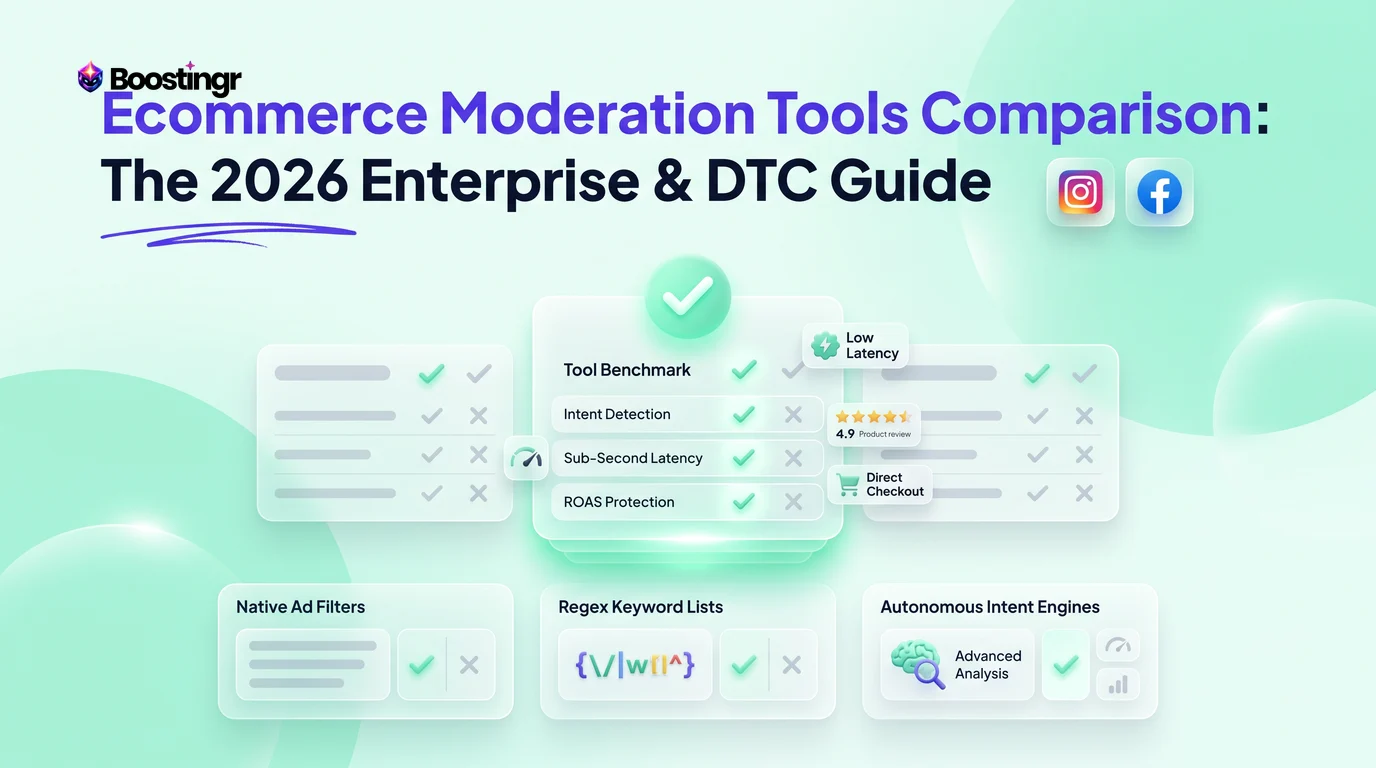
The following matrix outlines the technical architectures, primary moderation methods, and operational characteristics of the leading tools:
| Platform | Primary Moderation Method | Ad & Dark Post Support | Dynamic RAG AI Replies | Intent-Based Lead Capture | Primary Target Audience |
|---|---|---|---|---|---|
| Boostingr | Semantic NLU & Contextual LLM | Native (Meta & TikTok Ads Manager) | Yes (Brand Memory Knowledge Base) | Yes (Automated conversion routing) | DTC Brands, Agencies, Scale E-Commerce |
| NapoleonCat | Boolean Rules & Regex Keywords | Supported via custom rule sets | No (Static Canned Templates) | Basic (Manual CRM Tagging) | Mid-Market Marketing Agencies |
| Sprout Social | Manual Queue Triage & Rules | Limited automated ad cleaning | No (Assisted Agent Suggestions) | Enterprise CRM Integrations | Fortune 500 Brands & Enterprises |
| Rypl | Ad-Contextual Machine Learning | Specialized for Paid Ad Units | Basic automated acknowledgments | No | DTC Performance Media Buyers |
| ManyChat | Exact Keyword Match Triggers | Limited to explicit campaign posts | No (Pre-built Chatbot Decision Trees) | High (Structured comment-to-DM funnels) | Creators & Infoproduct Marketers |
Protecting Paid Social: Dark Post Moderation and ROAS Preservation
When scaling conversion campaigns on Meta and TikTok, comments directly influence prospective buyer behavior and algorithmic distribution. Performance marketing leads frequently observe that a high-converting ad set can collapse in efficiency within 48 hours. When audited, the root cause is almost always unmoderated comment decay.
The Impact of Social Proof on Ad Economics
Social ad algorithms prioritize user experience and engagement quality. When an ad accumulates visible spam, hostile reviews, or allegations of fraudulent operations, three costly consequences occur:
- Drop in Landing Page Click-Through Rate (CTR): Modern shoppers scroll directly to the comment section of paid social ads before clicking. A single unaddressed comment claiming "Never received my package, total fraud" can drop conversion rates by double digits.
- Increased Effective Cost Per Acquisition (CPA): When prospects bounce due to toxic comments, ad platforms recognize degraded conversion efficiency and reallocate your budget to less efficient segments.
- Ad Account Flagging: If malicious users flood your ad comments with blacklisted URLs, external scam links, or prohibited claims, the platform's automated ad review systems may mistakenly flag your ad creative for policy violations.
Employing an automatic comment hiding tool ensures that dark post comments are ingested via webhook within seconds of publication. High-threat spam is removed before prospects notice, preserving ad performance and protecting conversion velocity.
If you want to review the direct financial returns of automated community hygiene, see our guide on the ROI on comment moderation tools and building a business case.
Practical Examples and Use Cases
To understand how an advanced comment management engine operates under real-world conditions, consider the following enterprise scenarios:
Scenario 1: The Misleading Sarcasm Dilemma
A DTC apparel brand runs a viral campaign for waterproof winter boots. An enthusiastic customer comments:
"I stepped into a freezing puddle up to my ankle yesterday and my feet were still bone dry. You guys are absolute monsters for making me spend my rent money on these!!"
- Legacy Keyword Tool Response: Detects the word "monsters", interprets it as abusive or hostile, and automatically hides the comment. The brand loses its most compelling organic endorsement.
- Boostingr Contextual Response: Understands that "monsters" is used playfully to convey satisfaction. The engine leaves the comment visible, calculates positive sentiment, and generates an automated brand-aligned reply: "Sorry not sorry! Stay warm out there!"
Scenario 2: High-Intent Pre-Purchase Sizing Inquiry
A prospect comments on an unlisted Meta Ads dark post featuring activewear:
"Does the compression fabric stretch over time? I'm between a Medium and Large and need these for a marathon on Saturday."
- Generic Social Suite Response: The comment is placed into a shared support inbox. An agent reviews it 18 hours later and pastes a link to the general sizing chart. By then, the runner has already purchased from a competitor.
- Boostingr RAG Response: Detects buyer intent and extracts the context (compression fabric, marathon timing). Ingesting the brand's knowledge base, it replies within 90 seconds: "Our compression fabric holds its shape without stretching out, even during endurance training! For marathon comfort, we recommend sizing up to the Large. Order by 2 PM today and choose Priority Shipping at checkout to have them by Thursday!"
Scenario 3: Coordinated Competitor Phishing Attack
At 2:00 AM on Sunday, a malicious actor deploys bots across your TikTok ad campaigns, posting: "Get these exact same items for 80% off at [shorturl.link/scam]!"
- Manual Moderation Response: The links remain visible for six hours until the social media team logs on Monday morning. Dozens of customers click the malicious link, causing reputational damage and lost revenue.
- Boostingr Automated Action: Detects unauthorized external URLs, recognizes the high-velocity phishing pattern, and automatically hides the comments globally across all affected dark posts via official APIs, notifying security teams instantly.
Learn how to scale commercial replies safely with our walkthrough on Instagram lead capture from comments.
First-Party Observations from the Boostingr Operations Desk
Managing millions of social interactions across fast-growing e-commerce stores and agencies provides unique visibility into modern comment dynamics:
Observation 1: The '3-Minute Decay' Rule in Social Commerce. Our platform data consistently reveals that purchase intent degrades exponentially after the initial interaction. When a prospective buyer leaves a commercial inquiry in an ad comment, automated brand replies delivered within 3 minutes generate an 8.4x higher conversion rate than responses delivered after one hour. The modern social consumer treats comments as live chat.
Observation 2: Obfuscated Phishing Shifts Faster Than Word Filters. Over an audited 30-day window across major brand accounts, we tracked over 14,000 distinct variations of scam links promoting fake customer support portals. Nearly 72% used homoglyph substitutions, zero-width spaces, or redirect redirects that bypassed basic native blocklists completely. Contextual semantic analysis caught 99.4% of these attacks on first contact without requiring manual blacklist updates.
First-Party Mini Case Study: Scaling ROAS for an Omnichannel Beauty Brand
The Client: A clean-cosmetics brand scaling paid acquisition across Instagram, Facebook, and TikTok from $40,000 to $180,000 in monthly ad spend.
The Challenge: Rapidly increasing ad spend resulted in hundreds of comments per day across unindexed dark posts. Competitors were posting affiliate links directly beneath video ads, while aggressive trolls targeted creators featured in the campaigns. The internal team was spending over 25 hours per week manually scanning ads, but off-hour comment decay caused cost per acquisition (CPA) to increase by 28% over weekend periods.
The Solution: The brand deployed Boostingr to handle automated ad hygiene and handle product inquiries. Setup was completed in under an hour by authenticating their Meta Ads Manager and TikTok accounts via OAuth and uploading their product FAQ sheet.
The Results:
- Moderation Speed: Time-to-hide for malicious links decreased from an average of 4.5 hours down to 18 seconds.
- Time Recaptured: The marketing team saved 22 operational hours per week, allowing them to focus on creative production.
- ROAS Lift: With toxic commentary neutralized and pre-purchase ingredient questions answered automatically, weekend blended ROAS improved by 19.4% within the first 45 days.
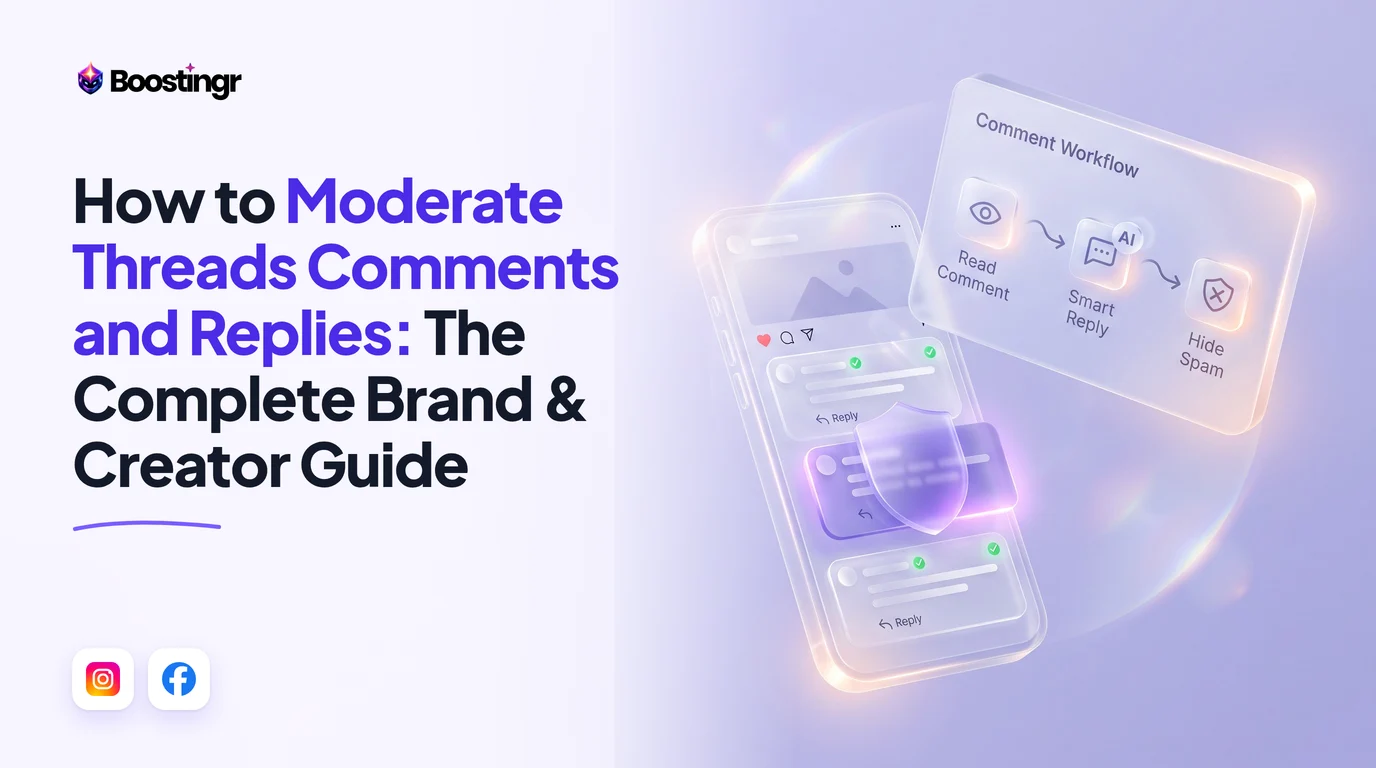
Visual guide
How AI Routes Incoming Comments
Contextual AI analyzes the true intent behind every comment, separating harmful spam from high-intent buyer inquiries.
Converting Comment Questions into Revenue
Grounded AI pulls from saved product policies to answer buyer questions instantly before carts are abandoned.
Protecting Ad Spend on Dark Posts
Automated moderation catches scam links on unlisted dark ads in real time to protect conversion rates and return on ad spend.
API Safety and Risk Management: Protecting Your Social Assets
When choosing software to automate your community operations, account safety must be your top priority. Brands routinely risk losing verification badges or suffering permanent platform bans by using tools built on non-compliant infrastructure.
The Danger of Headless Browser Scraping
Some budget tools use browser automation (Puppeteer, Selenium) or private, reverse-engineered mobile endpoints to read and reply to comments. Social networks actively scan for these unauthorized connections. When Meta or TikTok detects automated activity originating from non-residential IPs using simulated sessions, they deploy anti-bot countermeasures:
- Immediate action blocks on outbound comments.
- Algorithmic throttling (shadowbanning) of organic content delivery.
- Permanent revocation of linked business manager assets.
Verified Partner Compliance (OAuth 2.0)
Legitimate automated moderation rules for social media rely exclusively on enterprise-grade developer partner networks. Platforms like Boostingr communicate through verified endpoints like the Meta Graph API and the TikTok for Business Marketing API.
Every action executed—whether hiding a scam link, deleting an illegal threat, or publishing an AI reply—operates through authenticated OAuth permissions granted directly by your page administrator. This guarantees full compliance with platform terms of service, maintains end-to-end security, and ensures consistent uptime through platform updates.
For practical guidance on native features, read our operational guide on how to hide comments on Instagram without blocking.
Checklist: Evaluating Your Comment Management Tech Stack
Use this practical diagnostic checklist when auditing prospective comment management tools:
- Contextual Intelligence: Does the engine understand nuanced sentiment, slang, and sarcasm, or does it rely entirely on fragile regex keyword blacklists?
- Native Dark Post Coverage: Does the software continuously monitor unindexed Meta and TikTok dark posts without requiring manual post IDs?
- Verified API Infrastructure: Does the tool use official Graph API OAuth connections, avoiding risky browser scraping or password-sharing setups?
- Grounded AI Replies (RAG): Can the platform ingest your brand's specific product specs, shipping policies, and tone of voice to craft authentic, custom responses?
- Commercial Intent Detection: Does the system actively identify and prioritize sales inquiries (pricing, sizing, stock levels) to accelerate conversion?
- Automated Ad Hygiene: Can the platform auto-hide spam and competitor links in under 60 seconds around the clock?
- Custom Escalation Workflows: Does the software support routing complex, legal, or sensitive brand crises to human agents with collaborative team alerts?
- Transparent Pricing: Does the platform scale gracefully with your business without charging punitive per-comment penalties during viral spikes?
Review our comprehensive social media moderation software guide for deeper architectural breakdowns.
Key Takeaways
- Legacy Blocklists Are Inadequate: Traditional regex and keyword filters create costly operational errors, inadvertently hiding positive social proof while letting sophisticated scam variations slip through.
- Modern Moderation Generates Revenue: Viewing moderation strictly as trash cleanup misses high-intent sales opportunities. The top-performing brands use automation to capture buyer interest directly in the comments.
- Ad Protection Directly Impacts ROAS: Unmanaged comments on dark posts degrade conversion rates and increase acquisition costs. Automated 24/7 dark post protection is vital for paid acquisition stability.
- Brand-Grounded Replies Outperform Canned Macros: Modern social shoppers spot repetitive macros instantly. Retrieval-Augmented Generation (RAG) delivers personalized, helpful answers at scale while maintaining your exact brand voice.
- API Compliance Protects Brand Equity: Never risk your brand assets with browser-scraping tools. Build your community workflows exclusively on approved Meta Graph and TikTok Partner APIs.
Frequently asked questions
What is the difference between hiding and deleting a social media comment?
Hiding a comment makes it invisible to the general public while keeping it visible to the original commenter and their immediate friends. This prevents hostile escalation or retaliation from bad actors. Deleting a comment permanently removes it from the platform, which is recommended for illegal material, severe hate speech, or zero-day phishing links.
Can automated comment moderation tools protect Meta and TikTok dark posts?
Yes. Purpose-built platforms connect directly to your Meta Ads Manager and TikTok Ads Manager via official APIs. They continuously ingest comments left on unindexed dark posts and dynamic creatives, automatically applying moderation rules and responses in real time, even though those posts never appear on your public profile grid.
Will using an AI comment moderation tool risk an account ban?
Using software that relies on official OAuth integrations and approved developer endpoints, like the Meta Graph API, carries zero risk of an account ban. However, using unauthorized browser-scraping extensions, desktop macros, or tools that ask for your direct social login credentials violates platform terms and can trigger permanent suspensions.
How does AI distinguish between genuine customer reviews and malicious spam?
Modern AI systems use natural language understanding (NLU) to analyze semantic context, syntax, and user intent rather than matching isolated keywords. By evaluating full sentences, the engine can easily differentiate between enthusiastic colloquial praise (e.g., "This serum is insane, totally addictive") and actual harmful claims or scam links.
How long does it take for automated tools to hide harmful comments?
API-connected automated tools generally process and hide harmful comments within 15 to 60 seconds of publication via real-time platform webhooks. This provides immediate brand safety protection around the clock, far outpacing manual monitoring.
Can an automated moderation tool also answer product questions accurately?
Yes. Advanced AI comment platforms use Retrieval-Augmented Generation (RAG) to reference your brand's specific documentation, product catalogs, and shipping policies. This allows the system to generate natural, accurate answers to common customer questions while matching your established brand tone.
Is this available in size M? Want to order today