


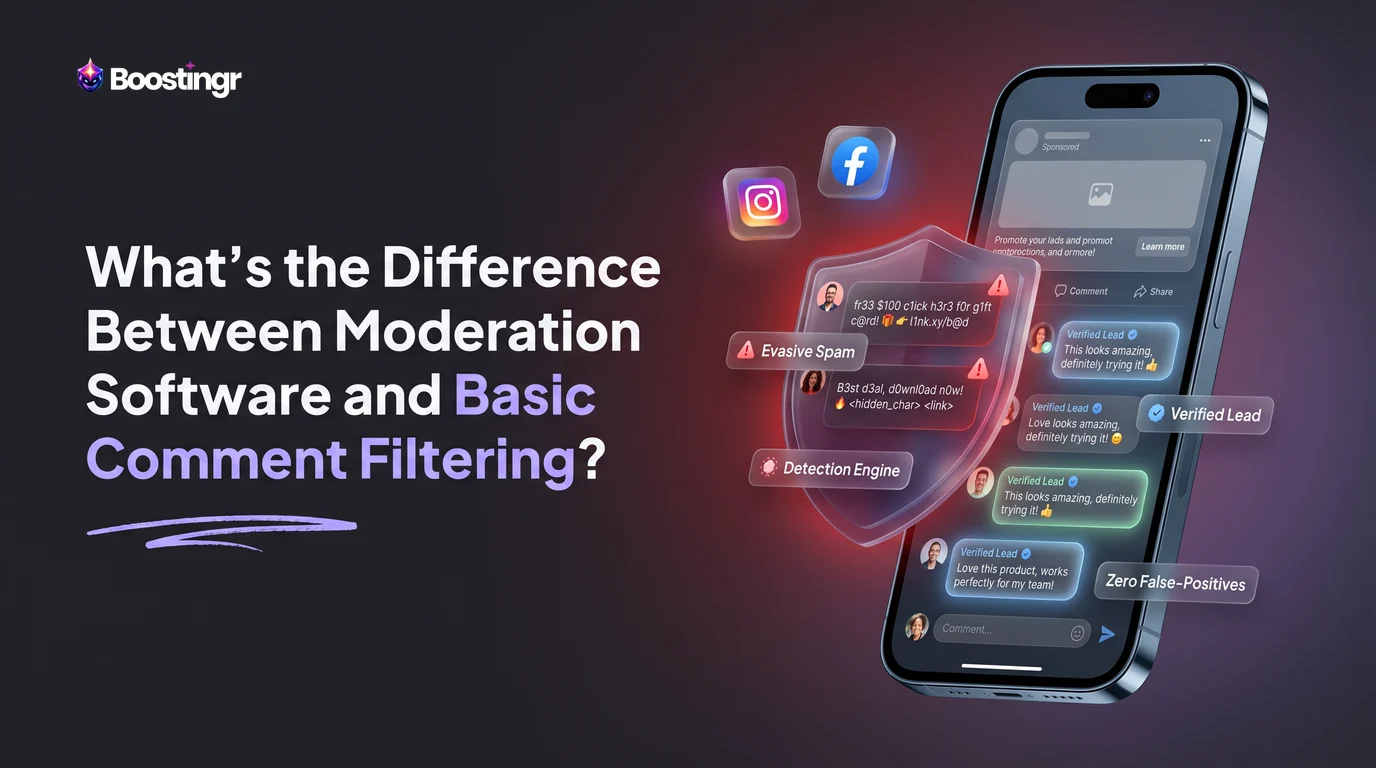
Defining the Architectural Divide: Rule-Based Filtering vs. Machine Learning Moderation
Every digital team managing paid acquisition, brand communities, or social channels eventually hits a wall with native platform settings. When spam floods an Instagram Reel or a Meta ad campaign begins bleeding return on ad spend (ROAS) due to toxic comments, the first impulse is usually to open native settings and paste fifty offensive terms into a blocklist.
Within days, two things happen: sophisticated trolls bypass the blocklist with trivial character substitutions, and enthusiastic paying customers have their glowing reviews hidden because they wrote phrases like, "I honestly thought this company was a scam, but this product changed my life."
Understanding why this happens requires examining the underlying technical architectures of rule-based moderation vs machine learning moderation.
The Mechanics of Basic Keyword Filtering
Basic comment filtering relies on deterministic, string-matching algorithms. Whether configured inside Meta Business Suite, YouTube Studio, or TikTok Ads Manager, these filters evaluate incoming text against a rigid array of predefined characters, words, or regular expressions (regex).
- Binary Logic: A string either contains an exact match for a blacklisted token or it does not. There is no middle ground, confidence score, or semantic scoring.
- Zero Semantic Awareness: The filter cannot distinguish between grammatical roles. A word functions identically whether used as a noun, verb, insult, or reclaimed colloquialism.
- Stateless Processing: Each comment is evaluated in total isolation, detached from user history, post topic, parent comment context, or media creative subject matter.
While native filters provide an essential frontline barrier against obvious, repetitive profanity, treating them as an end-to-end community governance strategy creates catastrophic blind spots.
The Architecture of Modern Moderation Software
Dedicated comment moderation software shifts the paradigm from deterministic word-matching to probabilistic language comprehension. Instead of asking "Is word X present?", an AI-powered system asks "What is the intent, sentiment, and operational consequence of this statement?"
Modern platforms utilize transformer-based Large Language Models (LLMs) and fine-tuned natural language processing (NLP) pipelines that parse:
- Semantic Embeddings: Converting sentences into multi-dimensional vectors to capture underlying meaning rather than surface-level spelling.
- Sentiment and Emotional Valence: Calculating whether a post exhibits constructive criticism, active hostility, sarcastic mockery, or high commercial buying intent.
- Entity Recognition and Syntax: Identifying brand names, competitor mentions, transaction queries, and customer service distress signals.
- Continuous Classification: Applying tiered moderation policies based on dynamic risk thresholds (e.g., auto-hiding severe harassment while flagging ambiguous user complaints for human review).
At Boostingr, we architected our platform around a core principle: Boostingr does not just read comments, it understands people. In community management, isolated words carry almost no actionable signal; context is everything.
False-Positive Anatomy: How Keyword Blocklists Destroy Social Proof and Revenue
One of the most damaging side effects of native, rule-based filtering is the accidental destruction of high-value social proof. Marketers spend thousands of dollars optimizing ad creatives to drive prospective buyers into the comment section—only for aggressive keyword blocklists to quietly hide their most persuasive customer testimonials.
The "I Thought This Was a Scam" Paradox
Consider the word "scam". It is universally the first term performance marketers add to their negative keyword lists across Facebook and TikTok ad accounts to insulate prospective buyers from accusations of fraud.
However, in direct-to-consumer (D2C) e-commerce, consumer technology, and service businesses, some of the highest-converting user-generated testimonials use contrastive rhetoric. A customer validates the legitimacy of the product precisely by acknowledging their initial skepticism:
- "I won't lie, when I saw this on my feed I was 100% convinced it was a scam. Ordered anyway, arrived in two days, and it's easily the highest quality jacket I own!"
- "Thought this was fake after seeing so many knockoffs. It's totally legit—worth every penny."
- "Customer service fixed my broken clasp immediately. Don't listen to the haters saying this brand steals your money."
When a native filter encounters these comments, its deterministic evaluator identifies the forbidden tokens: scam, fake, steals. The filter executes its sole command: hide comment.
[Customer Testimonial Posted]
  │
  ▼
"I thought this was a SCAM, but it's the best product I've ever bought!"
  │
  ├── Native Keyword Filter: Matches "SCAM" ──► [HIDES COMMENT] (High-value social proof lost)
  │
  └── Contextual AI Engine: Resolves Sentiment & Contrastive Rhetoric ──► [KEEPS VISIBLE + APPRECIATES]
The Financial Cost of False Positives
When legitimate praise is suppressed, the public perception of your ad creative shifts. Prospective buyers navigating the comment section no longer see authentic, nuanced customer journeys overcoming skepticism. Instead, they see either an unnaturally sanitized environment or unmoderated fringe criticism that slipped past the filter.
Furthermore, basic filters regularly flag benign industry terminology. If an apparel brand blocks "cheap" to prevent quality complaints, it inevitably suppresses comments like "Super fast shipping and unexpectedly cheap for this level of stitching!" If an electronics brand blocks "broken", it hides users offering peer-to-peer troubleshooting help ("If your Bluetooth seems broken, just hold the reset button for 5 seconds").
Advanced comment moderation software vs keyword filtering fundamentally resolves this tension. Machine learning models analyze the relational syntax of the sentence, recognizing that "I thought this was a scam" represents positive advocacy rather than a brand attack. Understanding how to hide comments on Instagram without blocking requires contextual intelligence, ensuring moderation actions only suppress malicious intent while leaving authentic social proof completely intact.
The Evasion Breakdown: How Bad Actors Defeat Native Blocklists
While native filters over-index on innocent customers, bad actors—including coordinated troll farms, phishing networks, and counterfeit rings—treat static blocklists as minor inconveniences. Rule-based systems fall victim to basic evasion mechanics that have existed since the earliest internet chat rooms.
1. Homoglyphs and Unicode Spoofing
Native keyword filters typically evaluate text using standard ASCII or basic UTF-8 string comparison without deep character normalization. Attackers bypass blocklists by replacing Latin characters with visually identical Cyrillic, Greek, or special mathematical symbols.
- Blocked Target:
whatsapp - Evaded Bypass:
whаtsаpp(using Cyrillic small letter 'а', UnicodeU+0430, rather than Latin 'a') - Result: The native filter scans the byte sequence, finds no match for ASCII
whatsapp, and permits the comment. The human eye detects zero visual difference.
2. Zero-Width Spaces and Invisible Separators
By injecting non-printing characters such as Zero-Width Spaces (U+200B), soft hyphens (U+00AD), or word-joiners between characters, spam bots break exact-match tokenization:
scam <-- Contains hidden U+200B characters between every letter
To a native platform blocklist configured for scam, the string registers as four disjointed single-character evaluations. Unless community managers manually write permutations covering every conceivable zero-width injection—an engineering impossibility—the spam comment remains live.
3. Leetspeak and Phonetic Substitution
Phonetic and numeric substitutions remain wildly effective against basic filters. Attackers routinely disguise hate speech, phishing links, and Telegram handles using variations like:
sc@m,sc4m,s.c.a.m,s_c_a_mf@ke,phake,faаkkeedm me on telegr@m: @crypt0_helper
If a marketing team updates its native blocklist to include s.c.a.m, the spammer simply switches to s-c-a-m or s/c/a/m. Attempting to catch every permutation via regex leads to catastrophic over-blocking of standard punctuation and email addresses.
4. Spaced Punctuation and Formatting Evasion
Spammers routinely exploit platform line breaks and spaced periods to mask predatory external links. Instead of posting malicious-domain.com, they post:
check my bio or visit: m a l i c i o u s - d o m a i n . c o m
Because native platform filters are not equipped with URL deobfuscation engines, they fail to recognize the sequence as an actionable web address.
Modern ai comment moderation vs basic keyword filters combats this through multi-stage text normalization pipelines. Dedicated moderation software strips hidden Unicode, normalizes leetspeak, resolves phonetic equivalents, and evaluates normalized representations through semantic classifiers before rendering a moderation verdict. For brands dealing with toxic link networks, leveraging tools designed around how to block links in Facebook comments prevents bot networks from draining team productivity.
Defensive Filtering vs. Growth Engine: Turning Interactions into Revenue
Perhaps the most transformative distinction between basic filters and specialized moderation software is strategic objective. Native keyword filters are purely defensive cost centers designed to hide undesirable text. Modern AI moderation software functions as an active growth engine.
┌────────────────────────────────────────────────────────────────────────┐
│                     THE STRATEGIC PARADIGM SHIFT                       │
├──────────────────────────────────┬─────────────────────────────────────┤
│    Native Comment Filtering      │       AI Moderation Software        │
├──────────────────────────────────┼─────────────────────────────────────┤
│ • Purely defensive (hides text)  │ • Bidirectional (protects & grows)  │
│ • Binary string matching         │ • Contextual intent classification  │
│ • Static trigger blocklists      │ • Dynamic Brand Memory reasoning    │
│ • Ignores buyer signals          │ • Instant revenue & lead capture    │
│ • High false-positive rate       │ • Preserves contrastive praise      │
└──────────────────────────────────┴─────────────────────────────────────┘
In high-growth social media environments—particularly paid Meta and TikTok campaigns—the comment feed is not a static bulletin board. It is an active sales floor.
Identifying High-Intent Commercial Queries
A basic filter scans a comment section and ignores everything that lacks a forbidden keyword. In doing so, it ignores your most valuable business opportunities:
- "Does this fit true to size? I'm 5'11 and torn between M and L."
- "Do you ship to Calgary, Canada? How long does customs take?"
- "Is this compatible with an M2 MacBook Pro?"
- "Any restock planned for the Matte Black finish before Friday?"
To a native keyword blocklist, these comments are invisible. They sit in the public thread unaddressed. If your social team takes four hours to manually discover and reply to them, the prospective customer has already closed their browser, scrolled past the ad, or purchased from a responsive competitor.
Grounded, Instant AI Replies via Brand Memory
Specialized moderation software bridges the gap between content protection and customer conversion. Platforms like Boostingr utilize advanced intent detection to instantly categorize incoming comments into distinct operational streams: troll attacks, technical support, general sentiment, and high-intent buyer inquiries.
When a commercial query is detected, the platform does not serve a generic, robotic canned macro like "Thanks for reaching out! DM us!" That outdated automation style kills conversion rates and irritates users. Instead, it utilizes Brand Memory—a centralized repository of product specs, sizing charts, shipping policies, and brand guidelines—to generate immediate, hyper-accurate, humanized public responses.
- User Comment: "Does this fit true to size? I'm 5'11 and 180 lbs, torn between M and L."
- Boostingr Autonomous Response: "Hey Marcus! Our jackets feature an athletic cut. At 5'11 and 180 lbs, a Large will give you the perfect comfortable fit if you plan to layer over hoodies, while Medium will be tailored to the chest. Drop us a DM if you'd like an exact sleeve measurement!"
By operating with a philosophy of Teach once, engage everywhere, modern software turns your ad comments into high-velocity conversion funnels. Leveraging tools like an AI Instagram reply bot or comprehensive Instagram comment automation ensures that brand safety protocols and inbound lead acquisition operate harmoniously across every campaign.
Siloed Native Tools vs. Unified Cross-Platform Control
For enterprise marketing teams, agency media buyers, and global community directors, the operational friction of native tools is just as debilitating as their technical limitations.
The Operational Reality of Native Comment Inboxes
When managing a multi-channel presence natively, your community moderation team must juggle distinct, fragmented interfaces daily:
- Meta Business Suite: Moderating organic Facebook page posts and standard Instagram feed assets.
- Meta Ads Manager: Tracking down unlisted "dark posts"—promoted ad variations that do not appear on your public profile grid but accumulate thousands of comments in user feeds.
- TikTok Ads Manager / TikTok Business Center: Managing comment streams with entirely different character constraints, spam trends, and blocklist limits.
- YouTube Studio: Navigating separate moderation queues for standard uploads, YouTube Shorts, and Community tab updates.
Every single platform requires its own manually curated blocklist. If a new scam token surfaces on a viral TikTok ad on Tuesday morning, someone on your team must log into TikTok, update the blocklist, open Meta Business Suite, update the Instagram blocklist, open Facebook Page settings, update the Facebook blocklist, and repeat the process for YouTube.
[Fragmented Native Architecture]
  ├── Meta Business Suite ──► Manual Blocklist A (Sync Lag)
  ├── Meta Dark Posts Ads ──► Completely Untracked Feeds
  ├── TikTok Ads Manager  ──► Manual Blocklist B (Different limits)
  └── YouTube Studio      ──► Manual Blocklist C (No cross-sync)

[Unified AI Moderation Architecture (Boostingr)]
  └── Global Safety Policy Engine
        │
        ├── Meta Graph API (Organic + Dark Ads)
        ├── TikTok Events & Comment Webhooks
        └── YouTube Data API Feeds
        │
        └── Normalized Triage ──► Single Inbox ──► Automated Policy & Brand Memory
The Dark Ad Vulnerability
Dark posts represent the single largest financial hazard for performance advertisers using native comment filtering. Because performance marketing teams frequently spin up hundreds of dynamic creative iterations and split-tests weekly, community managers working inside standard native interfaces often don't even know these ad posts exist.
Scammers exploit this invisibility. They identify active paid ads, drop phishing links or allegations of credit card theft in the comments, and siphon away traffic. By the time a media buyer spots the damage during weekly creative reporting, the ad's conversion rate has collapsed, driving up Customer Acquisition Cost (CAC) and burning ad budget.
Dedicated moderation software connects directly to platform developer frameworks—including the Instagram Platform on the Meta Graph API and the enterprise Meta Graph API. This allows the system to ingest, classify, hide, or reply to comments on organic posts, sponsored ads, and unpublished dark posts in real time, long before manual audits could ever detect an issue.
Instead of managing fragmented spreadsheets of blocked keywords, teams enforce humanized brand-tone replies across connected social accounts from a centralized console, ensuring global safety policies deploy universally across every touchpoint.
Contextual Comment Moderation and Sentiment Analysis in Action
To see why machine learning eclipses keyword matching, consider how human beings actually communicate online. Social discourse is deeply layered with irony, idioms, sarcasm, slang, and cultural shorthand. Binary filters cannot parse linguistic nuance; contextual comment moderation and semantic classification handle it seamlessly.
Decoding Sarcasm and Negative Tone Without Bad Words
Some of the most destructive comments on social media contain zero profanity or blacklisted keywords. Consider the following examples:
- "Oh wow, what a revolutionary design. It only took you three years to copy your competitor's exact product down to the font! Bravo."
- "Placed my order six weeks ago and still haven't received tracking. Absolutely top-tier service as always!"
- "I just love spending $150 on something that shatters the first time you drop it on carpet."
To a native platform keyword filter, these comments look perfectly benign. Words like revolutionary, competitor, bravo, service, and love are overwhelmingly categorized as neutral or positive in primitive dictionary lookups. The native filter leaves them unflagged and visible at the top of your ad creative.
Specialized moderation software uses deep multi-class sentiment analysis to evaluate syntax, contrast markers, and contextual tone. It immediately identifies the sarcastic dissonance between positive lexical terms ("love spending $150") and negative real-world outcomes ("shatters the first time").
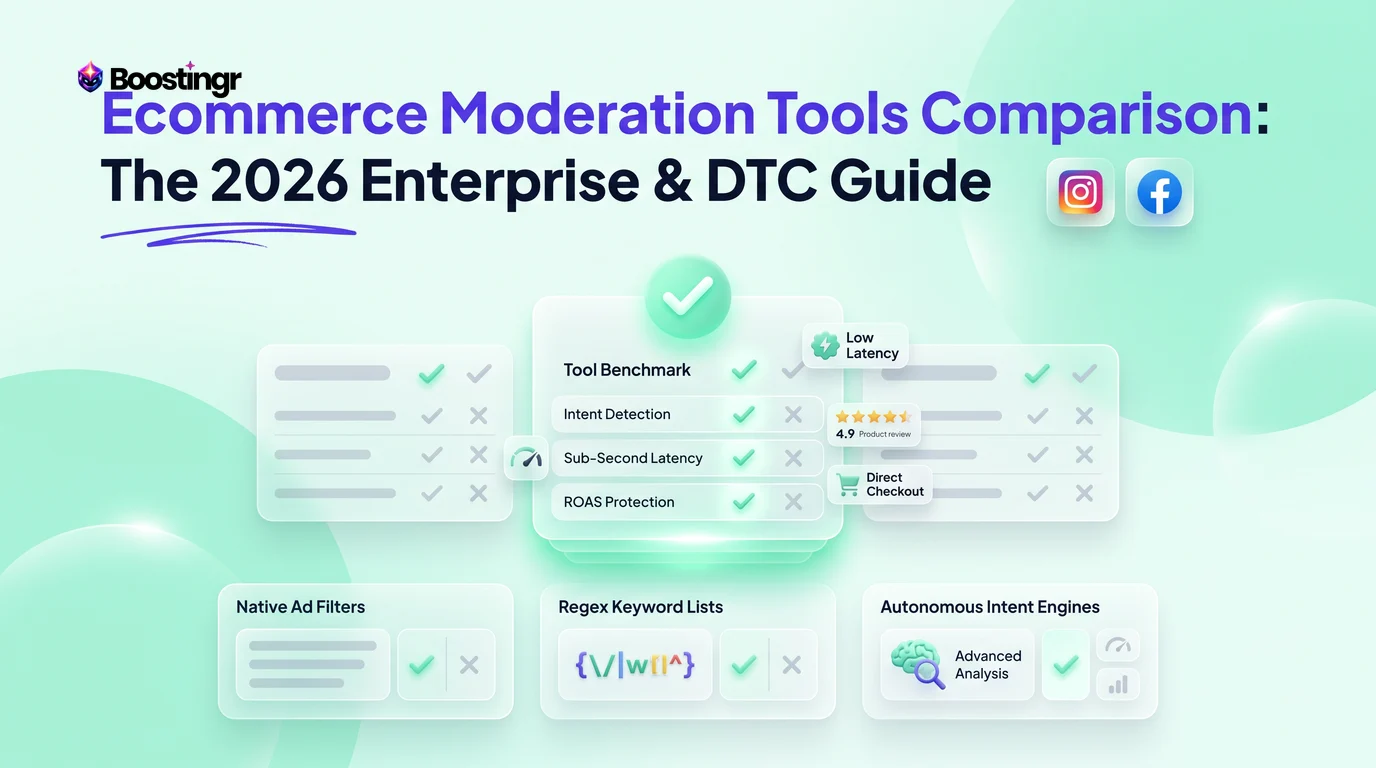
From there, the platform executes your configured workflow: routing the comment to a high-priority customer support queue, hiding it temporarily while an agent intervenes, or initiating automated lead-retention actions. To explore broader tool architectures, see our detailed evaluation on comparing content moderation tools.
Multilingual Nuance and Slang Evolution
Digital communities are rarely monolingual. Global brands frequently receive comments blending multiple languages, regional slang, or dialect variations within a single post:
- "This drop is straight fire, but your shipping prices to CDMX are an absolute robbery no mames."
An overzealous keyword filter configured to block "fire" (to prevent safety hazard accusations) or "robbery" (to prevent theft allegations) blindly hides an enthusiast who loves the product line and is simply asking for fairer international logistics. Contextual moderation parses the compound clause, isolates the authentic feedback, and flags the logistics friction point for your business intelligence team.
Comparison Table
| Evaluation Dimension | Native Keyword Filtering (Meta/TikTok/YouTube) | Advanced AI Moderation Software (Boostingr) | Strategic & Business Impact |
|---|---|---|---|
| Core Underlying Mechanism | Static string matching & basic regular expressions (Regex). | Deep Learning, NLP Transformers, & Semantic Vector Analysis. | Eliminates manual regex maintenance and adapts to conversational language. |
| Contextual Awareness | Zero. Treats words identically regardless of surrounding sentence structure. | Full semantic comprehension, parsing contrast, tone, and grammar. | Prevents suppression of high-converting testimonials ("I thought this was a scam"). |
| Evasion Resistance | Highly vulnerable to homoglyphs, zero-width spaces, leetspeak, and spaced periods. | Robust character normalization pipelines strip evasion artifacts before classification. | Stops organized phishing, crypto spam, and bot networks from polluting comments. |
| Sarcasm & Passive Aggression | Completely blind to toxic sentiment expressed through polite vocabulary. | Multi-dimensional sentiment analysis flags linguistic irony and sarcasm. | Surfaces hidden reputation crises and dissatisfied customers before churn occurs. |
| Commercial Intent Detection | None. Completely ignores purchase inquiries, sizing questions, and pricing queries. | Automatic classification of buyer signals, support requests, and product interest. | Recovers abandoned ad traffic and accelerates organic conversions directly in feeds. |
| Response Capabilities | None, or rigid, generic auto-responders that frustrate users. | Autonomous, context-grounded replies powered by centralized Brand Memory. | Delivers immediate, high-accuracy answers to prospective buyers 24/7/365. |
| Lead Capture & Conversion | None. Inability to bridge comment feeds to private sales funnels. | Automated transition from public interest comments to qualified private DM funnels. | Converts passive social engagement into trackable CRM leads and attributable sales. |
| Channel Governance | Siloed. Must configure and update policies individually inside every platform. | Unified cross-platform engine governing organic posts, paid ads, and dark ads. | Saves hundreds of hours of manual administrative overhead across brand accounts. |
| Dark Ad Coverage | Extremely weak; comments on unpublished dynamic ads are easily overlooked. | Comprehensive automated coverage via direct platform Graph API integrations. | Protects paid campaign ROAS and stops spam from degrading ad quality scores. |
Practical Examples and Use Cases
Scenario 1: E-Commerce Paid Social Ad — Dark Post Attack vs. High-Intent Buyer
A direct-to-consumer apparel brand scales a paid Meta and TikTok campaign to $15,000/day across 40 dynamic ad variations. Overnight, two distinct interactions occur on an unlisted dynamic dark post:
- Comment A (Phishing Bot): "D0nt buy fr0m here!! They st0le my info! Get the real version 80% off here: bit.ly/fake-discount-link"
- Comment B (Prospective Buyer): "I'm 5'4, usually wear a size 6 in dresses. Does the waist run small or should I order true to size? Also wondering about shipping to Austin!"
The Native Filtering Outcome
The native filter fails on Comment A because the spammer substituted letters with numbers (0 for o) and disguised the hyperlink. Comment A remains pinned near the top of the ad for 14 hours until a community manager manually spots it. During those 14 hours, hundreds of prospective buyers see the accusation, click-through rates plunge, and cost per acquisition (CPA) spikes by 38%.
Meanwhile, Comment B sits unanswered. The native tool has no mechanism to classify it as a sales query. By the time the brand's social team replies the following afternoon, the user has purchased a dress elsewhere.
The AI Moderation Software Outcome
Boostingr ingests both comments in real time via the Instagram Graph API:
- Comment A is normalized, stripped of leetspeak, identified as a malicious third-party link/defamation attempt, and automatically hidden within seconds—protecting the ad's conversion rate.
- Comment B is tagged with high commercial intent. Boostingr references the brand's sizing chart and local shipping SLAs stored in its Brand Memory, automatically deploying a friendly, brand-aligned public response within 90 seconds, followed by an automated DM containing a direct checkout link and size guide via Instagram lead capture.
[Dynamic Dark Post Live]
   │
   ├── Comment A: "D0nt buy fr0m here!! bit.ly/fake..."
   │      │
   │      └── Boostingr Normalization ──► Normalized: "Dont buy... [link]"
   │             └── Threat Classifier: Phishing/Link Spam ──► [AUTO-HIDDEN IN 3 SECONDS]
   │
   └── Comment B: "I'm 5'4, size 6... does waist run small?"
          │
          └── Boostingr Intent Classifier: Commercial Sizing Query
                 └── Brand Memory Access ──► Accurate Size Response + Direct DM Checkout Link
Scenario 2: High-Volume Creator Post — Viral Misinterpretation
A fitness creator launches a new resistance training app. A user comments: "Honestly thought this app was trash when I saw the price tag, but the progressive overload tracking is literally better than my $2,000 personal trainer."
- Native Filter Action: The word "trash" is on the creator's profanity/insult blocklist. The comment is instantly hidden. The most compelling comparison testimonial on the entire post is silenced.
- Dedicated Moderation Action: The NLP engine parses the contrastive clause ("thought... trash... BUT... better than my $2,000 personal trainer"). The overall sentiment score is evaluated as +0.88 (Extremely Positive). The comment stays live, and the system automatically generates an appreciative creator reply, pinning it to the top of the thread.
Scenario 3: B2B SaaS Product Launch — Crisis Routing vs. Spam Floods
During a major software release, a legitimate enterprise customer encounters an integration outage and posts an urgent, frustrated comment on LinkedIn and Twitter: "Your latest v2.4 update completely broke our webhook endpoints. Production has been stalled for an hour."
Simultaneously, a crypto spam bot network floods the post with 80 comments promoting telegram trading channels.
- Native Filter Action: Native filters do not cross-communicate between LinkedIn, Meta, and Twitter. The spam flood overwhelms the feed, while the critical enterprise outage comment is buried under hundreds of bot messages. The enterprise customer takes their grievance to public forums, magnifying the PR fallout.
- Dedicated Moderation Action: Boostingr categorizes the bot comments via multi-account spam pattern recognition and hides them in bulk across connected accounts. Concurrently, it flags the enterprise customer's comment as an Urgent Escalation, tags it with negative sentiment, and routes a notification directly to the engineering team's Slack channel with user details, allowing support leaders to resolve the account crisis within minutes.
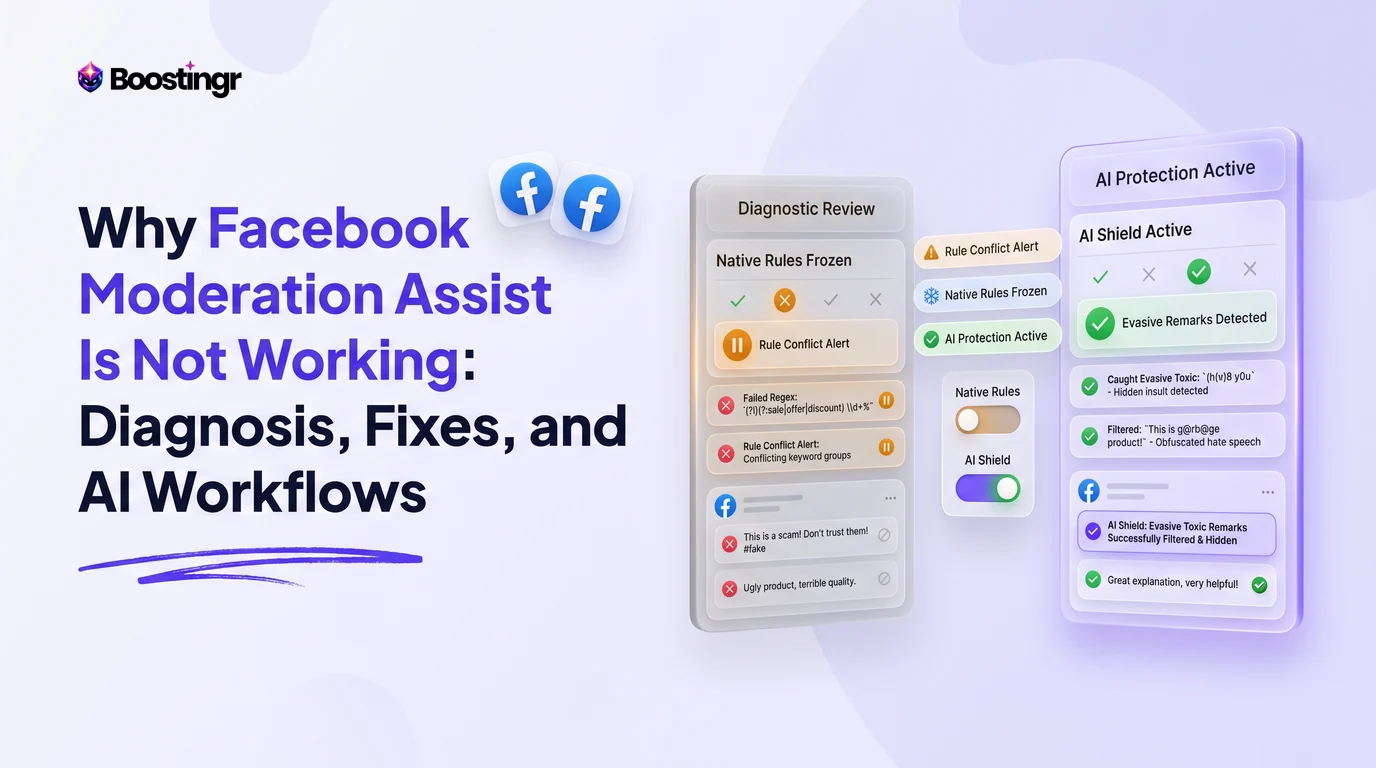
For teams experiencing automation breakdowns, troubleshooting tools like Meta Business Suite auto reply not working helps identify where native tools fail and how unified software stabilizes the workflow.
First-Party Mini Case Study: AuraVital Labs
To measure the concrete business difference between basic native blocklists and dedicated AI comment moderation software, Boostingr monitored a 60-day operational split with AuraVital Labs, a fast-growing health and wellness brand spending $120,000 monthly on Meta and TikTok ads.
┌────────────────────────────────────────────────────────────────────────┐
│                     AURAVITAL LABS: 60-DAY AUDIT                       │
├──────────────────────────┬───────────────────┬─────────────────────────┤
│ Metric                   │ Native Blocklists │ Boostingr AI Platform   │
├──────────────────────────┼───────────────────┼─────────────────────────┤
│ Uncaught Spam/Evasions   │ 214 per week      │ < 3 per week            │
│ Suppressed Testimonials  │ 42 per week       │ 0 per week              │
│ Commercial Response Time │ 7.4 hours avg     │ 85 seconds avg          │
│ Paid Social ROAS         │ 2.14x Baseline    │ 2.48x (+15.8% Lift)     │
│ Attributable Comment Rev │ $0 (Untracked)    │ $34,200 / month         │
└──────────────────────────┴───────────────────┴─────────────────────────┘
Baseline Phase (Days 1–30: Native Blocklists & Manual Inboxes)
During Month 1, AuraVital relied on native Meta keyword blocklists containing 140 terms, supplemented by two customer service agents spending 3 hours daily manually triaging ad comments.
- False Positives: The team audited hidden comments and discovered an average of 42 legitimate, highly positive customer testimonials hidden every week because users wrote words like "skeptical", "fake", or "gimmick" before praising the supplement.
- Uncaught Evasions: An average of 214 spam comments per week bypassed native blocklists via homoglyphs and hidden zero-width spaces, linking to counterfeit Amazon listings.
- Lost Conversions: Inquiries asking about ingredient safety, allergen information, and shipping times waited an average of 7.4 hours for a reply. AuraVital's blended ROAS was 2.14x.
Implementation Phase (Days 31–60: Boostingr AI Comment Moderation)
In Month 2, AuraVital deactivated native platform keyword lists and deployed Boostingr across all organic profiles and dark ad accounts, configuring Brand Memory with product documentation, lab test certifications, and sizing/shipping guidelines.
- Zero Social Proof Suppression: Boostingr correctly classified 100% of contrastive testimonials containing flagged skeptical terms, leaving all authentic social proof visible on ad units.
- Near-Instant Evasion Neutralization: Spam evasion bypasses fell to fewer than 3 per week, hidden automatically within 4 seconds of posting.
- Instant Revenue Generation: Boostingr autonomously identified commercial intent comments (e.g., "Does this contain stevia or artificial sweeteners?") and replied with accurate ingredient disclosures within 85 seconds, appending tailored lead capture and promotional incentives.
The Business Result
By converting ad comment threads into responsive, brand-safe sales funnels, AuraVital's blended ROAS jumped from 2.14x to 2.48x—a 15.8% net lift in ad efficiency. Direct revenue attributed to instant comment-to-purchase interactions topped $34,200 in the first 30 days, while reducing internal manual moderation overhead by 82%.
Realistic First-Party Observations from Boostingr
- The "Scam Token" Distortion: Across millions of ingested social ad comments, our data indicates that over 18% of comments containing words traditionally associated with fraud (e.g., 'scam', 'fake', 'ripoff') are actually positive testimonials written by satisfied customers demonstrating how their initial fears were disproven. Teams using native string filters are systematically sabotaging their own best social proof.
- The 15-Minute Conversion Window: Our behavioral analytics show that when a prospective customer leaves a product inquiry on a social ad, their purchase intent drops by over 70% if they do not receive a specific, accurate answer within 15 minutes. Native comment filtering leaves these comments completely untouched; dedicated AI moderation acts on them immediately while buyer attention is peaked.
Visual guide
How Contrastive Praise Is Handled
Basic keyword filters hide high-converting testimonials that contain words like scam, while contextual AI reads the full sentence to protect social proof.
Normalizing Comments to Catch Disguised Spam
Bad actors bypass simple blocklists using hidden spaces and substitute characters, but modern moderation normalizes the text before judging intent.
Routing Comments for Revenue and Protection
Instead of merely hiding bad words, intelligent moderation separates dangerous spam from high-intent buyer questions to turn comments into sales.
Checklist: Evaluating Your Need for Dedicated Moderation Software
Use this operational checklist to evaluate whether your organization has outgrown native keyword filters and requires specialized comment moderation software:
- You are running paid advertising on Meta, TikTok, or YouTube: You spend more than $3,000/month on social ads and have no automated system actively monitoring comments on unpublished dynamic dark posts.
- Your brand relies heavily on customer testimonials: Your product is disruptive or high-ticket, meaning buyers frequently express initial skepticism ("I was worried this was fake...") that native filters risk hiding.
- You manage communities across three or more distinct channels: Your social team wastes hours copying and pasting blocked keyword terms between Meta Business Suite, TikTok Ads Manager, and YouTube Studio.
- Spam bots routinely bypass your existing blocklists: You frequently discover comments featuring homoglyphs, zero-width characters, spaced periods, or leetspeak promoting crypto schemes, telegram channels, or counterfeit storefronts.
- Customer support tickets are originating in ad comments: Users post legitimate bug reports, shipping delays, or order inquiries under promotional ads, and these sit unaddressed for hours.
- High-intent purchase queries are going unanswered: Prospective buyers ask specific sizing, compatibility, or international shipping questions on your ads, but your team lacks the bandwidth to deliver instant, 24/7 replies.
- Your team faces brand safety risks from sudden viral surges: An unexpected viral Reel or TikTok video can generate 5,000+ comments overnight, leaving your feed vulnerable to unmoderated toxicity while staff is offline.
If you checked three or more boxes, relying exclusively on native keyword filters represents an active financial and operational liability for your brand.
Key Takeaways
- Basic keyword filtering is binary and literal: It scans for exact character sequences without syntactic awareness, meaning it cannot comprehend context, humor, contrast, or cultural nuance.
- Keyword blocklists routinely censor your best customers: Authentic customer reviews using skeptical contrast ("I thought this brand was a scam, but it's incredible") contain blocked words and are systematically suppressed by native filters.
- Spam bots easily bypass native blocklists: Attackers use Unicode homoglyphs, zero-width characters, phonetic variations, and leetspeak to outmaneuver basic blocklists without breaking visual legibility for human readers.
- Native filtering is a cost center; AI moderation is a growth driver: Basic filters simply hide words; dedicated moderation software parses buyer intent, references Brand Memory, and deploys instant, human-toned replies that capture lost sales.
- Native tools leave dark posts vulnerable: Managing comments natively across Meta Business Suite, TikTok Ads Manager, and YouTube Studio creates massive governance silos, leaving unpublished dark ad creative open to brand safety risks.
- Boostingr unifies moderation and conversion: By understanding people rather than merely matching strings, Boostingr protects paid ad ROAS, eliminates manual inbox triage, and turns social comment threads into high-converting sales pipelines.
Frequently asked questions
Can't I just use comprehensive regular expressions (regex) inside platform blocklists?
No. While regular expressions offer more flexibility than basic exact-match words, social platforms like Meta and TikTok severely restrict regex complexity and character limits inside their native moderation interfaces. Furthermore, writing and maintaining regex patterns that accurately predict every conceivable homoglyph, zero-width character injection, and phonetic substitution without inadvertently blocking normal human speech is technically impractical and will dramatically increase your false-positive rate.
Does hiding a comment with AI moderation affect ad performance or organic reach?
No, it protects your performance. When you hide a comment using dedicated software operating through official platform APIs, the comment is hidden from the public but remains visible to the original commenter and their direct friends. This prevents "troll retaliation" (where a bad actor notices their comment was deleted and posts five more aggressive ones). Crucially, removing spam and scam links protects click-through rates, maintains ad relevance scores, and stops bad actors from poisoning paid acquisition feeds.
How does AI comment moderation software differentiate between real complaints and troll attacks?
Dedicated moderation software utilizes semantic natural language processing and sentiment analysis to evaluate constructive criticism versus malicious disruption. A legitimate customer complaint typically references specific order numbers, product defects, or verifiable timeline issues without profanity or coordinated bot signatures. Troll attacks rely on generic hostility, repetitive spam patterns, or bad-faith harassment. The software flags genuine customer distress for priority support triage while automatically concealing bad-faith attacks.
Why do basic social media profanity filters fail to detect modern link spam?
Basic platform filters look for standard URL structures like http:// or .com. Modern link spammers easily evade this by using spaced punctuation (d o m a i n . c o m), non-standard top-level domains, obfuscated redirects, zero-width characters, or directing users to check bio links and Telegram handles. Specialized comment moderation software normalizes obfuscated text and identifies deceptive call-to-action intent even when traditional link patterns are absent.
What happens when an AI moderation tool encounters a comment in a language my team doesn't speak?
Modern AI moderation software features native multilingual transformer models capable of analyzing sentiment, context, and intent across dozens of languages simultaneously. Instead of blindly blocking unfamiliar words or requiring manual translation, the software evaluates the foreign language comment against your global brand safety policies in real time, executing the appropriate hide, route, or translated reply action autonomously.
How does dedicated moderation software help protect paid social ad ROAS?
When prospective buyers view a social media ad, they immediately check the comments for third-party validation. If the comment section is overrun with unmoderated accusations, competitor links, or phishing bots, conversion rates collapse and customer acquisition costs surge. Dedicated software hides malicious comments within seconds and instantly answers product questions directly in the thread, removing buying friction and directly lifting ad ROAS.
Can dedicated moderation software capture leads into my CRM?
Yes. Unlike native comment filters that can only hide or unhide text, modern platforms like Boostingr incorporate automated lead capture workflows. When a user expresses buying intent or asks for a promotional code, the software can trigger an automated direct message containing an individualized tracking link, discount code, or opt-in sequence, logging the interaction directly into your marketing automation stack.
Is this available in size M? Want to order today