Quick Answer
Sentiment analysis for social media comments is an AI-powered process that automatically identifies and categorizes the emotional tone behind user comments as positive, negative, neutral, or more nuanced emotions like anger or joy. This technology enables brands to move beyond simple keyword filtering and strategically prioritize comments, allowing them to triage customer service issues, identify high-intent leads, and amplify positive feedback at scale for more effective community management.
The Unseen Cost of Comment Overload
Your social media posts are performing. The likes are rolling in, shares are climbing, and the comments section is buzzing. This is the dream, right? Yes, but it comes with a hidden cost: comment chaos. For every genuine question and piece of glowing praise, there are spam links, angry complaints, troll provocations, and a sea of neutral chatter.
Manually sifting through this digital deluge is not just inefficient; it's impossible at scale. Community managers are forced to make tough choices, often using blunt instruments like keyword blocklists that silence valid criticism or hiding all comments containing links, potentially losing valuable leads. The result is a reactive, defensive posture that misses the immense strategic value hidden within the comment section.
What if you could instantly know which comments need an urgent, human response? Which ones are from potential customers on the verge of buying? And which ones are from superfans you should be celebrating? This isn't about simply reading comments; it's about understanding the people and the emotions behind them. This is the power of **sentiment analysis for social media comments**, and it's the core of modern community intelligence.
Why Simple Keyword-Based Moderation Fails
For years, the standard approach to comment moderation involved creating lists of 'bad' words. If a comment contained a word from the list, it was automatically hidden or flagged. While this can catch the most obvious spam or profanity, it's a deeply flawed system for several reasons:
* **Lack of Context:** A comment like "This product is sick!" could be flagged by a filter looking for negative words, even though the user's intent is clearly positive. Conversely, "Your support is a complete joke" contains no profanity but is a highly negative comment that needs immediate attention. * **Sarcasm and Nuance:** AI models that rely solely on keywords are notoriously bad at detecting sarcasm. "Wow, another 'amazing' update that breaks everything. Thanks a lot." would fly right under the radar of a simple keyword filter but represents a significant customer service issue. * **Evolving Language:** Slang, memes, and emojis are constantly changing. A manual keyword list is outdated the moment it's created and can't possibly keep up with the creative ways users express themselves. * **False Positives:** Overly aggressive filters can lead to "false positives," where legitimate comments from your community are hidden. This creates a frustrating user experience and can make your brand appear censorious, damaging the trust you've worked to build. You can learn more about this balance in our guide to AI spam comment detection.
This is why a workflow-first approach is critical. You need a system that doesn't just scan for words but understands meaning. Boostingr was built on this principle: to provide an AI that understands people, not just text strings.
The Core of Community Intelligence: Understanding Comment Sentiment
True **comment sentiment analysis** goes far beyond the binary of positive vs. negative. It's about understanding the rich tapestry of human emotion expressed in text. Modern AI, like the kind that powers Boostingr, can be trained to recognize a spectrum of feelings:
* **Positive:** General praise, happiness, excitement. * **Negative:** Disappointment, frustration, criticism. * **Neutral:** Factual statements, questions without emotional charge. * **Angry:** Aggressive frustration, outrage, often requiring immediate escalation. * **Celebratory:** Over-the-top praise, expressions of brand love, user-generated testimonials. * **Confused:** Questions indicating a user is lost or needs help. * **Inquisitive:** Questions showing curiosity or interest in a product/service.
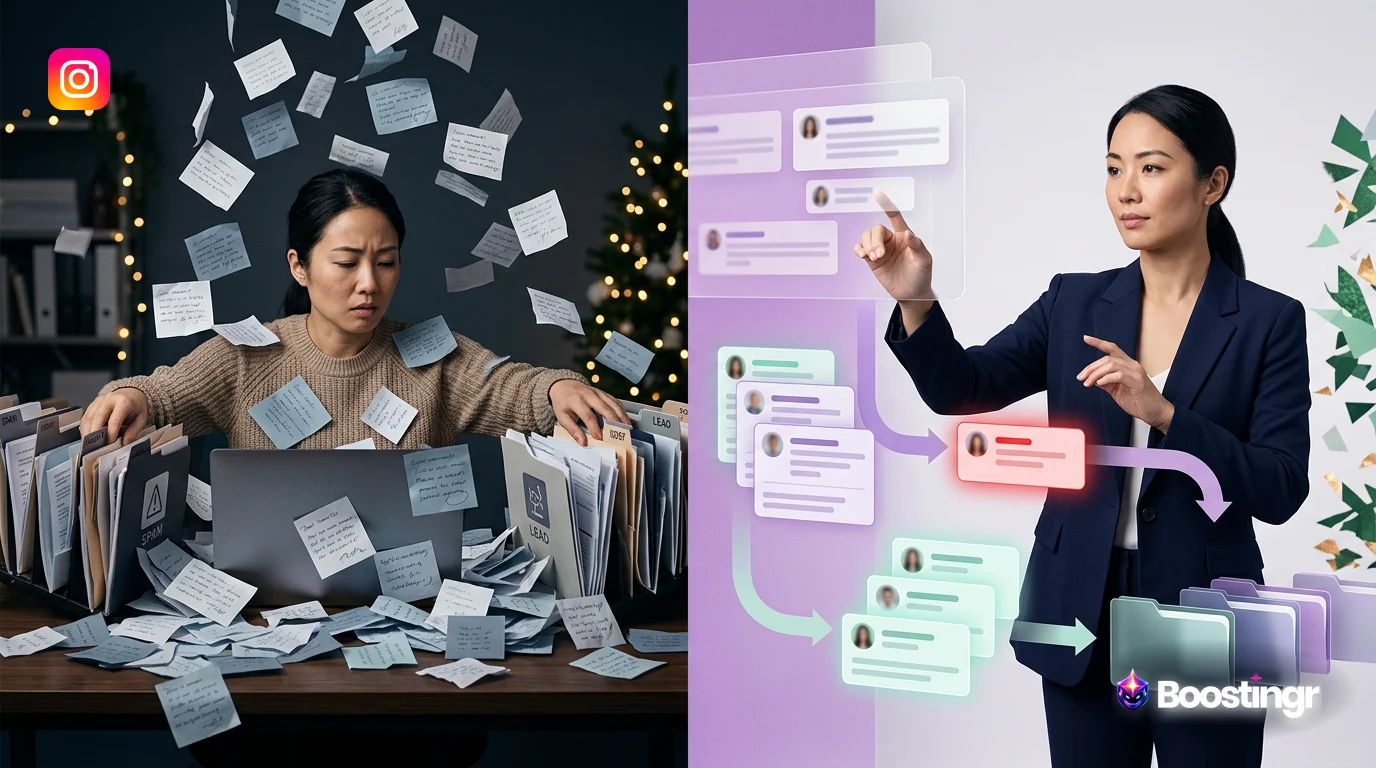
By classifying comments with this level of granularity, you transform a noisy comment feed into a structured, prioritized dashboard. It's the difference between having a pile of unsorted mail and a fully organized filing cabinet where every piece of correspondence is routed to the right department.
This level of understanding is the foundation of Community Intelligence. It allows you to stop reacting to your community and start engaging with them strategically, using their own feedback to drive business decisions.
The Triage System: Prioritizing Comments with Sentiment Analysis
Imagine your comment section as an emergency room. A simple "first-come, first-served" approach would be disastrous. You need to triage: assess the severity of each case and prioritize treatment. Sentiment analysis is the triage nurse for your social media community.
Here’s how a sentiment-driven workflow allows you to handle every type of comment with the appropriate level of attention and resources.
Handling the Fire: Prioritizing Negative and Angry Comments
Negative comments are not just a PR problem; they are a critical business intelligence source and a customer service opportunity. A **social comment sentiment ai** can instantly flag comments with strong negative or angry sentiment for immediate review.
**The Workflow:**
* Instantly hidden from public view to prevent a flame war, while still being visible in the moderation dashboard. * Escalated to a specific support channel (e.g., a Slack channel #social-media-fires) with all the context. * Assigned to a senior support agent for immediate, high-touch resolution.
- **Detection:** The AI identifies a comment like, "I've been waiting two weeks for my order and your support team won't reply! This is a scam!"
- **Classification:** It's tagged as `Negative` and `Angry`, with an `Urgent` flag due to keywords like "scam" and the mention of the support team.
- **Routing & Escalation:** Instead of sitting in a public feed, the comment is automatically routed. It could be:
This proactive approach, detailed in frameworks for brand safe AI replies, can turn a potential brand disaster into a demonstration of exceptional customer care. It also helps distinguish genuine customer frustration from coordinated attacks by bad actors, a topic we cover in our masterclass on troll detection.
Fueling the Growth Engine: Identifying High-Intent Comments
Not all positive comments are created equal. "Cool post!" is nice, but "This is exactly what I've been looking for, do you ship to Canada?" is a flashing neon sign that says "potential sale." A sophisticated AI can combine sentiment and intent detection to find these golden needles in the haystack.
**The Workflow:**
* It's routed to the sales team or a dedicated lead capture dashboard. * An AI Instagram reply bot can be configured to send an immediate, helpful public reply ("Great question! Yes, it does. I'll send you the details in a DM right now.") while simultaneously initiating a private conversation. * The user's information and comment are automatically logged in your CRM as a new lead.
- **Detection:** The AI spots a comment: "Love this! 😍 Does the pro version include API access?"
- **Classification:** It's tagged as `Positive` sentiment and `Purchase Intent` (or `Sales Inquiry`) intent.
- **Routing & Action:** This comment triggers a different workflow:
This transforms your comment section from a simple engagement channel into a powerful, automated engine for Instagram lead capture.
Amplifying the Love: Leveraging Celebratory and Positive Comments
Your happiest customers are your most effective marketers. When someone leaves a comment like, "I've used this for a month and it has completely changed my workflow for the better. Best money I've ever spent!"—that's pure gold. But these comments are often buried.
**The Workflow:**
* The comment is flagged for the marketing team to potentially feature as a testimonial (with permission). * A personalized, on-brand AI reply can be sent to thank the user and make them feel seen and appreciated. * The system can even track your most consistent advocates over time, allowing you to build a VIP or ambassador program.
- **Detection:** The AI identifies a comment with overwhelmingly positive or celebratory sentiment.
- **Classification:** It's tagged as `Celebratory` or `Testimonial`.
- **Routing & Amplification:** This triggers a community-building workflow:
By systematically identifying and engaging with your biggest fans, you create a powerful feedback loop that encourages more user-generated content and strengthens your brand community.
The Gray Area: Responding to Neutral and Inquisitive Comments
Neutral comments, especially questions, are often overlooked but represent a crucial opportunity for education and relationship-building. A comment like "How is this different from X?" or "What's the battery life?" is not emotionally charged, but it is a critical touchpoint in the customer journey.
**The Workflow:**
* Using Boostingr's **Brand Memory**, the AI can access a knowledge base of previously answered questions and approved product information. * It can generate a helpful, accurate, and brand-safe AI reply instantly, providing value to the commenter and anyone else who sees the thread. * If the AI is unsure, it can flag the comment for a human expert to review, and their answer can then be used to train the AI for future questions.
- **Detection:** The AI identifies a comment as `Neutral` or `Inquisitive`.
- **Classification:** It's tagged as a `Product Question`.
- **Routing & Education:**
This turns your comment section into a living, searchable FAQ, reducing the burden on your support team and helping potential customers overcome purchasing hurdles.
Practical Examples and Use Cases
Let's see how this sentiment-driven triage system plays out for different types of businesses using an advanced **sentiment analysis for comments** platform like Boostingr.
* **Ecommerce Fashion Brand:** They run an ad for a new jacket. * **Angry Comment:** "I ordered 3 weeks ago and nothing! Where is my stuff?!" -> **Action:** Auto-hide, escalate to the 'Urgent Support' Slack channel with customer order details if possible. * **High-Intent Comment:** "OMG I need this! Do you have it in black in a size M?" -> **Action:** Route to the lead capture dashboard. AI replies, "We do! It's a popular combo. I've sent a DM with a direct link to make it easy for you. 😊" * **Celebratory Comment:** "Just got mine and the quality is insane! I'm obsessed!" -> **Action:** Flag for the marketing team's 'Testimonial' folder. AI replies, "We're so thrilled to hear that! Thanks for being part of the family. ❤️"
* **B2B SaaS Company:** They post about a new feature release. * **Negative Comment:** "This update is so buggy. It's completely slowed down my team's process." -> **Action:** Auto-tag as 'Bug Report' and 'Negative Sentiment'. Escalate to the engineering support queue with user details. * **Inquisitive Comment:** "Does this integrate with Salesforce?" -> **Action:** Brand Memory-powered AI replies, "Great question! Yes, our Pro and Enterprise plans have a full native Salesforce integration. You can learn more here [link]." * **Positive Comment:** "Finally! This is the feature we've been waiting for. Game changer!" -> **Action:** Flag for the product team's 'Positive Feedback' report. AI replies, "We're so glad it's hitting the mark! Let us know how it impacts your workflow."
* **Online Creator/Coach:** They post a motivational video. * **Troll Comment:** A nonsensical or abusive comment. -> **Action:** AI uses troll detection models to instantly hide the comment and potentially block the user, protecting the community space. This goes beyond simple sentiment and is a key part of a robust troll detection workflow. * **High-Intent Comment:** "I'm struggling with this exact problem. Do you cover this in your course?" -> **Action:** Tag as 'Lead' and 'Sales Inquiry'. AI replies, "I'm sorry to hear you're struggling, but you're not alone. Yes, we cover this in-depth in Module 3 of the course. I'll DM you the curriculum details!" * **Celebratory Comment:** "Your advice helped me land a new job! Thank you so much!" -> **Action:** Flag for 'Success Stories'. AI replies with a personalized, heartfelt message of congratulations, strengthening the creator-audience bond.
Mini Case Study: How a DTC Skincare Brand Scaled Support and Sales
**The Challenge:** "GlowUp Skincare," a direct-to-consumer brand, was experiencing rapid growth. Their Instagram and Facebook ad comments were a chaotic mix of spam, customer complaints about shipping, legitimate product questions, and glowing reviews. Their two-person social media team was completely overwhelmed, leading to 48-hour+ response times. Negative comments festered, and sales questions went unanswered for days.
**The Solution:** GlowUp implemented Boostingr, creating a sentiment-driven triage workflow.
- **Negative/Angry Sentiment:** Comments containing words like "broken," "late," "never arrived," or expressing strong negative emotion were automatically hidden and sent to a dedicated Zendesk queue via an integration. This got them out of the public eye and into the hands of the support team within minutes.
- **Positive + Inquisitive Sentiment:** Comments like "This looks amazing, is it good for oily skin?" were identified. Boostingr's AI, using Brand Memory trained on the brand's FAQ, would reply, "It's fantastic for oily skin as it's non-comedogenic! We have a full ingredient list on the product page if you'd like to see more. ✨" Questions the AI couldn't answer were routed to the social team for a quick response.
- **Positive + Purchase Intent:** Comments like "I need this! Where can I buy?" triggered the lead capture workflow, sending an automated DM with a direct link to purchase.
**The Results:** * **75% Reduction in Average First Response Time:** From over 48 hours to under 12 hours for non-urgent queries, and near-instant for urgent ones. * **15% Increase in Captured Leads:** By systematically identifying and responding to high-intent comments, they directly attributed a 15% lift in sales from social comments in the first quarter. * **90% Reduction in Public Negative Comments:** The auto-hide and escalate workflow cleaned up their ad comments, improving social proof and ad performance.
**First-Party Observation from Boostingr:** We've seen that brands implementing a sentiment-based triage system often discover their 'negative' comments are actually their most valuable. They contain actionable product feedback and service improvement suggestions that were previously lost in the noise. The goal isn't to achieve zero negative comments, but to respond to them so effectively that they become a positive brand touchpoint.
Comparison Table: Evolution of Comment Sentiment Analysis
Not all platforms that claim to offer sentiment analysis are the same. The technology exists on a spectrum of sophistication. Understanding this spectrum is key to choosing a tool that truly delivers strategic value.
| Feature | Basic (Keyword Filtering) | Intermediate (Simple Sentiment) | Advanced (Boostingr's Nuanced AI) |
|---|---|---|---|
| **Core Technology** | Manual keyword lists | Basic NLP, positive/negative/neutral classification | Advanced NLP, Deep Learning, Transformer Models |
| **Emotion Detection** | None. Flags words, not emotion. | Limited to Positive, Negative, Neutral. | Granular emotions (Angry, Joyful, Sad, Inquisitive) + Sentiment Score (e.g., 95% negative). |
| **Context Awareness** | Very low. Prone to errors with sarcasm & slang. | Limited. Can be confused by complex sentences. | High. Understands sarcasm, context, and emojis. |
| **Intent Detection** | None. | Rudimentary, if any. | Fully integrated. Distinguishes between a complaint, a sales question, and spam. |
| **Automation** | Hide/delete based on keywords. | Hide/reply based on simple sentiment. | Complex, multi-step workflows based on sentiment, intent, and custom rules. |
| **Learning** | Static. Requires manual updates. | Minimal. Model is usually fixed. | Continuous learning via **Brand Memory**. Learns from every human interaction and edit. |
| **Use Case** | Basic spam filtering. | General brand health monitoring. | Strategic triage, lead capture, crisis management, and community intelligence. |
Checklist: Implementing a Sentiment-Based Comment Management Strategy
Ready to move from chaos to control? Use this checklist to build your own sentiment-driven workflow.
- [ ] **Define Your Goals:** What is your primary objective? Faster customer support? More leads? Better brand perception? Your goals will dictate your priorities.
- [ ] **Audit Your Comments:** Manually review a sample of 200-300 comments. What are the common themes? What categories of sentiment and intent do you see?
- [ ] **Choose Your Triage Categories:** Start simple. At a minimum, define workflows for `Urgent/Negative`, `Sales/Intent`, and `Positive/Advocacy`.
- [ ] **Design Your Workflows:** For each category, map out the ideal process. Who needs to be notified? What is the desired action (hide, reply, escalate, capture)? What is the target response time?
- [ ] **Select and Configure Your Tool:** Choose a platform like Boostingr that offers nuanced **sentiment analysis for social media comments** and flexible workflow automation. Connect your social accounts.
- [ ] **Train the AI (and Your Team):** Use your audit to inform the initial setup. For a platform with Brand Memory, provide it with your brand voice guidelines, product FAQs, and past successful replies. Ensure your team understands the new workflows and their roles.
- [ ] **Go Live and Monitor:** Activate your workflows. Pay close attention to the AI's decisions in the first few weeks. Use the dashboard to review and correct any errors, which will help the AI learn faster.
- [ ] **Refine and Optimize:** Your community isn't static, and neither is your strategy. Regularly review performance reports. Are response times improving? Are you capturing more leads? Adjust your workflows and AI training based on real-world data.
Key Takeaways
* **Not All Comments Are Equal:** Treating every comment the same is a recipe for missed opportunities and potential crises. A strategic approach requires prioritization. * **Sentiment is the Key to Prioritization:** Sentiment analysis allows you to triage your comment section like an ER, ensuring urgent issues are handled first, opportunities are seized, and positive interactions are amplified. * **Go Beyond Positive/Negative:** True community intelligence comes from understanding nuanced emotions (anger, joy, confusion) and combining sentiment with intent detection. * **Workflows Turn Insight into Action:** The real power of **comment sentiment analysis** is unlocked when it's connected to automated workflows that can hide, reply, escalate, and capture leads at scale. * **AI Should Understand People:** The best tools, like Boostingr, don't just read text; they understand the human context, sarcasm, and intent behind the words, enabling truly intelligent and brand-safe engagement.
Original Diagrams
These original visuals explain the workflow in a faster, more defensible format than plain text alone and give the article first-party assets that are easier to understand and harder to copy.
Comment Processing Workflow
This workflow illustrates how sentiment analysis acts as a smart filter for your social media comments. It automatically sorts incoming messages, ensuring the right teams see the right comments at the right time.
AI Decision Tree
See how AI makes a decision. This tree shows the logical steps sentiment analysis takes to move beyond a simple positive or negative label and understand the specific intent behind a user's comment.
Moderation Pipeline
This pipeline demonstrates a modern approach to content moderation. Automated sentiment analysis first flags and prioritizes harmful or urgent comments, allowing human moderators to focus their efforts where they're needed most.
Intent Classification Flow
Not all negative comments are the same. This flow shows how sentiment analysis can further classify a negative comment by its specific intent, helping you distinguish a cry for help from a valuable product suggestion.
Brand Memory Diagram
Every analyzed comment builds your brand's long-term memory. This diagram shows how insights from sentiment analysis are collected over time to create a rich knowledge base that informs smarter business decisions.
Evidence, Experience, and References
This article is based on Boostingr's direct experience in building and deploying AI-powered comment management systems for hundreds of brands, from fast-growing DTC companies to large enterprises. Our team has processed and analyzed billions of public comments across platforms like Instagram, Facebook, and YouTube. The workflows and strategies described are derived from real-world data and best practices developed in partnership with our clients. Our technology leverages publicly available APIs, such as the Instagram Graph API, to provide our services. All strategies are designed to be compliant with platform terms of service and best practices for user engagement as encouraged by sources like Google's SEO Starter Guide regarding high-quality user interaction.
About the Author
The Boostingr team is composed of AI engineers, data scientists, and veteran social media strategists who are passionate about helping brands build better communities. We believe that the future of marketing isn't about shouting louder; it's about listening better. Our collective experience is focused on a single mission: to build AI that doesn't just read comments but truly understands the people behind them, enabling safer, smarter, and more scalable online conversations.
Last Updated
October 2023
FAQs
Search Intent and Topic Map
This guide targets readers researching sentiment analysis for social media comments and maps the topic to practical evaluation and implementation decisions. Supporting concepts include comment sentiment analysis, social comment sentiment ai, sentiment analysis for comments, ai comment management, brand safe ai replies, comment moderation automation. These terms are used only where they clarify the reader's question, not as repeated ranking phrases.