Quick Answer
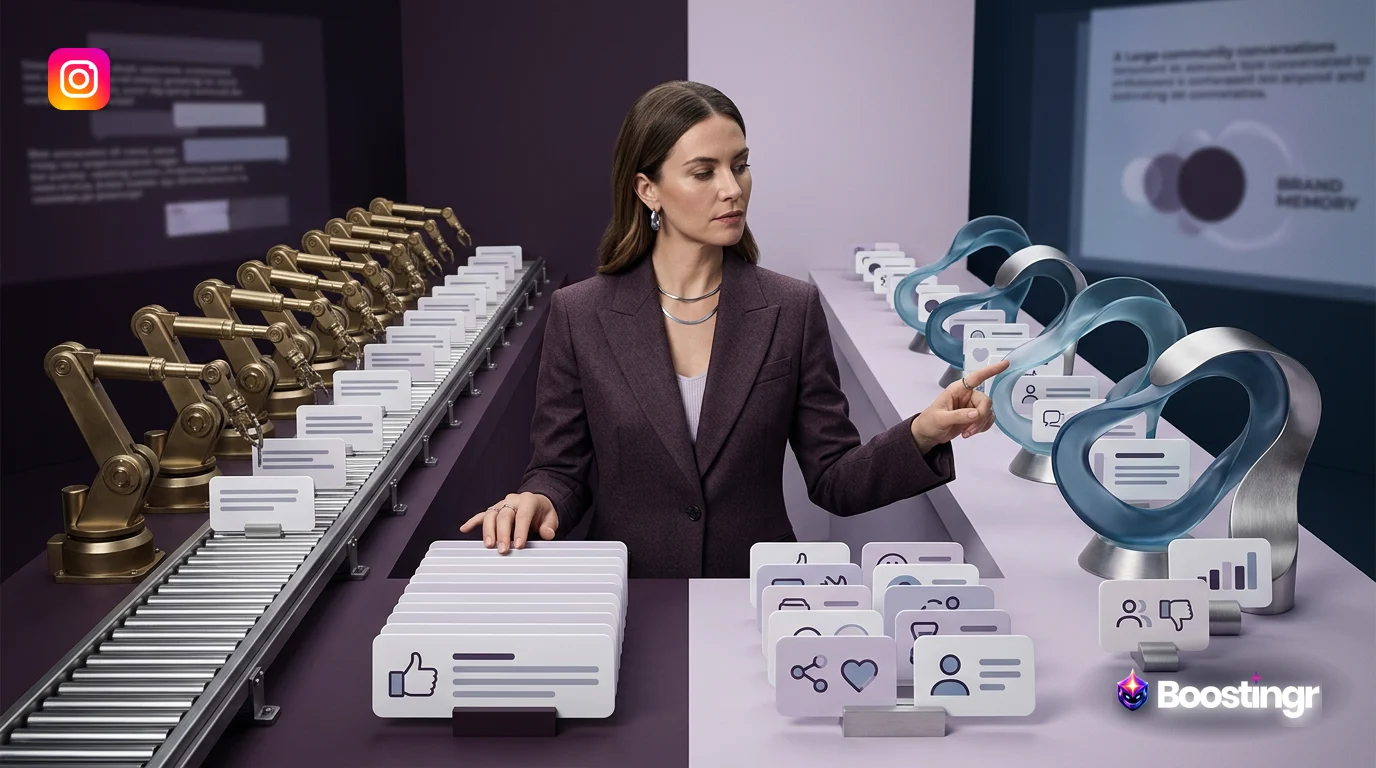
Sentiment analysis for social media comments is an AI-driven process that automatically identifies and categorizes the emotional tone behind user comments—such as positive, negative, or neutral. This allows brands to move beyond manual review, systematically prioritizing comments to engage high-value opportunities (leads, advocates) and mitigate risks (angry customers, PR crises) with targeted, efficient workflows, turning raw feedback into actionable community intelligence.
From Data Overload to Strategic Advantage
Your social media comments are a firehose of unfiltered public opinion. Buried within the hundreds or thousands of daily notifications are messages that can define your brand's trajectory: a customer on the verge of churning, a potential lead asking a final pre-purchase question, and a superfan ready to become a powerful advocate. The problem? They're all mixed in with spam, emojis, and low-stakes chatter.
For most brands, the default response is chaos. Community managers frantically scan notifications, trying to manually spot the fires and the opportunities. This approach is not scalable, is prone to human error, and guarantees that critical comments will be missed. The result is slow response times, frustrated customers, and lost revenue.
This is where a strategic approach to **sentiment analysis for social media comments** becomes a non-negotiable part of modern community management. It’s not about generating a colorful dashboard of positive vs. negative percentages. It’s about building an intelligent, automated system that understands the nuance of human emotion and triggers the right action, for the right comment, at the right time. With a platform like Boostingr, you can transform your comment section from a source of anxiety into a predictable engine for growth, support, and intelligence.
Why Sentiment Analysis is More Than Just "Positive" or "Negative"
Legacy tools often present sentiment as a simple binary: happy or sad. This is a dangerously oversimplified view of human communication. Social media language is complex, layered with sarcasm, slang, emojis, and subtle intent. True community intelligence requires a system that can discern the shades of meaning between different types of comments.
Consider these four "positive" comments:
- `"❤️"` - A low-effort positive signal.
- `"You guys are the best! I've been a customer for 5 years!"` - A celebratory comment from a loyal advocate.
- `"This looks amazing! How much is the pro version?"` - A positive comment with clear purchase intent.
- `"Finally! I've been waiting for this feature."` - A positive comment expressing relief, possibly from a previously frustrated user.
A basic sentiment tool would lump all four together. An advanced AI like Boostingr understands they represent four distinct opportunities requiring four different workflows:
* **Comment 1:** Acknowledge with a simple, automated "like" or reply. * **Comment 2:** Route to the community manager to personally thank a long-term advocate. This is a prime opportunity to nurture brand love. Boostingr's Brand Memory can even recall this user's history for a more personalized touch. * **Comment 3:** Immediately identify as a high-value lead and route to a dedicated Instagram lead capture workflow, potentially sending a DM with pricing information and a link to purchase. * **Comment 4:** Recognize the user's history (if available via Brand Memory) and provide a thoughtful reply that acknowledges their patience, turning a past pain point into a present win.
Similarly, negative sentiment isn't a monolith. The frustration of `"My order is late"` requires a different workflow (customer support ticket) than the maliciousness of a troll attack (hide, block, report). This granular understanding is the foundation of a workflow-first approach to comment management.
The Core Challenge: From Raw Sentiment Data to Actionable Workflows
Many social media management platforms offer some form of sentiment analysis. They can tag a comment as "negative" and show you a chart. The problem is, they stop there. They give you data, but they don't give you the operational tools to act on it at scale. Knowing 10% of your comments are negative is interesting; automatically routing every angry customer to your senior support team in real-time is transformative.
This is the gap that Boostingr fills. It acts as an AI-powered operating system for your comments, connecting sentiment and intent detection directly to a powerful workflow engine. Instead of just labeling comments, Boostingr allows you to build rules that trigger specific actions based on that analysis.
**First-Party Observation:** At Boostingr, we've observed that brands without a sentiment-based workflow often over-index on responding to neutral or low-priority comments simply because they are easier to handle. Meanwhile, critical, high-emotion comments from angry customers or hot leads wait for hours, leading to preventable churn and missed revenue.
An effective system doesn't just show you the problem; it helps you solve it. It moves you from a reactive state of manual review to a proactive state of automated, prioritized engagement.
Building a Prioritization Matrix with Comment Sentiment Analysis
To operationalize **sentiment analysis for social media comments**, you need a prioritization matrix. This framework maps different sentiment and intent combinations to specific, automated workflows. Here’s how to structure it within a platform like Boostingr.
Tier 1: High-Priority Negative (Crisis Management & Service Recovery)
These are the five-alarm-fire comments that require immediate attention to prevent escalation and protect brand reputation.
* **Sentiment Profile:** Angry, Frustrated, Disappointed, Accusatory. * **Examples:** `"This product broke after one use! I want a refund!"`, `"Your customer service is a joke. No one is responding to my emails."` * **Business Goal:** De-escalation, service recovery, churn prevention. * **Strategic Workflow in Boostingr:**
- **Classify:** The AI instantly identifies the high-negative sentiment and customer service intent.
- **Alert & Route:** The system immediately sends a high-priority notification (e.g., via Slack or email) to the head of customer support or a dedicated crisis response team.
- **Hide (Optional):** A rule can be set to automatically hide the comment from public view temporarily, giving the team time to respond without the issue spiraling in a public forum. This is a key part of AI comment moderation.
- **Respond:** The support team can use a pre-approved, brand-safe AI reply template that offers empathy and moves the conversation to a private channel (`"We're so sorry to hear about this. Please send us a DM with your order number so we can make this right immediately."`).
Tier 2: High-Priority Positive (Lead Generation & Sales Conversion)
These comments are buying signals hidden in plain sight. Speed is critical; the faster you respond, the more likely you are to close the sale.
* **Sentiment Profile:** Positive, Excited, Curious, Inquisitive. * **Intent Profile:** Purchase Intent, Pre-sale Question. * **Examples:** `"I need this! Where can I get one?"`, `"Does this work with the other accessories you sell?"`, `"What's the price for the bundle?"` * **Business Goal:** Convert leads, shorten the sales cycle, increase revenue. * **Strategic Workflow in Boostingr:**
- **Classify:** The AI detects positive sentiment combined with keywords indicating purchase intent (`"how much"`, `"where to buy"`, `"link"`).
- **Route:** The comment is routed to a dedicated sales or Instagram lead capture workflow.
- **Engage & Capture:** An automated reply is sent instantly. For a question, an AI Instagram reply bot can answer it directly. For a lead, it can trigger a DM to collect contact information or send a direct purchase link.
**First-Party Observation:** Our data shows that comments with positive sentiment combined with purchase intent keywords convert at a rate 3x higher than general positive comments when engaged within the first 15 minutes. An automated workflow makes this speed possible.
Tier 3: Mid-Priority Positive (Community Building & Advocacy)
These are your brand champions and superfans. Nurturing these relationships creates a powerful moat of brand loyalty and generates authentic social proof.
* **Sentiment Profile:** Celebratory, Grateful, Enthusiastic, Supportive. * **Examples:** `"I love everything you do! Best brand ever!"`, `"Just got my order and the quality is even better than I expected!"` * **Business Goal:** Nurture advocates, encourage user-generated content (UGC), build a strong community. * **Strategic Workflow in Boostingr:**
- **Classify:** The AI identifies highly positive, celebratory language.
- **Route:** The comment is routed to the community manager's queue for personalized engagement.
- **Engage with Context:** The community manager can use a humanized, brand-safe AI reply as a starting point. Boostingr's Brand Memory can add context, like `"We see you've been a fan for a while, [Username]. Thanks so much for your continued support!"`
- **Tag & Track:** The user can be automatically tagged as a "Superfan" in the system for future campaigns, early access, or UGC requests.
Tier 4: Neutral & Low-Priority (Efficiency & Hygiene)
This category includes general questions, simple statements, and comments that don't require urgent or personalized replies. The goal here is efficiency and maintaining a clean, professional comment section.
* **Sentiment Profile:** Neutral, General Questions, Simple Positive/Negative. * **Examples:** `"When did this launch?"`, `"cool"`, `"not for me"` * **Business Goal:** Maintain responsiveness, provide accurate information efficiently, and filter out noise. * **Strategic Workflow in Boostingr:**
- **Filter:** The system first runs the comments through AI spam comment detection and troll detection filters to remove unwanted content.
- **Automate FAQ:** For common questions, the AI provides an instant, pre-approved answer.
- **Bulk Actions:** Simple positive comments can be replied to in bulk or with a rotating set of approved, light-hearted replies. Low-priority negative comments can be queued for review at a non-urgent time.
How Social Comment Sentiment AI Works Under the Hood
Understanding the technology behind **social comment sentiment ai** helps clarify why modern solutions are so much more powerful than simple keyword filters. The process relies on a field of artificial intelligence called Natural Language Processing (NLP) and its sub-field, Natural Language Understanding (NLU).
- **Data Ingestion:** First, the platform connects to social media platforms via official APIs, like the Facebook Graph API, to pull in comments in real-time.
- **Tokenization & Pre-processing:** The AI breaks down each comment into its core components—words, phrases, emojis, and punctuation (tokens). It cleans the text by correcting common misspellings and understanding slang.
- **Feature Extraction:** The system analyzes the tokens for emotional indicators. This goes far beyond a simple dictionary. It understands that `"sick"` can mean "ill" or "amazing" depending on the context. It recognizes the sentiment value of emojis (e.g., 😊 vs. 😠 vs. 😂).
- **Sentiment Classification:** Using a machine learning model trained on billions of examples of social media comments, the AI assigns a sentiment score. Advanced models, like Boostingr's, don't just stop at positive/negative/neutral. They classify a spectrum of emotions (angry, sad, joyful, surprised) and intents (purchase, complaint, question).
- **Confidence Scoring:** The AI provides a confidence score for its analysis. For example, it might be 98% confident a comment is negative but only 70% confident it's sarcastic. This allows for workflows where low-confidence analyses are routed to a human for review.
This sophisticated process is what allows a platform like Boostingr to understand that `"I'm dying 😂"` is positive, while `"My package is dying in transit"` is negative. It's the difference between simply reading comments and truly understanding the people behind them.
Comparison Table: Sentiment Analysis Approaches
Not all tools that claim to offer sentiment analysis are created equal. Their focus and capabilities vary widely, directly impacting your ability to create effective workflows.
| Feature / Tool Type | Boostingr (AI Comment OS) | Social Media Suites (e.g., Sprout, Hootsuite) | Chatbot Builders (e.g., ManyChat) | Manual Moderation |
|---|---|---|---|---|
| **Primary Focus** | Deep comment understanding, moderation, and response workflows. | Content publishing, scheduling, and broad social listening. | DM automation and keyword-triggered chat flows. | Human review and response. |
| **Sentiment Analysis** | Granular (e.g., Angry, Celebratory, Purchase Intent) with high accuracy on slang & sarcasm. | Basic (Positive, Negative, Neutral). Often struggles with nuance. | Primarily keyword-based triggers, not true sentiment analysis on public comments. | Subjective, inconsistent, and varies by moderator. |
| **Workflow Automation** | Core feature. Build complex rules to route, hide, reply, and capture leads based on sentiment + intent. | Limited. Can tag comments or send basic alerts, but lacks deep workflow logic. | Strong for DMs, but weak for public comment prioritization and moderation workflows. | Non-existent. The workflow is the person's to-do list. |
| **Best For** | Brands seeking to scale high-quality, prioritized engagement and moderation across all comments. | Brands needing an all-in-one publishing and high-level monitoring tool. | Brands focused on automating lead funnels and conversations within DMs. | Small accounts with very low comment volume. |
Practical Examples and Use Cases
Let's see how these strategic workflows play out in real-world scenarios.
Use Case 1: The Global Ecommerce Brand
* **Challenge:** A fashion brand with a global audience receives thousands of comments daily across Instagram and Facebook in multiple languages. They struggle to identify product defect complaints, shipping issues, and high-intent sales questions amidst the noise. * **Boostingr Workflow:** * **Negative Sentiment:** Comments containing words like `"torn"`, `"broken"`, or `"late delivery"` are automatically flagged as high-priority negative, translated, and routed to the support team for the corresponding region. * **Positive/Purchase Intent:** Comments like `"Do you ship to Brazil?"` or `"Love this dress! Link?"` are identified. The AI automatically replies with a link to the product page and a relevant shipping policy answer, and triggers a DM to the user. * **UGC Mining:** Celebratory comments where users mention they `"just received"` their item are tagged and routed to the social media team, who can then reach out to request permission to use their photo as UGC. * **Outcome:** Support response times for critical issues are reduced from 24 hours to under 1 hour. The sales team captures hundreds of additional leads per month directly from comments. The marketing team has a steady stream of authentic UGC.
Mini Case Study: "GlowUp Cosmetics" Reduces Negative Comment Response Time by 90%
**Before Boostingr:** GlowUp Cosmetics, a popular online beauty brand, relied on two community managers to manually sift through over 3,000 comments per day on their Instagram ads. Negative comments about shipping delays or damaged products would sometimes go unanswered for over 12 hours, leading to public complaints and customer churn.
**After Implementing Boostingr:** GlowUp set up a Tier 1 workflow. Any comment with a negative sentiment score above 80% and containing keywords like `"shipping"`, `"damaged"`, `"refund"`, or `"disappointed"` was automatically hidden and a high-priority ticket was created in their support system via an integration. The support team was alerted instantly.
**The Result:** The average response time for critical customer complaints originating in comments dropped from 12 hours to just 45 minutes. They now resolve 85% of these issues within the first hour. Public sentiment scores on their ads have improved, and the community managers are freed up to focus on positive engagement and community building.
Use Case 2: The B2B SaaS Company
* **Challenge:** A SaaS company runs LinkedIn ads targeting decision-makers. They get insightful questions and buying signals in the comments, but their sales team doesn't have the time to monitor social media all day. * **Boostingr Workflow:** * **High-Intent:** Comments on LinkedIn posts with phrases like `"Can this integrate with Salesforce?"` or `"Requesting a demo"` are identified by the sentiment and intent AI. * **Lead Capture:** The comment is automatically routed to the BDR team's Slack channel with a link to the user's LinkedIn profile. An AI-powered reply is posted, acknowledging the question and letting them know a team member will reach out via DM or email shortly. * **Outcome:** The sales cycle is shortened as leads are engaged within minutes, not days. The marketing team can prove direct ROI from their social ad spend by tracking leads generated from comments.
Integrating Sentiment Analysis with Other AI Capabilities
Sentiment analysis is powerful, but its true potential is unlocked when it's integrated into a comprehensive AI comment management system. It's one layer in a multi-layered intelligence stack.
* **Sentiment + Intent Detection:** As we've seen, this is the most critical pairing. A positive comment's intent determines if it's a lead, a fan, or just a casual compliment. Boostingr's AI analyzes both simultaneously to enable hyper-specific workflows. Learn more in our guide to intent detection for comments.
* **Sentiment + Spam & Troll Detection:** A key challenge is distinguishing a genuinely angry customer from a malicious troll. A troll comment might be negative, but it's designed to provoke, not seek resolution. Boostingr's troll detection AI looks for patterns of abuse, profanity, and bad-faith arguments, allowing you to automatically hide or ban trolls while routing actual customers to support.
* **Sentiment + Brand Memory:** Imagine a customer was angry last week about a shipping delay. This week, they comment, `"Got my package, thanks for the help!"`. With Brand Memory, the AI knows the history. Instead of a generic `"You're welcome!"`, it can generate a reply like, `"So glad to hear it arrived safely! We appreciate your patience and are happy we could resolve it for you."` This level of contextual engagement turns a resolved issue into a moment of brand delight.
* **Sentiment + AI Replies:** The sentiment of the user's comment should directly inform the tone of your reply. An angry comment needs an empathetic, apologetic tone. A celebratory comment deserves an enthusiastic, grateful tone. Boostingr's brand-safe AI replies are designed to adapt their tone based on the sentiment analysis, ensuring your brand always sounds human and appropriate.
Checklist: Implementing a Sentiment Analysis Workflow
Ready to move from theory to practice? Use this checklist to build your own sentiment-driven comment management strategy.
- [ ] **Define Your Goals:** What is the primary objective? Faster support, more leads, better brand perception, or all of the above?
- [ ] **Map Sentiments to Priorities:** Create your own version of the Tier 1-4 matrix. What does a high-priority negative or positive comment look like for your brand?
- [ ] **Design Your Workflows:** For each priority tier, define the exact sequence of events: Hide, Alert, Route, Reply, Tag. Who needs to be notified? What is the desired outcome?
- [ ] **Choose the Right Platform:** Select a tool like Boostingr that offers granular sentiment *and* a robust workflow engine. Basic sentiment tagging is not enough.
- [ ] **Configure Your Rules:** In your chosen platform, build the rules that bring your workflows to life. Use combinations of sentiment, intent, keywords, and user history.
- [ ] **Teach the AI Your Brand Voice:** Configure your AI reply generator with your brand's specific tone, phrasing, and personality to ensure all automated responses are on-brand.
- [ ] **Establish Human-in-the-Loop Governance:** For sensitive replies (like to angry customers), set up an approval queue where a human must review the AI-drafted response before it goes live.
- [ ] **Connect Your Tools:** Integrate your comment management system with your other tools like Slack, Zendesk, or your CRM to create a seamless flow of information.
- [ ] **Monitor, Analyze, and Refine:** Use the analytics dashboard to track performance. Are response times improving? Are you capturing more leads? Use this data to continuously tweak and optimize your workflows.
Key Takeaways
* **Prioritize, Don't Just Categorize:** The goal of **sentiment analysis for social media comments** is not to create reports, but to create a system of prioritization that focuses your team's effort where it matters most. * **Workflows are the Engine:** Sentiment data is useless without an operational workflow to act on it. Your strategy should be built around automated actions: routing, hiding, replying, and alerting. * **Nuance is Everything:** Not all positive or negative comments are equal. Differentiating between angry customers, hot leads, and loyal advocates is the key to unlocking the value in your comment section. * **Speed Wins:** Automating the identification and initial engagement with high-priority comments (both negative and positive) provides a massive competitive advantage, reducing churn and increasing conversions. * **Integration is Power:** The most advanced strategies combine sentiment analysis with intent detection, spam filtering, and brand memory to create a truly intelligent and context-aware community management system like Boostingr.
Ready to stop drowning in comments and start building strategic workflows? Explore Boostingr's features or sign up for a free trial today to see the power of AI-driven comment intelligence in action.
Original Diagrams
These original visuals explain the workflow in a faster, more defensible format than plain text alone and give the article first-party assets that are easier to understand and harder to copy.
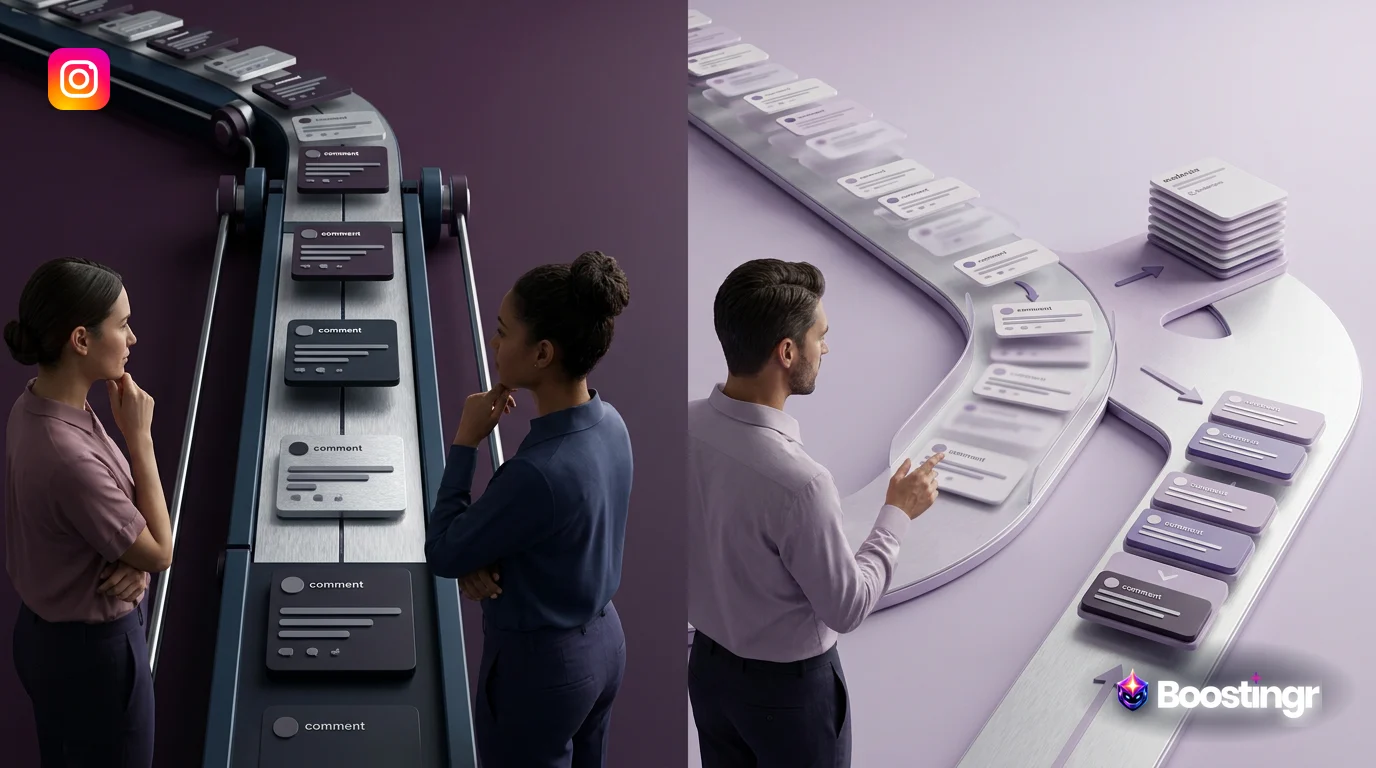
Comment Processing Workflow
This workflow illustrates how raw social media comments are ingested, analyzed for sentiment and intent, and then automatically sorted into prioritized categories. This turns a chaotic stream of feedback into an organized, actionable queue.
AI Decision Tree
An AI model doesn't just label a comment; it follows a decision path. This tree shows how a comment is routed based on its sentiment, keywords, and detected intent, ensuring it reaches the right team, such as support or sales.
Moderation Pipeline
This pipeline visualizes the trust and safety workflow for mitigating risk. High-risk comments are automatically flagged by the AI, escalated for human review, and then actioned according to moderation policies to protect the brand.
Intent Classification Flow
Going beyond positive or negative, this flow shows how AI classifies the underlying intent of a comment. It separates pre-purchase questions from customer support issues, allowing for highly targeted and effective responses.
Brand Memory Diagram
Analyzed comments and their outcomes are fed into a cumulative knowledge base, or 'brand memory.' This intelligence is then used by product, marketing, and support teams to make smarter, data-driven decisions over time.
Evidence, Experience, and References
This article is based on Boostingr's direct experience developing and implementing AI-powered comment management workflows for thousands of brands, from high-growth ecommerce stores to Fortune 500 companies and top creators. The insights and workflows described are derived from real-world data and best practices observed across millions of processed comments. Our approach is grounded in the official capabilities provided by social media platforms and a deep understanding of natural language processing.
**Authoritative Sources:**
* Facebook Graph API Documentation: https://developers.facebook.com/docs/graph-api * Google's SEO Starter Guide: https://developers.google.com/search/docs/fundamentals/seo-starter-guide
Our internal data on response times and conversion rates has been anonymized and aggregated to protect customer privacy while providing credible benchmarks.
About the Author
The Boostingr team is composed of AI engineers, data scientists, and veteran social media marketers who are passionate about building technology that fosters better human connection at scale. We believe that the future of community management isn't about replacing humans, but about empowering them with intelligent tools to focus on what matters most. Our content is written from the front lines of AI and social media engagement.
Last Updated
October 2023
FAQs
Search Intent and Topic Map
This guide targets readers researching sentiment analysis for social media comments and maps the topic to practical evaluation and implementation decisions. Supporting concepts include comment sentiment analysis, social comment sentiment ai, sentiment analysis for comments, ai comment management, brand safe ai replies, comment moderation automation. These terms are used only where they clarify the reader's question, not as repeated ranking phrases.