

Understanding the Instagram Group Management Bot Landscape
Modern social media operations rarely involve a single community manager responding to casual mentions. High-growth brands, digital marketing agencies, and creator networks operate in an environment where thousands of interactions occur simultaneously across organic feed posts, boosted Reels, paid ad campaigns, and direct messaging channels.
When professionals search for an instagram group management bot, their operational needs generally fall into two distinct buckets:
- Internal Team/Group Account Management: Coordinating a multidisciplinary team (support agents, copywriters, community managers, and compliance officers) to review, triage, assign, and resolve incoming conversations across multiple brand profiles from a unified workspace.
- External Group Communication & Moderation: Automating engagement, sentiment analysis, spam eradication, and member interactions across public brand communities, high-traffic comment threads, and multi-user direct messaging groups.
Navigating this landscape requires understanding what Meta's infrastructure permits, where standard automation fails, and how modern contextual AI systems safeguard brand equity.
Meta Graph API Group Chat Limitations: The Technical Reality
Before investing in automated tooling, community directors must understand the technical boundary enforced by Meta's developer ecosystem. A persistent misconception is that brands can deploy an autonomous instagram group chat bot directly inside private, multi-user Instagram direct messaging groups (threads with three or more participants).
According to the official Instagram Graph API documentation, programmatic messaging via webhooks and the Messenger API for Instagram is architected exclusively for one-on-one interactions between an Instagram Professional account (Business or Creator) and an individual user.
[Individual User] <--- 1-on-1 Direct Message ---> [Instagram Graph API] <---> [Verified AI Engine]
                                                         |
[Multi-User Group Chat (3+ Participants)] <---------------X [API Access Blocked / Unsupported]
Why Meta Restricts Group Chat Automation
Meta enforces these architectural boundaries for critical consumer protection reasons:
- Anti-Spam Governance: Unrestricted bots inside group DMs would enable automated scraping rings to add non-consenting users to mass promotional threads.
- End-to-End Privacy Alignment: Direct multi-participant conversations carry heightened privacy expectations under global regulatory frameworks.
- Infrastructure Overhead: High-frequency multi-participant webhook payloads create exponential concurrency loads compared to bidirectional 1-on-1 messaging pipelines.
Tools on the black market that claim to function as an autonomous instagram bot for group messages inside private group chats rely on browser automation, reverse-engineered private APIs, or credential-sharing user emulation scripts. Utilizing these tools violates Meta's Terms of Service and routinely triggers automated detection heuristics, leading to shadowbans, permanent messaging blocks, or account revocation.
For a secure approach to conversational automation that complies with platform guidelines, teams must redirect their strategy toward official webhook endpoints, unified team inboxes, and public-to-private conversational conversion.
How Legitimate Instagram Group Management Works
Because direct multi-user group chat scraping is unauthorized, legitimate enterprise "group management" centers on two operational pillars: team-based unified inboxes and intelligent community-level moderation.
1. Collaborative Team Workflows and Unified Inboxes
Rather than forcing six team members to log into a single Instagram mobile app using shared credentials—a security risk that frequently triggers two-factor verification challenges and checkpoint lockouts—an instagram team inbox bot acts as an orchestration layer.
Through an ai social inbox for teams, incoming volume is captured via webhooks, normalized into structured payloads, and displayed within a centralized dashboard. Within this layer, your organization can:
- Assign granular role permissions (Viewer, Moderator, Lead Agent, Admin).
- Route high-intent purchase inquiries automatically to dedicated sales representatives.
- Escalate hostile user encounters or potential regulatory liabilities directly to legal or PR teams.
- Prevent collision by showing real-time agent presence indicators when a colleague is drafting a response.
When evaluating operational workflows, review our guide on how teams triage Instagram comments to understand structural baseline routing.
2. Multi-Account Orchestration
Agencies and multi-brand conglomerates frequently deploy an instagram multi account management bot infrastructure. This setup aggregates direct messages, mention notifications, story replies, and public comment streams from dozens of client handles into a synchronized command center. Rather than managing fragmented notifications across disparate mobile devices, the bot platform standardizes interaction rules across all profiles.
The Evolution of Instagram Community Moderation: Rules vs. Contextual AI
Historically, an instagram moderation bot operated on deterministic "if-this-then-that" keyword triggers. If an incoming message or comment contained a substring from a static blocklist (such as "scam", "cheap", or "crypto"), the rule executed a predefined action (hide or delete).
In modern social media ecosystems, keyword-based moderation is fundamentally inadequate.
The Failure Modes of Keyword Blocklists
Static keyword filters fail because modern spammers and bad-faith actors deliberately obscure their language to bypass rudimentary regex filters:
- Obfuscated Text and Leetspeak: Bad actors swap letters for numbers or symbols (e.g., substituting
c-r-y-p-t-owith¢rypt0orc.r.y.p.t.o). - Contextual Nuance: A comment stating, "This product is sickeningly good, completely killed my acne!" contains the words sickeningly and killed. A rigid keyword filter flags or hides this high-converting social proof.
- Coordinated Troll Swarms: Coordinated harassment campaigns often use ordinary, non-profane words repeated hundreds of times across video posts to suppress algorithmic reach and intimidate real customers.
Contextual AI Moderation
Modern instagram community management bot architectures deploy Large Language Models (LLMs) paired with semantic vector embeddings. Platforms like Boostingr evaluate incoming public and private text through multidimensional linguistic analysis:
- Semantic Intent Detection: Discerning whether the user is expressing intent to purchase, requesting technical assistance, providing constructive feedback, or seeking confrontation.
- Sentiment Polarization: Measuring the emotional valence of the text, separating authentic customer frustration from malicious bad-faith trolling.
- Brand Memory Adherence: Utilizing customized company guardrails to generate humanized brand-tone replies across connected social accounts, honoring the brand's unique vocabulary, tone constraints, and product knowledge base.
[Incoming Interaction]
          │
          ▼
[Intent Analysis] ──(Hostile/Troll)──────> [Automated Contextual Hide / Audit Log]
          │
          ├────────(Support Issue)───────> [Private DM Escalation & Team Triage]
          │
          └────────(High-Intent Buy)─────> [Instant Humanized AI Reply + Tracking]
To see how basic filters compare against modern semantic engines, read our breakdown on what's the difference between moderation software and basic comment filtering.
Comparison Table
Evaluating how different technological approaches solve community management challenges across Instagram surfaces:
| Feature / Capability | Native Instagram App / Meta Suite | Legacy Rule-Based Bots (e.g., Basic ManyChat) | Black-Hat Group DM Bots (Scrapers) | Modern AI Comment & DM Engine (Boostingr) |
|---|---|---|---|---|
| Meta Graph API Compliance | 100% Native | 100% Official API | 0% (Violates TOS / High Ban Risk) | 100% Official API Partner Architecture |
| Multi-User Private Group Chat Support | Yes (Manual Only) | No (API Restricted) | Yes (Unstable User Emulation) | No (Redirects to Compliant 1:1 Flows) |
| Contextual Sarcasm & Troll Detection | None (Static Hidden Words Only) | None (Exact / Partial Keyword Match) | None | High (Semantic Intent & Sentiment Analysis) |
| Enterprise Team Routing & Triage | Basic (Shared Inbox) | Basic Routing Rules | None | Advanced (Collision Detection & Tier Escalation) |
| Comment-to-DM Conversion Pipelines | Manual | Rigid Pre-built Decision Trees | Not Supported | Dynamic Contextual AI Follow-up |
| Dynamic Brand Memory & Tone Tuning | Not Supported | Not Supported (Static Scripts Only) | Not Supported | Fully Integrated Dynamic Knowledge Base |
| Ad Account Protection Across Dark Posts | Inconsistent Notification Feed | Fragmented Ad Coverage | None | Real-Time Automatic Synchronization |
Protecting Communities Against Coordinated Trolling and Bot Rings
One of the most pressing challenges for community leads managing large public groups or high-traffic organic and paid posts is coordinated bot ring attacks. In these scenarios, rival entities, phishing operations, or malicious groups deploy automated farms to flood comment sections with deceptive claims, affiliate spam, or offensive media.
The Mechanics of an Attack
Unlike an isolated unhappy customer, a coordinated attack exhibits distinct structural markers:
- Temporal Burst Velocity: Dozens of accounts posting within milliseconds of each other.
- Lexical Variation via Spin-Syntax: Comments that communicate identical messaging using randomized synonyms to bypass static regex strings.
- Impersonation Handles: Utilizing official brand logos with subtle unicode variations in account names (e.g., replacing a capital "I" with an "l").
[Coordinated Bot Network] ──(Rapid-Fire Spam)──> [Brand Post / Ad Campaign]
                                                        │
                                                        ▼
                                              [Boostingr AI Sentinel]
                                                        │
                         ┌──────────────────────────────┴──────────────────────────────┐
                         ▼                                                             ▼
              [Matches Bot Ring Pattern]                                    [Legitimate User Engagement]
                         │                                                             │
       [Instantly Hidden via Graph API]                                  [Contextual Brand-Tone Reply]
                         │                                                             │
        [Internal Log Flagged for Triage]                             [Maintains Conversational Momentum]
Automated Defense Blueprints
When integrated with the Meta Graph API, an automated dm moderation instagram engine safeguards the brand through immediate defensive actions:
- Contextual Auto-Hiding: Rather than deleting comments—which notifies the troll and encourages them to regenerate another identity—the engine leverages the API to silently hide the comment. The offending user and their immediate followers still see the comment, preventing retaliation, while the broader public and real prospects are shielded from seeing the toxic content. For a detailed tactical guide on this technique, see hide vs delete comments on facebook and instagram.
- Ad ROAS Preservation: Dark ad posts frequently attract aggressive competitor trolling. Left unmoderated, negative social proof inflates Customer Acquisition Costs (CAC) by depressing ad click-through rates. Deploying automated defensive protocols preserves Return on Ad Spend (ROAS). Learn more about safeguarding paid campaigns in our guide on how to stop competitors commenting on Facebook and Instagram ads.
Practical Examples and Use Cases
Use Case 1: The High-Volume DTC Brand Flash Sale
- The Challenge: A direct-to-consumer skincare brand launches a viral holiday campaign on Instagram Reels. Within three hours, the post generates 4,500 comments containing a mix of sizing questions, shipping complaints, affiliate spam links, and purchasing queries.
- The Workflow: Boostingr's AI classifies incoming queries instantly. Spam links and bot-promoted crypto schemes are automatically hidden within seconds. Comments asking, "Will this irritate sensitive skin?" receive contextual public responses addressing ingredients directly from the brand's verified documentation. High-intent queries ("How do I get the 20% discount code?") trigger an automated public reply paired with an immediate personalized DM containing a tracking link.
- The Result: Community sentiment remains consistently positive, zero spam comments degrade the ad's effectiveness, and customer support representatives only need to step in for high-value ticket resolutions.
Use Case 2: Multi-Agent Healthcare Clinic Team Inbox
- The Challenge: A regional aesthetic medicine clinic with five locations runs an Instagram account receiving inquiries involving personal medical details, pricing, and appointment bookings. Multiple staff members responding from phones caused duplicate, conflicting replies and privacy exposure.
- The Workflow: The clinic deploys an ai social inbox for teams. Inbound public comments asking for pricing are acknowledged publically by the bot, which automatically opens a private 1-on-1 direct message via an instagram lead capture workflow. Within the shared dashboard, front-desk staff utilize internal collision detection to claim chats based on physical clinic branch locations.
- The Result: Zero internal communication overlap, compliance with consumer health privacy boundaries, and an organized pipeline converting interest into scheduled consultations.
Use Case 3: Crisis Management During a Supply Chain Disruption
- The Challenge: A sustainable apparel brand experiences a nationwide shipping carrier disruption. Frustrated customers flood every organic post and ad with hostile comments, creating a severe public relations bottleneck.
- The Workflow: Rather than shutting down comments entirely (which exacerbates community panic), the brand updates its AI Brand Memory. The engine identifies shipping-related grievances, validates the customer's frustration with an empathetic brand voice, and provides direct order-lookup links while directing complex escalations to Tier 2 customer service agents. To learn how to resolve platform reporting issues during high volume events, consult our breakdown on Meta Business Suite not showing ad comments.
- The Result: Triage cycle times drop from twelve hours to ninety seconds, stabilizing brand reputation without burning out support staff.
Enterprise Brand Safety and Escalation Blueprints
Deploying an instagram comment and dm automation platform requires a structured governance framework. Completely autonomous systems operating without guardrails risk catastrophic brand failures, such as cheerfully thanking a customer who is reporting a severe allergic reaction or product fault.
An enterprise-grade automation framework enforces a clear escalation hierarchy:
[Incoming Message / Comment]
              │
              ▼
     [Sentiment & Risk Scan]
              │
       ┌──────┴────────────────────────┐
       │                               │
 [Standard Inquiry]            [High-Risk Indicator]
       │                               │
 [Autonomous AI Reply]          [Safety Lockdown Triggered]
                                       │
                        ┌──────────────┴──────────────┐
                        ▼                             ▼
             [Contextually Hide]             [Assign Priority Flag]
                        │                             │
             [Internal Alert to Slack] ───────> [Tier 2 Human Agent]
The Three-Tier Escalation Model
- Tier 1: Fully Autonomous Resolution: Applies strictly to low-risk, standardized interactions. This includes welcoming new followers, answering straightforward FAQs (e.g., shipping windows, return policies), and instantly removing overt profanity or malicious links.
- Tier 2: Human-in-the-Loop Approval: Triggered when the AI encounters moderate-sentiment ambiguity, potential VIP/influencer accounts, or product inquiries that fall outside the indexed Brand Memory. The system drafts a recommended contextual response and queues it for one-click human approval in the team dashboard.
- Tier 3: Immediate Safety Lockdown & Human Handoff: Reserved for legal threats, public relations crises, explicit regulatory triggers, or severe product failures. The automation instantly hides the public comment to contain reputational damage, halts any planned robotic follow-ups, marks the internal thread as urgent, and pings the on-call crisis lead via Slack or webhook notification.
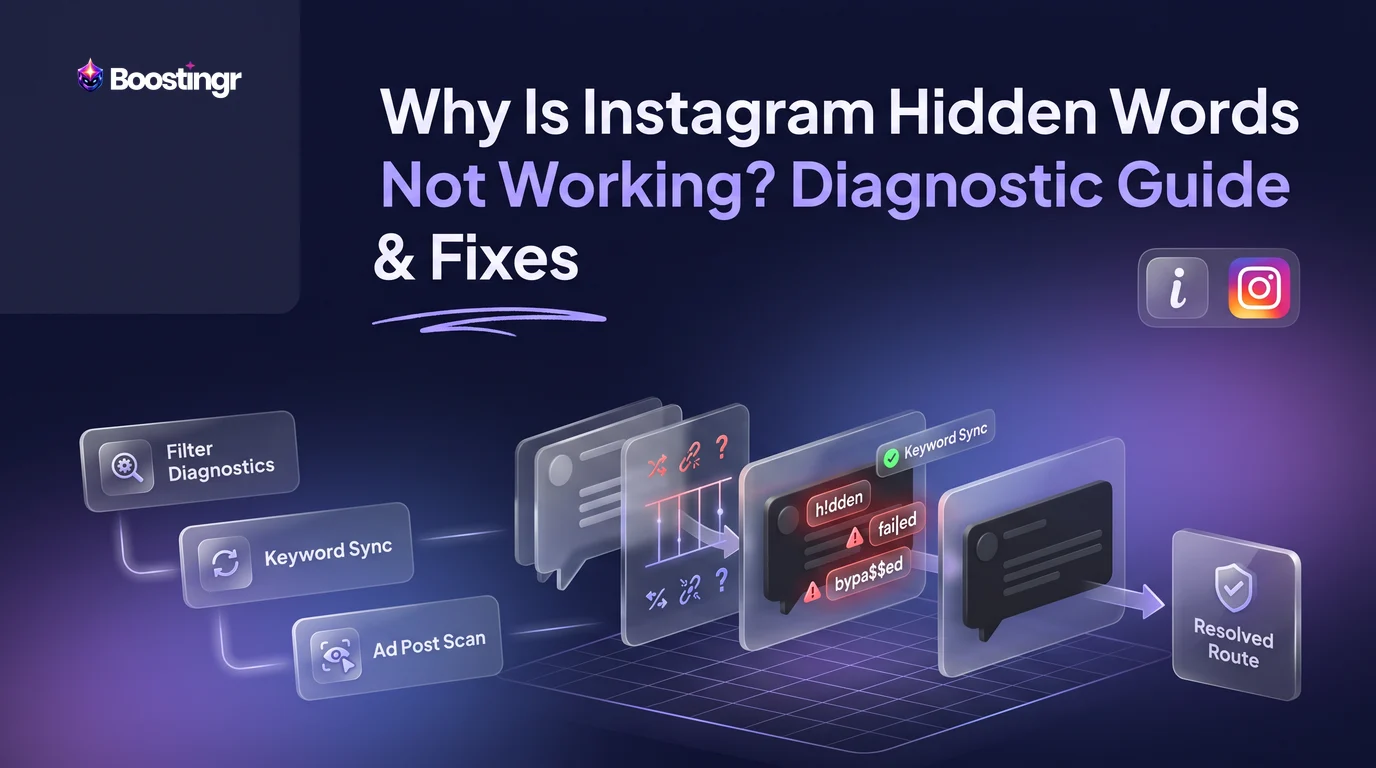
For a technical look at handling native platform filter bugs, read why is Instagram Hidden Words not working.
Comment-to-DM Conversion Architectures
Public comment sections are built for discovery and social proof; they are unsuited for complex customer support, lead qualification, or transactional checkouts. Attempting to resolve support tickets publicly exposes internal processes, creates cluttered threads, and risks exposing personal customer data.
The most effective implementation of an instagram group management bot is bridging public community spaces into private, one-on-one direct message funnels.
[User Comments on Public Post / Ad]
                 │
                 ▼
[Boostingr AI Evaluates Intent: High Purchase Intent Detected]
                 │
     ┌───────────┴───────────┐
     ▼                       ▼
[Public AI Reply]     [Private 1-on-1 DM Initialized]
("Sent details to     ("Hey! Here is the direct link +
your DMs!")           applied discount you asked about...")
                             │
                             ▼
                   [Interactive Lead Flow]
The Dual-Action Response Protocol
When a prospective customer comments on an organic post or paid ad—for instance, "Where can I get the configuration guide for this setup?"—an intelligent engine initiates a coordinated dual action:
- The Public Validation: The bot leaves a short, public response on the post: "We just sent the setup guide and direct link to your DMs! Check your inbox 🚀". This confirms to the broader audience that the brand is attentive, active, and helpful.
- The Private Resolution: Under official Meta API capabilities, the platform sends an automated, private Direct Message directly to the user. This message contains deep links, dynamic product options, or appointment booking modules.
By privatizing the operational conversation, the brand keeps public comment sections clean and focused on community praise, while moving prospects into a conversion channel with zero distraction from competitors. Discover how to deploy these interactive mechanisms with our dedicated Instagram comment automation workflow.
First-Party Operational Case Study: Scaling DTC Customer Ops
The Baseline Environment
A high-growth lifestyle apparel brand handling over 180,000 active followers and spending upwards of $40,000 monthly on Instagram ads faced a critical operational bottleneck. During a five-day promotional push, incoming interaction volume jumped to more than 1,200 comments and 450 DMs daily.
The brand was using native Meta Business Suite alongside a standard team shift of three community managers.
- Average Response Time: 4 hours and 18 minutes.
- Spam Leakage: 14% of ad comments contained unmoderated competitor links, phishing bots, or hostile promotional spam.
- Team Burnout: Support agents spent nearly 65% of their working hours manually deleting spam comments, answering identical sizing questions, and untangling overlapping message assignments.
The Boostingr Implementation
The brand replaced its fragmented manual triage with Boostingr, configuring custom Brand Memory parameters and dynamic intent-based routing:
- Contextual Sentiment Engine: Automatically scanned and hid obfuscated spam, competitor link farming, and hostile troll attempts within an average of 4.2 seconds.
- Automated Product Knowledge Routing: Sizing questions, fabric specifications, and shipping policies received immediate, contextually accurate brand-tone responses directly in the comments.
- Comment-to-DM Conversion Funnel: Every comment containing clear purchase intent ("want this", "where to buy", "discount code?") received an immediate public reply paired with a private direct message containing a tracked checkout link.
Results After 30 Days
- Response Time Reduction: Dropped from 258 minutes to 11 seconds for standard inquiries.
- Ad Conversion Rate (ROAS): Increased by 18.4%, driven primarily by the rapid removal of spam and instant delivery of checkout links in DMs.
- Manual Workload Reduction: Frontline community managers reclaimed 73% of their daily bandwidth, shifting their focus to proactive influencer outreach and VIP customer retention.
Visual guide
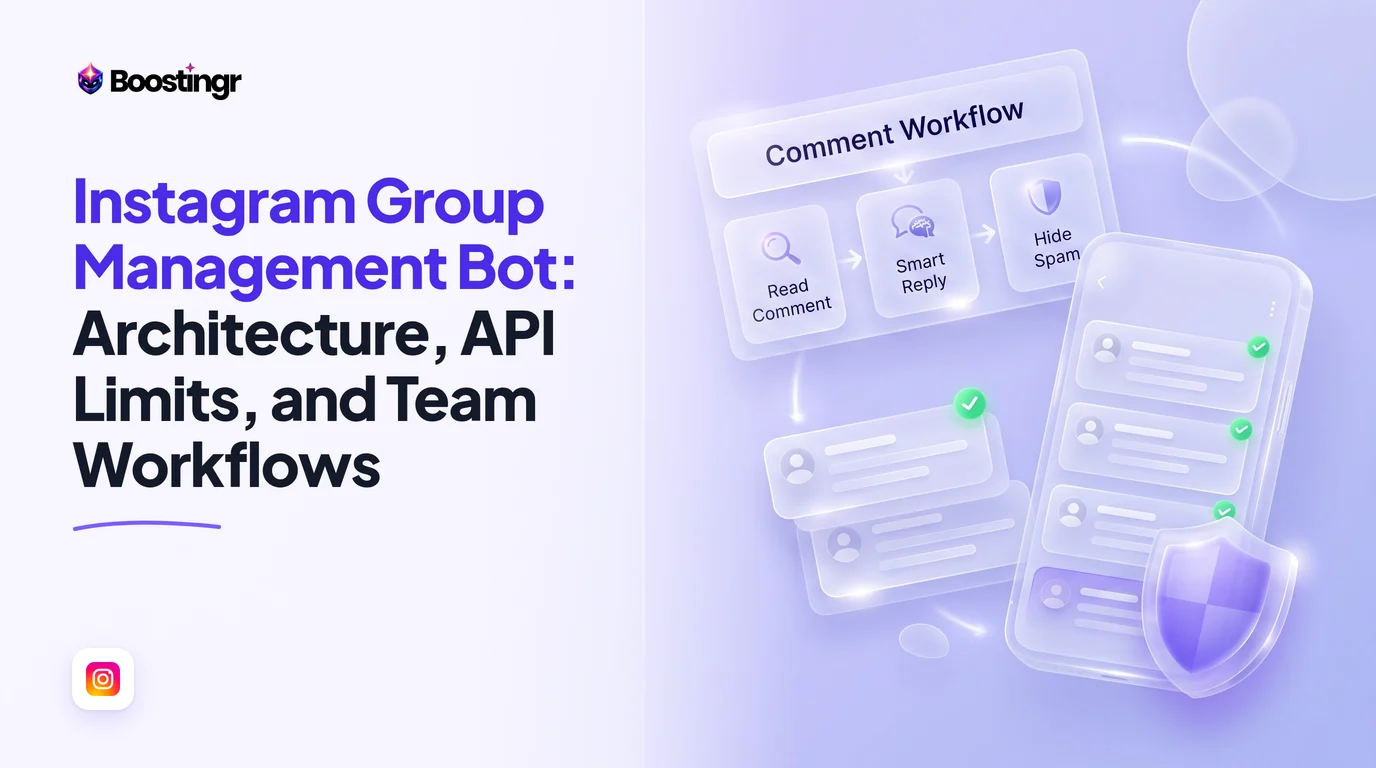
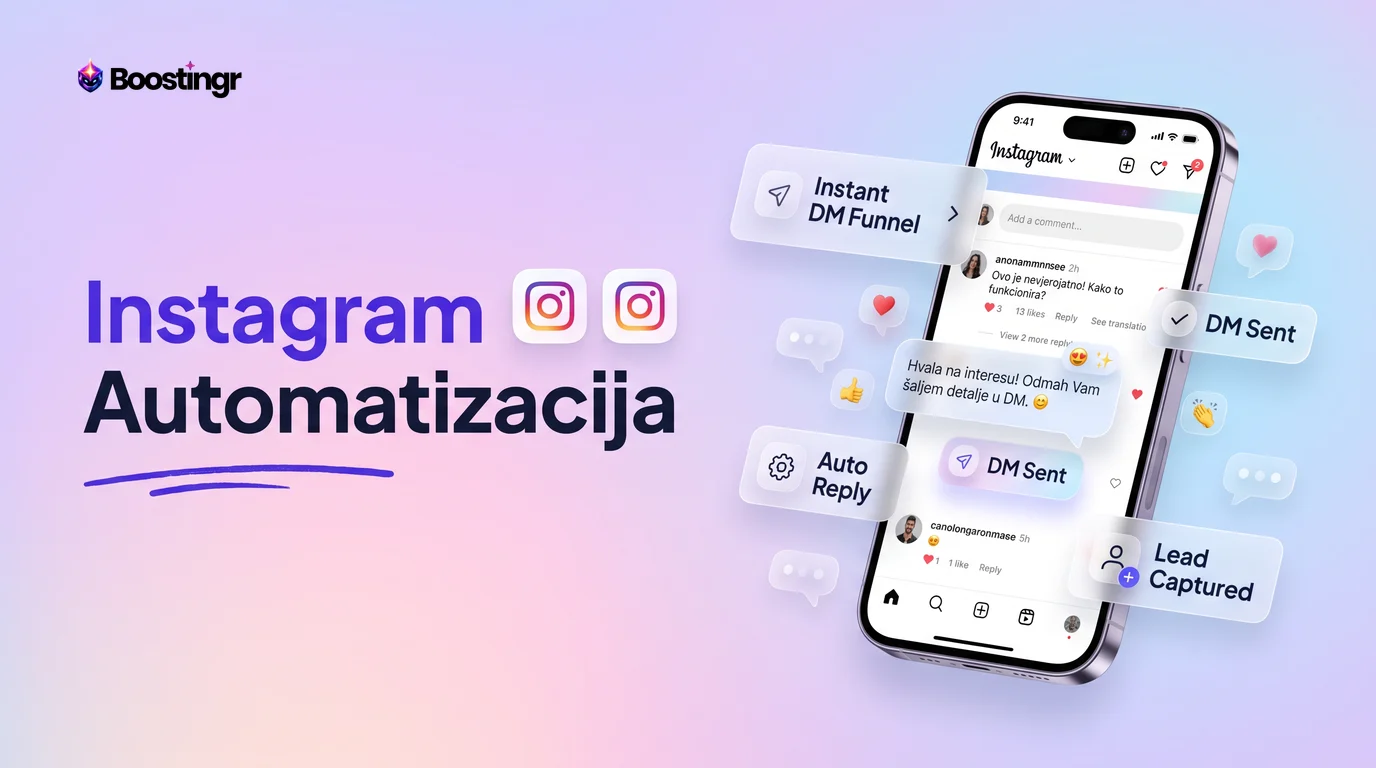
Routing Interactions Through Official Meta APIs
Understand which conversations can be automated via the official Instagram Graph API and which require manual handling.
Triage Inbound Comments and Direct Messages
Contextual AI evaluates incoming intent in real time to filter spam, assign support cases, or answer buying questions.
Defending Brand Posts Against Bot Swarms
See how automated safeguards detect rapid-fire bot attacks while keeping genuine customer conversations flowing.
Checklist: Deploying an Instagram Group Management Architecture
Use this operational checklist to evaluate, configure, and safely scale your Instagram automation stack:
- Audit Compliance Infrastructure
- Confirm that all automated platforms communicate strictly via the official Meta Graph API.
- Remove any legacy automation tools that require entering raw Instagram account credentials or session cookies.
- Eliminate any third-party tools promising automated message scraping inside multi-user direct group chats.
- Configure Administrative Routing & Team Governance
- Map internal team hierarchies into roles: Viewer, Content Moderator, Escalation Agent, Account Admin.
- Enable real-time collision detection inside the ai social inbox for teams to prevent overlapping agent replies.
- Integrate external notification channels (e.g., Slack or Microsoft Teams) for critical Tier 3 crises.
- Establish Brand Memory & Context Guardrails
- Index your brand's core documentation: return policies, shipping thresholds, ingredient/material specs, and regional FAQs.
- Define tonal guardrails: humor tolerance, formality index, banned expressions, and approved emoji usage.
- Configure automated fallback triggers for queries containing ambiguous sentiment.
- Implement Proactive Defense & Brand Safety
- Set real-time "Auto-Hide" rules for confirmed spam, phishing links, and hate speech to prevent thread visibility without alerting bad actors.
- Establish special monitoring sweeps over active Meta ad dark posts to protect ROAS.
- Review our diagnostic guide if platform tools falter: Facebook Moderation Assist not working.
- Activate Revenue & Conversion Workflows
- Configure comment-to-DM automations for high-intent keywords ("price", "link", "order", "details").
- Embed UTM tracking codes on all automated DM links to monitor downstream revenue attribution in Google Analytics.
- Test dynamic public comment variations so automated responses remain natural and avoid triggering platform rate limits.
Key Takeaways
- Meta API Restrictions Are Definite: Automated bots cannot operate inside private, multi-user Instagram direct messaging groups (>2 participants) via Meta's official Graph API. Tools promising this capability rely on scraping methods that risk account bans.
- True Group Management Focuses on Teams: Professional Instagram group management means coordinating cross-functional human teams through unified inboxes, role assignment, and multi-account social dashboards.
- Keywords Are Obsolete; Context Rules: Modern community safety requires natural language processing and semantic understanding. Static keyword filters fail against obfuscated text, sarcasm, and coordinated bot swarms.
- Public Engagement Should Drive Private Sales: Public comments validate brand presence, while automated comment-to-DM funnels protect customer data, clear out comment clutter, and shorten the path to purchase.
- Autonomous Governance Demands Escalation Tiers: Sustainable AI automation requires a three-tier system balancing instant autonomous replies, human-in-the-loop validation, and immediate crisis escalations.
Frequently asked questions
Can you put an automated bot into an Instagram group direct chat?
No. Meta's official Graph API strictly limits automated messaging to one-on-one direct messages between a verified business or creator account and a single user. Bots that claim to automate multi-participant direct message group chats use unauthorized scrapers that violate Meta's Terms of Service and create a significant risk of account suspension.
What is an Instagram group management bot used for?
An Instagram group management bot is primarily used to orchestrate internal team workflows across social accounts. It provides a shared collaborative inbox, automates role-based conversation assignments, handles high-volume public comment moderation, and converts public community comments into private, one-on-one direct message sales conversations.
How does an AI comment bot differ from basic keyword filters?
Basic keyword filters only search for exact, predefined word matches and are easily bypassed by deliberate typos, leetspeak, or sarcasm. An AI comment moderation engine uses natural language processing to evaluate the context, intent, and sentiment of every comment, accurately filtering out bad-faith trolls and coordinated spam while leaving positive customer praise untouched.
Will using an Instagram automation bot get my account banned?
Using unverified third-party software that asks for your direct Instagram username and password or uses browser-scraping hacks can easily trigger an account ban. However, tools that integrate directly through Meta's official Graph API using standard OAuth security permissions are fully compliant, secure, and endorsed for business operations.
What is a comment-to-DM conversion bot?
A comment-to-DM bot is an automated workflow that detects when a user leaves a comment on your organic post, Reel, or ad, and instantly sends them a private, one-on-one direct message. This workflow allows brands to answer questions, share links, or distribute promotional codes privately without cluttering public comment threads.
How can multiple team members manage one Instagram account safely?
Teams can safely manage a single Instagram account by connecting it to an official API-driven unified inbox platform. This eliminates the security risk of sharing account passwords, prevents unexpected verification lockouts, and gives team members clear internal ownership over tickets, assignments, and draft approvals.
Is this available in size M? Want to order today