



The Economics of Modern Comment Feeds: Cost Center or Growth Engine?
For enterprise brands, high-growth direct-to-consumer (DTC) merchants, and performance marketing agencies, social media comment feeds have transformed. They are no longer simply casual digital watercoolers. Instead, the comments beneath your organic posts, Instagram Reels, TikTok videos, and paid social campaigns (such as Meta dark posts) represent high-stakes commercial environments.
When a prospective customer pauses their scroll to view an ad, the comment section acts as the primary unmoderated review section. Prospective buyers read community reactions to validate product quality, shipping speeds, and customer support responsiveness. Conversely, bad actors see your ad spend as an opportunity to siphon traffic, posting phishing links, dropshipping counter-offers, brand impersonations, and toxic spam.
Historically, brands handled moderation defensively, treating it as an inevitable cost center. Social media managers or offshore moderation teams manually scrolled through hundreds of notifications daily to delete offending remarks. However, as paid ad spend scales across global markets, linear human moderation fails to keep up. When volume surges, labor costs spike, response latency stretches into hours, and paid social algorithms penalize ads plagued by negative engagement.
Automated comment moderation fundamentally shifts this dynamic. By deploying machine learning models, natural language processing, and semantic understanding, brands can automatically filter abuse, preserve ad auction efficiency, and engage high-intent shoppers instantaneously. To understand whether this technology makes sense for your operational stack, you must evaluate the hard financial return.
Unifying the 3-Way Economic Formula
Most existing analyses of moderation software fall into an incomplete binary: they measure operational labor savings or high-level defensive brand safety. Neither approach captures the holistic impact on an enterprise P&L.
To establish an audit-ready business case, growth directors and financial controllers must evaluate social moderation across three distinct financial vectors: operational labor replacement, ad spend protection, and conversational revenue recovery.
Here is the definitive comment moderation roi formula:
$$\text{Total Net ROI} = \frac{(\text{Labor Saved} + \text{Ad Spend Protected} + \text{Net Revenue Recovered}) - \text{Software Cost}}{\text{Software Cost}} \times 100$$
+--------------------------------------------------------------------------+
|                       THE 3-WAY MODERATION ROI ENGINE                    |
+--------------------------------------------------------------------------+
|  1. DIRECT LABOR SAVINGS                                                 |
|     [Hours Spent Triage] x [Blended Hourly Wage] x [Automation Rate %]    |
|                                                                          |
|  2. AD SPEND & ROAS PROTECTION                                           |
|     [Total Paid Social Spend] x [Algorithmic CPM Penalty Reduction %]    |
|                                                                          |
|  3. BUYING-INTENT REVENUE RECOVERY                                       |
|     [High-Intent Pre-Sale Comments] x [Conversion Lift %] x [AOV]        |
+--------------------------------------------------------------------------+
|  SUBTRACT: Total Cost of AI Moderation Platform Software                 |
|  EQUALS:   Definitive Net Financial Return (ROI)                         |
+--------------------------------------------------------------------------+
Pillar 1: Labor Cost Saved
Quantifying labor savings requires examining the real cost of human review. Human moderators, whether in-house community managers or third-party business process outsourcing (BPO) agencies, review social comments at an average pace of 60 to 90 comments per hour when accounting for context evaluation, logging, and decision latency.
$$\text{Labor Cost Saved} = \left( \frac{\text{Monthly Comments}}{\text{Comments Handled per Hour}} \times \text{Blended Hourly Rate} \right) \times \text{Automation Rate}$$
If your brand generates 120,000 comments per month across organic and paid channels, a human team reviewing 80 comments per hour requires 1,500 labor hours. At a fully loaded internal cost of $32/hour (including salary, benefits, and management overhead), manual moderation costs $48,000 monthly. An automated solution operating at a conservative 90% automation rate saves $43,200 in monthly labor.
Pillar 2: ROAS and Ad Spend Protected from Auction Penalties
Paid social algorithms evaluate user engagement to determine creative quality. When users leave spam, scam links, or unchallenged toxic feedback on your ads, auction mechanics register those signals as poor ad quality, driving up CPMs and suppressing reach. We will detail this algorithmic mechanic later in this guide.
$$\text{Ad Spend Protected} = \text{Monthly Ad Spend} \times \text{Estimated CPM Penalty Avoided (%) }$$
For an e-commerce brand spending $250,000 per month on Meta and TikTok ads, unmoderated scam comments and unresolved complaints often drive a 12% to 20% penalty on CPMs due to poor Ad Quality Rankings. Protecting against even a 10% auction degradation safeguards $25,000 in working media value every single month.
Pillar 3: Net Revenue Recovered from Buying-Intent Comments
Not every comment is defensive spam. A substantial portion consists of active pre-purchase friction: "Does this fit true to size?", "Can I get this delivered to Canada by Friday?", or "Is this compatible with the 2024 model?". When answered immediately, these comments convert at exceptionally high rates.
$$\text{Net Revenue Recovered} = (\text{Monthly Intent Inquiries} \times \text{Conversion Lift Rate}) \times \text{Average Order Value (AOV)} \times \text{Gross Margin %}$$
If you receive 3,000 commercial inquiries monthly, resolving them instantaneously can yield an incremental 15% conversion rate. At an AOV of $110 and a 60% margin, that yields $29,700 in net gross profit directly attributed to real-time comment engagement.
Manual vs. Automated Comment Moderation Cost Economics
Building an automated comment moderation business case requires directly comparing the cost profiles of manual review against intelligent automation. Human teams scale linearly: as your ad budget grows and campaign reach expands, comment volume rises proportionately, requiring more staffing, management layers, and weekend coverage shifts.
Cost Curve Comparison Over Time

Expense ($)
   |
   |                                    / (Manual Moderation: Linear Cost)
   |                                   /
   |                                  /
   |                                 /
   |                                /
   |   ----------------------------/----- (Automated AI Platform: Predictable Tier)
   |  /
   | /
   +---------------------------------------> Comment Volume / Ad Spend
The fundamental metric to track is the cost per comment reviewed automation versus human processing. Below is an operational breakdown illustrating how economics diverge as brand engagement scales.
| Operating Metric | Manual In-House Team | Offshore Outsourced (BPO) | Basic Native Keyword Filters | Automated AI Platform (Boostingr) |
|---|---|---|---|---|
| Average Cost per Comment | $0.35 – $0.55 | $0.12 – $0.20 | $0.00 (Direct) | $0.004 – $0.015 |
| Coverage Hours | 8 to 16 hours/day | Up to 24/7 (SLA-dependent) | 24/7 (Zero context) | 24/7 Instant (Sub-second) |
| Triage Speed / Latency | 15 mins to 4 hours | 10 mins to 2 hours | Immediate | < 2 seconds |
| Contextual Accuracy | High (Fatigue prone) | Moderate (Cultural drift) | Extremely Low (Keyword-only) | Exceptionally High (Semantic AI) |
| Pre-Sale Intent Conversion | Low (Too slow) | Low (Template scripts) | Non-Existent | High (Instant personalized reply) |
| Scalability during Spikes | Poor (Requires hiring) | Moderate (Overtime fees) | High (Breaks workflows) | Seamless Elastic Scaling |
When calculating your manual vs automated comment moderation cost, brands frequently overlook the hidden expenses of manual management: management time spent auditing tickets, high staff turnover caused by reviewing toxic material, and human cognitive fatigue that leads to missed scam comments during peak traffic hours.
For a deeper dive into the workflows enterprise organizations use to solve this operational bottleneck, explore our analysis of what tools big brands use to moderate Instagram comments.
Algorithm-Level ROAS Mechanics: Meta, Andromeda, and Auction Rankings
Many growth marketers assume comment sections are completely disconnected from paid social ad bidding algorithms. This assumption is costly. Paid ad platforms evaluate creative performance holistically, making ad spend protection comment moderation a primary lever for sustaining high return on ad spend (ROAS).
The Meta Ad Auction and Quality Rankings
Meta determines ad delivery using a total value equation:
$$\text{Total Value} = [\text{Advertiser Bid}] \times [\text{Estimated Action Rates}] + [\text{User Value}]$$
User Value incorporates both user experience signals and Ad Quality Rankings. Meta evaluates Ad Quality Rankings based on feedback from users who view or hide the ad, alongside automated assessments of low-quality attributes. If your comments section fills with unresolved complaints, scam URLs, spam bots, or customer reports of deceptive fulfillment, Meta’s internal classification systems—including its modern machine learning architectures like Andromeda—penalize the ad asset.
When User Value drops, your total auction value collapses. To win the same ad impression against competitors targeting identical demographic segments, the auction forces your account to pay higher bids, resulting in a spike in Cost Per Mille (CPM) and Cost Per Click (CPC).
How Unmoderated Comments Damage Paid Social ROAS

[Unmoderated Ad Comments: Spam, Scams, Toxic Feedback]
                      |
                      v
[Negative User Reactions: Hide Ad, Report Spam, Quick Bounces]
                      |
                      v
[Platform Machine Learning (Meta Andromeda) Detects Low User Value]
                      |
                      v
[Ad Quality Ranking Drops Below Average (Bottom 20-35%)]
                      |
                      v
[Auction Bidding Penalty Applied -> CPMs Increase by 15% to 40%]
                      |
                      v
[Direct ROAS Collapse & Elevated Customer Acquisition Cost (CAC)]
The Cost of Replying to Spam Instead of Hiding It
A frequent tactical error performance marketers make is engaging directly with spam bots or troll comments to artificially inflate engagement volume. As detailed in our breakdown of the Meta Ads algorithm impact of replying to spam comments, arguing with trolls or posting manual rebuttals sends mixed signals to recommendation and auction models. Algorithms interpret rapid back-and-forth toxic banter as low-quality engagement, further depressing your creative ranking.
Instead, real-time automated systems inspect comments via the Instagram Graph API or Meta Graph API, silently hiding toxic text and scam links within seconds of publication. Hiding keeps the comment visible to the author (avoiding retaliatory brigading) while instantly cleaning the public record for prospective buyers and the auction evaluation engines.
Deploying roas protection automated moderation safeguards paid social delivery, keeping CPMs competitive and letting creative assets scale without unprompted auction fatigue. Learn more about platform-specific execution in our guide on multi-platform comment automation.
Academic Proof: The Empirical Impact of Comment Moderation on Conversion
Is the conversion uplift from comment moderation merely an agency theory, or can it be validated scientifically?
Academic literature confirms that social feedback directly influences consumer purchasing decisions. In an influential field-experiment study conducted by researchers at Harvard Business School (Automated Comment Moderation Enhances Social Media Advertising Performance, accessible via hbs.edu), researchers analyzed the causal effect of automated comment moderation on paid social advertising effectiveness.
The findings were unambiguous:
- Direct ROAS Lift: Ads utilizing automated comment moderation demonstrated a statistically significant increase in Return on Ad Spend (ROAS) compared to identical ads left unmoderated or subjected to delayed manual moderation.
- CTR and Engagement Gains: Prospective buyers exposed to clean, scam-free comment sections showed higher Click-Through Rates (CTR) and spent significantly longer exploring destination landing pages.
- Preservation of Purchase Intent: The presence of unaddressed toxic comments, competitor disparagement, or fraudulent affiliate links depressed baseline purchase intent by over 20%. Hiding harmful commentary neutralized this friction, preserving the baseline conversion rate of the paid traffic.
Consumers interpret an unmoderated comment thread as evidence of an abandoned brand, unresponsive customer support, or deceptive marketing practices. By establishing consistent, automated brand safety, companies directly protect conversion equity.
The True Cost of False Positives and Latency
When brands attempt to solve moderation cheaply, they typically rely on two approaches: native keyword blocklists or periodic manual check-ins. Both carry severe, hidden financial costs that distort their expected ROI.
1. The Cost of Primitive Keyword Blocklists (False Positives)
Native platform filters rely on crude substring matching. If an administrator adds the word "cheap", "return", or "discount" to an Instagram or Facebook blocklist to deflect complaints, the filter acts as a blunt instrument.
Consider these real-world consumer comments:
- "Is this fabric cheap polyester, or is it high-grade linen?"
- "If this doesn't fit my frame, what is your return policy?"
- "Do you offer a first-time buyer discount code? I want to order 3 units!"
A basic keyword filter hides these comments instantly. The prospective customer perceives that their question was ignored, gets no response, and abandons their cart. In high-volume e-commerce, hiding qualified buyers can cost tens of thousands in lost Gross Merchandise Value (GMV) every month.
Modern platforms like Boostingr bypass crude blocklists by using intent detection and contextual sentiment analysis. Boostingr does not just read comments; it understands people. It distinguishes between a troll shouting "Your product is cheap garbage!" and an intrigued customer inquiring "Is this affordable because of a direct-to-consumer model?".
Crude Blocklists vs. Contextual AI Understanding

Incoming Comment: "What is your return policy if the medium size is too snug?"

[Crude Native Keyword Filter: Match 'return']
  --> Result: Comment Hidden Automatically
  --> Outcome: High-intent buyer ignored, cart abandoned ($120 Lost Sale)

[Boostingr Semantic Intelligence: Identifies Pre-Purchase Consideration]
  --> Result: Comment Left Visible
  --> AI Reply: "We offer hassle-free 30-day exchanges with prepaid labels!"
  --> DM Sent: Sizing guide + direct checkout link
  --> Outcome: Immediate Sale Closed ($120 Recovered GMV)
2. The Cost of Response Latency (The 15-Minute Drop-Off)
In consumer psychology, impulse purchase intent degrades rapidly. Research into digital lead conversion shows that the probability of closing a lead drops dramatically after the first 5 to 15 minutes of initial interest.
When a shopper asks a product question beneath an ad, they are actively holding their credit card. If your human moderation team takes three hours to answer because of off-shift hours or ticket backlogs, that shopper has scrolled away, purchased from an Amazon competitor, or lost interest entirely.
By leveraging automated lead recovery from social media comments, brands compress that response latency from hours to seconds. Our AI Instagram reply bot workflows identify purchase-intent inquiries instantly, delivering contextual, humanized answers in-thread while triggering automated Instagram lead capture directly into direct messages (DMs).
Dark Post Comment Moderation ROI
Performance marketing at scale relies heavily on dark posts—paid ads that do not appear on a brand's organic profile feed. Dark posts represent an acute operational vulnerability for marketing agencies and enterprise brands.
Because dark posts are disconnected from the standard organic timeline, community managers rarely monitor them daily. A single viral ad running across 40 ad sets can accumulate thousands of comments that go completely unnoticed by organic social teams.
Dark Post Vulnerability Matrix

Paid Traffic Funnel -------------------> High Scale (Spend: $500k/mo)
        |
        v
[Targeted Ad Creative (Dark Post)] ----> Unlisted on Profile Grid
        |
        +---> Comment Stream Ignored by Organic CM Tools
        |
        +---> Unchecked Competitor Hijacking (Spam links, coupons)
        |
        +---> Unresolved Shipping Frustrations Dominate Top Comments
        |
        v
[Prospective Buyer Checks Comments] ---> Sees 5-Star Creative with 1-Star Comments
        |
        v
[Result: Bounce Rates Spike, Blended ROAS Drops by 30%]
Calculating dark post comment moderation roi requires evaluating three direct business outcomes:
- Elimination of Competitor Poaching: Competitors frequently target high-spend dark posts, deploying bot accounts that comment "Don't buy here, get the exact same thing at [Competitor URL] for 40% less!". Automated moderation detects competitor domains and phishing redirects, hiding them in under two seconds.
- Prevention of Ad Fatigue: When an ad’s top three comments are negative complaints, click-through rates crater. By programmatically hiding abusive comments and prioritizing verified user sentiment, ad creative life cycles extend by weeks, reducing creative production and testing costs.
- Cross-Account Dark Comment Aggregation: Without an automated system connected via the official APIs, identifying comments across hundreds of active dark post variations requires tedious manual checks in Meta Ads Manager. Consolidating these streams into an automated engine saves significant operational hours each week.
To discover how agencies streamline these exact dark post workflows across multiple client accounts, read our guide on Instagram comment automation.
Comparison Table
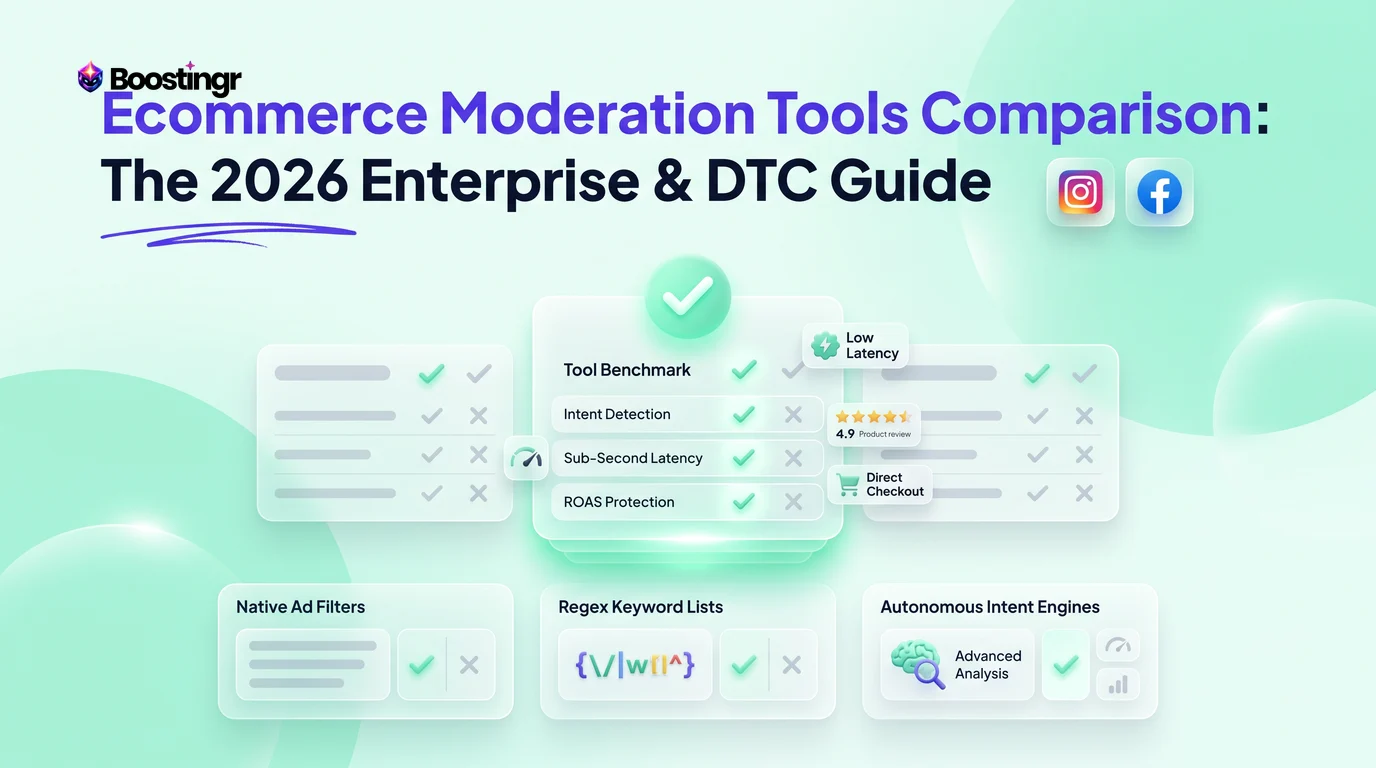
| Capability / Metric | Manual Human Moderation | Native Social Filters | Generic Social Inbox Tools | Boostingr AI Comment Management |
|---|---|---|---|---|
| Primary Function | Reactive cleanup | Basic word matching | Centralized ticket routing | Proactive moderation & growth |
| Understands Slang & Emojis | Yes | No | Limited | Yes (Contextual semantics) |
| Sub-Minute Latency (24/7) | No (SLA: Hours) | Yes (Immediate) | No (Manual action needed) | Yes (< 2 seconds) |
| Detects Buying Intent | Yes (Slow) | No | No | Yes (Automated conversion) |
| Protects Ad Platform Quality Rank | Moderate (Too slow) | Low (Keyword errors) | Low (Lagging metrics) | High (Real-time spam suppression) |
| Brand Tone Continuity | Variable per agent | N/A | Variable per agent | Unified ("Teach once, engage everywhere") |
| Dark Post Comment Scraping | Cumbersome | Partial | Tier-Restricted | Native & Comprehensive |
| Cost per 10k Comments | $1,200 – $2,500 | $0 (High hidden loss) | $400 – $800 | $40 – $150 |
| Prevents False Positives | High | Extremely Poor | High (Human needed) | Exceptionally High (Natural NLP) |
Practical Examples and Use Cases
To see how the roi of automated comment moderation plays out on balance sheets, examine these real-world scenarios across distinct operational models.
Use Case 1: The High-Volume DTC Apparel Brand
- Profile: Global athleisure brand spending $400,000/month on Meta and TikTok.
- Challenge: Scaling up ad spend caused negative spam and sizing questions to surge across 60+ ad variations. Manual customer service teams fell behind, responding with a 14-hour median latency. Ad Quality Rankings dropped to "Below Average" on 40% of their ad spend.
- Automated Solution: Deployed Boostingr for automated comment moderation, spam link removal, and automated sizing replies powered by Brand Memory.
- Financial Result:
- Lowered average CPMs by 18% within 3 weeks by cleaning spam signals, effectively recovering $72,000 in monthly ad delivery value.
- Automated sizing assistance converted 1,140 purchase-intent comments directly into checkouts in month one, yielding $96,900 in new GMV ($85 AOV).
- Replaced $9,500/month in outsourced offshore moderation contractor fees.
- Total Monthly Value Added: $178,400 against a modest software investment.
Use Case 2: The Multi-Client Performance Agency
- Profile: Growth agency managing 28 e-commerce accounts spending an aggregate $1.8M/month.
- Challenge: Account managers spent 60 to 90 minutes each morning moderating client dark posts, deleting crypto bots, and alerting clients to critical product complaints. High churn occurred whenever a client noticed competitor spam lingering under their ads.
- Automated Solution: Standardized all client onboarding onto an automated AI moderation workflow.
- Financial Result:
- Eliminated 42 hours of weekly internal agency labor, freeing senior strategists to focus on campaign optimization and creative testing.
- Preserved client retention rates; zero client churn attributed to unmoderated ads over four consecutive quarters.
- Captured warm leads by sending automated direct message discount codes to prospective customers asking "Where can I buy this?" in client comment feeds.
Use Case 3: The Enterprise SaaS & B2B Tech Provider
- Profile: B2B enterprise software brand running paid LinkedIn and Meta campaigns targeting enterprise decision-makers.
- Challenge: High-cost pay-per-click ad campaigns were routinely targeted by disgruntled former users, competitors spreading misinformation, and automated bot networks posting phishing URLs, destroying credibility with enterprise buyers.
- Automated Solution: Real-time troll and scam link detection configured to instantly hide off-brand commentary and route qualified technical questions to sales engineers.
- Financial Result:
- Safeguarded brand reputation across high-ticket ($30k+ ACV) enterprise pipeline campaigns.
- Reduced sales qualification cycle times by engaging technical inquiries in comments within 60 seconds.
Visual guide
Comment Processing Workflow
This visual shows how roi of automated comment moderation moves from incoming public comment to classification, moderation, reply routing, and retained learning.
AI Decision Tree
This visual breaks down how Boostingr decides when a comment should receive an instant reply, review, hide action, or human escalation.
Brand Memory Diagram
This visual explains how approved offers, tone rules, support boundaries, and campaign knowledge help Boostingr teach once and engage everywhere.
Checklist: Building Your Comment Moderation Business Case
Use this operational checklist to evaluate your current vulnerability, audit potential labor efficiencies, and present a compelling financial case to your executive leadership team:
- Quantify Historical Comment Volume: Pull total comment counts across organic posts, Reels, TikToks, and paid dark posts for the past 90 days.
- Calculate Fully Loaded Labor Costs: Determine the exact hourly cost of internal community managers or outsourced BPO contractors handling comment review.
- Audit Current Response Latency: Measure the average time elapsed between a pre-sale comment publication and your brand's reply during peak and off-peak hours.
- Evaluate Ad Quality Rankings: Inspect Meta Ads Manager to identify ads suffering from "Average" or "Below Average" Quality Rankings caused by negative feedback.
- Inspect Crude Keyword Filters: Review native blocklists to identify legitimate buyer inquiries that were hidden due to overzealous substring matching.
- Benchmark Pre-Sale Intent Ratios: Analyze a 1,000-comment sample to calculate the percentage of inquiries displaying clear commercial or product intent.
- Calculate CPM Degradation Cost: Run split tests comparing clean, moderated ad sets against unmoderated ads to determine the auction discount achieved by protecting ad quality.
- Model Software Investment vs. Headcount: Compare the fixed cost of an enterprise AI comment management platform like Boostingr against linear personnel hiring projections.
First-Party Case Study: Scaling ROAS for an Omnichannel Beauty Brand
To understand how these economics operate in practice, consider a first-party observation from Boostingr's deployment with a high-growth omnichannel beauty retailer.
The Baseline
The brand was investing $320,000 monthly across Meta (Instagram Reels, Feed Ads) and TikTok Ads. They relied on two full-time in-house community managers supported by a weekend agency team to monitor ad engagement. Despite this investment, the brand faced recurring challenges:
- Off-Hours Vulnerability: Ads scaled heavily between 7:00 PM and midnight, during which scam comments and counterfeit product links remained visible for up to five hours.
- Algorithmic Headwinds: Three of their primary creative assets were throttled by Meta with a "Below Average Quality Ranking," pushing CPMs up to $42.50.
- Abandoned Inquiries: Over 4,000 monthly questions regarding ingredient sensitivities and shade matching went unanswered until the next business day.
The Implementation
The brand integrated Boostingr across all ad accounts and organic profiles. Boostingr's real-time semantic engine was configured to:
- Instantly hide any comment containing external URLs, phishing hooks, competitor promotions, or derogatory attacks.
- Utilize Brand Memory to automatically interpret shade-matching questions and post contextual, humanized recommendations within 90 seconds.
- Automatically route complex customer service complaints into their dedicated helpdesk ticketing flow.
The Results
Within 45 days of deployment, the financial impact was clear across all three ROI pillars:
+--------------------------------------------------------------------------+
|                       FIRST-PARTY DEPLOYMENT RESULTS                     |
+--------------------------------------------------------------------------+
|  Pillar 1: Labor Savings                                                 |
|  - Manual triage hours reduced from 280 hours/mo to under 20 hours/mo     |
|  - Agency weekend coverage contract terminated                           |
|  - Direct monthly payroll savings: $11,200                               |
|                                                                          |
|  Pillar 2: ROAS & Ad Delivery Protection                                 |
|  - Meta Ad Quality Rankings improved from "Below Average" to "Top 35%"   |
|  - Account-wide blended CPM dropped from $42.50 to $34.80 (-18.1%)        |
|  - Value of preserved working media: $57,920 monthly                     |
|                                                                          |
|  Pillar 3: Revenue Recovery                                              |
|  - Automated shade-matching replies converted at 14.2%                   |
|  - Recovered GMV: $38,400 per month                                      |
|                                                                          |
|  TOTAL MONTHLY FINANCIAL LIFT: $107,520                                  |
|  NET ROI ON BOOSTINGR PLATFORM: 2,150%                                   |
+--------------------------------------------------------------------------+
Key Takeaways
- Moderation is a Revenue Driver: Automated comment moderation is not simply an administrative safety shield; it directly influences conversion rates, ROAS, and customer acquisition costs.
- The Unified Formula Governs True ROI: Accurate financial justification requires calculating the sum of labor hours eliminated, ad auction spend protected from CPM penalties, and pre-sale conversions recovered, minus software costs.
- Auction Mechanics Penalize Neglect: Meta Andromeda and TikTok ad delivery algorithms monitor ad quality. Leaving scam links or angry complaints in your comments lowers your Ad Quality Ranking, artificially inflating CPMs.
- Speed Closes Sales: Pre-purchase buying intent degrades within 15 minutes. Sub-minute, automated AI replies capture impulse shoppers when their intent is highest.
- Crude Blocklists Cost Revenue: Keyword filters lack semantic context, accidentally hiding qualified buyers asking ordinary product questions. Modern AI distinguishes between toxic trolling and commercial curiosity.
- Dark Posts Require Automated Oversight: Unlisted dark post ads represent the most vulnerable, highest-spend asset in your marketing portfolio. Automated cross-account aggregation is necessary to prevent competitor poaching and budget waste.
Frequently asked questions
How does automated comment moderation improve paid social ROAS?
Automated comment moderation improves ROAS by eliminating scam links, spam, and unaddressed complaints that drag down your ad platform Quality Rankings. When ad algorithms detect clean, safe user engagement, they award your campaigns higher auction relevance scores. This lowers your baseline CPMs and CPCs, allowing more of your media spend to reach qualified prospective buyers.
Can basic keyword blocklists replace AI comment moderation software?
No. Basic keyword blocklists rely on strict substring matching without semantic understanding. They routinely hide qualified, high-intent shoppers who use everyday terms like "return," "shipping," or "cheap" while asking legitimate pre-sale questions. Crude blocklists also fail to catch sophisticated spam, misspelled slurs, or emojis used by bad actors, leading to lost revenue and flawed moderation.
What is the average cost savings when switching from manual to automated moderation?
Brands switching from manual comment review to automated AI platforms typically reduce operational moderation costs by 70% to 90%. While manual human triage costs an average of $0.15 to $0.45 per comment, automated AI moderation processes comments for a fraction of a cent ($0.004 to $0.015), while providing instant 24/7 coverage without overtime or weekend fees.
How does fast response time in ad comments influence sales conversions?
Research demonstrates that pre-purchase consumer interest decays sharply after the first 5 to 15 minutes. When a prospective buyer asks a product, sizing, or shipping question in an ad comment, answering within seconds resolves friction while buying intent is peak. Brands deploying automated pre-sale replies regularly see an incremental 10% to 20% conversion lift on those interactions.
Does hiding comments hurt my organic engagement or reach?
Hiding spam or toxic comments does not hurt your reach; it protects it. When you hide a comment using the official Meta API, the comment remains visible to the original author and their immediate friends, preventing retaliatory attacks. Meanwhile, removing bad links and toxic remarks cleans up the user experience for the rest of your audience, signaling high creative quality to recommendation systems.
How does automated moderation protect dark posts specifically?
Dark posts do not show up on your brand’s public profile grid, which means manual community managers rarely review them in their daily workflows. Automated moderation systems connect directly to your ad accounts via API, automatically aggregating every dark post comment thread into a centralized processing pipeline. This ensures high-spend ads are continuously protected from spam, competitor links, and unanswered questions around the clock.
Is this available in size M? Want to order today