



The Evolution of Social Media Moderation: Beyond the Defensive Crisis Shield
For the past decade, performance marketing directors and community managers have viewed moderation tools strictly through a defensive lens. Teams bought software to act as a digital bouncer: keep profanity out of the feed, delete phishing links, and shield executive teams from viral PR crises.
This legacy framing leaves significant revenue on the table.
When a consumer comments on a paid Meta ad asking, "Does this fit true to size, or should I size up for wide feet?" or "Can this integrate with Shopify Plus?", traditional moderation suites treat the interaction as an unassigned ticket. It sits in a centralized queue alongside spam, waiting for an agent with an average first-response latency of 4 to 12 hours. By the time a support rep replies, the ad impression has decayed, the user has scrolled away, and the conversion window has closed.
High-growth digital brands no longer treat moderation as merely risk mitigation. They deploy automated social media moderation tools as an offensive revenue engine. By marrying defensive security (sub-second spam hiding) with conversational intent capture, modern software shields ad spend while simultaneously converting warm interest into direct sales pipeline.
Traditional Moderation (Defensive Shield):
User Comment ──> Static Filter ──> Manual Queue (4-12 hr wait) ──> Ticket Closed

Modern AI Moderation (Offensive Revenue Engine):
User Comment ──> Contextual LLM ──┬─> [Spam/Scam] ──> Auto-Hidden in <800ms
                                  └─> [High-Intent] ──> Instant On-Brand Reply + DM Lead Capture
Platforms built on the principle that "Boostingr does not just read comments, it understands people" transform reactive social inboxes into proactive conversion channels. To understand how to achieve this shift, we must examine the hidden mechanics of paid advertising auctions, rule-based filter limits, and platform engineering architectures.
Ad Auction Mechanics: How Unmoderated Comments Penalize Meta ROAS and Spike CPMs
Performance media teams often consider negative ad comments a nuisance rather than an immediate financial drain. However, unmoderated ad threads actively degrade paid campaign profitability inside the Meta, TikTok, and YouTube ad auctions.
The Algorithmic Feedback Loop
Meta evaluates ad auction competitiveness using a total value formula:
$$\text{Total Value} = (\text{Advertiser Bid} \times \text{Estimated Action Rate}) + \text{User Value}$$
User Value is calculated using post-click signals (bounce rate, landing page dwell time) combined with in-feed engagement quality. Meta's delivery algorithms parse comment sentiments, user reaction types, and thread behavior to assign ad relevance diagnostics:
- Quality Ranking: Measures your ad's perceived quality compared to ads competing for the same audience.
- Engagement Rate Ranking: Measures expected engagement rates versus competitors.
- Conversion Rate Ranking: Measures expected conversion completion based on historical creative engagement.
When malicious actors drop scam links, competitor promo codes, or unaddressed delivery complaints on your dynamic product ads (DPAs) or dark posts, your Quality Ranking drops into the "Bottom 20% of Ads" tier.
[Toxic Comment on Ad] ──> Users Read Negative Sentiment ──> Conversion Rate Drops
         │                                                            │
         ▼                                                            ▼
Meta Lowers Ad Quality Score ──> Auction Delivery Penalized ──> CPM Spikes (30-80%)
The Real Financial Cost of Slow Moderation
When ad quality drops, Meta compensates for the poor user experience by applying an auction penalty. To secure the same target ad impressions, your effective Cost Per Mille (CPM) increases by 30% to 80%.
Standard Ad Delivery Scenario (Clean Thread):
• Daily Budget: $10,000
• Baseline CPM: $25.00
• Impressions Delivered: 400,000
• Click-Through Rate (CTR): 1.80%
• Conversion Rate (CVR): 2.40%
• Conversions: 172
• Blended ROAS: 2.80x

Degraded Ad Delivery Scenario (Spam & Unresolved Complaints):
• Daily Budget: $10,000
• Penalized CPM (+40%): $35.00
• Impressions Delivered: 285,714
• Click-Through Rate (CTR): 1.10% (User hesitation caused by negative comments)
• Conversion Rate (CVR): 1.60%
• Conversions: 50
• Blended ROAS: 1.15x
Failing to deploy dedicated ad comment moderation software bleeds paid performance budget daily. Protecting return on ad spend (ROAS) requires removing algorithmic penalties before Meta's ad delivery engine flags creative sentiment as hostile.
The Technical Failure Modes: Why Keyword Blacklists and Regex Fail
Most social media management suites rely on regular expressions (Regex) and static keyword blacklists for automated moderation. While effective against straightforward obscenities, regex-based filters struggle against modern coordinated social spam, social engineering, and nuanced customer inquiries.
1. Homoglyphs and Leetspeak Evasion
Malicious comment bots run evasion scripts that swap ASCII characters for Unicode homoglyphs, zero-width spaces, or leetspeak substitutions. A rule-based filter searching for scam or whatsapp completely misses:
S-C-A-M(hyphenated delimiter)ԝһаtsарр(Cyrillic homoglyphs with identical visual representation to Latin glyphs)VV h a t s a p p(split characters)
Regex rules designed to catch every homoglyphic permutation quickly expand into fragile, thousand-line logic files that cause false positives and break team workflows.
2. Multi-Modal Context and Emoji Combinations
Hostility and brand damage often occur without conventional profanity. Coordinated trolling attacks frequently rely on contextual emoji sequences:
- Clown emojis (
🤡) or garbage bins (🗑️) flooded beneath a high-production founder announcement video. - Syringes, skull emojis, or biohazard symbols spammed on cosmetic and skincare ads to suggest product contamination.
Keyword engines cannot evaluate whether an emoji carries positive or negative sentiment without surrounding syntactic context. A clown emoji placed beside "My Halloween costume was a total 🤡 fail!" indicates lighthearted user engagement, whereas the same emoji posted as "Your support team is 🤡" signals brand dissatisfaction.
3. Sarcasm and Idiomatic Dissatisfaction
Example: "Oh wow, another revolutionary drop that breaks on day two! Outstanding quality control, guys. Bravo. 👏"
A basic keyword scanner classifies this comment as positive due to words like "revolutionary", "outstanding quality", and "bravo". In reality, the customer experienced product failure and posted a scathing review on your ad creative.
4. Over-Aggressive False Positives
Static blacklists frequently hide legitimate customers who use colloquial or sensitive language while expressing intent to buy:
- "This new jacket is sick as hell, what size should I order for a 6'1 frame?" (Flagged for "hell")
- "I'm dying to get my hands on the green shade, is it restocking this week?" (Flagged for "dying")
When rule-based filters hide these comments, you hide high-intent purchase queries, miss algorithmic engagement signals, and alienate your best prospects.
Contextual LLM Intent Analysis vs. Regex Rules
                                  Incoming Comment
                                         │
                  ┌──────────────────────┴──────────────────────┐
                  ▼                                             ▼
          Static Regex Filter                           Contextual LLM Engine
                  │                                             │
       Matches Exact Keywords?                       Analyzes Underlying Intent?
        (e.g., "hate", "scam")                   (Sarcasm, Homoglyphs, Emojis, Sentiment)
         ┌────────┴────────┐                           ┌────────┴────────┐
         ▼                 ▼                           ▼                 ▼
      [MATCH]          [NO MATCH]                  [THREAT]          [OPPORTUNITY]
   Hides comment    Ignores homoglyphs,         Auto-hides in       Passes to Brand Memory
  (False positives   sarcasm, & evasion         sub-seconds         for instant humanized
   on colloquial        (Spam passes                                response & sales
     language)            through)                                      routing
Modern ai social media moderation platforms replace brittle blacklists with small, fine-tuned language models. These models evaluate grammar, tone, emojis, and conversation history together. They classify user intent into discrete, actionable buckets:
Brand Safety Violation(Immediate hide)Competitor Poaching(Immediate hide + alert)Product Invalidation / Scam Claim(Escalate to support)High-Intent Purchase Question(Automated conversion workflow)Neutral / General Social Banter(Auto-like or light reply)
Dark Post & Dynamic Ad Latency Benchmarks: Why Sub-Second Moderation Matters
Dark posts—ads that do not appear on your organic brand feed—attract the highest percentage of malicious and competitive comments. Because these posts remain invisible on your profile grid, manual community moderation teams often discover toxic threads days after launch, usually after spending thousands of ad dollars.
Deploying an ad comment moderation software engine requires understanding the latency thresholds governing social APIs.
API Architecture and Ingestion Mechanics
When a user submits a comment on an Instagram or Facebook dynamic ad, the platform sends data downstream through the official Meta Graph API via webhook subscriptions.
User Comments on Ad
       │
       ▼
Meta Webhook Event Fired
       │
       ▼ (<200ms)
Moderation Engine Ingestion Queue (Redis / Kafka)
       │
       ▼ (<250ms)
LLM Intent & Toxicity Classification
       │
       ▼ (<350ms)
Graph API Call: POST /{comment-id}?is_hidden=true
       │
       ▼
Total Elapsed Latency: ~800ms (Comment hidden before visual render for other users)
Why Latency Benchmarks Dictate Paid ROAS
- Legacy Polling (15–60 Minute Intervals): Old social media scheduling suites poll account feeds periodically. In a 30-minute polling window, an active ad serving at scale delivers thousands of impressions displaying a scam comment that claims: "Don't buy from this site, it's a scam! Get it 80% cheaper at [malicious-link]."
- Real-Time Webhook Processing (<1.5 Seconds): Modern platforms ingest comments via persistent webhooks, run inference through an LLM layer, and return a Graph API call (
is_hidden=true) in under 1,000 milliseconds.
Hiding an ad comment keeps it visible to the author and their immediate friends (preventing retaliatory spamming), while instantly concealing the link from all other auction impressions. According to official developer documentation for the Instagram Graph API, setting the is_hidden property on a comment maintains full thread integrity without alerting malicious actors.
Comparison Table: Evaluating the Social Media Moderation Landscape
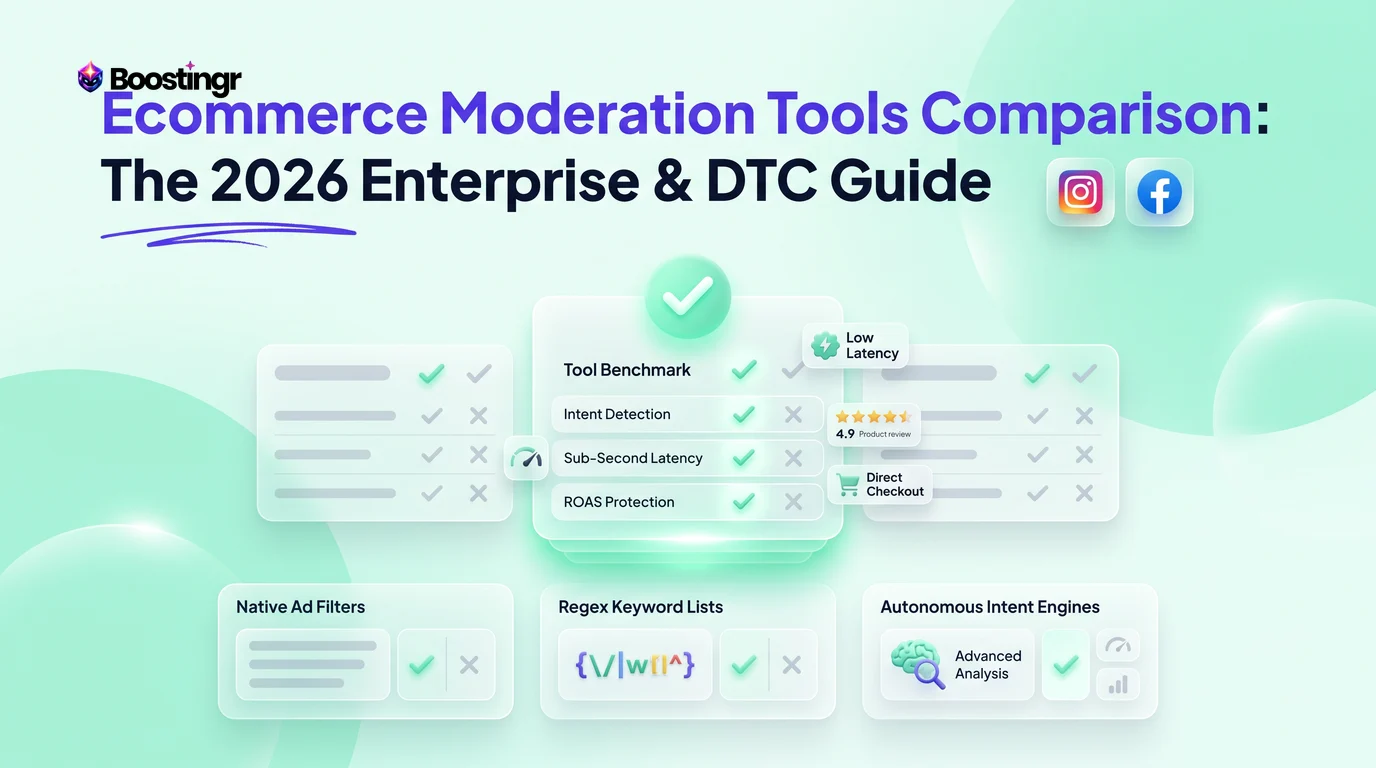
Choosing the best social media moderation software requires matching your operational goals against the software's underlying design. Below is a high-level, factual comparison of generalist social media management suites, dedicated security filters, and modern AI comment management platforms.
| Feature / Metric | Generalist Suites (e.g., Sprout Social, Hootsuite) | Dedicated Rule Engines (e.g., NapoleonCat) | Enterprise Brand Safety (e.g., BrandBastion, Sprinklr) | Modern AI Comment Engines (Boostingr) |
|---|---|---|---|---|
| Core Architecture | Multi-seat manual inbox & publisher | Rule-based boolean filters + basic tagging | Enterprise threat classification & triage | Contextual LLM intent & conversion platform |
| Ad Comment Coverage | Basic dark post sync via scheduled sync | Native support for Meta & TikTok paid ads | Deep multi-network paid ad monitoring | Real-time webhook sync across dynamic ads & organic |
| Filter Engine Type | Regex, keyword blacklists, manual tags | Boolean rules, keyword triggers, sentiment | Proprietary multilingual risk classifiers | Multi-modal contextual LLMs + fine-tuned intent |
| Action Latency | Minutes to hours (Queue-dependent) | Seconds (Rule matching) | Sub-second to minutes | Sub-second (<1,000ms automated execution) |
| Conversion Capability | Manual team assignment routing | Automated static canned responses | Escalation routing to support desks | Autonomous on-brand sales replies & DM lead capture |
| Brand Voice Customization | Manual agent reply templates | Basic token substitution ({username}) | Pre-approved corporate canned libraries | Brand Memory: Dynamic contextual knowledge base |
| Pricing Model | High per-seat pricing ($249–$499+/seat/mo) | Tiered by profile count and ticket volume | Custom annual enterprise contracts ($10k–$50k+/yr) | Volume-based transparent plans based on engagement |
| Best Suited For | Broad social team publishing & listening | Mid-market organic community teams | Fortune 500 corporate governance & compliance | High-growth DTC, performance advertisers & ecommerce |
For a deeper look into the operational software choices used across global brand stacks, explore our analysis of what tools big brands use to moderate Instagram comments.
Total Cost of Ownership (TCO): Seat Licenses vs. Volume-Based AI
When evaluating social media moderation tools for business, pricing transparency remains a major hurdle. Enterprise legacy suites often obfuscate true operational costs by tying their pricing models to human seat licenses rather than automated scale.
Legacy Enterprise TCO Model (Per-Seat Traps):
Software Base Fee ($1,000/mo) + Seat Taxes ($249/user/mo) + Human BPO Shift Labor ($12,000/mo)
└── Total Monthly Spend: $15,000+ with 4-12 hour average response times

Modern AI Engine TCO Model (Volume-Based):
Unified Platform Fee ($199-$599/mo) based on actual comment volume
└── Autonomous 24/7 coverage, <800ms hiding latency, zero seat license taxes
The Hidden Traps of Legacy Pricing Models
- The Seat License Penalty: Legacy suites charge $199 to $499 per seat per month. As your paid ad budget increases, incoming comment volume grows. To manage the spike across different time zones, you must add more customer support agents or hire a Business Process Outsourcing (BPO) team. Your software costs scale linearly with team headcount, disincentivizing growth.
- Manual Labor Costs vs. Software Cost: Hiring a 24/7 outsourced moderation team to manually review queues costs between $6,000 and $18,000 per month across three eight-hour shifts. Human moderation remains prone to fatigue, missed notifications, and inconsistent enforcement of brand guidelines.
- Transparent Volume-Based Infrastructure: Modern AI comment infrastructure bases its subscription tiers on total comment processing volume. Whether you have 2 community leads or 20 performance media managers viewing the dashboard, your software cost remains predictable. Review our transparent pricing tiers to calculate your brand's return on investment.
Practical Examples and Use Cases
Understanding how an automated social media moderation tool functions in live environments reveals the difference between basic regex filtering and true contextual AI orchestration.
1. Ecommerce / DTC Fashion: Sizing Inquiries on Paid Instagram Reels
- Scenario: A rapidly scaling DTC apparel brand spends $15,000/day on Instagram Reels ads.
- Comment: "Super cute set! But does the fabric stretch at all? I'm in between an M and L and have broader shoulders."
- Legacy Tool Action: Flagged as an unassigned support ticket. Placed in a shared queue. Wait time: 7 hours.
- Boostingr Action:
- Ingests comment in under 150ms.
- LLM classifies intent as
High-Intent Purchase QuestionwithSizing Attribute. - References connected Brand Memory (the brand's size chart and fit documentation).
- Automatically posts a tailored, on-brand public response: "Hey Sarah! The rib-knit fabric has a 5% elastane blend, giving it a gentle four-way stretch. If you have broader shoulders, we definitely recommend sizing up to an L for the most comfortable fit! 🤍"
- Fires an automated Instagram lead capture direct message containing a link to the Large size variant with a dynamic checkout code.
2. High-Growth Fintech: Phishing and Account Takeover Scams
- Scenario: A mobile banking app launches a national campaign announcing a deposit bonus. Bot networks immediately target the post's comments.
- Comment: "My account was locked for no reason! Message @OfficialHelp_Recovery01 on Telegram to get your funds cleared instantly!!"
- Legacy Tool Action: Misses the text because "Telegram" and the specific account handle were not explicitly included in the team's static 500-word blacklist.
- Boostingr Action:
- Scans semantic intent and flags
Financial Phishing / Scam Solicitationwith a 99.8% confidence score. - Executes a Graph API call hiding the comment in 720ms.
- Adds the malicious user ID to a temporary quarantine blacklist across all connected brand accounts, shielding other campaigns from coordinated fraud.
- Scans semantic intent and flags
3. SaaS / B2B: Competitor Hijacking and Affiliate Scraping
- Scenario: A enterprise B2B software vendor runs LinkedIn and Meta ads promoting a technical whitepaper.
- Comment: "Don't overpay for this tool. Use CompetitorX instead, here is a link for 50% off: competitorx.link/promo"
- Legacy Tool Action: Remains visible until a social media manager logs in at 9:00 AM the following morning. Dozens of ad clicks and hundreds of impressions are diverted to the competitor's checkout page.
- Boostingr Action:
- Classifies intent as
Competitor Poaching with External URL. - Automatically hides the comment across all ad sets in under 800ms.
- Notifies the performance media lead via Slack with a direct audit log of the hidden thread.
- Classifies intent as
Ecommerce Sizing Query ──> Classify as Purchase Intent ──> Brand Memory Pull ──> Instant Conversion
Phishing Account Scam  ──> Classify as Security Threat ──> Sub-Second Hide   ──> Zero Brand Damage
Competitor URL Link    ──> Classify as Link Poaching   ──> Sub-Second Hide   ──> Protect Ad Clicks
For teams scaling out automated replies across diverse business verticals, deploying an AI Instagram reply bot ensures responses remain accurate, conversational, and aligned with team governance.
First-Party Mini Case Study: Scaling ROAS for an Apparel Brand
The Background
A high-volume performance fashion retailer scaled their Meta dynamic catalog ads to $120,000 in monthly ad spend. As ad volume scaled, their customer service team was flooded with over 18,000 monthly comments across hundreds of unpublished dark post ad variations.
The Problem
- Scam bots and counterfeiters targeted their top-performing video ads, dropping links to fraudulent copycat websites.
- Sizing, material, and shipping inquiries remained unanswered for an average of 11.4 hours.
- Meta's ad relevance diagnostics degraded, pushing their creative Quality Ranking into the "Bottom 20%" and inflating average CPMs from $18.50 to $29.20.
The Implementation
The brand replaced its manual social inbox with Boostingr's ai social media moderation platform.
- The team uploaded their customer support handbook, product sizing charts, and tone-of-voice documentation into Brand Memory ("Teach once, engage everywhere").
- Autonomous rules were set to hide phishing, scam links, competitor promos, and severe profanity in under 1 second.
- Contextual AI replies were enabled to instantly answer product, inventory, and sizing questions directly on paid ad threads.
The Results Over 90 Days
- Comment Processing Latency: Average threat mitigation time dropped from 11.4 hours to 780 milliseconds.
- Meta Quality Ranking Recovery: Ad relevance metrics returned to the "Average to Above Average" tier within 14 days of cleaning up toxic ad threads.
- CPM Reduction: Blended Meta CPMs dropped by 34.2%, falling from $29.20 back down to $19.21.
- Net-New Revenue: Automated, instant answers to sizing questions generated $42,600 in directly attributed post-comment sales conversions within the first quarter.
For a complete financial breakdown of automated moderation, review our deep dive on the ROI of automated comment moderation.
Visual guide
Turning Ad Comments Into Revenue
Modern moderation tools separate harmful spam from high-intent purchase questions, converting ad comments into direct sales.
How Bad Comments Drain ROAS
Unresolved complaints and spam trigger ad quality penalties that quietly inflate your auction costs.
Sub-Second Dark Post Moderation
Automated hiding conceals scam links from prospective buyers in real time without alerting malicious spammers.
Checklist: Selecting the Best Social Media Moderation Software
Use this evaluation checklist when auditing platforms for your marketing and community operations:
- Native Dark Post & Dynamic Ad Ingestion: Does the platform sync unpublished ad variants via real-time webhooks, or does it require manual post-ID tracking?
- Sub-Second Execution Latency: Can the software classify and hide high-risk comments in under 1,000 milliseconds to preserve ad quality scores?
- Contextual Intent Engine (LLM vs. Regex): Does the tool evaluate full sentences, emojis, and sarcasm, or does it rely solely on static keyword blacklists?
- Non-Destructive Action Handling: Does the platform support soft-hiding (
is_hidden=true) so the poster remains unaware their comment was hidden? - Dual-Engine Capability (Defend + Convert): Can the tool answer complex product questions and capture leads alongside basic spam filtering?
- Brand Memory Knowledge Integration: Can you train the engine on brand guidelines, internal documentation, and product spec sheets once, deploying that knowledge across all channels?
- Transparent, Volume-Based Pricing: Does the platform bill based on comment volume rather than penalizing your business with high seat-license fees?
- Multi-Platform Coverage: Does the platform manage comments natively across Instagram, Facebook, TikTok, YouTube, and LinkedIn from a unified view?
To see how modern multi-network workflows simplify daily community operations, read our comprehensive social media comment automation multi-platform guide.
Key Takeaways
- Moderation is an Offensive Revenue Engine: Modern comment management protects ad spend while actively converting high-intent questions into sales.
- Unmoderated Threads Inflate Ad Costs: Toxic comment sections and unresolved complaints degrade Meta's Quality Ranking, driving CPM increases of 30% to 80%.
- Static Regex Filters Are Inadequate: Evasion tactics like homoglyphs, zero-width characters, leetspeak, and sarcastic phrasing easily bypass keyword blacklists, requiring contextual LLM evaluation.
- Sub-Second Latency is Essential: Managing dark posts effectively requires real-time API webhook integrations that hide spam in under 1,000 milliseconds.
- Per-Seat Licensing Inflates Total Cost of Ownership: Legacy enterprise suites create software cost bottlenecks by charging per seat. Volume-based models provide better scalability for performance advertisers.
- Context Drives Automated Conversion: Unifying moderation with dynamic Brand Memory lets brands answer product questions instantly, turning paid ad comments into measurable revenue.
Frequently asked questions
What is social media moderation software?
Social media moderation software is an automated platform designed to monitor, filter, hide, and respond to user comments, mentions, and messages across social channels. It combines real-time API integrations with machine learning or LLMs to shield brands from spam, scams, and abuse while streamlining community management.
How does social media comment moderation software protect Meta ad ROAS?
When negative comments, spam, and unaddressed complaints accumulate on paid ads, Meta's ad algorithm lowers the creative's Quality Ranking. This penalty increases ad CPMs and lowers overall delivery efficiency. Auto-moderation software hides toxic comments instantly, preserving high relevance diagnostics and keeping acquisition costs down.
Can automated social media moderation tools handle dark posts and dynamic ads?
Yes. Modern moderation tools integrate directly with the Meta Graph API and TikTok for Business API to automatically track unpublished dark posts, dynamic catalog ads (DPAs), and influencer partnership posts via webhooks without requiring manual configuration for every creative.
Why do keyword blacklists fail to catch modern spam and scams?
Keyword blacklists rely on exact string matches. Bot networks easily bypass these filters using Unicode homoglyphs, intentional spacing, zero-width characters, leetspeak, or external link re-directors. Contextual LLMs overcome this issue by evaluating the semantic meaning of the sentence rather than isolated character strings.
Does hiding a comment alert the user who posted it?
No. When an ad comment moderation software engine uses the official Graph API is_hidden=true parameter, the comment remains fully visible to the original poster and their immediate friends. It becomes invisible only to the broader public, preventing retaliatory spam from trolls.
What is the difference between brand safety moderation and comment management?
Brand safety moderation focuses strictly on risk management: hiding profanity, stopping phishing links, and deflecting PR crises. Modern AI comment management combines safety filtering with conversational sales automation, using trained brand memory to answer product questions and capture qualified customer leads.
Is this available in size M? Want to order today