


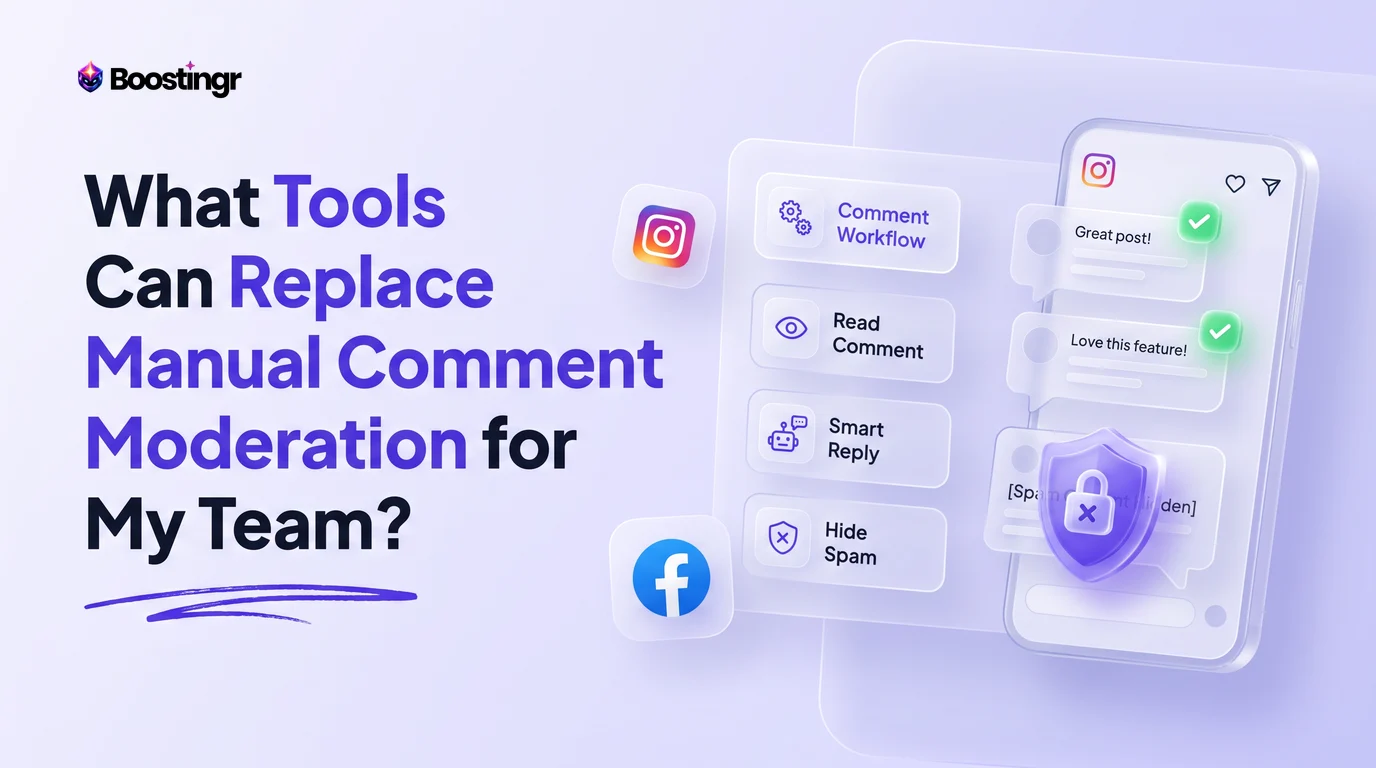
The Breaking Point for Manual Comment Moderation
Your team is drowning. Every paid ad campaign, every viral Reel, every proactive post unleashes a torrent of comments. For a while, managing them manually was feasible. A small team could sift through the spam, hide the trolls, answer the questions, and thank the fans. But now, the scale has tipped.
Your team is facing:
- Moderator Burnout: The sheer volume and negativity are exhausting. Team members spend their days in a reactive state, fighting fires instead of building community.
- Skyrocketing Costs: To maintain 24/7 coverage, especially on high-spend ad campaigns, you need to hire more people. This balloons your operational costs without a proportional increase in value.
- Inconsistent Enforcement: With multiple moderators, standards can vary. What one person deems inappropriate, another might let slide. This leads to an inconsistent brand voice and community experience.
- Missed Opportunities: Buried within the hundreds of spam comments are golden opportunities: high-intent sales leads, critical customer service issues, and glowing user-generated content (UGC). Your manual team, focused on defense, simply can't catch them all.
If this sounds familiar, you're past asking why you need a better solution. You're asking what tools can replace manual comment moderation for my team? This guide is your answer. We'll go beyond a simple list of software and provide a strategic framework for transitioning your team from manual labor to an intelligent, AI-powered workflow.
The Evolution: From Manual Teams to AI-Hybrid Systems
The goal isn't to fire your social media team. It's to elevate them. The most effective way to replace the drudgery of manual moderation is by adopting an AI-hybrid model.
The AI-Hybrid Model: In this workflow, an advanced AI platform acts as the first line of defense and opportunity detection. It handles the vast majority—often 90% or more—of incoming comments automatically. It can instantly hide spam, filter out trolls based on context (not just keywords), and, most importantly, identify and categorize valuable comments.
This leaves the remaining 10%—the nuanced, high-value, or complex comments—for your human team. Instead of wading through spam, your team becomes a squad of specialists who handle:
- AI-Flagged Escalations: Complex customer complaints that require human empathy.
- High-Intent Sales Leads: Comments like "Where can I buy this?" or "Do you have this in blue?" that the AI has identified and routed to the sales-assist team.
- Community Building: Engaging in meaningful conversations with top fans and advocates.
- Strategic Analysis: Reviewing the AI's reports on sentiment trends, common questions, and product feedback to inform overall marketing strategy.
This transition transforms your team's role from digital janitors to strategic community architects. They work on the community, not just in it.
Understanding the Technology: Not All "AI" Is Created Equal
When you start looking for automated comment moderation tools, you'll see the term "AI" everywhere. However, the sophistication of this AI varies dramatically. Understanding the difference is crucial to choosing a tool that truly replaces manual work, rather than just adding another dashboard to your stack.
Level 1: Keyword & Rule-Based Filtering
This is the most basic form of automation. You provide the tool with a list of keywords, and it hides or deletes any comment containing them. Native platform tools (like Facebook's moderation assist) and some simpler tools like CommentGuard operate primarily at this level.
- How it works:
IF comment contains [keyword] THEN [hide/delete/flag]. - Pros: Simple to set up, effective for catching obvious profanity and spam phrases.
- Cons: Lacks context. It can't distinguish between a customer complaining about a "broken" product and someone saying a new song is "broken" (slang for amazing). It also requires constant updating of keyword lists as spammers and trolls evolve their language.
Level 2: Contextual & Sentiment Analysis
More advanced tools, often found in larger social media moderation software suites like Sprout Social, go a step further. They use Natural Language Processing (NLP) to analyze the sentiment (positive, negative, neutral) of a comment.
- How it works: The AI analyzes the words and their relationship to each other to determine the overall feeling of the comment.
- Pros: More accurate than keyword lists. It can identify a negative comment even if it doesn't contain any of your banned words.
- Cons: Sentiment is often just a starting point. A "negative" comment could be a critical customer service issue, a valid product complaint, or a non-constructive troll. The tool may not be able to differentiate, still requiring significant human review.
Level 3: Intent Detection & 'Comment Intelligence'
This is the cutting edge and the true replacement for a manual team's cognitive work. Platforms like Boostingr use AI comment moderation software that doesn't just understand what is being said or how it's being said (sentiment), but why it's being said (intent).
- How it works: The AI is trained to recognize distinct user intents at scale. It can identify a comment as a Sales Lead, a Customer Complaint, a Request for Information, Spam, Trolling, or a Positive Review.
- Pros: This is a game-changer for team workflows. Instead of a messy inbox of "negative" comments, your team gets neatly categorized and prioritized tasks. Sales leads can be routed to your e-commerce team, complaints to your support desk, and positive reviews flagged for your community manager to amplify.
- Cons: Requires a more sophisticated platform and setup to teach the AI your brand's specific nuances.
This 'Comment Intelligence' approach is what allows you to confidently transition to an AI-hybrid model. The AI isn't just hiding bad comments; it's actively sorting, prioritizing, and creating value from your entire comment stream.
Comparison Table
To help you decide, here's a comparison of the different types of tools available to replace your manual moderation team.
| Tool Category | Key Features | AI Sophistication | Best For | Platforms | Team Workflow |
|---|---|---|---|---|---|
| Native Platform Tools | Free, basic keyword blocking, profanity filters. | Level 1: Rule-Based | Individuals or small businesses with very low comment volume. | Platform-specific (Facebook, Instagram, YouTube, etc.) | Very limited. No cross-platform view, no team collaboration or escalation. |
| Basic Automation Tools | Auto-hiding negative comments, simple keyword rules. | Level 1: Rule-Based | Brands focused solely on hiding negative comments on Meta ads to protect ROAS. | Primarily Facebook & Instagram. | Poor. Designed for a single user to 'set and forget'. Lacks team roles, assignments, or reporting. |
| All-in-One Social Suites | Scheduling, publishing, listening, analytics, unified inbox. | Level 2: Sentiment Analysis | Teams needing a single platform for all social media activities, where moderation is one feature among many. | Most major platforms (FB, IG, TW, LI, YT, etc.) | Moderate. Offers a unified inbox but often lacks advanced, intent-based routing and escalation workflows. |
| AI Comment Intelligence Platforms (e.g., Boostingr) | Intent detection, AI-powered replies, brand memory, multi-platform inbox, lead identification, team collaboration, advanced reporting. | Level 3: Intent Detection | Teams looking to truly replace manual work, scale operations, and turn comments into revenue and intelligence. | Multi-platform (FB, IG, YT, TikTok, LinkedIn) from a single dashboard. | Excellent. Built for the AI-hybrid model with custom routing, escalation paths, team assignments, and per-user analytics. |
Deep Dive: The Best Tools to Replace Your Manual Moderation Team
Now let's look at how these tool categories apply in practice for a team looking to automate and scale.
Boostingr: The Operating System for Comment Intelligence
Boostingr is designed from the ground up to solve the exact problem of replacing a manual team with an intelligent, efficient system. It operates at Level 3, focusing on 'Comment Intelligence' and enabling a true AI-hybrid workflow.
Here’s how it addresses the key challenges:
- Multi-Platform Mastery: While competitors focus heavily on Meta, brands live everywhere. Boostingr provides a single dashboard to
moderate ad commentsand organic comments across Facebook, Instagram, YouTube, TikTok, and LinkedIn. Your team doesn't need to switch between tabs or learn different native tools. - Sophisticated Intent Detection: This is the core of the replacement. Instead of just hiding comments, Boostingr's AI understands them. It automatically classifies comments into categories you define:
Sales Lead,Urgent Support Ticket,Spam,UGC Opportunity, etc. This pre-sorted feed allows your team to focus only on what matters. - Built for
Comment Moderation for Teams: Boostingr isn't a single-player tool. You can create custom workflows, automatically assign comment types to specific team members or departments (e.g., all 'Sales Lead' comments go to the e-commerce team), and track resolution times. Managers get detailed reports on team performance and comment trends. - The AI-Hybrid Bridge: Boostingr facilitates the transition. You can start by having the AI flag comments for human review. As you gain confidence, you can enable fully automated actions (hiding, replying) for high-certainty classifications (like spam) while keeping humans in the loop for sensitive categories.
All-in-One Suites (Sprout Social, Hootsuite)
These platforms are the Swiss Army knives of social media. They are excellent for teams that need a centralized tool for content scheduling, publishing, and broad social listening. Their moderation capabilities are a feature within this larger ecosystem.
- When to choose them: If your primary problem is content organization and your comment volume is manageable, these tools can be a good fit. Their unified inboxes bring all messages into one place, which is a step up from native tools.
- The Gap: For teams overwhelmed specifically by comment volume and complexity, these suites can be insufficient. Their moderation often relies on sentiment analysis (Level 2), which still requires a human to determine the intent behind a negative comment. They are not purpose-built to identify leads or support issues at scale with the same precision as a dedicated Comment Intelligence platform.
Niche Automation Tools (CommentGuard, ManyChat)
These tools are specialists that solve one problem very well.
- CommentGuard: Its primary function is to
auto-hide comments Facebookand Instagram based on keywords. It's a defensive tool designed to protect ad performance by removing negativity. It's effective for this narrow purpose but does not provide team workflows, intelligence, or opportunity detection. - ManyChat: A leader in chatbot development and DM automation. It's excellent for building guided conversations, especially for comment-to-DM funnels ("comment 'DEMO' to get the link"). However, its strength is in structured, triggered flows, not in moderating and understanding the unstructured chaos of a public comment section.
For a team, these tools are more like plugins than a full replacement. They can be part of a larger strategy, but they won't replace the core need for a centralized, intelligent moderation and engagement hub.
Practical Examples and Use Cases
Let's see how an AI-hybrid workflow with a Comment Intelligence platform like Boostingr works in the real world.
-
Use Case 1: The Overwhelmed E-commerce Brand
- Problem: A fashion brand runs a Meta ad that goes viral. They receive 5,000+ comments in 24 hours. Their two-person social team is swamped, unable to distinguish between spam, trolls, and real customers.
- Boostingr Workflow:
- The AI instantly hides 3,500 comments identified as spam, profanity, or competitor links.
- It identifies 450 comments with purchase intent (e.g., "Do you ship to Canada?", "I need this dress!") and tags them as
Sales Lead, assigning them to the sales-assist team member. - It flags 80 comments with negative sentiment and product-related keywords (e.g., "My zipper broke after one wear") and tags them as
Urgent Support, assigning them to the customer service lead. - The remaining comments (general praise, questions) are available in the main inbox for the community manager to engage with when time permits.
- Result: The team avoids burnout, captures hundreds of potential sales, and quickly addresses critical service issues, all while maintaining a clean comment section on their ad. This is a core part of protecting ROAS on your ad spend.
-
Use Case 2: The Multi-Client Digital Agency
- Problem: An agency manages social media for 10 clients, each with a different brand voice and moderation policy. Their team spends hours each day logging in and out of different accounts across Facebook, Instagram, and YouTube.
- Boostingr Workflow:
- The agency connects all 10 clients' accounts to a single Boostingr dashboard.
- Each client has a separate workspace with its own AI rules, Brand Memory (so the AI knows specific product names and policies), and reporting.
- An account manager can view all comments across all clients in one unified stream, filtered by intent.
- The AI is taught each client's unique voice, allowing it to generate on-brand AI-powered replies for common questions, which are then approved by a human before being sent.
- Result: The agency dramatically increases efficiency. They can now manage 20 clients with the same headcount, provide more detailed and valuable reports to clients (e.g., "We identified 50 sales leads from your comments this month"), and ensure consistent moderation across the board.
Building Your AI-Hybrid Workflow: A Step-by-Step Guide
Transitioning from a manual team is a strategic project. Here’s how to approach it.
- Audit Your Current State: Quantify the problem. Track the number of comments you receive per day/week, the number of moderators you have, and the hours they spend on moderation. Use this to calculate your current cost per moderated comment.
- Define Your Goals (Beyond Hiding): What does success look like? Don't just aim to "reduce spam." Set specific goals like: "Reduce first response time by 50%," "Identify and respond to all sales leads within 1 hour," or "Increase positive sentiment by 15%."
- Configure Your AI Engine: This is where you 'teach' a platform like Boostingr. You'll set up your intent classifications, connect your accounts, and populate the Brand Memory with key terms, product names, and FAQs. This initial setup is critical for long-term success.
- Establish Escalation Paths: Map out your team structure. When the AI identifies a
Sales Lead, who gets notified? When it flags anUrgent Supportticket, what's the process? Define these roles and responsibilities within the tool. - Implement, Train, and Iterate: Roll out the new system to your team. Train them not on how to moderate, but on how to manage the AI-powered workflow. Start with the AI in 'suggest' mode, then gradually move to full automation as you build trust in its accuracy. Continuously review the AI's performance and refine your rules.
Measuring Success: How to Prove the ROI of Automated Moderation
A key part of replacing a manual system is making the business case for it. The ROI of a Comment Intelligence platform goes far beyond salary savings. Track these metrics to demonstrate the full impact.
-
Cost & Efficiency Metrics:
- Cost Per Moderated Comment: (Total cost of software + team time) / Total comments processed.
- Time to First Response: How quickly are you engaging with non-spam comments?
- Resolution Time: How long does it take to resolve a flagged support issue or sales lead?
- Moderator Hours Saved: The most direct cost-saving metric.
-
Performance & Revenue Metrics:
- Conversion Rate from Comments: Track how many comments tagged as
Sales Leadresult in a sale. This directly ties moderation to revenue. Boostingr's Instagram lead capture capabilities make this easy. - Ad Performance (ROAS): A cleaner, more positive comment section on ads often leads to higher trust, better relevance scores, and a lower CPA.
- Sentiment Score: Track the percentage of positive vs. negative comments over time.
- Conversion Rate from Comments: Track how many comments tagged as
-
Intelligence Metrics:
- Number of Leads Identified: A direct measure of the opportunities you were previously missing.
- Number of Support Issues Proactively Solved: Shows how you're reducing customer churn.
- Top Themes & Trends: Use the AI's reports to identify recurring questions and feedback to inform your content and product strategy.
For a deeper dive, check out our complete guide on calculating the ROI of comment moderation tools.
Checklist: Are You Ready to Transition from a Manual Team?
Use this checklist to assess if it's time to make the switch.
- Your team spends more than 2 hours per day manually deleting spam or hiding negative comments.
- You are running paid ad campaigns and are concerned about negative comments impacting your ROAS.
- You have a multi-person team managing comments, leading to inconsistencies.
- You need 24/7 moderation coverage but can't afford the headcount.
- You suspect you are missing sales leads or customer service issues in the comments.
- You manage social media for multiple platforms and struggle to keep up.
- Your team feels reactive and burnt out rather than strategic and engaged.
- You lack clear data on comment sentiment, trends, or the ROI of your community management efforts.
If you checked three or more boxes, it's time to seriously evaluate an AI Comment Intelligence platform.
Visual guide
The AI-Hybrid Moderation Workflow
This shows how an AI platform handles most comments automatically, freeing up your team to focus on high-value interactions that require a human touch.
How Different AI Levels See Comments
This shows how three levels of AI technology interpret the same user comment. True replacement for manual work requires understanding user intent, not just keywords or sentiment.
From Comment Chaos to Team Workflow
An AI Comment Intelligence platform automatically sorts incoming comments by intent and routes them to the correct team member, turning a messy inbox into an organized workflow.
Key Takeaways
- Manual moderation is not scalable. It leads to team burnout, high costs, and missed opportunities.
- The solution is an AI-hybrid model, where AI handles the bulk of comments, and your team manages high-value exceptions.
- Not all "AI" is the same. Differentiate between basic keyword filtering, sentiment analysis, and true 'Comment Intelligence' that understands user intent.
- The right tool is a multi-platform operating system for your team, not just a simple filter. It should offer a unified inbox, sophisticated AI, and robust team collaboration features.
- The ROI of automation is measured in more than just cost savings. Track efficiency gains, revenue from comment-based leads, and the strategic intelligence you gain.
- Transitioning is a strategic process. It involves auditing your current state, configuring the AI, defining workflows, and training your team to work alongside automation.
Stop asking your team to be a filter. It's time to give them a tool that provides leverage, turning the chaos of comments into a clear source of intelligence, revenue, and community growth. Ready to see how an AI-powered workflow can transform your team? Explore Boostingr's features or sign up for a demo.
Frequently asked questions
What is the best tool for moderating comments on Facebook ads?
The best tool for moderating Facebook ad comments depends on your goal. For simply hiding negative comments, a rule-based tool is sufficient. However, for a team looking to replace manual work and find opportunities, an AI Comment Intelligence platform like Boostingr is superior. It not only hides spam but also identifies sales leads and customer service issues within your ad comments, maximizing your return on ad spend (ROAS).
Can AI completely replace my human comment moderators?
AI can replace the vast majority of manual, repetitive moderation tasks, such as filtering spam and categorizing comments. The most effective approach is an AI-hybrid model, where the AI handles about 90% of the volume automatically. This frees up your human moderators to focus on the 10% of high-value, complex, or sensitive comments that require empathy and strategic thinking, making their roles more impactful and efficient.
How does AI comment moderation software handle different languages?
Advanced AI comment moderation software uses multilingual language models. This allows them to understand the context, sentiment, and intent of comments in dozens of languages without requiring you to create separate keyword lists for each one. This is crucial for global brands running campaigns in multiple regions.
Is it better to use a dedicated moderation tool or an all-in-one social media suite?
If your primary challenge is the overwhelming volume and complexity of comments, a dedicated, AI-powered moderation tool is almost always better. All-in-one suites are great for general social media management, but their moderation features are often less sophisticated. A dedicated tool provides deeper features for team workflows, intent detection, and turning comments into business intelligence.
How do I measure the ROI of an automated comment moderation tool?
Measure ROI by tracking several key areas: 1) Cost Savings from reduced moderator hours. 2) Efficiency Gains like faster response times. 3) Performance Uplift, such as improved ad ROAS and conversion rates from identified leads. 4) Intelligence Gained, by quantifying the number of sales leads, support tickets, and UGC opportunities uncovered by the AI.
What is 'Comment Intelligence'?
Comment Intelligence is the practice of using advanced AI to go beyond simple moderation (hiding spam) to deeply understand the user's intent behind every comment. It involves automatically identifying and categorizing comments as sales leads, customer support issues, user-generated content, product feedback, and more, turning your comment section into a valuable source of business data and opportunities.
How can I manage comments from TikTok, YouTube, and Instagram in one place?
To manage comments from multiple platforms like TikTok, YouTube, and Instagram in one place, you need a multi-platform comment management tool. Platforms like Boostingr offer a unified inbox that aggregates comments from all your connected social accounts, allowing your team to moderate and engage from a single dashboard with a consistent workflow.
How do I transition my team from manual moderation to an AI tool?
The transition involves five steps: 1) Audit your current comment volume and team costs. 2) Define clear goals for the new system. 3) Configure the AI tool with your brand's rules and knowledge. 4) Establish clear escalation paths for your team. 5) Implement the tool, train your team on the new workflow, and iterate based on performance.
Is this available in size M? Want to order today