


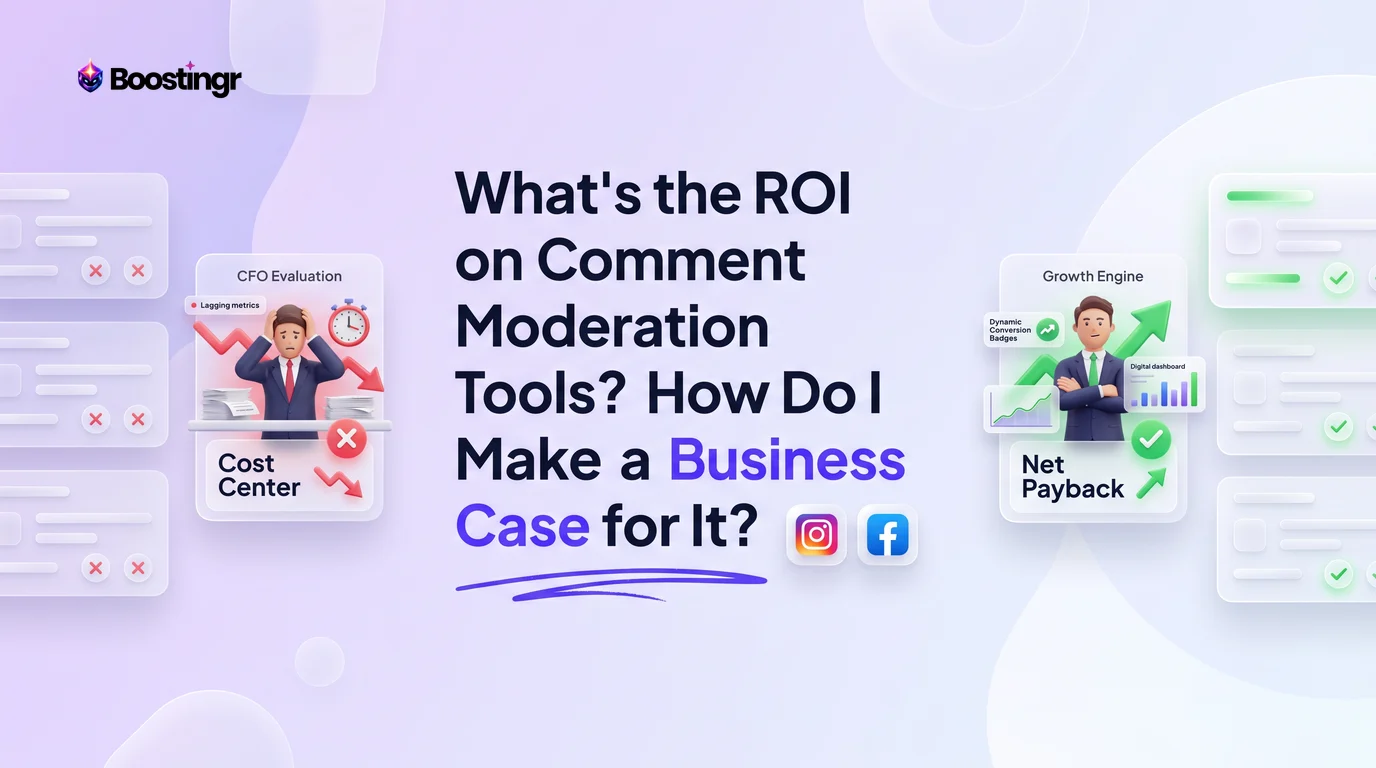
The Executive Disconnect: Why Leadership Views Comments as a Cost Center
Marketing directors, paid media leads, and community heads constantly encounter the same institutional wall: senior leadership views social comment moderation merely as brand cleanup—a non-revenue cost center that can be outsourced to cheap virtual assistants, assigned to overburdened social interns, or left to Meta’s native keyword blocklists.
This view fails to account for how social algorithms function today. An unmoderated comment thread is not just an aesthetic issue; it is a direct leak in your conversion funnel. When an enterprise or mid-market brand runs millions of dollars in paid traffic across Meta, TikTok, and YouTube, social proof dictates performance. According to research by Respondology, comments on paid ad units are nearly twice as toxic as those on organic posts. Leaving phishing attacks, competitor links, and spam unchallenged on high-spend ad units increases Customer Acquisition Cost (CAC) and suppresses Return on Ad Spend (ROAS).
To secure budget from a Chief Financial Officer (CFO) or VP of Growth, you cannot pitch "better brand sentiment" or "cleaner community vibes." You must present a mathematically defensible business case for comment moderation software grounded in direct labor savings, paid media protection, and net-new conversational revenue.
At Boostingr, our foundational philosophy is simple: an enterprise platform should not just read comments—it must understand people. By deploying automated AI comment management that pairs real-time safety with revenue-generating intent detection, marketing teams convert high-friction cost centers into defensible growth drivers.
The 5-Stage Executive Business Case Framework
To justify procurement to executive stakeholders, follow this structured 5-stage framework designed to navigate procurement, legal, and executive sign-off.
[1. Problem & Labor Bottleneck] ➔ [2. Quantified Cost of Inaction] ➔ [3. Four Pillars of ROI] ➔ [4. 30-Day Controlled Pilot] ➔ [5. TCO vs. Vendor Matrix]
Stage 1: Problem Statement and Labor Bottlenecks
Document current operational limits. Industry benchmarks from Delos show that human reviewers can manually evaluate and triage roughly 150 to 200 comments per hour under optimal conditions. When ad spend scales or viral reels hit, comment velocity easily reaches thousands of comments an hour. The result is a compounding backlog, delayed response times to prospective buyers, and severe staff burnout.
Stage 2: The Cost of Inaction (COI)
Outline what happens if the business does nothing:
- Ad Waste: High-intent ad spend is wasted when the top comments on an ad creative feature competitor links or scam alerts.
- Algorithmic Penalties: Failure to address engagement metrics impacts cost-per-click under Meta’s Auction Delivery System.
- Lost Revenue: Purchase-ready prospects asking product questions abandon carts due to delayed responses.
Stage 3: The Four Pillars of Comment ROI
Detail where financial returns originate across labor, performance marketing, direct sales, and brand equity (expanded below).
Stage 4: Proof-of-Concept (POC) Validation Plan
Propose a low-risk, 30-day controlled test that isolates a subset of ad accounts to generate internal, unassailable comparative metrics before submitting an annual enterprise contract request.
Stage 5: Total Cost of Ownership (TCO) vs. Vendor Pricing
Present clean pricing tiers alongside internal implementation costs, proving that purpose-built software costs a fraction of continuous human staffing or agency retainers.
The Plug-and-Play Mathematical ROI Formula
To effectively demonstrate how to calculate comment moderation roi, avoid vague estimates. Use this comprehensive formula:
$$\text{Total Net ROI ($)} = (\text{Hard Labor Savings} + \text{Performance ROAS Protection} + \text{Commercial Intent Revenue}) - \text{Software TCO}$$
$$\text{ROI (%)} = \left( \frac{\text{Total Financial Gain} - \text{Software TCO}}{\text{Software TCO}} \right) \times 100$$
Let us break down each financial component with realistic figures.
1. Hard Labor Savings (FTE & BPO Reduction)
Calculate the direct operational expenditure (OpEx) saved by shifting triage from human operators to contextual AI:
$$\text{Labor Savings} = (\text{Monthly Comment Volume} \times \text{Hours per 1,000 Comments} \times \text{Fully Loaded Hourly Wage}) - \text{Retained Human Oversight Cost}$$
Benchmark Example: A brand processing 100,000 comments monthly requires approximately 500 hours of manual triage (at 200 items/hour). At a fully loaded cost of $35/hour for internal staff or specialized agency support, manual processing costs $17,500/month ($210,000/year). Automating 80% of routine spam hides, toxic triage, and FAQ replies reduces required human hours to 100 hours/month ($3,500/month), yielding $168,000 in annual direct labor savings.
For a deeper operational breakdown, review our analysis on why manual comment moderation is inefficient and costly.
2. Performance ROAS Protection (Paid Media Efficiency)
Unmoderated ad comments inflate customer acquisition costs by depressing post-click conversion rates. When potential customers see negative reviews, unsubstantiated scam allegations, or competing product promotions pinned at the top of an ad, click-through rates (CTR) and on-page conversion rates drop.
$$\text{Ad Revenue Protected} = \text{Monthly Ad Spend} \times \text{Projected Conversion Rate Lift (%)} \times \text{Average Order Value (AOV)}$$
Benchmark Example: An e-commerce brand spending $200,000/month on Meta ads experiencing a 0.4% conversion rate drop due to hostile spam comments loses roughly $16,000 in monthly gross revenue. Restoring conversion rates through sub-second spam shielding protects $192,000 in annual gross ad revenue.
To understand the platform mechanics behind this, explore how Meta ads algorithms respond to comment moderation.
3. Commercial Intent Revenue (Comment-to-DM Sales)
Data from Respondology demonstrates that enterprise brands routinely ignore over 90% of actionable purchase-intent comments. Implementing conversational commerce via Instagram lead capture workflows transforms reactive comment management into a direct revenue driver:
$$\text{Commercial Revenue} = \text{Intent Comments} \times \text{Instant Reply Rate (%)} \times \text{DM Opt-in (%)} \times \text{Checkout Conversion (%)} \times \text{AOV}$$
Benchmark Example: If an apparel brand generates 2,000 commercial questions monthly ("What size fits a 6'2 frame?", "Is this still in stock?"), answering them within 30 seconds via contextual AI Instagram reply bots converts 15% to direct DMs and yields a 5% checkout rate. At a $120 AOV, that equates to $216,000 in net-new annual revenue.
The 4 Pillars of Comment Moderation ROI
When presenting comment automation to CFO and CMO stakeholders, organize your pitch around four pillars:
┌────────────────────────────┬────────────────────────────┐
│      1. Operational        │       2. Performance       │
│   Direct labor reduction   │     ROAS preservation      │
│   and BPO triage savings   │    Lower Cost-Per-Lead     │
├────────────────────────────┼────────────────────────────┤
│      3. Conversational     │      4. Brand Safety       │
│    Instant comment-to-DM   │    Crisis prevention &     │
│      revenue pipelines     │    PR hazard mitigation    │
└────────────────────────────┴────────────────────────────┘
Pillar 1: Operational Efficiency & FTE Reallocation
Modern growth teams should not waste high-cost strategists on hiding crypto spam. Automated moderation eliminates the rote mechanics of social monitoring, freeing your community managers to execute high-impact creator collaborations and active community building.
Pillar 2: Paid Ad Health & ROAS Maximization
Meta's auction algorithm continuously gauges user experience signals. Paid ads burdened with high toxicity, unaddressed complaints, or spam links see drops in creative quality rankings, triggering higher CPMs. By instantly hiding brand-unsafe noise through direct integrations with the Instagram Graph API, automated tools maintain clean comment feeds, lowering CPA.
Pillar 3: Commercial Pipeline Acceleration
Comments are high-velocity intent channels. A shopper asking "Does this ship to Canada?" is at the very bottom of the funnel. Answering within seconds captures intent before the buyer scrolls away. Platforms powered by unified "brand memory" allow your marketing engine to "teach once, engage everywhere," delivering humanized brand-tone replies across every connected channel.
Pillar 4: Enterprise Risk Mitigation & Brand Equity
Brand safety disasters unfold in minutes, not days. A single undetected phishing link or coordinated harassment campaign can trigger lasting brand damage. Contextual comment platforms neutralize threats 24/7 without requiring overnight shifts or weekend emergency teams.
For a deeper look into automated safety standards, consult our guide on enterprise AI escalation workflows.
Comparison Table
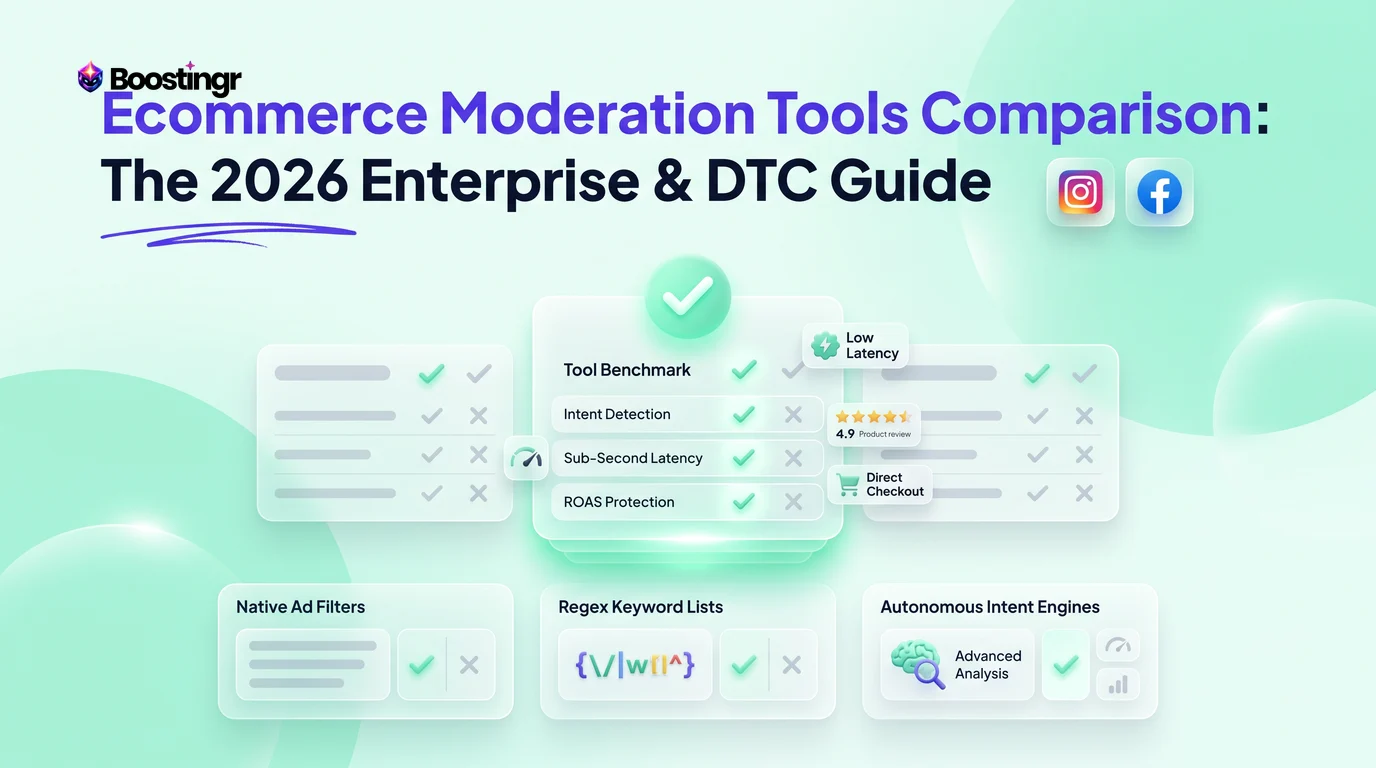
Evaluating the cost benefit analysis comment moderation landscape requires comparing standard alternative approaches with a dedicated platform like Boostingr.
| Evaluation Criteria | Native Free Blocklists (Meta / TikTok) | Outsourced BPO / Virtual Assistants | Basic Bot Flow-Builders (e.g., ManyChat) | Boostingr AI Comment Intelligence Platform |
|---|---|---|---|---|
| Primary Cost | $0 direct cost (High indirect labor cost) | $2,000–$8,000/month per human seat | $15–$150/month per account | Transparent SaaS subscription (See Pricing) |
| Contextual Understanding | ❌ None (Strict keyword matching) | ✔️ High (Human understanding) | ❌ None (Keyword-based trigger matching) | ✔️ Complete (Advanced NLP & brand memory) |
| Response Latency | Instant on exact keyword match only | 15 minutes to 8+ hours | 1–5 seconds on exact matches | Sub-second real-time execution |
| False Positive Risk | Very High (Blocks benign customer comments) | Low | High (Misfires on multi-word intent) | Extremely Low (Contextual nuance engine) |
| Scalability Under Ad Spikes | Infinite (but ineffective against evasion) | ❌ Drops sharply; requires overtime staffing | Scales technically; fails conversational context | Infinite automated scale across all endpoints |
| Purchase Intent Detection | ❌ None | ✔️ Moderate (Dependent on agent training) | ❌ Only rigid pre-defined keyword buttons | ✔️ High (Understands buying intent automatically) |
| Brand Tone Consistency | ❌ N/A | Variable across agent shift changes | Robotic, static scripted templates | Consistent (Trained on historical brand memory) |
Addressing Executive Objections with Data
When delivering your executive business case for community moderation, anticipate and prepare for these common leadership objections:
Objection 1: "Why can't we just use Meta's free native blocklist?"
Executive Rebuttal: "Meta's native keyword filters operate on simplistic string-matching logic. If we add the word 'cheap' to block low-quality product complaints, we inadvertently hide comments like: 'This looks so good and the shipping is surprisingly cheap!' Native filters also fail when spammers introduce deliberate misspellings (e.g., 's-c-a-m' or 'cl!ck here'). This binary approach creates false positives that frustrate loyal customers while letting adversarial spam slip through. Modern AI moderation relies on contextual semantic analysis, evaluating phrase structure, sentiment, and user intent before taking action."
Objection 2: "Can't a low-cost virtual assistant handle this for less money?"
Executive Rebuttal: "Human triage does not scale linearly during ad campaigns. Standard human review caps at 200 comments per hour per agent. If an ad creative goes viral over a weekend, comment queues rapidly back up. In addition, human coverage across a 24/7/365 operational schedule requires at least 4 to 5 dedicated shifts when factoring in PTO and turnover, creating high recurring overhead. An AI-first system handles routine spam suppression and common inquiries instantly, allowing a single human manager to oversee the entire channel with higher accuracy at a fraction of the cost."
Objection 3: "Why not just set up basic automation rules in ManyChat?"
Executive Rebuttal: "Traditional workflow builders are rigid decision trees designed for scripted chat routing, not contextual comment moderation. If a user leaves a nuanced comment containing both a complaint and a sales question, a basic flow tool either fails completely or delivers an inappropriate canned reply that damages customer trust. Dedicated comment platforms like Boostingr combine moderation, sentiment analysis, and conversational sales intelligence to safely engage customers while keeping the community clean."
To review competitive distinctions in more detail, read our breakdown of modern tools that replace manual moderation.
The 30-Day Pilot Validation Blueprint
Before submitting a major annual budget request, run a controlled 30-day proof-of-concept (POC) to gather first-party data. This structured approach helps performance media teams prove value before making a long-term commitment.
[Days 1-5: Baseline Audit] ➔ [Days 6-10: Connect & Train] ➔ [Days 11-25: A/B Split Test] ➔ [Days 26-30: Executive Deck]
Days 1–5: Establish the Operational Baseline
- Measure current weekly comment volume across organic and paid channels.
- Audit average first-response times for product questions.
- Calculate current moderator hours spent on routine spam deletion.
- Record baseline blended CPA and ROAS across primary ad sets.
Days 6–10: Platform Integration and Knowledge Training
- Connect the software via the official Facebook Graph API without disrupting active campaigns.
- Configure automated moderation rules (e.g., auto-hide competitor links, crypto scams, hate speech).
- Set up brand guidelines and knowledge base parameters so the AI matches your company's tone.
Days 11–25: Controlled A/B Split Testing
- Split budget equally across two matched ad sets:
- Cell A (Control): Moderated manually using your existing routine.
- Cell B (Test): Moderated with real-time AI automation (instant spam suppression and rapid-response intent triggers).
- Track operational metrics: time saved, spam capture rate, click-through rate, cost-per-lead, and ROAS lift.
Days 26–30: Executive Summary Synthesis
- Consolidate test data into a concise five-slide deck for executive leadership, focusing on three clear metrics: moderator hours saved, ROAS lift in Cell B, and net-new conversion revenue.
Practical Examples and Use Cases
Use Case 1: High-Growth D2C E-Commerce Brand Scaling Paid Social
An omnichannel skincare brand scaled its monthly Meta ad spend from $50,000 to $250,000. Within two weeks, ad comment volume jumped to 14,000 comments per week. Competitors began dropping affiliate links directly under high-performing video ads, and unverified ingredient claims went viral in the threads. By deploying automated Instagram comment automation workflows, the brand suppressed unauthorized links in under two seconds. Conversational AI handled routine shipping and cruelty-free ingredient questions immediately, lifting post-click ROAS by 18% over a 60-day period.
Use Case 2: Multi-Location Healthcare or Financial Services Provider
Regulated enterprises face strict compliance requirements around public user interactions. A multi-location healthcare network running regional recruitment and patient-education campaigns faced severe penalties if medical advice claims or offensive comments were left unaddressed. Traditional BPO agency retainers cost over $14,000 monthly for round-the-clock monitoring. By implementing contextual comment intelligence, the compliance team automated 95% of toxic message filtering and routed sensitive clinical escalations directly to certified staff, cutting third-party agency spend by 65% while maintaining compliance.
First-Party Mini Case Study: Boostingr Implementation
A mid-market SaaS company running paid performance campaigns across Instagram and Facebook integrated Boostingr to streamline comment management across its ad sets.
- Challenge: The internal team spent 14 hours per week manually deleting affiliate spam and answering repetitive pricing inquiries on sponsored Reels, resulting in a delayed average response time of 7.2 hours.
- Solution: The team activated Boostingr's contextual AI moderation rules and enabled automated intent-to-DM flows with integrated brand memory.
- Measured Results: Within 30 days, manual moderation time fell to under 1.5 hours per week (an 89% labor reduction). Ad conversion rates increased by 14.3% thanks to the instant suppression of competitor promotions, and the team generated $11,200 in tracked pipeline revenue from prospects who received automated responses within 45 seconds of commenting.
Visual guide
Five Steps to Executive Approval
Follow this structured roadmap to present your business case to leadership and secure budget.
Automated Comment Triage on Paid Ads
See how incoming comments are sorted instantly to protect ad conversions and capture sales.
Calculating Total Net Financial Return
Combine three operational gains and subtract software cost to establish defensible ROI.
Checklist: The Executive Procurement Readiness Audit
Before presenting your comment moderation business case template to the CFO and executive committee, ensure your business case covers every core operational requirement:
- Quantified Current Workload: Documented current monthly comment volume across all active brand channels.
- Fully Loaded Labor Accounting: Calculated the true hourly cost of internal team members and agencies currently handling manual comment cleanup.
- ROAS Baseline: Tracked baseline click-through rates, conversion rates, and CPAs across primary paid ad campaigns.
- Executive-Ready Objection Slides: Prepared clear, data-backed answers explaining why native platform keyword blocklists and standard chatbot builders fall short.
- Security and Compliance Alignment: Confirmed software vendor security standards, including GDPR/CCPA compliance and official platform API integration.
- 30-Day Pilot Parameters: Established an isolated test budget and operational success benchmarks to run an initial proof-of-concept.
- Commercial Revenue Projections: Projected net-new revenue potential from automated comment-to-DM conversational funnels.
- Implementation Timeline: Outlined a low-lift technical roadmap demonstrating that internal engineering resources are not required for rollout.
Key Takeaways
- Comment Moderation is a Growth Lever: Moving past the view that social moderation is merely a reactive cost center is essential for unlocking measurable marketing ROI.
- Labor Costs Are Just the Beginning: While automating human comment triage routinely delivers operational cost savings of 60% to 80%, the largest financial gains come from paid ad ROAS protection and automated conversational lead capture.
- Native Keyword Filters Fall Short: Standard blocklists rely on strict string matches, causing brand-damaging false positives and failing to catch modern spam variations.
- Pilot Before You Scale: Securing executive sign-off is straightforward when supported by a 30-day split test comparing an unmoderated control ad set against an AI-moderated campaign.
- Unified AI Outperforms Disjointed Workflows: Purpose-built platforms like Boostingr combine context, brand memory, and automated execution into a single system, allowing growth teams to protect brand safety while systematically driving sales.
Explore how to streamline your comment strategy by checking out our guides to social media moderation software and our platform pricing plans.
Frequently asked questions
How does social comment moderation impact paid ad ROAS?
Social comment moderation directly impacts paid ad ROAS by removing scam links, offensive complaints, and competitor promotions that depress ad quality scores and conversion rates. When prospects encounter unmoderated spam in ad comment sections, post-click conversions drop. Fast, automated moderation protects the user experience, stabilizing conversion rates and lowering overall Customer Acquisition Costs (CAC).
How long does it take for automated comment moderation software to show positive ROI?
Most mid-market and enterprise brands achieve positive ROI within 30 to 60 days. Immediate labor savings appear in the first pay period as teams cut manual triage hours. Performance marketing gains and conversational lead-generation revenues typically stabilize within 3 to 4 weeks of continuous ad spend and campaign testing.
Can AI comment moderation accurately capture nuanced brand tone without sounding robotic?
Yes, modern AI comment platforms utilize unified brand memory and advanced contextual NLP rather than static script templates. By training the system on approved product documentation, past high-performing community replies, and specific tone guidelines, the AI crafts relevant, contextual responses that match your brand voice.
What is the primary difference between ManyChat and dedicated AI comment moderation software?
ManyChat is primarily an automated chat marketing tool designed around static decision trees, predefined keywords, and DM sequences. In contrast, dedicated AI comment platforms like Boostingr are purpose-built for comprehensive comment intelligence. They analyze the sentiment, context, and nuance of public comments, systematically hide brand-unsafe spam, and route complex inquiries to appropriate workflows.
How do we measure the cost of inaction for our social channels?
Calculate the cost of inaction by estimating three key liabilities: the fully loaded labor cost spent manually triaging repetitive comments, the estimated 5% to 20% conversion drop on paid ad sets overrun by unchecked spam, and the missed revenue from unaddressed purchase-intent comments that go unanswered for hours.
Will using third-party automated moderation software put our social accounts at risk of platform penalties?
No, provided the platform connects exclusively via official, developer-approved channels like the Instagram Graph API and Meta Graph API. Account integrity issues occur when brands use unauthorized scraping tools or headless browser emulators that violate platform terms of service.
Is this available in size M? Want to order today