



The Moderation Architecture Dilemma: APIs vs. Enterprise Platforms vs. Social Engines
When engineering, trust and safety, and growth marketing teams set out to compare content moderation tools, they often stumble into a fundamental trap: comparing fundamentally incompatible software categories under the same rubric.
Most high-ranking buying guides juxtapose raw developer APIs against turn-key SaaS suites as if they were direct drop-in alternatives. In reality, choosing between these systems dictates your team's operational overhead, engineering requirements, and ongoing infrastructure budget.
                                  ┌─────────────────────────────┐
                                  │ Architectural Categorization│
                                  └──────────────┬──────────────┘
                                                 │
         ┌───────────────────────────────────────┼───────────────────────────────────────┐
         ▼                                       ▼                                       ▼
┌─────────────────────────┐             ┌─────────────────────────┐             ┌─────────────────────────┐
│ Raw Classification APIs │             │ Trust & Safety Suites   │             │ Turnkey Social Engines  │
│ (OpenAI, Azure, Hive)   │             │ (Checkstep, Besedo)     │             │ (Boostingr, Smart Mod.) │
├─────────────────────────┤             ├─────────────────────────┤             ├─────────────────────────┤
│ • Stateless inference   │             │ • Complex policy logic  │             │ • Webhook-to-action     │
│ • No UI / No queues     │             │ • Audit logs & queues   │             │ • Ad ROAS protection    │
│ • Dev-heavy buildout    │             │ • Regulatory compliance │             │ • Subtractive + Additive│
└─────────────────────────┘             └─────────────────────────┘             └─────────────────────────┘
1. Developer Classification APIs (Inference-Only Infrastructure)
Platforms such as Hive Moderation, Azure AI Content Safety, and OpenAI Moderation API are raw classification engines. They receive a payload (text string, image URL, or video frame) and return floating-point confidence scores across predetermined categories such as hate speech, self-harm, sexual violence, and harassment.
- What they provide: Highly scalable, stateless machine learning inference.
- What they lack: Ingestion webhooks, token management, databases for conversational history, agent decision queues, audit logging, custom business logic interfaces, and direct integrations with platforms like Meta or YouTube.
- The hidden cost: Adopting a developer API requires allocating full-time engineers to build, host, and maintain custom middle-layer orchestration. If your team is evaluating whether manual comment moderation is inefficient and costly, building a bespoke API bridge from scratch often inflates costs before delivering a single moderation action.
2. Enterprise Trust & Safety Platforms (Compliance & Governance Engines)
Solutions like Checkstep, Besedo, and Spectrum Labs target compliance officers, in-house Trust & Safety (T&S) teams, and marketplace operators governed by strict legal frameworks such as the EU Digital Services Act (DSA) or the UK Online Safety Act.
- What they provide: Enterprise-grade policy rule builders, cross-platform human-in-the-loop (HITL) review queues, model explainability, forensic audit trails, and automated regulatory transparency reporting.
- What they lack: Native organic and paid social growth loops. These tools treat moderation purely as compliance enforcement, risk mitigation, and liability reduction.
- The ideal buyer: Digital marketplaces, gaming networks, community forums, and dating applications where user-generated content (UGC) presents direct platform liability.
3. Real-Time Social & Comment Management Engines
Platforms like Boostingr, alongside legacy social suites like Sprout Social, Hootsuite, and Sprinklr, focus on dynamic social feeds, ad campaigns, and community interactions across platforms like Instagram, Facebook, and YouTube.
- What they provide: Turnkey, direct API integrations with platforms such as the Instagram Graph API and Meta Graph API. They instantly ingest comments, detect nuance, execute defensive actions (hiding, deleting, banning), and execute offensive growth actions (context-aware AI replies, sentiment-based routing, lead capture).
- What they lack: Custom SDK embedding for proprietary iOS/Android user profiles or mobile in-game chat pipelines.
- The ideal buyer: Direct-to-Consumer (DTC) brands, digital agencies, performance marketers, and enterprise community teams handling high-volume organic engagement and paid acquisition channels.
The Subtractive vs. Additive Paradigm: Why Filtering Alone Stalls Growth
Traditional content moderation software operates on a subtractive-only model: scan content, detect a policy violation, and purge the offending text from public view. While essential for brand safety, treating moderation as a purely defensive filter creates significant missed opportunities on modern algorithmic social platforms.
The Algorithm Penalty of Dead Air
Social algorithms reward conversational density, comment velocity, and fast creator-to-community interactions. When a brand runs automated moderation rules that simply hide 15% of comments and leave the remaining 85% unanswered, post distribution decelerates.
Traditional Subtractive Engine:    [Incoming Comments] ──► [Filter Spam/Trolls] ──► [Hidden: Silence / Stalled Reach]

Additive Intelligence (Boostingr): [Incoming Comments] ──► [Filter Toxicity]   ──► [Hidden: Protected Ad Account]
                                                       └─► [Detect High-Intent]──► [AI Context Reply + Lead Capture]
Modern community operations demand an additive moderation model. When an automated filter detects high-intent questions, playful banter, or genuine customer objections, the system must immediately trigger brand-aligned, humanized responses.
By leveraging platforms that feature advanced brand memory and conversational awareness, brands maintain the social algorithm's engagement momentum while neutralizing toxicity.
Unlocking Revenue via Intent Detection
A user commenting on an Instagram ad asking, "Does this fit true to size for wider feet?" is often minutes away from making a purchase. If traditional moderation software scans this comment, tags it as "Non-Toxic," and marks it "Resolved," that sale is often lost.
Conversely, an additive comment intelligence platform identifies commercial intent, auto-responds with specific sizing details, and delivers a frictionless conversion pathway. Exploring instagram lead capture workflows demonstrates how moderation transitions from a pure cost center into an active revenue driver.
Ad Account and ROAS Protection: The Missing Evaluation Metric
When evaluating ai content moderation tools comparison frameworks, enterprise buyers frequently overlook paid advertising environments. Paid social campaigns run on Meta, TikTok, and YouTube represent a company's most expensive public surface area, where unmoderated comment threads directly degrade Return on Ad Spend (ROAS).
                                  ┌─────────────────────────────┐
                                  │ Paid Social Threat Vectors   │
                                  └──────────────┬──────────────┘
                                                 │
         ┌───────────────────────────────────────┼───────────────────────────────────────┐
         ▼                                       ▼                                       ▼
┌─────────────────────────┐             ┌─────────────────────────┐             ┌─────────────────────────┐
│ Competitor Link-Jacking │             │ Toxic Dogpiling         │             │ Phishing & Crypto Scams │
├─────────────────────────┤             ├─────────────────────────┤             ├─────────────────────────┤
│ Competitors paste links │             │ Unaddressed complaints  │             │ Impersonation handles   │
│ stealing warm traffic   │             │ inflate CPM auction costs│             │ siphon customer trust   │
└─────────────────────────┘             └─────────────────────────┘             └─────────────────────────┘
The Direct Link Between Ad Sentiment and CPMs
Meta’s ad auction algorithms evaluate post engagement quality and user experience signals. When an ad's comment section fills with toxic complaints, unaddressed product confusion, or spam, negative user engagement signals cause ad auction delivery penalties.
This dynamic spikes Customer Acquisition Costs (CAC) and inflates Cost Per Mille (CPM). Implementing real-time social moderation to swiftly hide toxic comments protects ad quality ranking scores, maintaining healthy CPM baselines and preserving paid campaign efficiency.
Neutralizing Competitor Link-Jacking and Scam Exploits
High-performing ads inevitably attract bad actors. These range from competing brands dropping affiliate links directly in your comments to impersonator accounts running phishing scams directed at prospective buyers.
Developer classification APIs (like basic OpenAI endpoints) typically do not classify a competitor link as "toxic" or "hate speech" because the comment's syntax is safe. Only comment intelligence software engineered with link-detection, handle-spoofing analysis, and commercial context can automatically hide these parasitic comments within milliseconds of publication.
Beyond Keyword Blocklists: Semantic Context, Slang, and Evasion
Early-generation automated content moderation tools relied on rudimentary RegEx strings, exact-match keyword blacklists, and hardcoded profanity dictionaries. In modern conversational social environments, pure keyword matching introduces catastrophic false-positive and false-negative rates.
Semantic Distinction Matrix:

Phrase: "This jacket is insane, I'm dead!"
├─ Keyword Engine Action:  FLAG / HIDE (Matched: "dead", Severity: Self-Harm/Violence)
└─ Semantic AI Action:    APPROVE / ENGAGE (Intent: High Praise, Emotion: Positive Enthusiasm)

Phrase: "Took my money, still no shipping update. Total cl0wn show..."
├─ Keyword Engine Action:  PASS (Evasion: "cl0wn" bypassed dictionary)
└─ Semantic AI Action:    FLAG / ESCALATE (Intent: Order Dispute, Escalated to CS Tier 1)
The Cost of False Positives in Community Banter
In modern vernacular, colloquial phrases like "I'm screaming," "This is sick," or "Shut up, take my money" express excitement and purchase intent. Basic keyword filters routinely flag these phrases as harassment or violence, hiding authentic praise and alienating passionate brand advocates.
Phonetic and Leetspeak Evasions
Bad actors and persistent trolls evade basic keyword blocks using homoglyphs, deliberate misspellings, and leetspeak (e.g., swapping Latin characters with Cyrillic lookalikes or writing "s.c.a.m").
Semantic moderation engines deploy contextual embeddings that decode phonetic evasions and sarcasm, maintaining strict brand safety standards without silencing your community's organic dialect.
Comparison Table
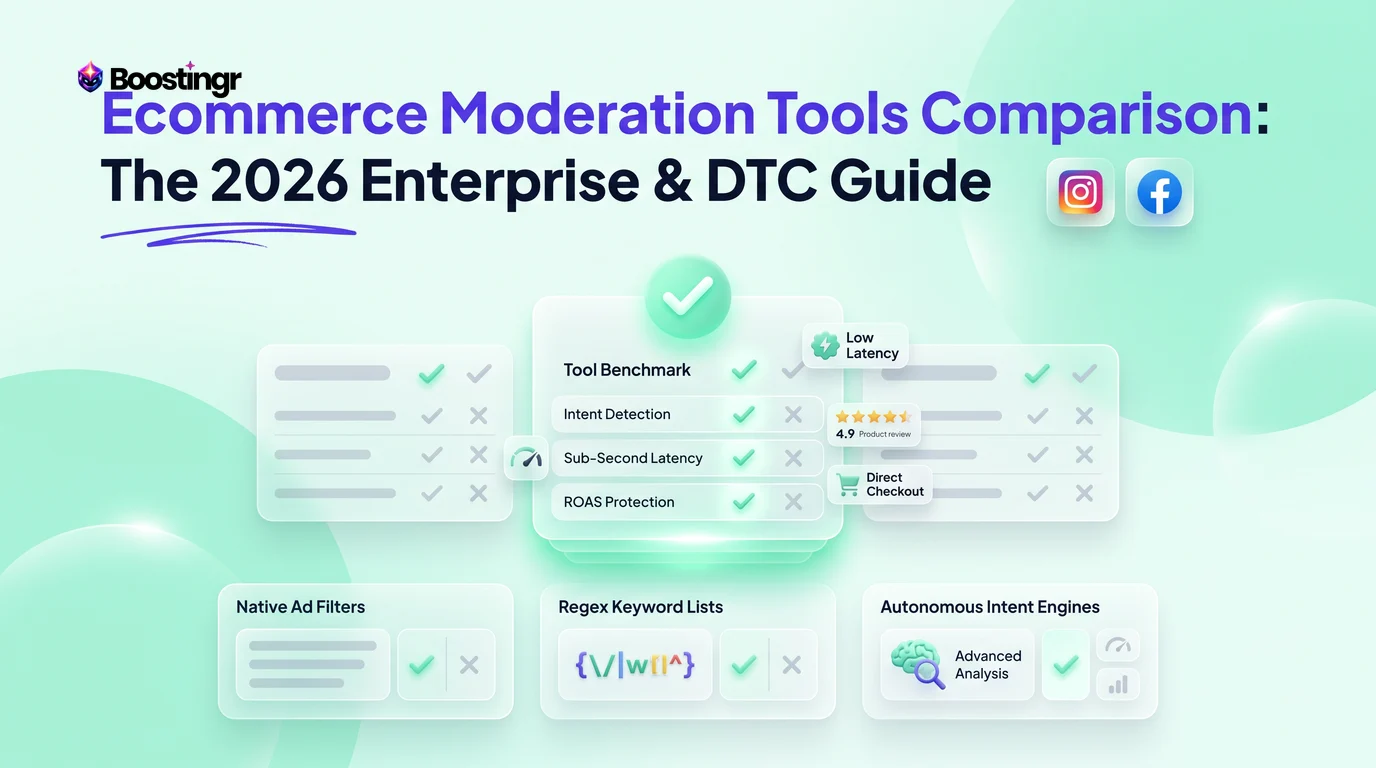
| Evaluation Dimension | Developer Classification APIs (OpenAI, Azure, Hive) | Enterprise Trust & Safety Suites (Checkstep, Besedo) | Social Comment Intelligence (Boostingr, Smart Mod.) | Legacy Social Media Suites (Hootsuite, Sprout, Sprinklr) |
|---|---|---|---|---|
| Core Architectural Target | Raw machine learning inference for text/images | Comprehensive policy governance and regulatory compliance | Real-time social comment hygiene, ad protection & engagement | Multi-channel social scheduling, listening & inbox triage |
| Primary Ideal User | Software Engineers, MLOps, Data Scientists | Trust & Safety Leads, In-House Counsel, Policy Teams | Performance Marketers, Community Managers, Social Ops | Enterprise Brand PR, Comms Teams, Social Strategists |
| Time to Value (TTV) | Weeks to Months (Requires custom frontend & queues) | Weeks (Requires enterprise onboarding & policy mapping) | Minutes (One-click OAuth account connection) | Days to Weeks (Requires seat setup & workspace routing) |
| Ad Account Protection | None (No native Meta/TikTok Ad account hooks) | None (Platform and UGC-focused, not ad-focused) | Native Ad Account comment monitoring & auto-hiding | Limited ad comment integration; largely manual triage |
| Engagement & Lead Capture | None (Stateless analysis only; no reply generation) | Minimal (Focused on enforcement, not conversations) | Advanced (Context-aware AI replies, brand memory, lead capture) | Basic template macros and manual canned responses |
| Pricing Architecture | Pay-per-call / Per token (Spikes with firehose volume) | Custom Enterprise Annual Contracts (Seat + Volume tiers) | Predictable, tier-based account/volume subscriptions | Per-seat monthly/annual software licenses |
| Regulatory Compliance (DSA/OSA) | Raw building block only | Built-in audit logs, queues & transparency reports | Community guidelines enforcement | Standard enterprise social compliance logs |
Deep Dive: Comparing Top Content Moderation Tools
To navigate the marketplace effectively, teams must understand how leading platforms across each category tackle moderation challenges.
                                  ┌─────────────────────────────┐
                                  │ Tool Comparison Landscape   │
                                  └──────────────┬──────────────┘
                                                 │
         ┌───────────────────────────────────────┼───────────────────────────────────────┐
         ▼                                       ▼                                       ▼
┌─────────────────────────┐             ┌─────────────────────────┐             ┌─────────────────────────┐
│ Raw APIs                │             │ Trust & Safety Platforms│             │ Social-First Tools      │
├─────────────────────────┤             ├─────────────────────────┤             ├─────────────────────────┤
│ • OpenAI Moderation     │             │ • Checkstep             │             │ • Boostingr             │
│ • Azure AI Content      │             │ • Besedo                │             │ • Bodyguard.ai          │
│ • Hive Moderation       │             │ • Spectrum Labs         │             │ • Smart Moderation      │
└─────────────────────────┘             └─────────────────────────┘             └─────────────────────────┘
1. Developer APIs: Hive Moderation, Azure AI, OpenAI
- Hive Moderation: Industry benchmark for high-throughput multimodal content moderation platforms. Analyzes live video, audio, image, and text with custom sub-classification models. Highly regarded by engineering teams running streaming platforms or dating apps, but requires dedicated infrastructure to ingest webhooks and manage human review.
- Azure AI Content Safety: Enterprise cloud classification covering text and image modalities. Includes severity-level scoring (0, 2, 4, 6) across categories like Hate, Self-Harm, Sexual, and Violence. Outstanding model explainability, but strictly limited to classification; your engineering team must build all operational logic.
- OpenAI Moderation API: A free or low-cost classification endpoint for builders leveraging the OpenAI ecosystem. Provides rapid baseline checks across safety categories, but lacks domain-specific nuances required for nuanced social comments, sarcasm detection, or automatic platform actions.
2. Enterprise Trust & Safety Platforms: Checkstep, Besedo
- Checkstep: A premier orchestration engine for platforms navigating EU DSA compliance and digital safety mandates. Combines multiple AI models with an ergonomic human review dashboard, audit logging, and configurable appeals pipelines. Ideal for high-risk social networks and online communities; excessive and cost-prohibitive for social media comment moderation.
- Besedo: Combines automated AI engines (such as their Implio platform) with managed BPO human moderation services. Excellent for high-volume classifieds, gig-economy marketplaces, and dating platforms needing deep fraud detection, but lacks organic social engagement and growth workflows.
3. Specialized Social Moderation: Bodyguard.ai, Smart Moderation, Brand24
- Bodyguard.ai: Specializes in real-time community protection across social platforms, gaming networks, and creator channels. Excels at linguistic nuance, cyberbullying detection, and toxicity filtering, but maintains a strictly subtractive approach with limited automated engagement or lead qualification.
- Smart Moderation: Operates across Facebook, Instagram, and YouTube to auto-hide toxic comments, trolls, and spam in real time without human intervention. Excellent for simple, hands-off defense, though it lacks deep contextual AI reply engines, brand memory, or automated ad conversion loops.
4. Turnkey Social AI Operations: Boostingr
Boostingr bridges the gap between brand protection and automated engagement, serving as an intelligent operating system for comment management. Built on the principle that modern software shouldn't just read comments, but understand people, Boostingr operates with a Teach once, engage everywhere philosophy.
- Comprehensive Threat Neutralization: Monitors connected Meta and YouTube accounts, instantly hiding spam, competitor link-jacking, hate speech, and troll activity to safeguard ad ROAS.
- Additive Growth Loops: Leverages unified brand memory to automatically formulate contextually accurate, humanized replies, turning routine comment interactions into engaged followers and verified customer leads.
- Accessible Time-to-Value: Connects in minutes via secure OAuth integrations, eliminating custom code and expensive developer maintenance.
Unmasking Hidden Total Cost of Ownership (TCO)
Public pricing pages rarely tell the full economic story. When selecting software, teams must evaluate the full Total Cost of Ownership across both visible and invisible budget lines.
Developer API (Hidden Iceberg Model):
[Public API Cost: $0.001/Call] ◄── What Finance Sees
─────────────────────────────────────────────────────
[DevOps Cloud Hosting]         ◄── What It Actually Costs
[Webhook Queue Engineering]    ◄── 3 Months Dedicated Dev Time
[Internal Dashboard Dev]       ◄── Ongoing Frontend Maintenance
[Model Drift Retraining]       ◄── Continuous Data Science Retainers
The Developer API "Iceberg" Cost
A classification API may market an attractive rate of $0.001 per text inspection. However, social comment streams demand an expansive, always-on infrastructure stack:
- Webhook Ingestion Infrastructure: Running scalable Redis queues and serverless functions to ingest thousands of real-time webhooks from Meta Graph APIs without dropping payloads.
- Custom Queue Development: Building bespoke frontend review queues so team members can audit edge-case decisions, manually unhide comments, and monitor false positives.
- Token & Rate Limit Overhead: Engineering resilient backoff-and-retry logic to handle social spikes during viral moments or major product launches.
What begins as a seemingly modest monthly API bill quickly balloons into tens of thousands of dollars in initial engineering investment and ongoing system maintenance. Reviewing the financial ROI of automated comment moderation provides a clear breakdown of build versus buy economics.
Per-Seat Enterprise Pricing Bloat
Conversely, legacy enterprise social management suites charge aggressive per-seat software licenses. When community management duties are shared across marketing teams, customer support specialists, and external agency partners, adding individual user seats creates massive financial drag.
Modern automated workflows thrive on predictable, tier-based comment volume architectures that scale with brand audience growth rather than head-count penalties. Review our transparent pricing model for an example of volume-aligned predictability.
Practical Examples and Use Cases
Use Case 1: The Performance Ad Scale-Up (ROAS Defense)
A rapid-growth DTC skincare brand scales monthly Meta ad spend from $15,000 to $120,000. Within days, comment velocity increases tenfold, creating severe vulnerabilities across their campaigns.
- The Threat: Aggressive drop-shipping competitors hijack top-performing ad creatives by posting links to counterfeit products in the comments. Unresolved customer service questions spark negative sentiment cascades, degrading ad delivery.
- The Workflow: The brand connects Boostingr to its ad accounts. The platform's semantic engine automatically hides competitor links, spam domains, and phishing attacks within seconds of publication.
- The Outcome: The brand maintains clean ad comment threads, preventing ad delivery penalties. Customer Acquisition Cost stabilizes, preserving an estimated 22% improvement in ROAS compared to unmonitored ad sets.
Use Case 2: Transforming Product Inquiries into Tracked Revenue
A luxury apparel brand frequently receives hundreds of high-intent sizing, material, and shipping questions on organic Instagram Reels and paid carousels.
Customer: "Does this run small? I'm between a Medium and Large!"
   │
   ▼ (Real-Time Semantic Evaluation)
Intent Detected: High-Intent Pre-Purchase Sizing
   │
   ▼ (Brand Memory Recall)
Retrieves Brand Sizing Logic: Athletic Fit / True to Size / Exchange Policy
   │
   ▼ (Automated Response Action)
Public Reply: "Hey Sarah! It has an athletic cut, so if you prefer a slightly relaxed look, we suggest sizing up to Large! Exchanges are totally free if you need to swap. ✨"
By leveraging automated instagram comment automation powered by rich brand memory, the brand delivers instant pre-purchase support, capturing warm sales intent before interest wanes.
Use Case 3: Enterprise Crisis Mitigation and Toxic Escalation
An airline brand experiences severe regional flight cancellations, causing customer frustration to boil over across public social channels.
- The Threat: Thousands of angry travelers flood public posts with a mix of genuine rebooking requests and severe profanity.
- The Workflow: Rather than blindly wiping all incoming comments with aggressive keyword blocklists, the team applies nuanced AI workflows for community moderation escalations.
- The Outcome: Severe profanity, doxxing, and abusive threats are automatically hidden from public feeds. Legitimate customer rebooking inquiries are categorized by flight number and routed to Tier-1 customer support agents for high-priority resolution.
First-Party Observations from the Field
Operating real-time comment intelligence infrastructure across millions of user interactions reveals consistent operational patterns:
- The Friday Evening Spam Surge: Comment attacks, crypto phishing campaigns, and coordinated trolling disproportionately surge on Friday evenings between 8:00 PM and 2:00 AM UTC. Malicious actors intentionally exploit the downtime of human social media managers. Teams relying on manual monitoring wake up to compromised ad accounts and damaged brand trust on Saturday morning, highlighting the necessity of real time content moderation tools.
- The Engagement Multiplier Effect: In testing across enterprise community accounts, public posts that received an intelligent, contextual brand reply within the first 5 minutes of a user's comment generated an average of 3.4x more downstream follow-up comments than posts where comments sat unacknowledged for over an hour. Swift, brand-aligned engagement signals algorithmic relevance, directly driving organic reach.
Checklist: The Buyer’s Evaluation Framework
Before signing a contract or committing engineering resources to a content moderation solution, review this operational readiness checklist:
- Architectural Alignment: Have you confirmed whether your team requires a raw classification API (needs custom dev), an enterprise T&S platform (for marketplace/regulatory compliance), or a turnkey social comment engine?
- Implementation Speed & TTV: Can the platform connect directly to Meta Graph APIs, YouTube, and TikTok via secure OAuth in under fifteen minutes without custom middleware?
- Ad Account Connectivity: Does the tool actively ingest, monitor, and auto-moderate comments on dark posts and dynamic paid social ads, or is it restricted strictly to organic feeds?
- Semantic Context & Slang Understanding: Has the tool been tested against colloquial modern slang (e.g., "this is insane," "I'm screaming") to confirm low false-positive rates on positive community banter?
- Dual Subtractive & Additive Capabilities: Does the platform support both threat elimination (hiding spam, blocking trolls) and community engagement (contextual AI replies, lead capture)?
- Brand Voice & Memory Governance: Can you train the AI on specific brand policies, product FAQs, and tone guidelines once, applying that knowledge across all connected channels?
- Transparent, Scalable TCO: Is pricing based on predictable monthly or annual comment volume tiers, avoiding unpredictable per-call API billing or punitive per-seat software licenses?
Visual guide
Choosing the Right Moderation Architecture
Select the right software category based on whether you need custom code, legal audit compliance, or turnkey social ad protection.
The Additive Social Moderation Workflow
Modern moderation filters threats to protect ad spend while simultaneously answering buyer questions to drive revenue.
Keyword Blocklists Versus Semantic Understanding
Rules-based keyword filters misinterpret harmless modern slang, whereas semantic engines read genuine customer intent.
Key Takeaways
- Avoid Architectural Misalignment: Developer APIs require substantial engineering buildout, while enterprise T&S platforms focus heavily on regulatory compliance. Brands managing social communities require turnkey platforms that integrate directly with social APIs out of the box.
- Shift from Subtractive to Additive Moderation: Defensive filtering keeps comments clean, but modern algorithmic growth requires additive workflows. Combining safety checks with intelligent AI replies accelerates community engagement and captures revenue.
- Protect Paid Social ROAS: Unaddressed negative sentiment, spam, and competitor links directly damage Meta ad quality rankings, driving up CPMs. Protecting ad comment threads is essential for maximizing paid acquisition efficiency.
- Rely on Semantic Intelligence Over Simple Keywords: Keyword blacklists suffer from high false-positive rates on positive community banter and miss phonetic evasions. Semantic AI accurately decodes sarcasm, slang, and context.
- Calculate Full Total Cost of Ownership: Factor developer maintenance, infrastructure hosting, and dashboard engineering into the cost of developer APIs. Transparent, tier-based SaaS platforms offer faster time-to-value and predictable ongoing costs.
Frequently asked questions
What is the difference between a content moderation API and a content moderation tool?
A content moderation API is a stateless machine learning endpoint that scores submitted text or media for policy violations, requiring developers to build custom databases, review queues, and frontends. A content moderation tool is a fully functional SaaS application that includes ingestion pipelines, automated moderation rules, and ready-to-use user interfaces.
Why do simple keyword blocklists fail in social media comment moderation?
Keyword blocklists lack contextual understanding. They frequently generate false positives by flagging affectionate slang (e.g., "I'm screaming," "this is sick") while missing harmful comments that use deliberate phonetic misspellings, leetspeak, or subtle sarcasm.
How does comment moderation directly impact Facebook and Instagram ad ROAS?
Meta's ad algorithms factor post quality signals and viewer reactions into ad auction costs. Toxic, spam-heavy, or scam-ridden comment sections degrade user experience ratings, leading to ad delivery penalties that inflate CPMs and lower overall campaign ROAS.
Can automated content moderation tools respond to comments or do they only hide them?
Traditional moderation tools focus purely on subtractive actions like hiding, deleting, or banning. Modern comment intelligence platforms like Boostingr combine moderation with additive engagement, automatically publishing context-aware, brand-aligned replies to high-intent questions.
What is Total Cost of Ownership (TCO) in content moderation software?
Total Cost of Ownership includes not just the base software subscription or per-call API fee, but also the engineering resources required for system maintenance, cloud hosting costs, custom dashboard development, and human review overhead.
How fast do real-time content moderation tools process comments?
High-performance real-time comment moderation platforms process incoming webhooks, perform semantic classification, and execute actions (such as hiding or replying) within 500 milliseconds to 3 seconds of publication.
Do content moderation tools support dark posts and unpublished ads?
Turnkey social moderation tools with deep ad account integrations automatically monitor both public organic posts and dark unpublished ads. Developer APIs require custom integrations with ad management endpoints to achieve this.
How do teams get started with automated comment intelligence?
Teams can connect their social channels via one-click OAuth integrations, configure safety thresholds and brand memory settings, and begin automated moderation immediately without writing code. You can get started with a free signup in just a few minutes.
Is this available in size M? Want to order today