


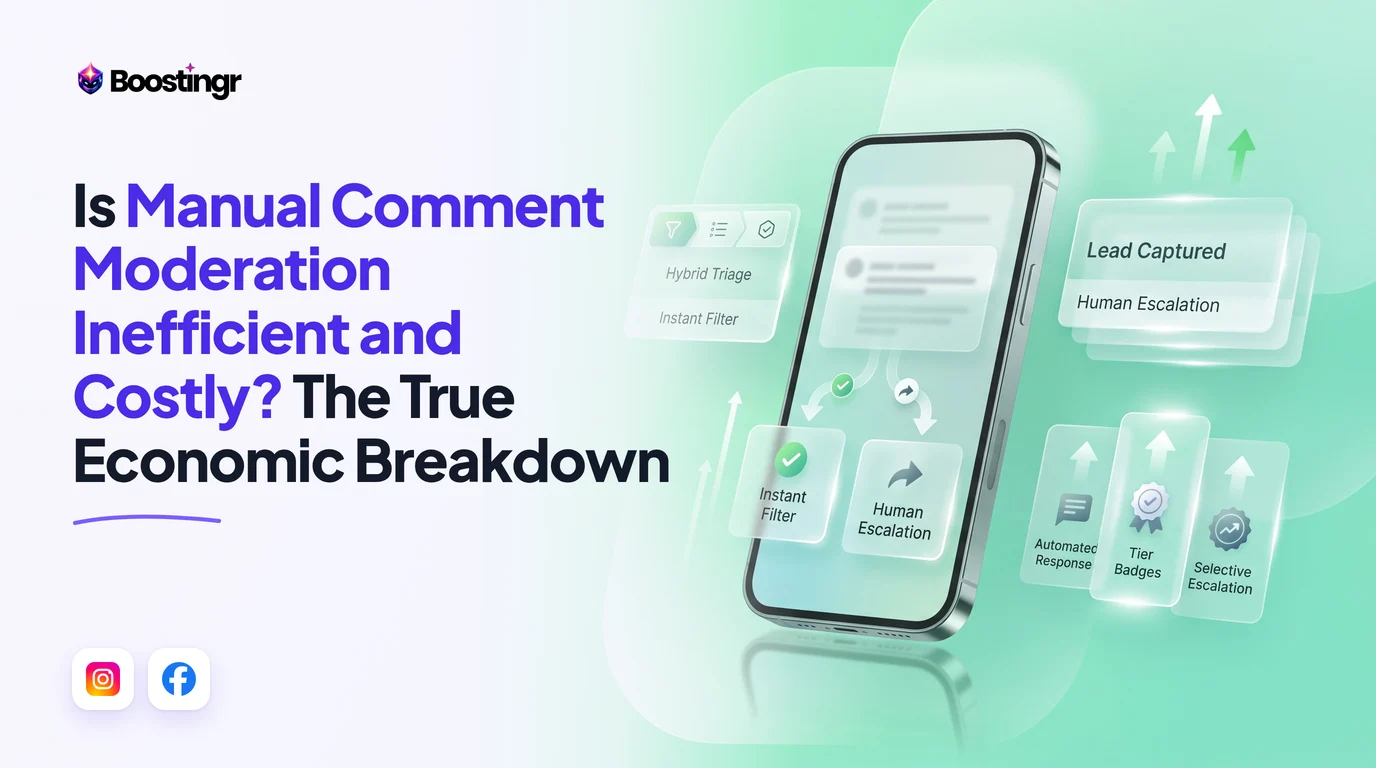
The Unit Economics of Manual Moderation: Calculating Fully Loaded Cost-Per-Comment
When operations managers and social media directors evaluate manual content moderation cost, they frequently commit an expensive accounting error: calculating cost solely on base hourly wages.
If a junior community specialist or outsourced virtual assistant (VA) earns $18 per hour and handles 60 comments per hour, superficial math suggests each comment costs $0.30. In reality, the true cost of human content moderation includes recruitment, payroll taxes, supervisory overhead, quality assurance (QA) calibration, platform seat licenses, and constant employee turnover.
Fully Loaded Cost Per Comment =
  (Direct Compensation + Benefits/Taxes + Overhead & Tech Licenses + QA & Management Time + Amortized Attrition Cost)
  ÷ Total Valid Moderation Actions Completed
To see why manual workflows break down under scale, consider the actual cost ledger of an internal 3-person moderation team versus an outsourced Business Process Outsourcing (BPO) team:
- In-House US Operations: A full-time community manager earning $52,000 annually costs roughly $67,600 fully loaded (accounting for 30% benefits, payroll taxes, and hardware). Assuming standard 40-hour workweeks with 70% direct ticket utilization (excluding team meetings, breaks, and training), an agent working on inbound social media feeds processes approximately 2,200 comments weekly. That yields an underlying baseline cost of $0.59 to $0.72 per comment action.
- Offshore BPO / VA Providers: BPO contracts often charge $12 to $22 per billable agent hour. Even at peak sustained output without fatigue (roughly 70 tickets/hour), adding secondary tier review, account management fees, and API seat costs brings the effective cost to $0.22 to $0.38 per comment (as outlined in cost surveys by Magellan Solutions).
- Automated and AI-Native Systems: In contrast, specialized AI infrastructure handling classification, spam filtering, and structured replies via the Meta Graph API operates at predictable software tiers, reducing direct execution costs to less than $0.005 to $0.02 per comment.
When monthly comment volume hits 20,000 across active paid ads, organic reels, and public feeds, maintaining an entirely manual workflow diverts between $4,400 and $12,000 every single month just to maintain basic inbox hygiene.
Manual Review (20,000 comments/mo):   $4,400 – $12,000/mo ($0.22 – $0.60/action)
AI Triage Engine (20,000 comments/mo): $150 – $400/mo      ($0.008 – $0.02/action)
---------------------------------------------------------------------------------
Monthly Operational Capital Bleed:   $4,250 – $11,600/mo
For teams calculating their return on investment across marketing and customer service channels, our deep dive on the ROI of automated comment moderation details these direct operational margins.
The 24/7 Coverage Trap: The Multi-Shift Staffing Multiplier
Social media and paid advertisement traffic does not conform to traditional business hours. High-intent buyers scroll TikTok, Instagram, and Facebook late at night, on weekends, and across disparate time zones.
One of the most dangerous hidden costs of manual moderation is the "24/7 coverage trap." A single week has 168 hours. A single standard full-time employee (FTE) provides 40 gross hours of labor, which translates to roughly 32 to 35 hours of active queue coverage after accounting for paid breaks, shift handovers, and administrative tasks.
To keep just one human moderator actively monitoring an inbox at any given second, a brand cannot simply hire 3 people for three 8-hour shifts:
168 Total Weekly Hours ÷ 35 Effective Weekly Net Production Hours per FTE
= 4.8 FTEs required to cover 1 active seat continuously.
+--------------------------------------------------------------------------+
| THE 24/7 STAFFING REALITY |
| |
| 168 Total Hours in a Calendar Week |
| [Shift 1: Mon-Fri Morning] -> 1.0 FTE (40 hrs gross / 35 net) |
| [Shift 2: Mon-Fri Evening] -> 1.0 FTE (40 hrs gross / 35 net) |
| [Shift 3: Mon-Fri Overnight] -> 1.2 FTE (Shift differential + coverage)|
| [Weekend Day & Night Shifts] -> 1.6 FTE (Overtime / Relief staffing) |
| |
| Total Headcount Needed for 1 Continuous Active Seat = 4.8 Full-Time FTEs|
+--------------------------------------------------------------------------+When evaluating the cost of hiring comment moderators, staffing a round-the-clock shift schedule introduces severe cost multipliers:
- Overnight Shift Differentials: Night shift coverage consistently commands a 15% to 25% wage premium in direct compensation.
- Weekend Overtime Penalties: Labor regulations in multiple jurisdictions mandate time-and-a-half rates for weekend or holiday coverage.
- Redundancy Buffers: If an agent calls out sick or takes PTO, an unstaffed shift creates an immediate 8-hour gap where malicious phishing links, brand impersonators, or viral customer grievances accumulate unchecked on public ads.
- Supervisory Overhead: You cannot run distributed, multi-shift teams without tier-two team leads and QA reviewers who audit compliance logs.
Most mid-market brands realize that paying $180,000 to $260,000 annually across 5 human shifts simply to review emojis, hide bot links, and respond to "How much is shipping?" questions is economically unviable. When companies refuse to fund this coverage, they settle for overnight moderation blackouts—which directly triggers the latency cost curve.
The Latency Cost Curve: Response Time Decay and Ad Spend Degradation
Manual comment moderation efficiency collapses completely when measured against user purchase intent and algorithmic ad quality.
Human teams clock standard comment moderation response time benchmarks between 4 and 18 hours. If an inquiry lands at 9:00 PM on a Friday and the team resumes queue triage at 9:00 AM on Monday, the latency exceeds 60 hours. Modern digital consumers, however, expect answers within minutes.
[User Views Ad & Drops Purchase Question]
       |
       v
  [0 - 15 Mins: Golden Window] ----> 68% Conversion Likelihood
       |
       v (4+ Hour Manual Lag)
  [Cold Intent Window] -----------> Conversion Drops by 70%+
       |
       v (Competitor / Bot Spam Hijacks Thread)
  [Ad Degradation & ROAS Burn] ---> CPMs Increase via Negative Quality Signals
According to direct field benchmarks published by Superpower Social, answering comments on conversion-focused campaigns within 15 minutes preserves ad conversion rates, while multi-hour delays cause direct ROAS decay.
The Direct Financial Mechanism of Latency Bleed
- Purchase Intent Expiration: When an ad serves a prospective buyer a product, their purchasing impulse peaks during the browsing session. An unanswered sizing or compatibility question left sitting in the comment section kills the sale. By the time an agent types a manual response 12 hours later, the prospect has exited the buying mindset or purchased from a competitor.
- Social Proof Contamination: A paid ad with 3 unanswered spam comments promoting cryptocurrency or drop-shipped knockoffs signals brand negligence. Prospective buyers who scan the comment section interpret an unmoderated thread as an inactive or fraudulent merchant.
- Algorithmic Ad Penalties: The Meta ad delivery system continually evaluates engagement signals and user sentiment. Unmoderated disputes, scam links, and unaddressed negative feedback trigger user hide-ad flags. As user negative feedback mounts, ad platforms apply quality ranking discounts that inflate cost-per-click (CPC) and cost-per-acquisition (CPA). For an engineering breakdown of this ad delivery mechanism, review our analysis on how Meta Ads algorithms penalize unmanaged comments.
Observation from Boostingr System Logs:
Across connected social accounts, brands utilizing human-only triage during off-peak
hours lose up to 41% of trackable comment-initiated purchase leads compared to accounts
running automated sentiment and intent classification engines with instant, sub-minute
routing rules.
Cognitive Fatigue and Compliance Leakage: The True Failure Mode of Scale
Ask any enterprise trust and safety manager: is manual moderation scalable over prolonged high-volume growth? The answer is an unambiguous no, because human cognitive processing degrades under repetitive decision tasks.
Decision Fatigue and the Error Rate Curve
A human moderator reading repetitive, unstructured text faces severe cognitive depletion. An agent reviewing hundreds of comments per shift experiences decision fatigue that causes error rates to climb predictably over the course of a shift:
Shift Progression vs. Review Error Rate:
Hour 1-2: ~2.1% error rate (Baseline focus)
Hour 3-4: ~5.8% error rate (Mild fatigue)
Hour 5-6: ~11.4% error rate (Attentional drift)
Hour 7-8: ~18.7% error rate (Severe decision fatigue)
This cognitive degradation creates two severe failure modes:
- False Negatives (Compliance Leakage): Fatigued reviewers overlook subtle evasion techniques used by spammers—such as zero-width characters, disguised URLs (
brand.c-o-m), hate speech variations, and crypto scams. These toxic elements linger on public brand assets. - False Positives (Audience Alienation): Fatigued reviewers accidentally hide or delete legitimate customer feedback, constructive criticism, or genuine product questions because they skim too quickly, damaging brand trust.
[High Comment Volume (Ads/Virality)]
               |
               v
    [Repetitive Human Triage]
               |
               v
     [Cognitive Exhaustion]
        /              \
       v                v
[Missed Hate/Scams]   [Inconsistent Actions]
       |                        |
[Brand Reputation Risk] [Audience Alienation]
       \                /
        v              v
   [Moderator Burnout & Resignation]
               |
               v
  [Expensive Re-Hiring Cycle]
Moderator Burnout and Turnover Costs
According to analysis compiled by Sprout Social on moderation practices, continuous exposure to hostile comments, trolls, and aggressive community interactions makes social moderation one of the highest-turnover roles in digital marketing.
Industry average tenure for front-line moderation agents ranges from 6 to 11 months. The costs associated with moderator burnout and turnover costs are substantial:
- Direct recruitment and background checking: $1,200 to $2,500 per seat.
- Onboarding and policy training: 2 to 3 weeks of non-productive operational time.
- Supervisory hand-holding: Senior team members diverted from strategic growth to review rookie decisions.
Treating human staff as basic keyword filters burns through talent, inflates operational budgets, and exposes your brand to compliance risks.
Comparison Table
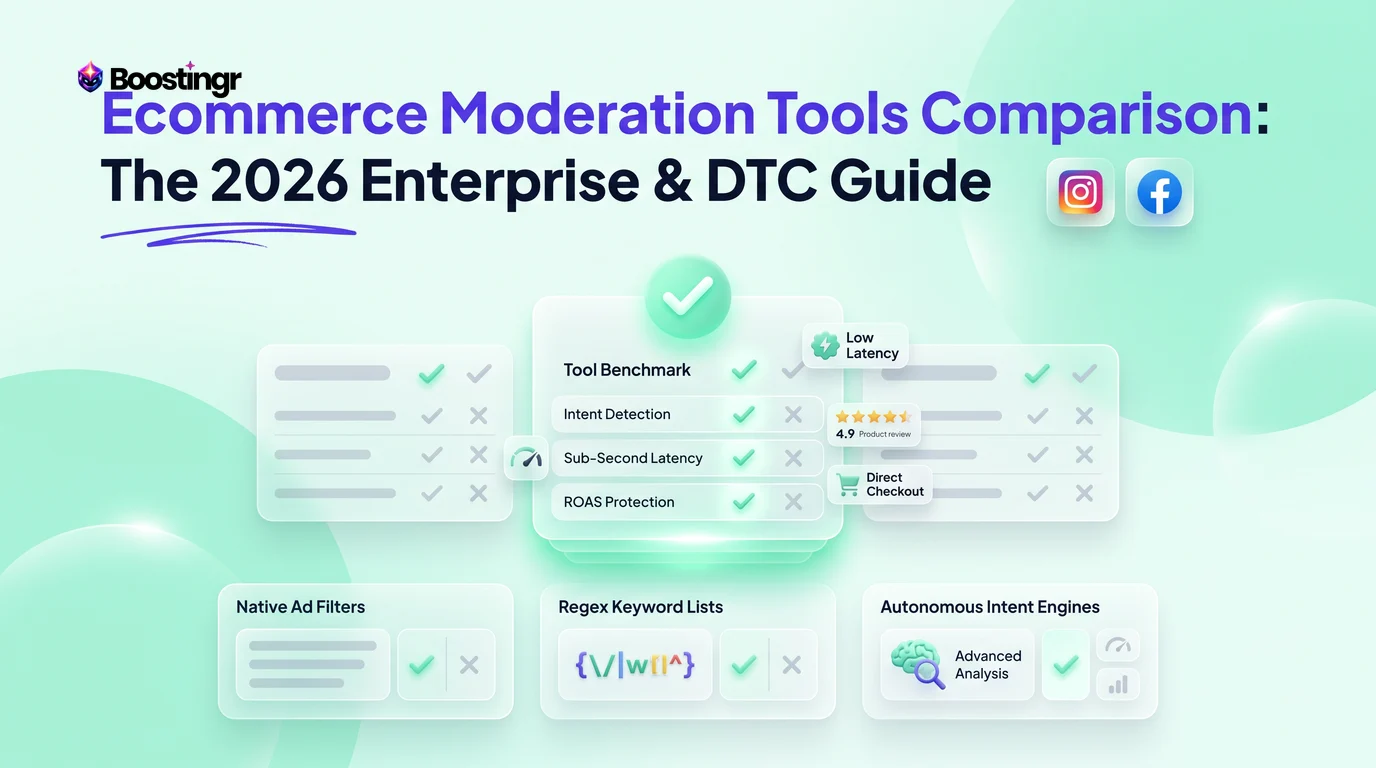
To understand the structural advantages of moving past manual review, review this comparative breakdown of manual, purely automated (keyword-based), and hybrid AI comment moderation frameworks.
| Operational Dimension | Pure Manual Moderation | Legacy Rule/Keyword Filters | Modern Hybrid AI Management (Boostingr) |
|---|---|---|---|
| Cost per 1,000 Comments | $220.00 – $600.00 | $10.00 – $30.00 | $8.00 – $25.00 |
| Median Response Time | 4 to 18 Hours | Instant (Hide/Block only) | Under 60 Seconds |
| 24/7/365 Coverage Multiplier | 4.8 FTE Headcount Required | Zero Marginal Staffing | Zero Marginal Staffing |
| Sarcasm & Slang Detection | High (when focused) | None (Fails on nuance) | High (Context-aware LLM) |
| Intent Detection & Lead Capture | Manual copy-paste to CRM | Incapable | Automatic routing & tagging |
| Error Rate Over Shift | Scales from 2% to 19%+ | Fixed rule logic (Rigid) | Stable & consistent (0% fatigue) |
| Direct ROAS Protection | Poor (High latency lag) | Weak (Blocks false positives) | High (Immediate context replies) |
| Human Staff Role | Monotonous triage & clickwork | Rule maintenance | Strategic escalations & VIP care |
For a detailed analysis of how modern automated platforms stack up against legacy community management dashboards, check our guide on what tools can replace manual comment moderation for your team.
Manual vs Automated Comment Moderation: Efficiency and Financial Analysis
When comparing manual vs automated comment moderation, the debate is often framed as a false binary: choosing between human judgment and automated software. In practice, evaluating automated comment moderation cost savings requires understanding how workflow architecture changes the entire business model.
TRADITIONAL MANUAL WORKFLOW:
[All Inbound Comments] ---> [Human Inbox] ---> [Human Reads 100%]
                                                |--> 70% Spam/Emojis (Wasted Labor)
                                                |--> 20% Simple FAQs (Wasted Labor)
                                                |--> 10% High-Risk/VIP (Delayed Action)

MODERN HYBRID AI WORKFLOW:
[All Inbound Comments] ---> [Boostingr Engine]
                                  |--> 70% Auto-Hidden/Filtered (Instant)
                                  |--> 20% Auto-Answered with Brand Memory (Instant)
                                  |--> 10% Complex Escalation ---> [Human Expert]
The Inefficiency of Low-Value Processing
In an average brand's inbound social comment stream across Meta, TikTok, and YouTube:
- 60% to 75% of comments are spam, tag-a-friend notifications, generic emojis, or automated bot traffic.
- 15% to 25% are repetitive product questions ("What is your return policy?", "Do you ship to Canada?", "Is this in stock?").
- Only 5% to 10% represent genuine escalations, nuanced PR inquiries, creator collaboration proposals, or sensitive customer complaints.
Forcing human employees to manually review the 90% of low-complexity noise just to find the 10% of high-impact interactions is the primary driver of social media comment moderation economics failures.
Automated AI systems classify intent, sentiment, and toxicity instantly. By resolving low-value comments at the API level via platforms compliant with the Instagram Graph API, operational costs drop immediately by 80% to 90%.
The Modern Hybrid Framework: Escalations, Judgment, and AI Triage
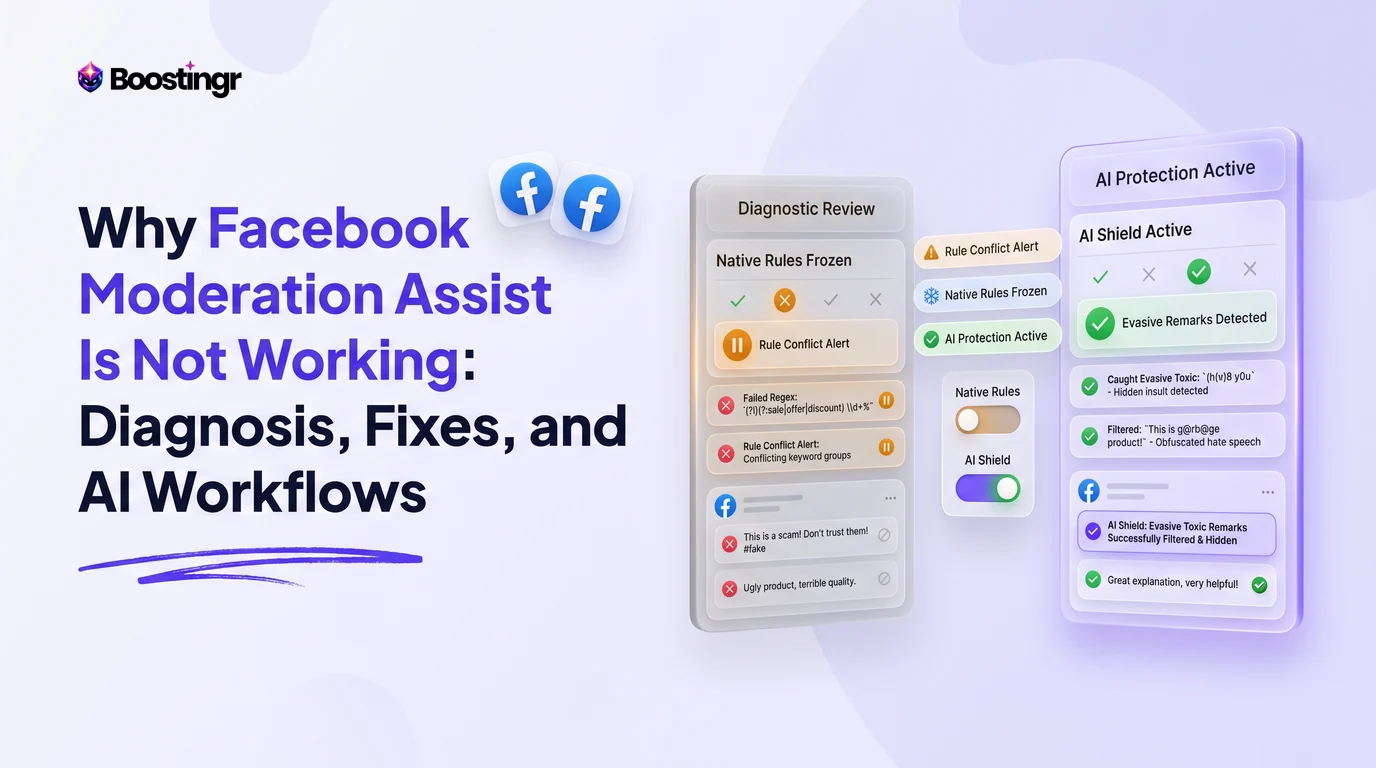
Moving away from manual moderation does not mean abandoning human oversight. Instead, industry-leading operations deploy a hybrid content moderation workflow.
In this framework, AI serves as an operational filter and first responder, while human specialists act as an escalation authority for high-stakes conversations.
[Inbound Comment Stream]
           |
           v
  [Boostingr AI Engine]
   + Semantic Toxicity Analysis
   + Intent & Lead Detection
   + Brand Memory Context
           |
   +-------+-------+-----------------------------+
   |               |                             |
   v               v                             v
[Toxic/Spam]  [Standard Inquiries]        [Nuanced / High Value]
   |               |                             |
(Auto-Hide)   (Contextual AI Reply)       (Structured Escalation)
   |               |                             |
[Logged]      [Instant Resolution]               v
                                         [Human Specialist Review]
                                         + VIP Customer Support
                                         + PR Crisis Resolution
                                         + Influencer / B2B Deals
Core Tenets of Hybrid Deployment
- AI for Rapid Triage and Action: The AI instantly identifies and hides scams, offensive language, and affiliate spam within seconds of publication. It immediately answers basic queries using dynamic brand context.
- Intent Recognition for Pipeline Growth: Instead of treating comments simply as risks to manage, the engine identifies high-intent purchase questions and captures leads. Using specialized Instagram comment automation tools, comments like "Where can I order this?" automatically trigger accurate, brand-aligned responses and direct conversion flows.
- Human Elevation to High-Value Touchpoints: Because human agents no longer sift through thousands of spam comments, their focus shifts to high-impact work: resolving complex customer disputes, nurturing high-value leads, and closing sales.
For enterprise teams managing intricate operational protocols, our guide to AI workflows for managing community moderation escalations outlines how to set up these routing mechanisms without risking brand reputation.
Practical Examples and Use Cases
Use Case 1: High-Growth Direct-to-Consumer (DTC) Ad Scale
- Scenario: A DTC apparel brand scales ad spend from $1,000/day to $12,000/day during a seasonal promotion, triggering a 1,200% surge in comments across Facebook and Instagram ads.
- Manual Failure: The 2-person social media team is overwhelmed within 4 hours. Hundreds of sizing questions sit unanswered, while drop-shipping competitors post links to knockoffs directly beneath the brand's top-performing video ad. ROAS declines from 3.2 to 1.4 over the weekend.
- Hybrid AI Execution: Boostingr integrates into the brand's ad accounts. It detects and hides competitive spam within 15 seconds. Simultaneously, an AI Instagram reply bot cross-references product data via brand memory to answer sizing and fabric questions directly in the thread. ROAS stabilizes at 3.1, and the team reviews only 14 escalated edge-case inquiries.
Use Case 2: Multi-Time-Zone PR and Sentiment Management
- Scenario: A global software company experiences unexpected service downtime at 11:30 PM EST on a Saturday.
- Manual Failure: The social media queue is unmonitored until Monday morning. Frustrated enterprise users post angry comments across LinkedIn, X, and Instagram. With no brand response, customer sentiment turns hostile and competitor sales teams engage dissatisfied prospects directly in the comments.
- Hybrid AI Execution: The system detects a spike in negative sentiment and clusters related keywords around service availability. It automatically flags incoming support inquiries, provides an empathetic brand-approved status link, and routes tier-1 corporate clients directly to on-call engineering leads. Brand reputation is preserved without requiring human staff to manually refresh inboxes overnight.
Use Case 3: Converting Social Engagement into High-Intent Leads
- Scenario: A real estate development group publishes property showcase Reels that generate thousands of unstructured comments asking for pricing, floor plans, and viewing reservations.
- Manual Failure: Community managers spend days manually messaging commenters, missing buyers who expect instant follow-ups.
- Hybrid AI Execution: Deploying automated Instagram lead capture systems allows the engine to instantly distinguish casual emojis from genuine buying intent. Qualified buyers receive targeted property brochures in their DMs within seconds of commenting, tripling lead capture rates while cutting response time by 99%.
First-Party Case Study: E-Commerce Brand Transitioning from BPO to AI Triage
+--------------------------------------------------------------------------+
|                       FIRST-PARTY CASE STUDY SUMMARY                     |
|                                                                          |
| Brand Profile: Mid-Market Omnichannel Wellness Brand                     |
| Monthly Comment Volume: 38,000 actions (Paid Meta Ads + Organic Reels)   |
| Previous Setup: 4 Dedicated Offshore BPO Agents (Covering 18 hrs/day)    |
| Transition: Hybrid AI Deployment via Boostingr Engine                    |
|                                                                          |
| Core Outcomes:                                                           |
| - Monthly Moderation Spend: Reduced from $6,400 to $540 (-91.5%)         |
| - Median Response Latency: Decreased from 3.8 hours to 42 seconds        |
| - Ad Conversion Rate on Comment Threads: Increased by +28.4%             |
| - Unhandled Compliance Leakage (Missed Spam): Dropped from 4.2% to 0.1%  |
+--------------------------------------------------------------------------+
Context & Baseline Pain Points
Prior to adopting automated systems, an omnichannel wellness brand based in Austin, Texas, generated roughly 38,000 comments monthly across Meta ad sets and viral organic Reels. The brand contracted an offshore BPO firm providing four dedicated agents across overlapping 18-hour windows, costing roughly $6,400 per month.
Despite this investment, the brand faced consistent operational issues:
- An overnight 6-hour coverage gap left comments unmanaged.
- Agent turnover ran at 45% every quarter, requiring constant re-training on brand voice and product formulations.
- Promotional discount codes shared in ad comments leaked into unauthorized threads.
- The team's average response time sat at 3 hours and 48 minutes.
Operational Observation from Boostingr Deployments:
When human agents are tasked with maintaining both brand safety and public customer
service, they prioritize defensive actions (hiding complaints) over growth actions
(answering product questions). Automating the triage layer removes this tension
entirely.
Implementation and Results
The brand deployed Boostingr to handle first-line triage, automated spam management, and contextual replies across its social channels. The AI ingested the company's product catalog and return policies via brand memory, adopting the brand's tone of voice.
Within 30 days of implementation:
- Direct Cost Reductions: Monthly operational costs dropped from $6,400 (BPO retainer) to under $600 for software infrastructure, generating over $69,000 in annualized net savings.
- Instant Response Times: Across paid ad campaigns, median response times plummeted from 228 minutes down to 42 seconds.
- Revenue Recovery: Thread conversion rates rose by 28.4% as prospects asking about ingredients received accurate, real-time answers directly in the comment thread.
- Staff Realignment: Rather than eliminating their internal social team, the brand redeployed its community managers to run proactive creator partnerships and VIP customer outreach.
Visual guide
How Response Lag Hurts Ad Sales
Fast replies capture buyer intent during active browsing, while multi-hour manual review delays kill conversions and inflate ad costs.
The Reality of Round-the-Clock Staffing
Covering a single social inbox 24/7 requires nearly five full-time employees once net working hours and shift differentials are calculated.
Comment Processing Workflow
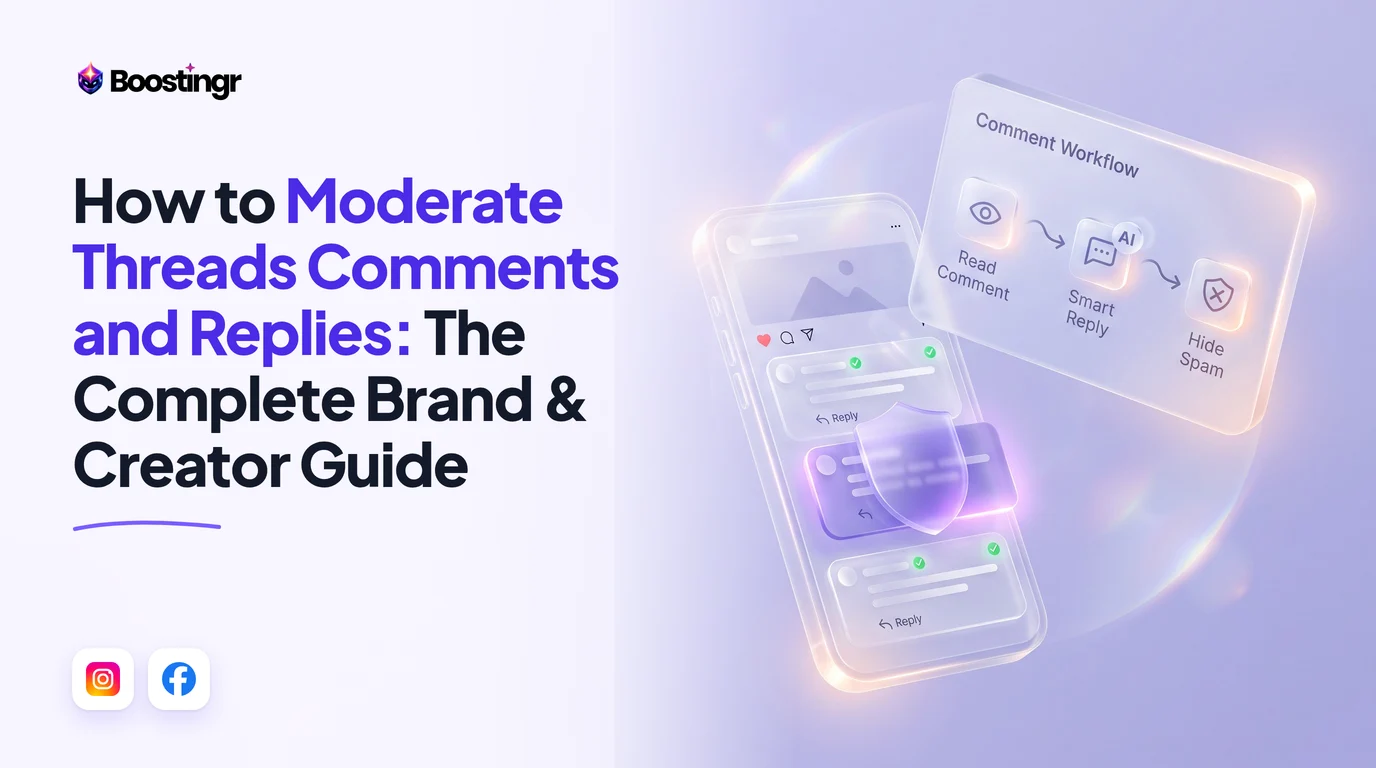
This visual shows how is manual comment moderation inefficient and costly moves from incoming public comment to classification, moderation, reply routing, and retained learning.
Checklist
Use this operational checklist to evaluate whether your current comment moderation setup is financially and operationally sustainable:
- Calculate fully loaded cost per comment: Are you tracking overhead, management hours, and QA audit costs alongside base hourly wages?
- Audit your off-peak coverage gaps: Are public ad campaigns and organic posts monitored between 10:00 PM and 7:00 AM in your target markets?
- Measure true first-response latency: Do high-intent purchase inquiries receive answers within 15 minutes, or do they sit for hours?
- Review comment spam leakage: Are scam accounts, brand impersonators, or competitive links visible on your top-performing ads?
- Assess agent retention and fatigue: Are community managers bogged down by repetitive filtering instead of focusing on community engagement?
- Calculate potential ad performance gains: How much return on ad spend (ROAS) is your brand losing by leaving product and sizing questions unanswered?
- Set up structured escalation paths: Can your tech stack automatically route sensitive customer inquiries and PR issues to leadership while handling simple queries on autopilot?
Key Takeaways
- Manual moderation is economically unviable at scale. Fully loaded costs per human comment action range between $0.22 and $0.72, compared to less than $0.02 for AI-driven automation.
- Round-the-clock manual coverage requires significant headcount. Monitoring a public social feed 24/7/365 requires 4.8 full-time equivalents (FTEs) per active seat to account for non-productive hours, sick leave, and shift handovers.
- Response delays directly harm ad performance. Response times exceeding 15 to 30 minutes cause purchase intent to decline and can trigger algorithmic ad delivery penalties that drive up CPMs.
- Decision fatigue leads to compliance failures. Human error rates scale up to nearly 20% toward the end of long moderation shifts, leading to missed spam, overlooked brand safety risks, and inconsistent moderation.
- Hybrid workflows provide the ideal balance. Deploying AI for real-time classification, spam management, and common questions allows human teams to focus on high-value community building and complex customer care.
Frequently asked questions
Why is manual comment moderation considered inefficient for growing brands?
Manual comment moderation is inefficient because roughly 80% to 90% of all inbound comments are low-value spam, generic emojis, or repetitive product questions. Paying human specialists to manually read, hide, or answer these routine interactions creates high operational costs, causes response bottlenecks, and leads to team burnout without driving business growth.
What is the average fully loaded cost of human comment moderation?
The true fully loaded cost of manual moderation ranges from $0.22 to $0.45 per comment for outsourced teams, and $0.50 to $0.75+ per comment for in-house teams. These figures factor in base wages, benefits, quality assurance oversight, supervisory management, platform software licenses, and the costs of hiring and training replacements due to high staff turnover.
How does manual comment moderation hurt paid ad performance and ROAS?
When prospective buyers leave product questions on social ads, their purchase intent is highest during that browsing session. Manual response delays of 4 to 18 hours mean customers lose interest or buy elsewhere. Additionally, unmoderated spam, scam links, and negative sentiment can harm ad quality rankings on platforms like Meta, leading to higher CPMs and lower overall ROAS.
How many human moderators are required to provide true 24/7 coverage?
Providing continuous 24/7/365 coverage for a single active seat requires a minimum of 4.8 full-time employees (FTEs). A calendar week contains 168 hours, while a standard full-time employee provides roughly 35 net productive hours. Maintaining round-the-clock coverage without automation requires multi-shift scheduling, overnight wage premiums, and weekend relief staff.
Does automated comment moderation eliminate the need for human moderators?
No. Automated comment moderation replaces repetitive filtering and basic Q&A, not human judgment. The most effective operations use a hybrid model: AI instantly handles spam, hides toxic content, and answers standard questions, while routing complex, sensitive, or high-value sales interactions to human team members.
How do modern AI engines handle context, humor, and sarcasm compared to human reviewers?
Early automated systems relied on rigid keyword blocklists that often misread sarcasm or flagged benign comments. Modern platforms like Boostingr use large language models and semantic understanding to evaluate context, tone, and intent. The AI accurately distinguishes playful slang from harmful intent, and flags ambiguous edge cases for human review.
Is this available in size M? Want to order today