


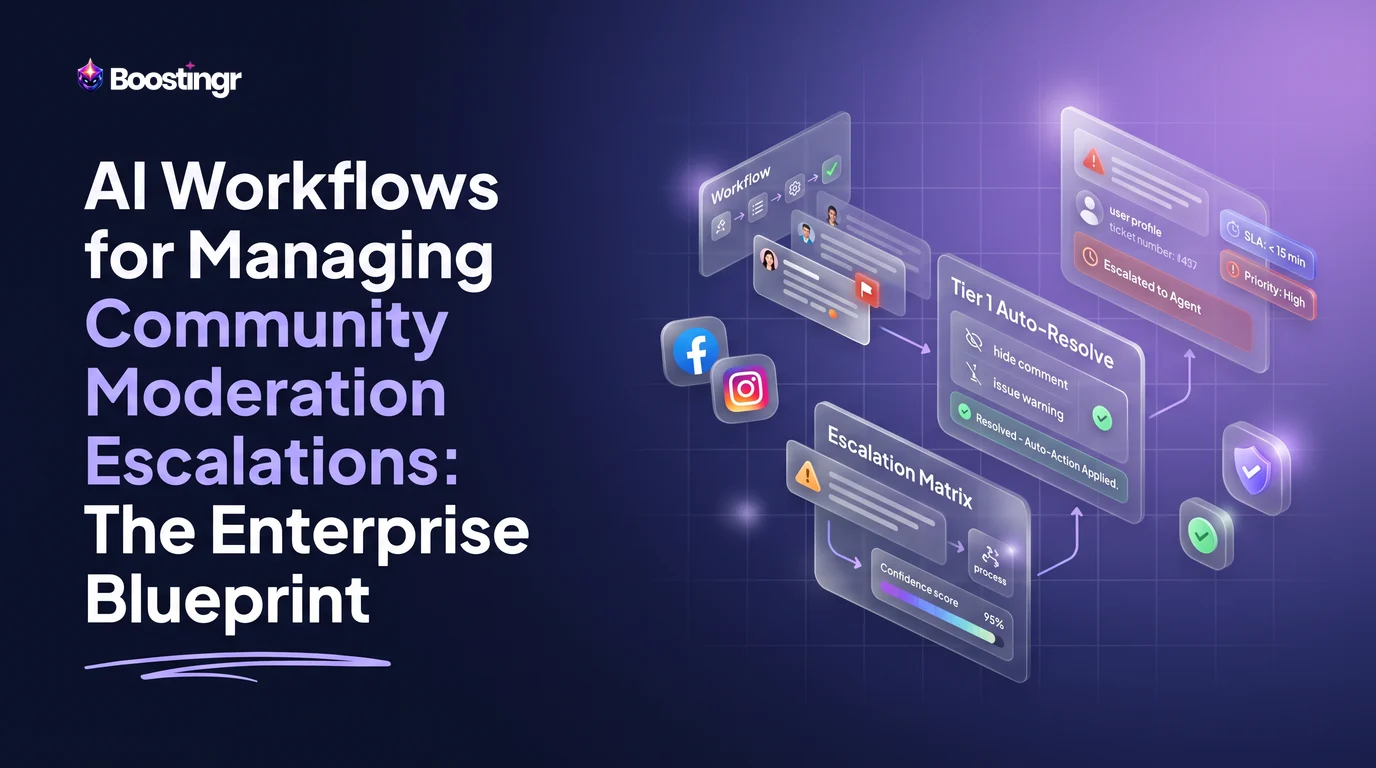
The Crisis of Scale in Modern Community Operations
Modern digital brands no longer manage single-thread customer forums. Today, enterprise community teams, Trust & Safety directors, and performance marketing leads face an unending stream of user-generated content (UGC) across paid Meta ads, organic TikTok reels, YouTube channels, and brand communities. When a product launch sparks controversy, an ad creative is misinterpreted, or a coordinated spam botnet targets your paid acquisition funnels, manual moderation queues collapse within minutes.
Legacy social management tools rely on rigid keyword blocklists and basic inboxes. These systems fail because human language is nuanced: sarcasm, regional slang, toxic nuance, and veiled threats easily slip past exact-match filters. Conversely, blunt keyword filters frequently block legitimate customer questions, damaging customer satisfaction and public perception.
Building dependable ai workflows for managing community moderation escalations requires moving beyond simple auto-replies or flat review queues. High-performing community teams use a structured tiered content moderation architecture that blends autonomous real-time actions, intelligent context packaging, cross-functional routing, and strict Human-in-the-Loop (HITL) controls.
At Boostingr, our foundational engineering philosophy is simple: Boostingr does not just read comments, it understands people. Managing volatile, multi-platform comment surges requires deep intent detection, continuous brand memory, and reliable escalation playbooks.
The 4-Tier Content Moderation Escalation Matrix
Most legacy community guides advise teams to "escalate difficult comments to a human." This generic instruction creates organizational gridlock. A frontline social media specialist cannot resolve a coordinated regulatory smear campaign, and an executive PR director should not spend their day reviewing promotional spam.
To establish an effective content moderation escalation matrix, enterprises divide comment triage into four distinct, SLA-backed operational tiers:
+-------------------------------------------------------------------------+
|                        INCOMING COMMENT STREAM                          |
+-------------------------------------------------------------------------+
                                     |
                                     v
            +------------------------------------------------+
            |      AI Ingestion, Intent & Toxicity Scoring   |
            +------------------------------------------------+
                                     |
         +---------------------------+---------------------------+
         |                           |                           |
         v                           v                           v
+-----------------+         +-----------------+         +-----------------+
|  Tier 0: Auto   |         | Tier 1 / Tier 2 |         |  Tier 3: P0     |
| (Spam, Phishing)|         | Context Routing |         | (Legal, PR, CSAM|
+-----------------+         +-----------------+         +-----------------+
         |                           |                           |
      Action:                     Action:                     Action:
Instant API Hide/Delete      Enriched Ticket to        Instant Alert to War
  (Latency < 3s)            CM or Support Inbox          Room (< 60s SLA)
Tier 0: Autonomous Instant AI Action (Zero-Touch Triage)
- Target Content: Crypto scam links, phishing vectors, commercial affiliate spam, bot-driven repetitive promotions, overt hate speech, and severe profanity.
- Confidence Requirement: $\ge 0.92$ confidence across toxicity or spam classification models.
- Action: Instant automated hiding, soft deletion, or quarantine via native platform webhooks (such as the Instagram Graph API).
- SLA: $< 3$ seconds from webhook delivery to execution.
- Human Oversight: Human-on-the-Loop (HOTL). Moderators do not review individual actions before they occur; instead, supervisors review daily telemetry sampling to spot false positives.
Automating Tier 0 protects your paid acquisition ROAS. Leaving spam and scam links unmoderated on high-traffic ad units destroys ad relevance scores, drops quality rankings, and erodes conversion rates. To see how these automated protections preserve your advertising budget, explore our guide on the ROI of automated comment moderation.
Tier 1: Contextual Ambiguity (Community Manager Review)
- Target Content: Culturally nuanced critique, competitor comparisons, borderline sarcasm, edgy brand humor, slang-heavy user feedback, and complaints about creative messaging.
- Confidence Requirement: $0.65$ to $0.91$ confidence.
- Action: Ingestion into a dedicated moderation queue with suggested reply drafts generated via brand memory. The comment remains visible or soft-quarantined depending on campaign risk tolerance.
- SLA: 1 to 4 hours.
- Human Oversight: Human-in-the-Loop (HITL). A human community manager decides whether to approve an AI reply draft, write a custom response, hide the comment, or ignore it.
Tier 2: High-Risk Customer Support and Churn Threats
- Target Content: Escalated billing issues, shipping failures, broken products, verified influencer complaints, cancelation threats, and churn indicators.
- Confidence Requirement: $\ge 0.80$ intent detection for transactional distress.
- Action: Automated creation of high-priority tickets in helpdesk platforms like Zendesk or Gorgias via webhook, complete with customer sentiment analysis and historic social interactions.
- SLA: 15 to 30 minutes.
- Human Oversight: Dedicated Tier 2 Customer Support Specialists. The platform acts as an automated triage router, connecting front-of-funnel social friction directly with back-office resolution teams.
Tier 3: Priority 0 Legal, Regulatory, and Brand Crises
- Target Content: Imminent threats of violence, self-harm signals, severe harassment campaigns, coordinated brand extortion, product safety recalls, whistleblower allegations, and pending legal threats.
- Confidence Requirement: $\ge 0.75$ keyword-entity match paired with negative sentiment clustering, or any verified match against custom legal alert dictionaries.
- Action: Instant soft-quarantine (auto-hide pending review) and an automated emergency webhook trigger dispatching alerts to Slack or Microsoft Teams war rooms, alerting Legal, PR, and Trust & Safety leadership.
- SLA: $< 60$ seconds for automated notification; $< 15$ minutes for human executive containment.
- Human Oversight: Multi-stakeholder review involving Legal Counsel, VP of Communications, and Head of Trust & Safety.
For a broader look at how enterprise brand teams configure their software stacks across these operational boundaries, see our breakdown of what tools big brands use to moderate Instagram comments.
Setting Automated Moderation Triage Rules and Ingestion Pipelines
An ai community moderation workflow depends on the speed and data integrity of its ingestion pipeline. If webhook latency stalls or payloads drop metadata during viral surges, escalation paths break down immediately.
[Social Network Webhook]
         │ (Raw JSON: comment_id, user_id, message, timestamp)
         ▼
[Boostingr Ingestion Gateway]
         │ (Payload Enrichment: Extract Parent Thread, Creative Context, CRM Data)
         ▼
[Parallel Evaluation Engine] ──────┬───────────────────────────────┐
         │                         │                               │
         ▼                         ▼                               ▼
[Zero-Shot Intent Engine]   [Toxicity/Safety Model]    [Brand Memory & Tone Match]
(Detect: Return, Churn)     (Detect: Spam, Slurs)      (Retrieve: Approved Answers)
         │                         │                               │
         └─────────────────────────┼───────────────────────────────┘
                                   ▼
                   [Decision & Threshold Matrix]
                                   │
           ┌───────────────────────┼───────────────────────┐
           ▼                       ▼                       ▼
     Score >= 0.92           0.65 <= Score <= 0.91        Score < 0.65
     [Auto-Execute]          [HITL Enriched Queue]         [Auto-Pass]
Ingestion Latency and Real-Time Webhooks
Scalable moderation architectures consume events directly from social platform endpoints (such as the Meta Graph API). The ingestion gateway must process inbound comment payloads within 200 milliseconds to preserve operational real-time guarantees.
When a comment arrives, modern engines extract:
- The raw text string and UTF-8 emoji sequences.
- The actor ID, account creation age, and historic interaction frequencies.
- The asset context (organic post, Reel, paid ad creative, or direct message thread).
Parallel Evaluation Pipelines
Passing every comment through a single, slow large language model (LLM) creates latency bottlenecks and high inference costs. Resilient automated moderation triage rules use an asynchronous, multi-stage evaluation pipeline:
- Stage A: Fast Heuristic and Deterministic Filtering (0–10ms): Regular expressions evaluate verified scam links, banned phone numbers, and hard-coded blocklists.
- Stage B: Specialized Intent and Sentiment Scoring (50–150ms): Smaller, fine-tuned transformer models evaluate semantic toxicity, commercial spam, competitor mentions, and customer service intents.
- Stage C: Contextual Brand Memory Evaluation (200–400ms): If a comment requires support or proactive brand engagement, the system references stored product catalogs, shipping policies, and brand knowledge bases.
To discover how automated classification connects directly with sales-generating engagement, read our playbook on Instagram comment automation workflows.
Calibrating Confidence Thresholds for AI Moderation
Setting confidence scores for automated actions requires balancing the risk of false positives (censoring legitimate customer conversation) against the danger of false negatives (allowing toxic vitriol or scam links to infect your public channels).
0.00                              0.65                     0.92            1.00
  │                                 │                        │               │
  ▼                                 ▼                        ▼               ▼
┌───────────────────────────────────┬────────────────────────┬───────────────┐
│         SAFE / AUTO-PASS          │    HITL REVIEW QUEUE   │  AUTO-ACTION  │
│  Low risk; engagement enabled     │   Contextual ambiguity │  Zero-touch   │
│  or low-priority response queued  │   Human oversight req. │  hide/delete  │
└───────────────────────────────────┴────────────────────────┴───────────────┘
Mathematical Threshold Boundaries
Empirical testing across high-volume social channels indicates that binary "safe or unsafe" determinations fail in production. Instead, operational teams configure three explicit operational zones:
- The Autonomous Execution Zone (Score $\ge 0.92$): The model holds high statistical certainty that the comment violates clear community guidelines (e.g., explicit phishing URLs or blatant slurs). The system hides the comment immediately without waiting for human intervention.
- The Escalation and Review Zone (Score $0.65$ to $0.91$): The model detects potential toxicity, passive-aggressive churn risk, or contextual sarcasm, but falls short of autonomous certainty. The comment routes to a human in the loop moderation workflow with pre-classified tags.
- The Clear Zone (Score $< 0.65$): The comment contains standard product engagement, positive sentiment, or routine questions. The asset passes downstream to automated engagement flows or remains live.
Confidence Threshold Drift and Recalibration
Static thresholds degrade over time. Sarcasm evolves, cultural events create new slang, and spammers shift phrasing to evade detection filters. Without continuous calibration, your workflow will suffer from threshold drift.
To prevent drift, high-performing teams enforce a closed-loop recalibration cycle:
- Granular Human Override Tagging: When a human moderator overturns an AI decision, they cannot simply click "Undo." They must tag the root cause using clear categories: False Positive: Sarcasm, False Positive: Brand Policy Exception, or False Negative: Emerging Scam Variant.
- Weekly Edge-Case Partitioning: Overridden comments are automatically isolated into an operational edge-case dataset.
- Model Retraining and Threshold Auditing: Every thirty days, Trust & Safety leads review precision-recall curves across all categories. If precision drops below $95%$ in the autonomous execution zone, the threshold increases (e.g., from $0.92$ to $0.94$) until retrained classifiers resolve the blind spot.
Thread Context Preservation: Eliminating Blind Reviews
One of the most critical flaws in legacy community moderation is isolated string analysis. Standard systems ingest a single comment and hand it to a human reviewer as a standalone string. Out of context, human decisions become coin flips.
Consider this real-world comment:
"I finally got it today. Absolutely unreal experience, took long enough."
Read in isolation, an AI classifier or a rushed human moderator might categorize this as toxic sarcasm or a critical shipping complaint.
However, look at the preserved thread context:
- Parent Ad Creative: A dramatic cinematic teaser for an innovative tech product that endured months of high demand and backorders.
- Parent Comment: "Has anyone's pre-order actually arrived yet?"
- User Profile Sentiment History: Positive brand loyalty across three prior purchases.
With thread context preserved, the comment is revealed as genuine enthusiasm mixed with playful humor. Suppressing it would silence an authentic brand advocate and waste an opportunity for celebratory brand engagement.
The Context-Enriched Escalation Payload
When an AI system flags a comment for human review, it must compile and forward an enriched operational payload containing four core elements:
{
  "incident_id": "esc_98421_meta",
  "platform": "instagram",
  "channel_type": "paid_ad_comment",
  "timestamp_utc": "2026-03-30T14:22:18Z",
  "escalation_tier": "Tier_1_Contextual_Ambiguity",
  "model_confidence_score": 0.78,
  "predicted_intent": "passive_aggressive_complaint",
  "context_payload": {
    "parent_post_id": "ad_creative_summer_campaign_v4",
    "parent_post_copy": "Pre-orders are officially shipping today!",
    "thread_history": [
      {"author": "@user_alpha", "text": "Mine hasn't shipped yet :("},
      {"author": "@customer_99", "text": "I finally got it today. Absolutely unreal experience, took long enough."}
    ],
    "user_historical_metadata": {
      "total_comments_lifetime": 14,
      "lifetime_sentiment_score": 0.82,
      "prior_flags_count": 0
    }
  },
  "recommended_action": {
    "suggested_status": "approve_and_reply",
    "suggested_reply_draft": "We know the wait was tough, but we are thrilled it's finally in your hands! Let us know what you think of the new features!"
  }
}
Preserving full conversational context stops teams from making blind decisions, protects authentic community sentiment, and speeds up review queues.
Human-in-the-Loop (HITL) vs. Human-on-the-Loop (HOTL) Governance
Enterprise-grade comment escalation requires combining Human-in-the-Loop and Human-on-the-Loop frameworks rather than relying on one alone. Confusing these two models results in either exhausted review teams or unmonitored brand risks.
+-------------------------------------------------------------------------+
|                    GOVERNANCE ARCHITECTURE SEPARATION                   |
+-------------------------------------------------------------------------+
                                     │
         ┌───────────────────────────┴───────────────────────────┐
         ▼                                                       ▼
┌─────────────────────────────────┐     ┌─────────────────────────────────┐
│   HUMAN-IN-THE-LOOP (HITL)      │     │   HUMAN-ON-THE-LOOP (HOTL)      │
│      Synchronous Gatekeeper     │     │       Asynchronous Auditor      │
├─────────────────────────────────┤     ├─────────────────────────────────┤
│ • Execution holds until approval│     │ • AI acts instantly in realtime │
│ • Applied to Ambiguous / Tier 1 │     │ • Applied to High-Volume/Tier 0 │
│ • Resolves nuanced edge cases   │     │ • Monitors drift via telemetry  │
│ • Generates model training data │     │ • Audits 1-3% random sample     │
└─────────────────────────────────┘     └─────────────────────────────────┘
When to Apply Human-in-the-Loop (HITL)
HITL operates as a gatekeeper. The automated action is held in a pending state until a human specialist reviews the recommendation. HITL workflows are essential for:
- High-intent organic comments with clear buying signals that require personalized sales assistance (learn more about our approach to Instagram lead capture).
- Public brand critiques from verified accounts or industry journalists.
- Borderline hate speech, cultural slang, or political commentary that risks public backlash if misclassified.
When to Apply Human-on-the-Loop (HOTL)
HOTL functions as a supervisor. The AI executes actions autonomously in real time (e.g., hiding phishing comments, deleting pornographic bot attacks, or auto-answering routine tracking questions). The human does not approve individual decisions. Instead, human supervisors:
- Monitor real-time telemetry dashboards tracking auto-hide volumes, sentiment distribution, and latency spikes.
- Review a randomly sampled $1%$ to $3%$ slice of autonomous actions daily to audit decision quality.
- Hit system-level kill switches to pause autonomous actions if a major software update, API change, or social crisis causes systemic errors.
Cross-Functional Routing and Escalation SLAs
A community management escalation protocol breaks down if flagged comments sit in a generic, unmonitored inbox. To protect brand safety, automated escalation workflows must route comments directly to specialized tools based on intent and risk.
                               [Enriched Ingestion Event]
                                           │
                                           ▼
                         [Cross-Functional Routing Logic]
                                           │
           ┌───────────────────────────────┼───────────────────────────────┐
           ▼                               ▼                               ▼
[Intent: Support / Churn]       [Risk: Legal / P0 PR]          [Intent: Brand Dialogue]
           │                               │                               │
           ▼                               ▼                               ▼
    {Webhook / API}                 {Emergency Alert}              {Moderator Queue}
           │                               │                               │
           ▼                               ▼                               ▼
[Zendesk / Gorgias Helpdesk]    [Slack / Teams War Room]        [Boostingr Unified Inbox]
 • Auto-Create High-Pri Ticket   • Mobile Push / PagerDuty       • Single-Click Review
 • Pass Customer Social ID       • Tag Legal & Comms Leads       • Brand-Memory Suggested
 • SLA: 15 to 30 Minutes         • SLA: < 15 Minutes             • SLA: 1 to 4 Hours
Cross-Functional Webhook Integrations
- Helpdesk Pipelines (Zendesk, Gorgias, Salesforce Service Cloud): When intent models classify an issue as a Tier 2 support or churn risk, the system triggers a REST webhook to create an enriched support ticket. Support agents can view the entire public social interaction directly in their primary customer service interface, without needing native social account logins.
- Crisis Incident Channels (Slack, Microsoft Teams): For Tier 3 threats, the system dispatches an alert into dedicated
#incident-social-crisischannels using secure webhooks. The alert includes direct deep links to the affected post, an exact quote of the violation, user handle history, and pre-authorized containment actions (such as "Mute Thread" or "Turn Off Post Comments").
Operational SLA Matrix
Reliable escalation management requires binding response times backed by executive support:
| Escalation Tier | Target Description | Destination Platform | Max Notification Latency | Target Resolution SLA | Primary Accountability |
|---|---|---|---|---|---|
| Tier 0 | Obvious Spam, Phishing, Bot Attacks | Native Platform API (Auto-Hide) | Instant ($< 3$ seconds) | Autonomous ($< 3$ seconds) | AI Moderation Engine |
| Tier 1 | Ambiguous Tone, Creative Criticism | Boostingr Unified Inbox | $< 60$ seconds | 1–4 hours | Community Managers |
| Tier 2 | Order Issues, Churn Risks, Defective Items | Zendesk / Gorgias Ticket | $< 2$ minutes | 15–30 minutes | Customer Support Leads |
| Tier 3 | Severe Brand Safety, Legal Threat, PR Flash | Slack / Teams War Room & SMS | $< 60$ seconds | $< 15$ minutes | Trust & Safety / PR Execs |
Maintaining strict SLAs prevents social comment threads from deteriorating into viral PR crises. Discover how our tools help teams transition from manual inbox sorting to automated workflows in our guide on what tools can replace manual comment moderation for my team.
Comparison Table
Evaluating how your community moderation architecture stacks up against legacy approaches is essential for modern operations. The following table contrasts traditional keyword blocklists, basic social media management (SMM) suites, and multi-tier AI escalation workflows.
| Capability / Feature | Traditional Regex & Native Filters | Basic SMM Suites (e.g., Hootsuite, Sprout) | Multi-Tier AI Moderation Workflows (Boostingr) |
|---|---|---|---|
| Triage Mechanism | Static string matching and banned words | Manual inbox queues with basic keyword tags | Multi-stage AI intent, safety, and sentiment scoring |
| Context Awareness | None; treats each word in isolation | Limited; displays immediate comment only | Complete; compiles parent post copy, full thread history, and user sentiment |
| Escalation Architecture | Binary (Show or Block) | Manual reassignment within unified inboxes | 4-Tier Matrix (Auto-action, HITL CM review, CS ticketing, PR war rooms) |
| Confidence Thresholds | Not applicable; static rules | Not applicable; binary filtering rules | Calibrated thresholds ($>0.92$ auto, $0.65-0.91$ HITL, $<0.65$ pass) |
| SLA Enforcement | None | Manual timer alerts | Automated webhook routing with real-time breach notifications |
| Drift Management | Manual keyword updates after incidents occur | Manual filter maintenance by team members | Continuous model recalibration using categorized human override tags |
| Cross-System Routing | None; restricted to native platform settings | Limited native integrations | REST Webhooks to Zendesk, Gorgias, Slack, Teams, and custom endpoints |
| Brand Tone Integration | None | Manual canned response templates | Context-aware Brand Memory suggesting humanized, brand-safe replies |
For an in-depth platform evaluation, check out our comparative review of the best community moderation software.
First-Party Mini Case Study: Omnichannel Footwear Brand Handles a Black Friday Surge
The Challenge
During a peak Black Friday campaign, an international direct-to-consumer footwear brand scaled its Meta ad spend by $450%$. Within 48 hours, incoming comment volume spiked from 1,200 comments per day to more than 38,000 daily comments across Instagram and Facebook ad creatives.
Their existing community management setup—a legacy social inbox managed by four team members—quickly fell behind. Response backlogs stretched past 16 hours. Crucially, sophisticated scam accounts began posting phishing links offering fake "$20 Clearance Coupons" directly beneath top-performing ad units, causing ad conversion rates to drop significantly.
The Solution
The brand deployed Boostingr’s multi-tier ai community moderation workflow:
- Tier 0 Deployment: All comments scoring $\ge 0.92$ for promotional spam, external URLs, or scam indicators were hidden autonomously via real-time webhooks within 2.2 seconds of publication.
- Tier 2 Ticketing Integration: Comments containing intent signals for missing packages, sizing exchanges, or payment issues were enriched with parent ad metadata and routed directly into Gorgias as high-priority support tickets.
- Context-Preserved Tier 1 Triage: Ambiguous questions and product inquiries were routed to human community managers with pre-drafted responses sourced from the brand’s knowledge base, honoring the rule: Teach once, engage everywhere.
Black Friday Crisis Resolution: Response Time vs. Suppression Rate

Metric                         Pre-AI Implementation     With Boostingr Multi-Tier Workflow
──────────────────────────────────────────────────────────────────────────────────────────
Scam Comment Exposure Time     14.2 Hours                1.8 Seconds (99.9% drop)
Tier 2 Support SLA             8.5 Hours                 18 Minutes (96.4% drop)
Frontline Moderator Burnout    High (Turnover risk)      Low (Routine triage eliminated)
Ad Conversion Rate Drop        -28% during spam attack   +14% (Full ROAS recovery)
──────────────────────────────────────────────────────────────────────────────────────────
First-Party Operational Observations
During this deployment, our engineering and operations teams documented two vital operational insights:
Observation 1: Sarcasm-Induced False Positives Spike During High-Velocity Conversions. When customers expressed excitement using colloquial hyperbole (e.g., "Take all my money, this drop is deadly!"), older toxicity models falsely flagged them as dangerous content. By enforcing a $0.92$ confidence threshold for automated hiding and routing $0.65–0.91$ scores to human reviewers, the brand prevented the accidental suppression of its most enthusiastic advocates.
Observation 2: Thread Context Preservation Cuts Review Fatigue by More Than Half. In internal testing, human reviewers spent an average of 42 seconds toggling between browser tabs to locate the parent post context for ambiguous comments. By providing an enriched payload that surfaced parent ad copy alongside user comment history, review handle times dropped to 11 seconds per item.
Visual guide
Four Tier Escalation Matrix
Incoming comments are sorted by risk level so severe threats get immediate attention while everyday issues reach the right team.
Multi Stage Comment Screening Process
Comments pass through fast checks in sequence so moderation stays instant without slowing down during viral traffic spikes.
Confidence Threshold Routing Decisions
The system automatically resolves clear cases and sends uncertain comments to humans with pre-drafted replies.
Practical Examples and Use Cases
Scenario A: Coordinated Meta Ad Scam Hijacking
- The Trigger: A drop-shipping competitor targets your high-traffic Instagram ad campaign with 200 automated bot accounts posting links to a counterfeit checkout site.
- The Workflow:
- The ingestion pipeline catches the surge via real-time webhooks.
- The classifier identifies identical URL structures and duplicate semantic patterns, scoring them at a $0.98$ spam confidence level.
- Tier 0 Action: All 200 comments are automatically hidden within three seconds. They never appear publicly on your ad units.
- Telemetry Audit: The supervisor dashboard displays an automated alert: "High volume spam wave mitigated (200 actions/min). System stability normal."
- Business Impact: Ad quality rankings remain high, your conversion funnel stays secure, and customers avoid phishing scams. Discover more about safeguarding paid campaigns in our guide to Instagram ad comment moderation and ROAS protection.
Scenario B: High-Value Customer Threatening Churn Over a Shipping Delay
- The Trigger: An established loyalty member leaves a frustrated comment under an organic Reel: "Still waiting on my order #84920 after 3 weeks. Customer service won't answer. Canceling my membership today."
- The Workflow:
- The intent model flags the phrases "order #" and "Canceling my membership", classifying the comment as an urgent support issue with an $0.88$ churn risk score.
- Tier 2 Action: The comment bypasses the social marketing team entirely. An enriched high-priority ticket is created in Gorgias, complete with the extracted order number and customer handle.
- Resolution: A senior customer support agent reaches out via direct message within 20 minutes, resolves the carrier delay, and saves the account.
- Business Impact: Churn is averted, public frustration is turned into a visible customer service win, and the social team avoids acting as an accidental support bottleneck.
Scenario C: Developing Regulatory and PR Crisis
- The Trigger: A comment under a new product launch video claims: "Be careful, the internal battery in this model overheated and sparked in my child's bedroom. Talking to my attorney."
- The Workflow:
- The entity extractor flags legal and physical hazard keywords ("sparked", "child", "attorney"), assigning a high crisis severity score.
- Tier 3 Action: The comment is soft-quarantined immediately (hidden from the public while remaining visible to the commenter to avoid tipping them off).
- An emergency alert pings the internal
#legal-pr-alertsSlack channel via webhook, notifying the VP of Communications, Lead Product Safety Counsel, and the Head of Community. - The cross-functional team convenes in a dedicated huddle within eight minutes, following a pre-approved incident playbook to respond professionally.
- Business Impact: The brand prevents an unverified product safety claim from going viral unchecked, while maintaining a clear audit trail for legal compliance.
Checklist
Use this operational checklist to evaluate and improve your organization's AI community moderation escalation workflows:
-
Infrastructure & Ingestion
- Are real-time webhooks configured for all active social channels (Meta Graph API, TikTok, YouTube)?
- Does end-to-end webhook ingestion latency average under 200 milliseconds?
- Is there an automated system kill switch to halt automated actions if platform APIs change?
-
Escalation Matrix Architecture
- Are team roles and responsibilities mapped across all four tiers (Tier 0 auto-action through Tier 3 crisis)?
- Do Tier 2 support escalations connect directly into ticketing platforms like Zendesk or Gorgias?
- Is an emergency webhook alerting channel established in Slack or Teams for Tier 3 brand safety risks?
-
Confidence Thresholds & Safety Bounds
- Is the autonomous action threshold locked at a conservative level (e.g., $\ge 0.92$) to avoid false positives?
- Is there a clearly defined HITL review zone ($0.65$ to $0.91$) for ambiguous comments?
- Are comments scoring under $0.65$ allowed to pass downstream without creating manual review bottlenecks?
-
Thread Context Preservation
- Does the human review queue display parent post creative and marketing copy?
- Can human reviewers see the preceding parent-child comment exchanges?
- Is historic user sentiment and account interaction frequency visible during review?
-
Governance & Closed-Loop Learning
- Must human moderators select an explicit override tag (e.g., False Positive: Sarcasm) when overturning AI actions?
- Are human override edge cases archived for regular model evaluation?
- Does the Trust & Safety team audit precision-recall curves every month?
Key Takeaways
- Stop Treating All Escalations the Same: A reliable content moderation escalation matrix separates instant autonomous actions (Tier 0) from community nuance (Tier 1), support issues (Tier 2), and severe crises (Tier 3).
- Never Review Comments in Isolation: Flagged comments need full conversational context. Forwarding parent post copy, comment reply chains, and user history prevents costly false positives.
- Use Mathematical Threshold Boundaries: Avoid binary decision filters. Calibrate your AI to execute autonomous actions only at high confidence ($\ge 0.92$), and route borderline items ($0.65$–$0.91$) to human moderators.
- Balance HITL and HOTL Governance: Use Human-in-the-Loop as a gatekeeper for sensitive, borderline decisions, and Human-on-the-Loop telemetry to supervise high-volume, automated streams.
- Route Comments Directly to the Right Teams: Connect your social moderation platform directly to customer support helpdesks and crisis communication channels to resolve issues faster and protect customer trust.
- Actively Manage Model Drift: Require moderators to tag the reasons behind human overrides. Using these edge cases to retrain models preserves precision over time.
Frequently asked questions
What is an AI moderation escalation workflow?
An AI moderation escalation workflow is an automated operational system that ingests user-generated comments, classifies their risk level and intent using natural language understanding models, applies strict confidence thresholds, and either resolves issues autonomously or routes complex, high-risk items to specialized human teams with full contextual metadata.
How do confidence thresholds work in AI community moderation?
Confidence thresholds set mathematical boundaries (from 0.00 to 1.00) determining an AI model's authority. For example, comments scoring above 0.92 certainty for toxic spam are hidden autonomously, while scores between 0.65 and 0.91 are routed to human reviewers for contextual verification, and scores below 0.65 are allowed to pass.
What is the difference between HITL and HOTL in content moderation?
Human-in-the-Loop (HITL) requires a human operator to review and approve an AI's classification before an action takes place on borderline or sensitive cases. Human-on-the-Loop (HOTL) allows the AI to execute actions autonomously in real time while human supervisors monitor live telemetry, perform quality audits, and intervene during system drift.
Why does thread context preservation matter during moderation escalations?
Evaluating social comments as isolated text strings causes frequent false positives and inappropriate responses. Thread context preservation packages parent-child comments, original post ad copy, campaign intent, and historical user sentiment into the escalation payload so human moderators make accurate, well-informed decisions.
What are standard SLAs for community moderation escalations?
Standard operational SLAs depend on risk tier: Tier 0 autonomous actions execute in under 3 seconds; Tier 1 contextual ambiguity resolves within 1 to 4 hours; Tier 2 customer support and churn risks resolve within 15 to 30 minutes; and Tier 3 legal or PR crises require immediate notification within 60 seconds and containment within 15 minutes.
How do human override tags prevent AI model drift?
When human reviewers overturn an AI recommendation, they tag the rationale (such as False Positive, Sarcasm, or Brand Policy Exception). These labeled edge cases are fed back into the training dataset and used during periodic model recalibration runs to prevent recurring errors and eliminate threshold drift.
Is this available in size M? Want to order today