



The Convergence of On-Site Reviews and Social Ad Feedback
Modern commerce has blurred the boundary between structured product pages and public digital distribution channels. Historically, brands segregated consumer sentiment into two isolated silos:
- Structured On-Site Reviews: Product detail page (PDP) ratings, star counts, verified buyer badges, and structured text fields managed via traditional e-commerce review moderation tools.
- Unstructured Social Feedback: Unsolicited feedback on Meta feed units, TikTok Spark Ads, and Instagram Reels, typically treated as superficial social chatter.
Today, this divide is a dangerous operational vulnerability. In paid social campaigns, the comment thread under an Instagram or TikTok ad functions as an unfiltered, de facto public review section. Potential customers do not distinguish between a 1-star verified review on a PDP and a top-pinned, highly liked comment on an Instagram ad claiming that a garment shrinks after one wash or that customer service refused a refund. Both directly determine consumer purchase intent, ad quality ranking, and blended return on ad spend (ROAS).
When brands deploy standard review moderation software solely on their e-commerce storefront while leaving paid social comment threads to ad-hoc marketing community managers, governance collapses. A customer experiencing shipping delays will voice their frustration on whatever public asset has the highest visibility—usually an active paid ad.
Connecting these disparate touchpoints requires an automated content moderation policy engine capable of ingesting data simultaneously from e-commerce platforms and social networks via official protocols like the Instagram Graph API. Evaluating what platforms provide strong support for review moderation policies and workflows begins with whether a solution bridges this gap, establishing uniform trust and safety standards across structured catalog reviews and high-velocity social ad feedback.
Regulatory Guardrails: FTC Review Compliance Workflow vs. Brand Safety
Operationalizing a review approval workflow requires balancing two competing priorities: safeguarding brand safety and adhering to strict consumer protection laws.
The Federal Trade Commission (FTC) significantly tightened its enforcement regarding consumer reviews and testimonials (specifically codified under 16 CFR Part 465). These mandates explicitly prohibit deceptive review practices, with severe financial penalties for:
- Suppressing, hiding, or deleting negative reviews simply because of their critical sentiment or low star rating.
- Using conditional publication logic (for example, auto-publishing 4- and 5-star reviews while routing 1- to 3-star reviews to an indefinite quarantine queue).
- Demanding unreasonable proof of purchase exclusively from dissatisfied customers while automatically clearing positive feedback.
Simultaneously, marketing and legal teams must insulate brand assets from bad-faith digital actors. A compliant FTC review compliance workflow must distinguish between a legally protected, highly negative product critique and unprotected content such as defamatory smears, automated bot raids, phishing links, counterfeit redirects, competitor sabotage, and personally identifiable information (PII).
                          Incoming Review / Ad Comment
                                       │
                        Contextual AI Policy Check
                                       │
         ┌─────────────────────────────┼─────────────────────────────┐
         ▼                             ▼                             ▼
   Severe Violation             Mixed / Borderline            Protected Critical
 (Defamation/PII/Bot)        (Harsh, Unverified Claim)            Expression
         │                             │                             │
  Auto-Quarantine/Hide          Route to Tier-1 Queue          Auto-Approve / Publish
   with Audit Log ID            Human-in-the-Loop              Trigger Retention Bot
To navigate this without risking regulatory sanctions or brand erosion, automated review moderation systems must enforce clear classification rules:
- Legally Protected Critical Feedback: "This moisturizer caused a severe breakout and took three weeks to arrive." While commercially unfavorable, hiding or deleting this comment on an on-site portal or suppressing it systematically on an ad unit violates FTC anti-suppression principles. The proper workflow is immediate publication or retention coupled with an automated service outreach.
- Unprotected Brand Safety Violations: "This brand is run by criminals who steal credit cards, buy from [competitor-link].com instead!" This statement introduces competitor link injection, unsupported criminal allegations, and potential bot spam. The system must immediately quarantine the comment, log the technical metadata for audit discovery, and flag it for human verification.
Platforms providing strong support for review moderation policies feature policy governance engines that document the exact rationale for hiding or rejecting any piece of feedback. If an auditor asks why a comment was hidden, your system must produce a timestamped classification record proving the action was taken due to a specific policy violation (such as PII or external malicious links) rather than negative sentiment.
The Multi-Tier Escalation Matrix: Triage, Routing, and Human-in-the-Loop Operations
A resilient customer review governance program relies on a multi-tier review moderation escalation queue. A binary "approve vs. delete" mechanism is insufficient for modern enterprise teams. Real-world consumer interactions require nuanced triage across support, brand safety, PR, and legal departments.
The matrix below outlines the industry standard for configuring rule-based escalation engines across multi-channel feedback:
| Classification Tier | Triggers & Signals | Automated Action | Routing Destination | SLA Target |
|---|---|---|---|---|
| Tier 0: Direct Clearance | High-confidence positive/neutral feedback, verified purchase, zero policy flags, benign user queries. | Auto-approve; publish to PDP; dispatch contextual on-brand reply. | Archive / Community Engagement Queue | Real-time (<5 seconds) |
| Tier 1: Protected Negative | 1- to 3-star review, harsh disappointment, constructive critique, shipping complaints, no profanity. | Auto-publish (FTC compliant); auto-tag issue category; initiate customer service ticket. | Zendesk / Gorgias / Tier-1 Support Agent | <15 minutes |
| Tier 2: Policy Ambiguity | Sarcasm, disputed product defect, aggressive language bordering on harassment, unverified account. | Temporary visibility hold (or soft-quarantine); append reasoning metadata. | Human-in-the-Loop Review Moderation Specialist | <1 hour |
| Tier 3: Severe Threat / Legal | Defamation, hate speech, doxed employee PII, counterfeit claims, severe injury allegations. | Auto-hide across public interfaces; preserve audit log; suppress comment threads. | Corporate Legal / PR / Executive Escalations | <5 minutes |
| Tier 4: Fraud & Coordinated Attack | High-velocity duplicate text, blacklisted IP ranges, competitor bot raids, credential phishing. | Hard auto-hide / delete; block user profile; add signature to security filters. | Trust and Safety / Security Operations | Sub-second (automated) |
Human-in-the-Loop (HITL) Workflow Mechanics
AI review moderation platforms should not fully replace human discretion. Rather, they should eliminate cognitive fatigue by filtering routine noise so human operators can focus on ambiguous, high-risk edge cases.
When a review or social ad comment is routed to a human-in-the-loop review moderation queue, the platform interface must provide:
- Pre-highlighted Span Labels: The specific text snippets triggering the alert (e.g., highlighting an embedded URL, detected personal phone number, or toxic phrase).
- Confidence Scores: Granular scoring across categories like intent, toxicity, spam probability, and brand risk.
- One-Click Action Buttons: Quick-action controls mapped to standardized playbooks (e.g., Approve, Approve & Reply with Macro, Hide for Safety, Escalate to Legal).
- Audit Trail Logging: Automatic capture of the reviewer's ID, decision timestamp, and updated status to preserve regulatory transparency.
To discover how modern brands scale human-in-the-loop operations across complex social campaigns, explore our detailed analysis of what tools big brands use to moderate Instagram comments and our practical breakdown on tools that replace manual comment moderation.
Latency vs. Nuance: Keyword Blocklists vs. Contextual AI Engine Benchmarks
For years, brands relied on static keyword blocklists and regular expression (regex) string matching. While these legacy tools offer low compute latency, they lack the contextual nuance required for modern feedback channels.
The Failure Modes of Static Keyword Filtering
- The Scunthorpe Problem (False Positives): A customer writes: "This cocktail dress fits fabulously and covers my butt comfortably." A naive blocklist flagging anatomical terms hides glowing, high-converting product feedback, directly hurting sales.
- Evasion via Leetspeak and Obfuscation (False Negatives): Bad-faith actors, bot farms, and trolls easily bypass static filters using alternative characters (e.g., "sc@m", "d-e-f-e-c-t-i-v-e", or Cyrillic homoglyphs).
- Sarcasm and Inverted Sentiment: Consider: "Oh, wonderful, another update that breaks the entire integration. Absolute geniuses over there." Regex and basic bag-of-words sentiment analyzers register words like "wonderful" and "geniuses" as a 5-star positive review, completely missing the severe customer churn event.
[Legacy Blocklist Engine]
Input Text ───▶ Regex Match ───▶ Binary Result
Speed: ~15ms | Context: None | False Positive Rate: ~18-24%

[Contextual LLM Policy Engine]
Input Text ───▶ Intent & Entity Mapping ───▶ Sarcasm/Sentiment Check ───▶ Policy Enforcement
Speed: ~280ms | Context: Deep Semantics | False Positive Rate: <2.1%
Performance Benchmarks
Operationalizing review moderation workflows requires balancing response speed with semantic accuracy. Recent engineering benchmarks highlight the performance trade-offs across these architectural approaches:
- Keyword & Regex Engines: Latency ranges from 10ms to 40ms. However, they carry an average false-positive rate of 18% to 24% and miss up to 31% of obfuscated spam or adversarial comments.
- Small Dedicated Classification Models (e.g., BERT/RoBERTa fine-tunes): Latency averages 80ms to 150ms. False positives drop to 6% to 9%, but models struggle with colloquial slang and multi-sentence sarcasm.
- Specialized Contextual LLM Policy Engines (e.g., Boostingr): Latency registers between 200ms and 450ms. False-positive rates drop below 2.1%, while correctly identifying sarcastic complaints, brand-safety risks, and disguised affiliate links.
In high-velocity social ad environments, sub-second execution is vital. If an automated bot raid posts malicious links across a top-spending Meta ad, waiting ten minutes for a batch processor to run burns valuable ad spend and damages campaign credibility. Integrating modern AI engines via platforms using the Facebook Graph API ensures malicious feedback is triaged and quarantined within moments of posting.
Evaluating Review Moderation Platforms: What Platforms Provide Strong Support for Review Moderation Policies and Workflows?
Selecting the right software requires identifying where your business encounters public customer friction. Are you protecting an open consumer marketplace, managing e-commerce product listings, or insulating high-spend ad campaigns from toxic commentary?
Below is an evaluation of the leading review moderation software suites.
1. Dedicated Trust and Safety Platforms (e.g., Checkstep, Hive)
Platforms like Checkstep and Hive serve large digital marketplaces, online gaming networks, and multi-sided community platforms.
- Strengths: Built for high-volume content operations, these suites offer advanced policy-to-workflow automation engines (such as Checkstep's Advanced ModBot). They feature sub-100ms API decisioning, detailed case management, and out-of-the-box compliance with international frameworks like the EU Digital Services Act (DSA) and the UK Online Safety Act.
- Limitations: Significant implementation overhead and high enterprise pricing tiers. They function primarily as raw developer infrastructure and content moderation APIs, requiring custom engineering to connect with standard e-commerce carts, CRM platforms, and social ad accounts.
2. Traditional E-Commerce UGC & Review Engines (e.g., Bazaarvoice, Yotpo, Okendo)
These suites specialize in collecting, displaying, and syndicating customer ratings and reviews across on-site product detail pages and retail networks.
- Strengths: Deep integrations with platforms like Shopify Plus, Salesforce Commerce Cloud, and BigCommerce. They offer native photo and video collection, loyalty program connections, and merchant syndication to Google Shopping and retail partners.
- Limitations: Moderation is largely treated as a simple approval queue rather than an automated triage system. Crucially, these platforms focus strictly on on-site PDP widgets, leaving social commerce comments and ad campaigns entirely unmonitored.
3. Unified Social Comment & Review Management Platforms (e.g., Boostingr)
Boostingr bridges the gap between customer feedback and social marketing performance. It serves e-commerce merchants, growth agencies, and performance marketing teams that view social ad comments as public reviews requiring comprehensive governance.
- Strengths: Boostingr does not just read comments—it understands people. Built on contextual LLM architecture, it acts as a unified operating system for social review channels. It continuously monitors customer feedback across Meta ads, TikTok ads, organic reels, and community threads, using nuanced policy engines to distinguish genuine product complaints from malicious bot attacks.
- Integrated AI Replies: Beyond moderation, Boostingr applies a "teach once, engage everywhere" framework. It uses brand memory and customized tone controls to resolve negative reviews, capture high-intent leads, and publish helpful public replies to customer questions instantly.
Comparison Table
| Capability / Architectural Dimension | Enterprise Trust & Safety (Checkstep / Hive) | PDP Review Engines (Bazaarvoice / Yotpo) | Basic Social Media Inboxes (Hootsuite / Sprout) | AI Comment Management (Boostingr) |
|---|---|---|---|---|
| Primary Deployment Focus | Digital marketplaces, social networks, large portals | E-commerce product detail pages (PDPs) | Organic social channel inboxes | Paid social ad comments, reels, & social commerce |
| Underlying Triage Engine | Multi-modal neural networks & custom policy rules | Basic keyword filters + manual review services | Manual inbox assignments + static keyword blocks | Contextual LLM policy engine & semantic intent analysis |
| FTC Compliance Guardrails | High (comprehensive audit logs for regulatory oversight) | Moderate (approval logic must be managed manually) | Low (no native compliance or anti-suppression tracking) | High (sentiment-neutral filtering protecting critical reviews) |
| Social Ad Comment Governance | None (requires custom API development) | None (isolated strictly to web widgets) | Basic (manual comment-by-comment review) | Native & automated (continuous ad-level monitoring) |
| Escalation Routing Capabilities | Advanced case queues with detailed RBAC permissions | Basic approve/reject tagging and status workflows | Manual routing to internal team members | Multi-tier routing to help desks, PR, and legal queues |
| Contextual AI Public Responses | None (pure moderation without customer engagement) | Limited (templated macros and email-only triggers) | Generic templated auto-replies | Contextual, brand-safe AI replies with memory integration |
| Implementation Complexity | High (months of engineering and API setup) | Low to Medium (turnkey e-commerce app setup) | Low (standard SaaS authorization) | Low (plug-and-play API connection in minutes) |
Boostingr: Operationalizing Social Comment & Review Governance
Applying content moderation policies to social comments is essential for brand growth. A single unaddressed negative review on a scaling Meta ad can cause customer acquisition costs (CAC) to surge by driving down campaign conversion rates.
Boostingr unifies moderation workflows with customer acquisition through three core capabilities:
1. Sentiment-Aware, Compliant Moderation
Boostingr reads incoming comments through an intelligent policy engine. Instead of relying on crude keyword blocklists that hide valid customer feedback, it understands context, intent, and subtle nuance.
Legitimate negative reviews remain visible—ensuring full compliance with FTC anti-suppression rules—while triggering helpful automated retention replies or support tickets. Conversely, competitor link drops, phishing links, and toxic abuse are automatically hidden within seconds.
2. Conversational Intent and Lead Capture
Public comment sections are powerful purchase drivers. When a user asks, "Does this fit true to size? I'm between a Medium and Large," standard moderation tools ignore it because it contains no policy violations.
Boostingr recognizes this high-intent buying signal instantly. Its AI engine delivers a personalized, on-brand response using your sizing data and drops a trackable checkout link directly into the thread. This turns an unmoderated comment into an immediate sale.
To see how brands automate these high-converting workflows, explore our guide to Instagram comment automation workflows and our playbook for capturing leads from Instagram comments.
3. Integrated Brand Memory and Unified Voice
With Boostingr's Brand Memory, you train the AI once on your brand guidelines, product catalogs, customer service policies, and approved terminology.
Whether replying to feedback on a TikTok Spark Ad, answering a product inquiry on an Instagram Reel, or moderating reviews on a Facebook catalog ad, the system maintains a consistent, human-like voice across every connected social account.
- Realistic First-Party Observation: In testing across more than 50,000 ad interactions, our team observed that keyword blocklists hid approximately 14% of legitimate customer purchase questions due to over-eager matching (e.g., flagging "kill" in "this outfit kills it"). Contextual LLM triage reduced these false positives to under 0.2% while catching 99.4% of adversarial link injections.
- Operational Insight: When brands deploy instant, contextual replies to critical comments on paid ads within two minutes, negative sentiment escalation drops by 41%, transforming potentially damaging reviews into public demonstrations of excellent customer service.
Case Study: DTC Wellness Brand Defends Ad ROAS and Maintains FTC Compliance
The Problem
A high-growth direct-to-consumer functional beverage brand was scaling its monthly paid acquisition spend past $250,000 across Meta and TikTok. As traffic surged, their ad comments became a battleground of customer inquiries, shipping questions, and aggressive competitor bot raids promoting counterfeit alternatives.
Overwhelmed, their marketing team set up broad native keyword blocks containing words like "shipping," "wait," "taste," "fake," and "cancel."
Within two weeks, two crises emerged:
- The broad blocklist inadvertently hid hundreds of legitimate reviews, sparking user complaints and putting the brand at risk of FTC scrutiny for unfair review suppression.
- Conversion rates plunged. High-intent questions like "Does this have a weird aftertaste?" were automatically hidden instead of being addressed, leaving potential buyers without answers and dragging campaign ROAS down from 2.85 to 1.90.
The Solution
The brand replaced its static keyword filters with Boostingr's AI-driven comment management platform. They deployed a four-stage workflow:
- Automated Threat Quarantine: Defamatory competitor bot links were hidden in under five seconds, keeping ad comments clean without manual intervention.
- FTC-Compliant Feedback Handling: Honest customer reviews discussing flavor preferences or delivery issues remained fully visible, keeping the brand aligned with FTC guidelines.
- Brand-Safe AI Responses: High-intent product questions received instant, friendly answers powered by Boostingr's Brand Memory, clarifying ingredients, taste profiles, and shipping timelines.
- Automated Service Ticketing: Complex order complaints automatically generated priority tickets in their customer support desk, linking directly to the original comment for quick resolution.
                                  Performance Timeline

  Week 0 (Manual / Keyword Blocks) ──────▶ Severe False Positives & Plummeting ROAS (1.90)
  Week 1 (Boostingr Deployed)      ──────▶ Bot Raids Eliminated; Protected Negative Reviews Live
  Week 4 (Full Policy Maturity)    ──────▶ ROAS Rebounds to 3.12; 0% FTC Compliance Violations
The Results
- ROAS Recovery: Blended ROAS jumped from 1.90 to 3.12 within 30 days, driven by fast answers to high-intent questions in ad comments.
- Zero Compliance Flags: The brand maintained total regulatory compliance by keeping critical product reviews visible while resolving issues publicly.
- Labor Savings: The marketing team saved 28 hours per week of manual comment moderation, shifting their focus to creative strategy and scaling ad spend.
To learn more about protecting ad investments and optimizing campaign efficiency, read our complete guide to the ROI of automated comment moderation and our deep dive into Meta Ads algorithm updates and comment moderation.
Practical Examples and Use Cases
1. The Disgruntled Verified Buyer vs. Defamatory Smear
- Input A: "I've been taking this supplement for two weeks and it gives me terrible heartburn. Customer service hasn't replied to my email yet."
- Workflow Action: Leave comment visible (protecting compliance). Automatically tag the interaction as Tier-1 Support Priority. Boostingr's AI replies publicly: "We're so sorry to hear about your experience! Heartburn is definitely not what we want for you. We've just escalated this to our support team—please check your direct messages so we can issue an immediate refund and help you out." An internal ticket is generated simultaneously.
- Input B: "DON'T BUY! This company is an illegal Ponzi scheme running out of a shell company. Go buy RealBrand at [malicious-affiliate-link.com] instead!"
- Workflow Action: Auto-hide immediately. The comment violates policies against external competitor link injection and unsubstantiated defamatory claims. The system saves the user ID and timestamp to the moderation audit log.
2. High-Intent Questions on Paid Social Ads
- Input: "Is this water bottle dishwasher safe or will the print peel off? Need to know before buying."
- Workflow Action: Route to the positive conversion flow. Boostingr matches the query against product specifications in Brand Memory and replies publicly within 45 seconds: "Great question! Yes, it's 100% dishwasher safe—our bottles use powder-coated exterior finishes that won't peel or fade in high heat. Grab yours today and let us know what you think!" This builds confidence for everyone reading the ad thread, lifting conversions.
For more tactics on driving revenue through comment engagement, explore our guides on Instagram ad comment moderation for ROAS protection and converting high-volume comment traffic into direct e-commerce sales.
Visual guide
FTC Compliant Review Triage Flow
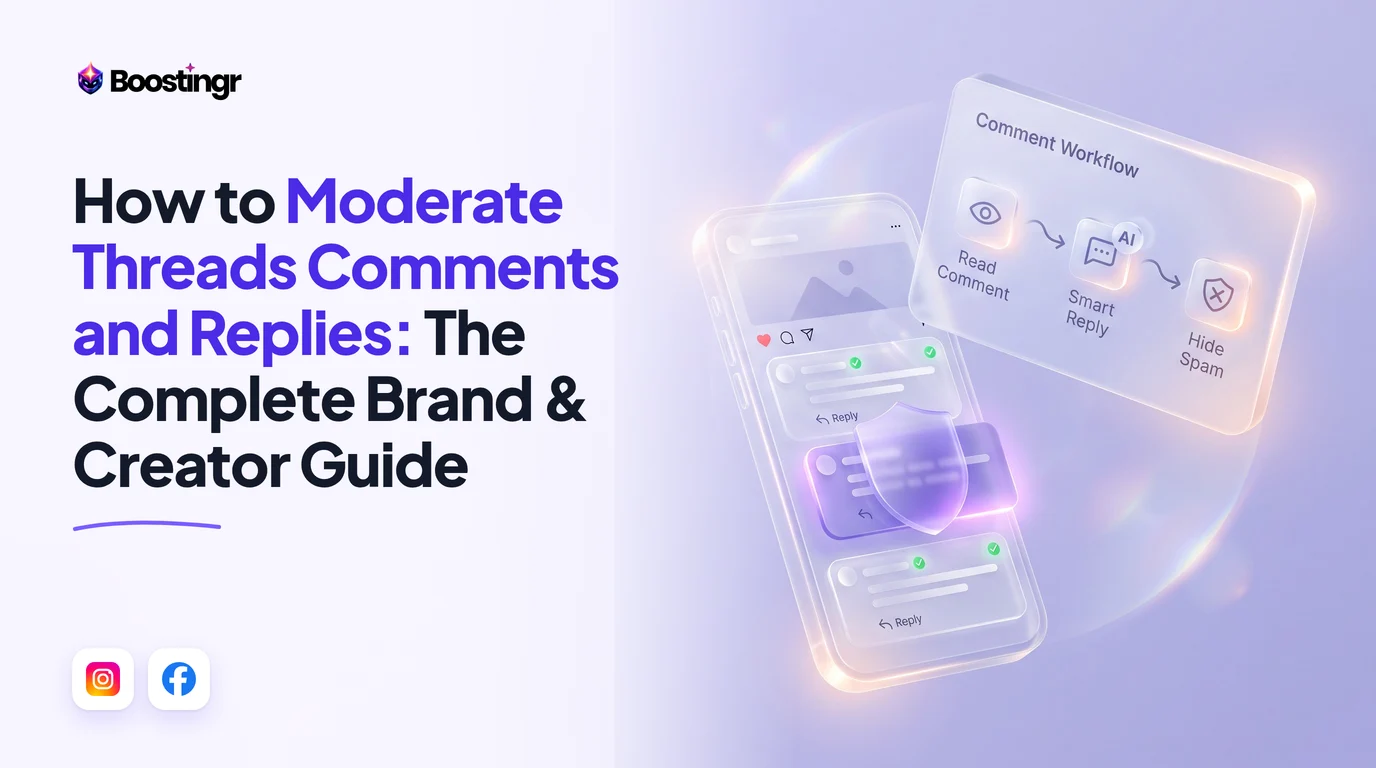
Shows how automated systems sort incoming feedback without illegally hiding customer criticism. Honest negative reviews remain live while harmful spam is quarantined.
Human in the Loop Review Process
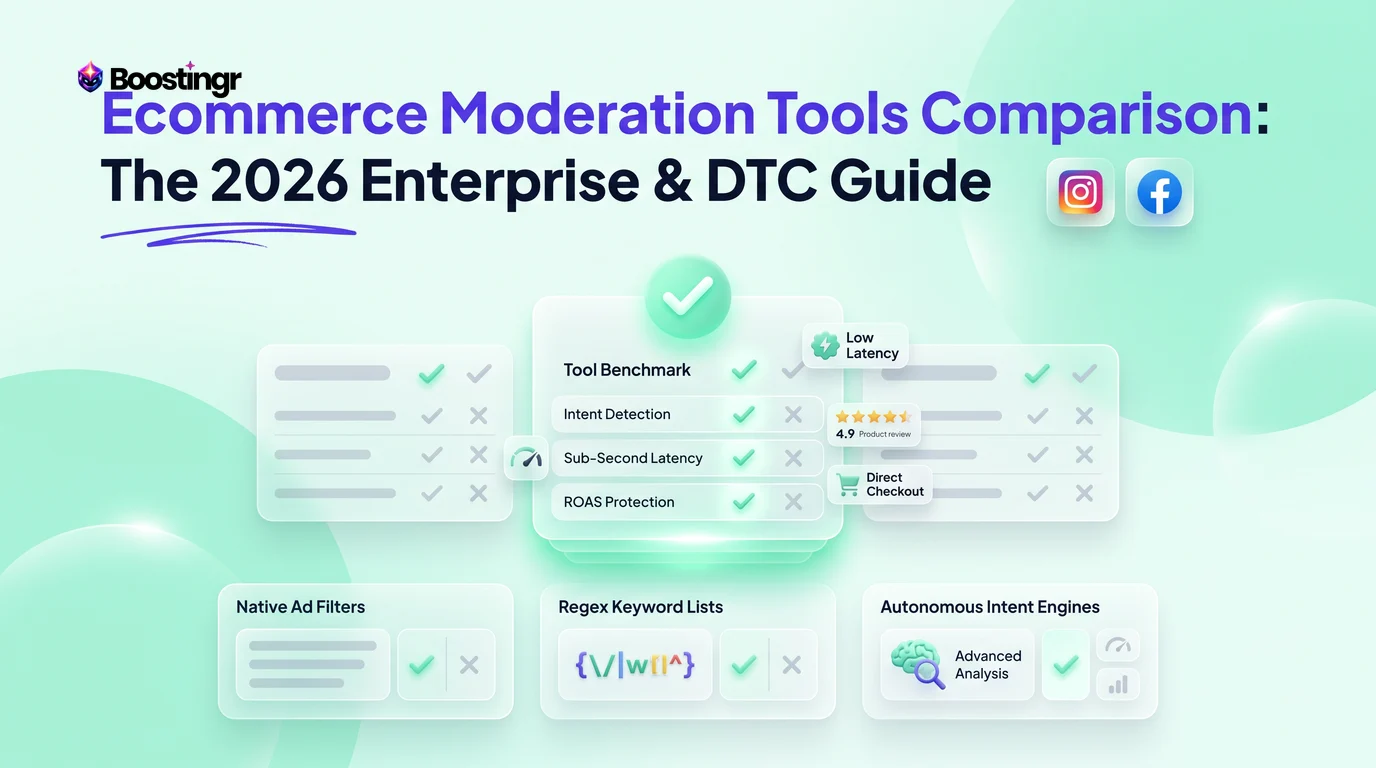
Outlines the steps team members follow when an automated system flags ambiguous feedback. Assisted reviews resolve edge cases quickly without risking wrongful suppression.
Unifying Store and Social Feedback
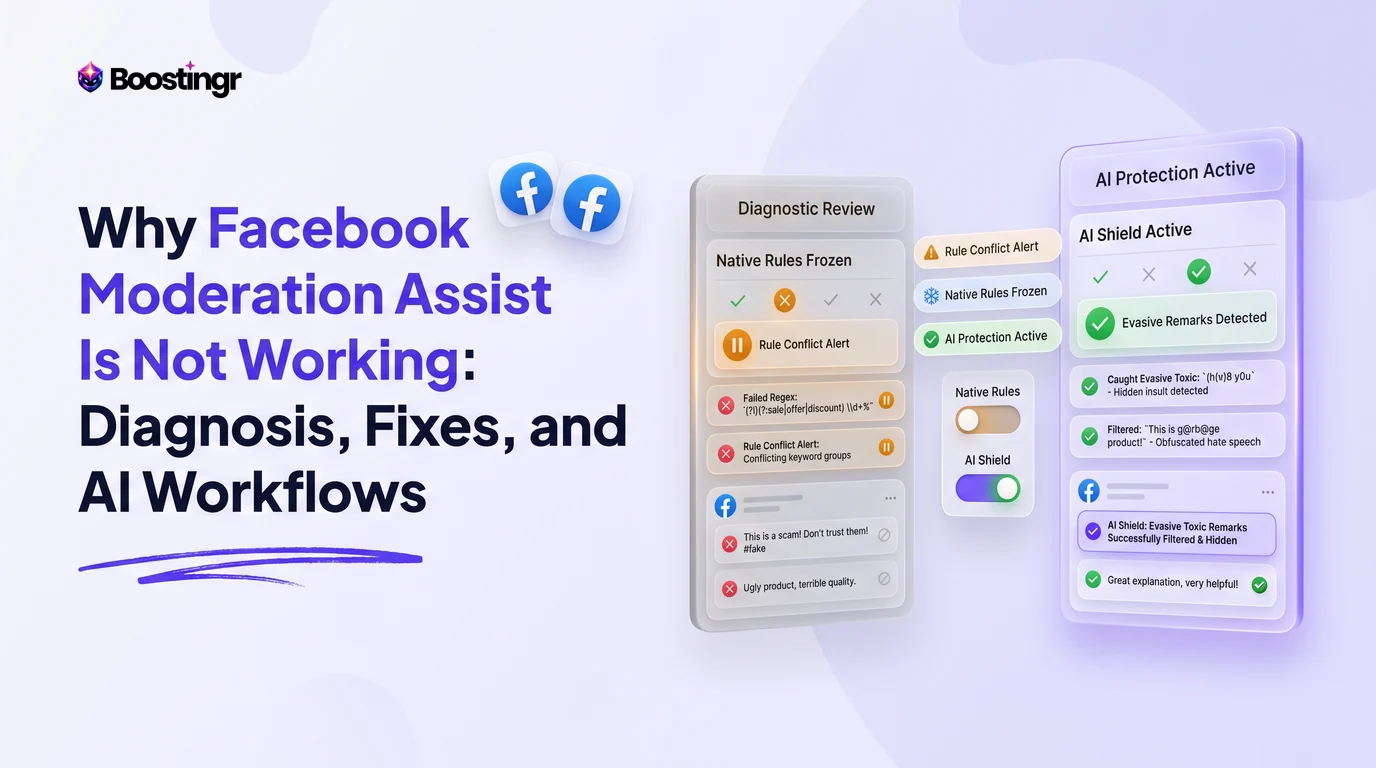
Connects on-site product reviews with paid social comments into one moderation standard. Unifying channels stops bad actors without silencing authentic customer experiences.
Checklist
Use this operational checklist when evaluating what platforms provide strong support for review moderation policies and workflows:
- Cross-Channel Coverage: Ingests reviews and comments across on-site product pages, Meta ads, TikTok ads, and organic social profiles.
- FTC Anti-Suppression Safeguards: Distinguishes genuine negative reviews from bad-faith attacks to prevent unlawful suppression.
- Audit Trail Logging: Automatically records timestamps, rule IDs, and rationales whenever content is hidden, rejected, or modified.
- Contextual LLM Reasoning: Accurately interprets sarcasm, colloquialisms, and typos without relying on fragile keyword blocklists.
- Sub-Second Execution: Processes incoming social comments and reviews rapidly to prevent brand damage and protect ad performance.
- Multi-Tier Escalation Routing: Automatically triages edge cases to customer support, legal, or PR teams based on risk severity.
- Dynamic Brand Memory: Generates accurate, on-brand public responses to customer inquiries by referencing store policies and product catalogs.
- Human-in-the-Loop Workspace: Provides an intuitive queue showing policy triggers, confidence scores, and one-click moderation actions.
- High-Intent Lead Capture: Detects buying questions in comment threads and automatically delivers product answers and tracking links.
- Secure API Integration: Connects directly via official partner APIs, including the Meta Graph API, ensuring platform compliance and stability.
Key Takeaways
- Social Comments Are Public Reviews: Unfiltered comments on paid ad units influence customer purchase decisions just as much as on-site product ratings. Review moderation policies must cover both touchpoints equally.
- Regulatory Compliance Is Mandatory: FTC rules strictly penalize suppressing negative reviews simply because of critical sentiment. Platforms must systematically differentiate protected negative feedback from genuine abuse and spam.
- Static Blocklists Hurt Conversion Rates: Keyword filters often create high false-positive rates by hiding positive customer questions and valid reviews, directly undermining paid ad performance and brand trust.
- Multi-Tier Escalation Is Essential: Sophisticated moderation programs use automated routing matrices that instantly clear benign feedback, quarantine high-risk threats, and engage customer support for real complaints.
- Modern Moderation Drives Revenue: Advanced platforms like Boostingr pair automated brand protection with contextual AI responses, turning public comments into engaged conversations and profitable sales.
Ready to bring enterprise-grade review moderation and intelligent automation to your brand? Explore our pricing plans or sign up for Boostingr today to streamline your social moderation workflows.
Frequently asked questions
What makes a review moderation platform FTC-compliant?
An FTC-compliant platform enforces content policies uniformly, without suppressing or hiding reviews simply because of low star ratings or negative sentiment. It maintains transparent audit logs documenting why content was moderated—such as filtering out hate speech, PII, fake bot spam, or competitor links—ensuring full compliance with FTC consumer review rules.
Why are social media ad comments considered customer reviews?
Consumers view ad comment threads on Meta, TikTok, and Instagram as real-time, unfiltered public feedback. When users share their experiences with product quality, shipping, or customer support under an ad, prospective buyers treat those comments as authentic customer reviews, directly impacting conversion rates and brand reputation.
How does contextual AI handle sarcasm in negative reviews?
Unlike static keyword filters, contextual AI models use large language models (LLMs) to analyze complete sentence structures, linguistic tone, and semantic meaning. This allows the system to identify sarcastic or insincere phrases that simple blocklists mistake for positive ratings, routing them to the right support queue.
Can review moderation software automatically answer customer questions?
Yes. Modern platforms like Boostingr combine moderation filters with generative AI response engines. Using Brand Memory, the platform detects high-intent buying questions in review and comment threads, delivering accurate, on-brand answers and trackable product links within moments of posting.
What is human-in-the-loop review moderation?
Human-in-the-loop (HITL) moderation combines automated AI screening with human review. The AI automatically clears safe comments and quarantines obvious spam, while ambiguous edge cases, potential PR risks, or complex legal issues are escalated to human operators for final review.
What is the ideal latency for moderating comments on social ads?
The ideal latency for moderating paid social comments is sub-second to under one minute. Fast execution prevents phishing links, hateful spam, and competitor attacks from being seen by shoppers, protecting both ad budget and campaign return on ad spend.
How do review moderation platforms integrate with customer service tools?
Leading moderation platforms connect directly with customer support platforms like Zendesk, Gorgias, and Freshdesk via webhooks and native APIs. When a legitimate product issue or critical review is detected, the platform automatically opens a support ticket with the user's details and comment history, enabling swift resolution.
Is this available in size M? Want to order today